
Places, subjects, or plaques matching "United Irishmen"
2 subject matching "United Irishmen"
14 plaque matching "United Irishmen"
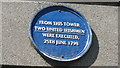
From this tower two United Irishmen were executed, 25th June 1798
, Ballymoney, United Kingdom
Subjects

Gorey Market House 1709 Held by Crown Forces and The United Irishmen 1798. Gorey Municipal District.
Main Street, Gorey, Ireland

To Commemorate All Those Who Lost Their Lives In The Capture of Aughrim By General Joseph Holt's United Irishmen On Sept 19th 1798. Coiste Chill Mhantain '98.
Market Square, Aughrim, Ireland
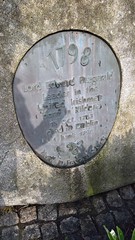
1798 Lord Edward Fitzgerald Leader in the United Irishmen Born in Kildare 15 Oct 1763 died in Dublin 4 June 1798 Lived in Frascati House
Frascati Road, Blackrock, Co Dublin, Ireland
Subjects

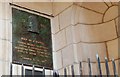
Henry Joy McCracken radical Belfast Presbyterian hanged at Cornmarket for leading the United Irishmen at the Battle of Antrim 7th June 1798. "Faithful to the last"
Masonic Hall, Rosemary Street, Belfast, United Kingdom
Subjects


Adjacent to this house was born AD 1740 James Napper Tandy civic tribune soldier and patriot, Secretary Dublin Society United Irishmen, Chef de Brigade Armée de la Republique Francaise, died in Bordeaux 1803. Erected by Quay Ward branch Wolfe Tone and '98 Memorial Association A.D. 1900 [full inscription unknown]
English translation: Adjacent to this house was born AD 1740 James Napper Tandy civic tribune soldier and patriot, Secretary Dublin Society United Irishmen, Chef de Brigade Armée de la Republique Francaise, died in Bordeaux 1803. Erected by Quay Ward branch Wolfe Tone and '98 Memorial Association A.D. 1900 [Google Translate]
in the grounds of St Audoen's Chruch, 5 High Street, Jamestown, Dublin, Ireland
Subjects

During and after the insurrection of 1798 Wexford Bridge was the site of many executions. Some ninety Loyalist prisoners were put to death, among whom were Edward Turner, Magistrate; David Dalton, Thomas Ganford, Samuel Atkin, Francis Plumer, William Baubier, Benjamin Sunderland, George Sparrow, John Smyth and Kenneth Mathewson. Amongst the sixty-five United Irishmen executed were the leaders Beauchamp Bagnal Harvey, Dr John Colclough, John Kelly, Cornelius Grogan, Patrick Prendergast, Fr. Philip Roche, John Herron, Edward Frayne, Esmond Ryan and Matthew Keugh. Ah dheis lamh de go raibh siad
English translation:
Wexford Bridge, Wexford, Ireland
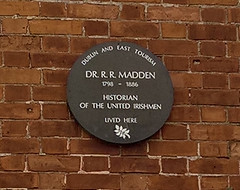
Dr. R. R. Madden 1798-1886 Historian of the United Irishmen lived here
3 Booterstown Avenue, Dublin, Ireland
Subjects
.jpg?width=250)

NEW GENEVA BARRACKS 1798 Thousands of United Irishmen were held prisoner here under inhumane conditions, many awaiting transportation. Described by Col. Thomas Cloney, a prisoner here himself, "As the filthiest, most damp and loathsome prison, devoid of any comfort." Remember all who suffered and died here. Liberty, Equality, Fraternity. Ar Dheis Dé go raibh a n-anamacha.
Crooke Road, Newtown, Passage East, Ireland
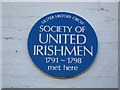
Society of United Irishmen 1791-1798 met here
Kelly's Cellars, Bank Street, Belfast, United Kingdom
Subjects
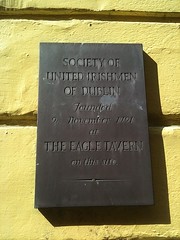
Society of United Irishmen of Dublin founded 9th November 1791 at The Eagle Tavern on this site
Quaker Meeting House, Eustace Street, Dublin, Ireland
Subjects
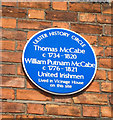
Thomas McCabe c.1734-1820 William Putnam McCabe c.1776-1821 United Irishmen lived in Vicinage House on this site
St Malachi's College, Antrim Road, Belfast, United Kingdom
Subjects
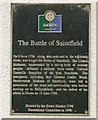
The Battle of Saintfield. On 9 June 1798, along this road and in the adjoining fields, was fought the Battle of Saintfield. The United Irishmen, represented by a strong body of country people, defeated a military force under Colonel Granville Stapylton of the York Fencibles. The insurgents, including Rev Thomas Leslie Birch, Presbyterian Minister of Saintfield, were left in possession of the town and surrounding area before moving on to Ballynahinch, and the defeat of the rebels in Down on 13 June 1798
Saintfield High School, Belfast Road, Saintfield, United Kingdom
Subjects
Texas Historical Marker #02652
Irish Immigrants in Refugio. The history of settlement in Refugio is closely associated with Ballygarrett, County Wexford, Ireland. Irish natives James Power (c. 1788-1852) and James Hewetson (1796-1870), both of whom immigrated to the United States in the early 19th Century and later became citizens of Mexico, obtained permission from the Mexican government to oversee the immigration of more than 200 Irish families to Texas in the 1830s. The first group of Irish settlers arrived on the Texas Gulf Coast in 1834. A cholera epidemic and the loss of provisions and equipment in rough waters as the immigrants reached the shore delayed their arrival in Refugio, where they were to settle near the former Spanish mission of Nuestra Senora del Refugio. The colony soon was established, however, and almost immediately the new settlers were embroiled in the cause of Texas independence from Mexico. Many Irishmen fought in the Texas Army and later served in the Republic of Texas Congress. The Irish people established a lasting presence in the Refugio area. Many descendants of the early immigrants still reside in the area, some on land granted to their ancestors in the 1830s. #2652
Purisima & Osage Streets, Refugio, TX, United States