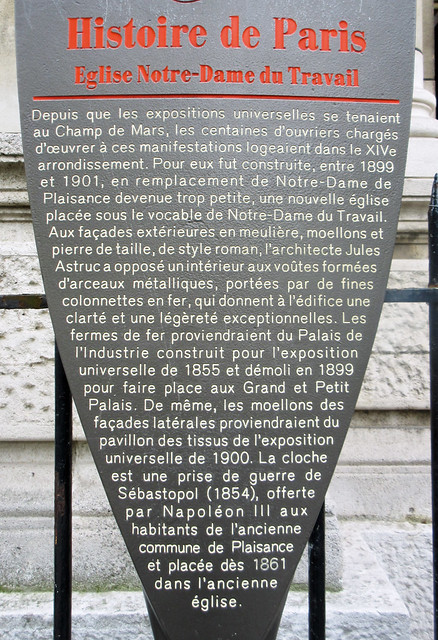
Eglise Notre-Dame du Travail. Depuis que les expositions universelles se tenaient au Champ de Mars, les centaines d'ouvriers chargés d'oeuvrer à ces manifestations logeaient dans le XIVe arrondissement. Pour eux fut construite, entre 1899 et 1901, en remplacement de Notre-Dame de Plaisance devenue trop petite, une nouvelle église placée sous le vocable de Notre-Dame du Travail. Aux façades extérieures en meulière, moellons et pierre de taille, de style roman, l'architecte Jules Astruc a opposé un intérieur aux voûtes formés d'arceaux métalliques, portées par de fines colonnettes en fer, qui donnent à l'édifice une clarté et un légèreté exceptionnelles. Les fermes de fer proviendraient du Palais de l'Industrie construit pour l'exposition universelle de 1855 et démoli en 1899 pour faire place aux Grand et Petit Palais. De même, les moellons des façades latérales proviendraient du pavillon des tissus de l'exposition universelle de 1900. La cloche est une prise de guerre de Sébastopol (1854), offerte par Napoléon III aux habitants de l'ancienne commune de Plaisance et placée dès 1861 dans l'anciene église.
English translation: "Church of Our Lady of Labour. Since the universal exhibitions took place in the Champ de Mars, hundreds of workers working on these events have been living in the 14th arrondissement. For them was built, between 1899 and 1901, to replace Notre-Dame de Plaisance, which became too small, a new church under the name of Notre-Dame du Travail. The architect Jules Astruc, with his Romanesque-style exterior facades of grinding, rubble and stone, opposes an interior with the vaults of metal arches, worn by fine iron colonnettes, which give the building exceptional clarity and lightness. The iron farms would come from the Palais de l'Industrie built for the universal exhibition of 1855 and demolished in 1899 to make way for the Grand and Petit Palais. Similarly, the moellons on the side facades would come from the tissue pavilion of the 1900 Universal Exhibition. The bell is a war takeover of Sevastopol (1854), offered by Napoleon III to the inhabitants of the former municipality of Placentia and placed as early as 1861 in the old church. [AWS Translate]"