
Coventry
Gender Diversity
The top 10


George Curtis 1939 - 2021 John Sillett 1936 - 2021 FA Cup Winners 1987 Coventry City Football Club John Sillett and George Curtis are two of the most influential figures in Coventry City's history, leading the club to its greatest achievement - the 1987 FA Cup triumph. As joint managers, their leadership and determination inspired the Sky Blues to a thrilling 3-2 victory over Tottenham Hotspur at Wembley, securing the club's first major trophy. Curtis, a commanding centre-half, made 543 appearances for Coventry between 1956 and 1969 before moving into management and later becoming the club's managing director. while Sillett; a former full-back, played for the club before returning as a coach and later manager, their impact extended beyond the FA Cup win, playing crucial roles in Coventry's rise and stability in the top flight. Honoured as life presidents of the club, their legacy remains a lasting source of pride for Coventry City and its supporters: With kind thanks to all those who donated and contributed towards the making of this commemorative statue Jean Sillett Neil Sillett Dawn Sillett Jackie Sillett John Sillett Jr. Alan Sillett Inger Curtis Julie Curtis-Hicks & William Hicks Kevin & Julie Curtis Jackie Curtis & Peter Gibson Michael & Marti Curtis Leanne McKenna Danielle McKenna Charlie Curtis Danny Curtis Abbie Dobbins George Curtis Coventry City Football Club Bob Jennings & Family Grace & Joe Elliott M.B.E. John; Taylor CBS Arena.* Paul Michael Mark Hornby Predrag Mihajlovic lovie g Patricia & Roger Medwell M.B.E Dave & Lyn Willetts Paddy Lynch Richard & Gaynor Frost Genesis Employment- Ted Stocker O.B.E Clive & Paula Benfield Eric Grove. David Shortland M.B.: Cary & ortand ABOR Alan James Harringcon Mark & Sam Georgevic G P. Cooke League Managers Association Dave Grimley Tom Grennan & John Dawkins Dal Dhillon - Sky Blue Tavern. Sara Robb Mark Gould Dave Kay & The Mad Hatters Siobhan Newbold David Boddy Southam Supporters Club Patrick Baggott Terry Butler Simon Pitcher Sky Blues in the Community Matthew Benson Jas Sandhu Diane Mansell Paul & Sally Wilkinson John & Betty Green Myles Cadden Dave Kear David Mc Gee.- Bright Fyes Celeste & John Clarke O.B.E Andrew. Cook Paul Vuckovic Keaton Slater Ann Curtis-Port Emma Lockey Steve Thompson: Michael McBroom Pete Griffiths Lord Christopher Leigh Simon Poole - AJA Architects lan C Taylor Dwyer fam Pete Witherow. 5.30 Micky French Paul & Lorraine Sullivan Auto Jap Spares Robin Fletcher Alek Mihallovic Rock Solid Concrete BB Building & Timber Merchants Pirkka Kivenheimo* Anthony Evans Reg Hayre Ron Foskett. Parmy Singh Overson Family John Oughton Stephen Arotsky Scott Joyce Steve & Heather Taylor Graham Paine: Dave Busst. Paul Curtis Simon Miller Pat Moynihan & Family The Diamond Club The Sky Blue Trust lan Bullock: Moseley Sign's Bedworth & Nuneaton Supporters Club Mogan Family CV Hire Centre Daly Family, Ainscough Crane Hire Coventry City Former Players Association lan Edward Small Hawkesbridge Fencing John Nollett Alan Pickering Maro randoloMike Moore Sel Moe Kandola Darren Thompson Noel Hand John Bloxham Coventry Music Museumg: Ronald F Payne 2 Tone Village Grown Waste Keith Pearce lan Wright Johnny Reay Malik Family Professional Footballers' Association David Johnson Dal Dhilli Dillong by CFc Supporters Club Sylv McDonald founDavies Stephanie Board HVH Bronze Foundry Ray Phipkins Steele Family Bates Timber Merchants Paul Hughes Peter Shelle Sonith Coventry Cley London Supporters Club Stonecrest Stonemasons GEORGE & JOHN'S SKY BLUE ARMY Unveiled by the Curtis and Sillett families on the 17th April 2025 Sculpted by Douglas Jennings M.R.B.S
Coventry Building Society Arena, Coventry, United Kingdom

Sculptress of Sound: Delia Ann Derbyshire Born Coventry in 1937. An English composer, Delia is best known for realising the Doctor Who theme music during her time at the BBC Radiophonic Workshop. She later said that the sound of falling bombs and air raid sirens she heard as a child in the Coventry Blitz of 1940 influenced her approach to electronic music and several of her haunting compositions. Delia died in 2001. She was awarded an Honorary Doctorate of Arts from Coventry University in 2017.
Jordan Well, Coventry, United Kingdom
Subjects
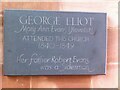
George Eliot Mary Ann Evans (novelist) attended this church 1840-1849. Her father Robert Evans was a Sidesman.
Holy Trinity Church, Priory Row, Coventry, United Kingdom

The University of Warwick Art Collection. Laura Ford Days of Judgement (Cat 1) Bronze 2012. From an edition of 5 purchased by the University, 2015. The use of large-scale animal figures, or people dressed as animals, is a strong element in Laura Ford's work; she uses these to create surreal and haunting representations of human emotions and frailties. This cat is one of a group of seven. Their different poses are inspired by the figures of Adam and Eve in a fresco by the Renaissance artist Masaccio called The Expulsion from the Garden of Eden painted in 1427. Here the single cat appears preoccupied with its own thoughts and anxieties, pacing, oblivious to the world around it.
University of Warwick, Coventry, United Kingdom

10 and 10A Hay Lane. A 16th Century timber framed merchant's house with red brick frontage. Added in the 19th Century No9 is an early 19th Century building with a similar front.
10-10a Hay Lane, Coventry, United Kingdom
Subjects

This stone commemorates the opening of the Belgrade Theatre by Her Royal Highness The Duchess of Kent 27 March 1958. In the presence of the Right Worshipful the Lord Mayor of Coventry Alderman Mrs Pearl Hyde MBE JP. [full inscription unknown]
Belgrade Theatre, Belgrade Square, Coventry, United Kingdom

This foundation stone was laid by Sir Laurence Olivier first director of the National Theatre on the 20th day of March 1965.
Belgrade Theatre, Belgrade Square, Coventry, United Kingdom

The Belgrade Theatre Trust gratefully acknowledge the grant given by the West Midlands County Council for the refurbishment of the lower foyer. Opened on 8th January 1985 by Councillor B.V. Smith West Midlands County Council.
Belgrade Theatre, Belgrade Square, Coventry, United Kingdom
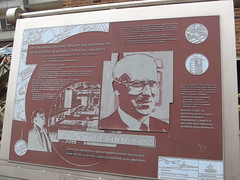
Sir Donald Gibson CBE Gibson was regarded as a pioneer modern architect and his work made him one of the most influential architects of his generation. 'He was ahead of his time. What he did astonished the world. Coventry desperately needed his inspiration' Gibson, Sir Donald Evelyn Edward, C.B.E., D.C.L., M.A., P.P.R.I.B.A., D.I.S.T., T.P., M.T.P.I., T.P.I. Born 11th October 1908, Died December 1991 Gibson was Coventry's first City Architect. He was regarded as a pioneer modern architect and his work made him one of the most influential architects of his generation. He may never have the chance to put his ideas into action, but for the terrible bombing. Within a fortnight of the November 1940 Blitz of Coventry, the City Council had set up a re-development committee and along with powerful allies and devoted members were able to begin the drive to rebuild the city. Gibson was the sort of genius who wanted to throw off sparks of imagination and his ideas. He was way ahead of his time, what he did was astonishing and Coventry desperately needed his inspiration. Many people thought that his ideas would sweep away too much of the old city, but his ideas encompassed old details amongst the open spaces and uncluttered views of his new vision. The alignment of the shopping precinct with the cathedral spire was a moment of inspiration that was to be copied by other cities worldwide. Gibson achieved many firsts as the City Architect. Apart from the first pedestrian precinct there was the first rooftop parking, the first postwar civic theatre, the circular retail market and experimental building methods. Planners and architects all around the world came to see what was happening in Coventry. Characteristically Gibson was prepared to acknowledge the fact that given his time again he might do some things differently. "If you cannot put up buildings of your own time, you might as well forget it. A town must live, you cannot wait until fashions change" In 1955 Sir Donald left Coventry, this meant that his personal vision was never completed. He became County Architect in Nottinghamshire, where he worked on radical new building techniques. Gibson went on to a Knighthood and became in effect the government's senior architect, raising architectural standards during his tenure. However it is for his pioneering work in Coventry that he will be best remembered. It made him one of the most influential architects of his generation.
Upper Precinct Mall, Coventry, United Kingdom
Subjects

B2 opened by HRH The Earl of Wessex KG KCVO 4 February 2008. Following the redevelopment of the Belgrade Theatre in 2004-07.
Belgrade Theatre, Belgrade Square, Coventry, United Kingdom

Incorporated within the original 1958 building, the Chandeliers were designed by German artist Bernard Shottlander. The commission reflected Coventry's commitment to peace and reconciliation across Europe. The refurbishment of the chandeliers in 2007 was made possible with funding from The Alan Higgs Charity.
Belgrade Theatre, Belgrade Square, Coventry, United Kingdom

City of Coventry Stivichall An animal pound existed here before 1663. To mark the restoration by Coventry Civic Amenity Society this plaque was unveiled by Councillor JD Berry Chairman of the Planning Committee. November 1975
Stivichall Animal Pound, Coat Of Arms Bridge Road, Coventry, United Kingdom
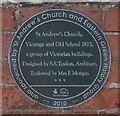
St Andrew's Church, Vicarage and Old School 1875, a group of Victorian buildings. Designed by S.S. Teulon, Architect. Endowed by Mrs. E. Morgan.
St Andrews Church, Church Lane, Coventry, United Kingdom
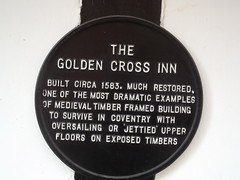
The Golden Cross Inn. Built circa 1583. Much restored, one of the most dramatic examples of medieval timber framed buildings to survive in Coventry with oversailing or 'jettied' upper floors on exposed timbers.
Bayley Lane, Coventry, United Kingdom
Subjects

Foundation stone laid by Ben Moules F.R.I.C.S 26th September 1968. Architects: Hellberg Harris & Partners. Builder: A.G. Gale & Co Ltd.
New Union Street, Coventry, United Kingdom

Cheylesmore Manor. Dating from the 13th century much altered and rebuilt in the 14th, 15th and 16th centuries. The remains of the manor and gatehouse were extensively restored 1965-1968 and a new wing added to provide offices for the city registrar. Built for the earls of Chester it passed to Queen Isabella, wife of Edward II, and later in 1338 to her grandson Edward the black prince. Both of whom were instrumental in Coventry's early municipal history.
New Union Street, Coventry, United Kingdom
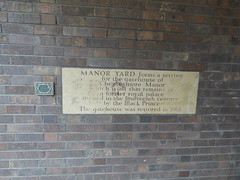
Manor Yard forms a setting for the gatehouse of Cheylesmore Manor which is all that remains of a former royal palace owned in the fourteenth century by the Black Prince. The gatehouse was restored in 1968.
Manor Yard near New Union Street, Coventry, United Kingdom
Subjects


Cheylesmore Manor House A manor house at Cheylesmore is first mentioned in the year 1250. In 1320 it passed to Queen Isabella. wife of Edward II. and from her to her grandson, the Black Prince. In 1385 the royal manor was enclosed within the city walls, then under construction. In the 16th century Leland wrote, "the King has a palace at Coventry now somewhat in ruin. The great hall was said to be down. In 1661 its other buildings were repaired by Sir Robert Townsend. In 1738 a weaver asked permission to make a tenement of one of them! In 1955 most of the South wing, which had become a range of industrial top-shops, was demolished. In 1965 Coventry Corporation undertook restoration of the gatehouse and the surviving bays of the north and South wings. The work. completed in 1968. revealed important historical features. For example. the south wing probably belongs to the original manor house of the 13th century: the ogee-headed doorway (on right) is an original entrance into the manor grounds from the Grey-Friars Monastery of which only the church steeple still stands: the open timber roofs had scarcely been altered since they were built; and of the original framework enough had survived to assure authentic restoration.
Coventry Register Office, Manor House Drive, Coventry, United Kingdom
Subjects


The College of Bablake and Bond's Hospital. The site of collegiate buildings of the Church of St John since 1344. The 14th century priests quarters were remodelled in 1560 as a boys hospital and later as a boys school which remained until 1890 when Bablake School transfered to new buildings in Coundon Road. Bond's or Bablake Hospital was endowed by the will of Thomas Bond in 1506. Much restored in 1832-34 it still provides a home for the elderly
Lower Hill Street, Spon End, Coventry, United Kingdom
Subjects

This plaque was unveiled by Mr Vladven V. Kolesnikov, interim chair of Volgograd city Duma and councillor Abdul Salam Khan J.P, deputy leader of Coventry City Council , in the presence of the right worshipful the lord mayor of Coventry, councillor Linda Bigham, on Saturday 9 November 2019 to mark the 75th anniversary of the continuing friendship between Volgograd and Coventry. A friendship born out of the suffering of both cities during wartime and now devoted to promoting international understanding and peace. This space and Volgograd Place, dedicated on Saturday 25 November 1972 in the presence of Mikhall Zolotaryov and the right worshipful the lord mayor of Coventry, councillor Wifred Spencer are places to pause and remember the importance of friendship, peace and understanding.
Trinity Street, Coventry, United Kingdom
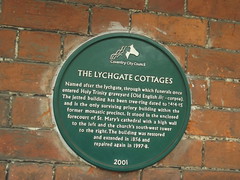
The Lychgate Cottages. Named after the lychgate, through which funerals once entered Holy Trinity graveyard (Old English lic, corpse). The jetted building has been tree-ring dated to 1414-15 and is the only surviving priory building within the former monastic precinct. It stood in the enclosed forecourt of St Mary's cathedral with a high wall to the left and the church's south-west tower to the right. The building was restored and extended in 1856 and repaired again in 1997-8.
Priory Row, Coventry, United Kingdom
Subjects
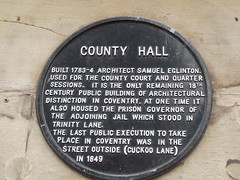
County Hall. Built 1783-4 architect Samuel Eglinton used for the County Court and Quarter Sessions. It is the only remaining 18th Century public building of architectural distinction in Coventry. At one time it also housed the prison Governor of the adjoining jail which stood in Trinity Lane. The last public execution to take place in Coventry was in the street outside (Cuckoo Lane) in 1849.
Cuckoo Lane, Coventry, United Kingdom
Subjects
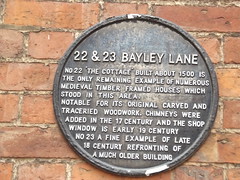
22 & 23 Bayley Lane No 22 "The Cottage" built about 1500 is the only remaining example of numerous medieval timber framed houses which stood in this area. Notable for its original carved and traceried woodwork. Chimneys were added in the 17th century and the shop window is early 19th century. No 23 is a fine example of late 18th century refronting of a much older building.
22 and 23 Bayley Lane, Coventry, United Kingdom
Subjects

"He rode into the canal , got out and jumped back in to get his bike"
Canal Bridge No.4 , Stoney Stanton Road, Coventry, United Kingdom

The Edge Mural Project 1998. Made by the pupils of Edgewick Park and Sydney Stringer Schools with artists Krishnakumar Alageswaren and Naida Hussain. Funded by ReTexs Coventry City Directorate. People discs made by children from St Barnabas, Eagle Street and Yardley Street Youth Centres with artist Kate Turner.
Foleshill Road, Coventry, United Kingdom

Holy Trinity Church. Constructed during the 13th and 15th centuries on the site of a Norman building as the parish church for the priors half of Coventry. The spire, height 237 feet (72 metres) was rebuilt in 1667 after the original was blown down. Extensive restoration and a new west front were completed in 1849 by R.C. Hussey. The interior was restored in 1855 by Gilbert Scott.
Holy Trinity Church, Priory Row, Coventry, United Kingdom
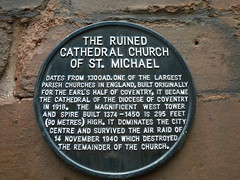
The ruined cathedral Church of St Michael. Dates from 1300AD. One of the largest parish churches in England, built originally for the Earl's half of Coventry, it became the cathedral of the Diocese of Coventry in 1918. The magnificent west tower and spire built in 1374-1450 is 295 feet (90 metres) high. It dominates the city centre and survived the air raid of 14 November 1940 which destroyed the remainder of the church
St Michael's Avenue, Coventry, United Kingdom
Subjects
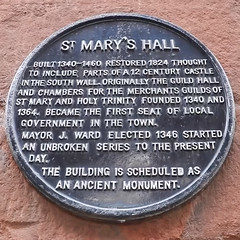
St Mary's Hall. Built 1340-1460 restored 1824 thought to include parts of a 12 century castle in the south wall. Originally the guild hall and chambers for the Merchants Guilds of St Mary and Holy Trinity founded 1340 and 1364. Became the first seat of local government int eh town. Mayor J. Ward elected 1346 started an unbroken series to the present day. The building is scheduled as an ancient monument
Bayley Lane, Coventry, United Kingdom
Subjects

Draper's Hall. Built 1832 with an east wing added 1864. The third hall on this site since 1637 for the Drapers Company, formed in 1247. Neoclassical Greek style by architects T. Rickman and H. Hutchinson. With a fine interior in Grecian decorative moulded plasterwork
St Mary Street, Coventry, United Kingdom
Subjects

The Charterhouse The Carthusian priory of St. Anne was founded in 1381and King Richard II laid the foundation stone in 1385. The Carthusians originated in Chartreuse in France, hence the name Charterhouse given to their monasteries. Unlike most monks, Carthusians were a “silent” order, only speaking to one another on special occasions. They lived alone in their cells, which were small two storey, detached houses. Twelve cells were located on the other side of the building around a courtyard or cloister in what is now the garden. The cells were demolished in the period after 1539 when Henry VIII closed the priory and evicted the monks (the Dissolution) The stone building contained the monks’ refectory (left) and the priors’ lodgings (right). The timber-framed end was probably added in the sixteenth century after the building became a. private house. One of the treasures is the lower part of a wall painting that dominated the refectory. It was probably finished about 1471 soon after the building was constructed and depicts the crucifixion of Christ. The church was situated in the open ground immediately to the left, but was also demolished in the Dissolution. Its plan was revealed in the excavations (1984-7) but these were reburied and cannot be seen. Coventry City Council 2008
London Road, Coventry, United Kingdom
Subjects

St Anne's Chapel and Bisseley, later Shortley The lost medieval village of Bisseley, later called Shortley, lay somewhere not far from here in the 12th century Bisseley Mill a water com mill was located about 100 yards upstream of the Sherboume bridge. Later known as Charterhouse Mill, it was not demolished until the 1930s. Part of the village may lie under the Charterhouse and its grounds. The medieval chapel of St Anne's stood in the field between the London road and the. Sherboume. Its origins are obscure, but in 1393 it was described as a chapel with a house entirely surrounded by water, perhaps a moat fed by the Sherbourne. It belonged to the Trinity Guild, who leased it to the Charterhouse in the early 16th century. The chapel was confiscated and sold by the Crown in 1546. The lower part of the field near the river retained the name St Anne's Grove into the 19th century. In. 1733 it contained a dyehouse, possibly the converted chapel, out by 1820 it had disappeared. The best preserved medieval boundary wall in Coventry runs around the north and east sides of the Charterhouse precinct. At this end, close by the bridge, siged an ancient house, built partly on the wall it survived into the mid-19th century and was perhaps where the Charterhouse's gatekeeper lived.
The Charterhouse, London Road, Coventry, United Kingdom
Subjects

Medieval Ruin Possibly late 13th century sandstone building revealed during wartime bombing. Some 13th & 14th century pottery was found when the site was excavated in 1971, but archaeologists have not been able to discover it's origins or purpose. It may have been a merchants house or possibly linked in some way with nearby Whitefriars Priory.
Much Park Street, Coventry, United Kingdom

Godiva, Lady of Coventry (died 10th September 1067) and her husband Leofric, Earl of Mercia (died 28th September 1057) were buried here in the church of Benedictine monastery they founded in 1043 on the site of St Osburg's nunnery, sacked by the Danes in 1016. The Saxon church, which became Coventry's first Cathedral in 1102, was replaced in the 13th century by a great church, destroyed at the Dissolution in 1539. The remains of the west end are here exposed to view: vestiges of the east and adjoin the present cathedral. No traces of the Saxon buildings have yet been discovered.
3-5 Priory Row - Priory Gardens, Coventry, United Kingdom
Subjects

This stone was unveiled by the Lord Mayor of Coventry Councillor William McKernan on 7th September 1985 to commemorate the 600th anniversary of the founding of Charterhouse
Charterhouse, London Road, Coventry, United Kingdom
Subjects


Swift Quinton Works. Originally the office block of S. & B. Gorton's Cycle Works, built in 1890 (Quinton Cycle Company 1891, New Beeston Cycle Company 1896). Under the motor entrepreneur, Harry J. Lawson, the latter company produced a 11/4 - hp motor tricycle here in August 1896, the only British-built entry in the London to Brighton 'Emancipation Run' that November. Along with the Daimler wagonettes assembled at the 'Motor Mills' in 1896, it marks the birth of the British Motor Industry in Coventry. As the Beeston Motor Company, the firm produced cars commercially from 1897-1900. The building then became Rademaker's Chocolate Factory until 1905 and the Swift Motor Company Works until 1931. It was restored and adapted for use as an hotel in 1998-99.
Parkside, Coventry, United Kingdom
Subjects

1959-1970. Tocil Farm. This is the site of Tocil Farm, which was worked by and happy home to the Clayton family. William, Minnie, Peter, Marion, David and Reg.
Warwick University, Coventry, United Kingdom

This stone is laid to the glory of God by Councillor H. Weston October 23rd 1954.
210 Ansty Road, Coventry, Coventry, United Kingdom