
Gender Diversity
The top 10



Jaguar E-type Designed by Malcolm Sayer under the direction of Sir William Lyons (HonFIMechE) the Jaguar E-type is a direct descendant of the cars which won five Le Mans 24 hour races during the 1950s. It introduced breakthrough motor engineering technology such as the combined monocoque-spaceframe which in later years was adopted by Formula one.
Jaguar Heritage, Browns Lane, Allesley, Coventry, United Kingdom

Erected AD 1885. W. Scott. Vicar. F Duck, ? Elliott, Wardens. [full inscription unknown]
Exhall, Coventry, United Kingdom
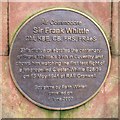
Air Commodore Sir Frank Whittle OM, KBE, CB, FRS, FRAes. This statue celebrates the centenary of Frank Whittle's birth in Coventry and shows him watching the first test flight of a jet-propelled Gloster-Whittle E28/39 on 15 May 1941 at RAF Cranwell. Sculpture by Faith Winter unveiled on 1 June 2007
Millennium Place - near Hales Street, Coventry, United Kingdom
Subjects
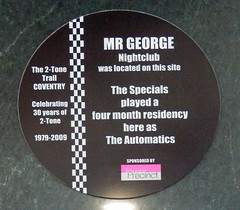
Mr George Nightclub was located on this site. The Specials played a four month residency here as The Automatics
Lower Precinct, Coventry, United Kingdom
Subjects
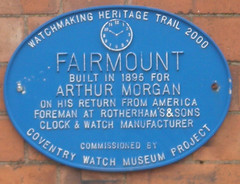
Fairmount - Built in 1895 for Arthur Morgan on his return from America - Foreman at Rotherham's & Sons - Clock & Watch Manufacturer
26 Clarendon Street, Coventry, United Kingdom
Subjects


On this site stood the Theatre Royal where the Salvation Army began its mission in Coventry on the 17th February 1878.
Former BHS - Upper Precinct, Coventry, United Kingdom
Subjects

This stone was laid by the Marquess of Hertford, C.B. January 29th 1910.
50 Walsgrave Road, Coventry, United Kingdom

Sue Neale. Leader since 1962. Organiser of the Neale clan. Party host to us all. Lives here.
110 Beanfield Avenue, Coventry, United Kingdom

Coventry Cycling Club. Eileen Sheridan (1923-2023). "The Mighty Atom". A legend of British cycling. Won her first race here in 1947.
Butts Park Arena., Coventry, United Kingdom

On this site John Siddeley, later Lord Kenilworth, founder of world famous motor and aviation companies began making cars 1909. Coventry Heritage Plaques.
Coventry University Technology Park, Coventry, United Kingdom
Subjects
.jpg?width=250)

51 Albany Road The birthplace of 2-Tone The ska phenomenon was created here by Jerry Dammers, The Specials and The Selecter It also served as the HQ for the iconic 2-Tone Record label
51 Albany Rd, Coventry, United Kingdom
Subjects

Coventry Canal Basin It was here in 1979 that photographers Chalkie Davies & Carol Starr took a set of iconic images that graced the covers of the first two Specials albums
Canal Basin, Coventry, United Kingdom
Subjects

On this site stood St Michaels Baptist Church from 1856 until November 1940 rebuilt at Quinton park, Cheylesmore, Coventry. New building completed on original foundations.
Bayley Lane, Coventry, United Kingdom
Subjects
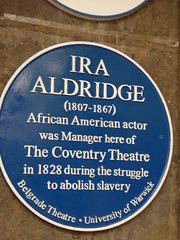
Ira Aldridge (1807-1867) African American actor was Manager here of The Coventry Theatre in 1828 during the struggle to abolish slavery
Former BHS - Upper Precinct, Coventry, United Kingdom
Subjects


This tree was planted in 1928 to the memory of David Spencer A generous benefactor of Coventry who presented this park to the city in 1882 (David Spencer Born 1805 Died 1888)
Spencer Park, Spencer Road, Coventry, United Kingdom
Subjects
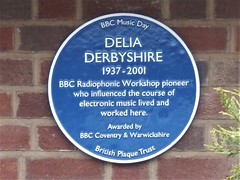
BBC Music Day 2017 #BBC West Midlands 1
Delia Derbyshire 1937-2001 BBC Radiophonic Workshop pioneer who influenced the course of electonic music lived and worked here. Awarded by BBC Coventry & Warwickshire.
104 Cedars Avenue, Coventry, United Kingdom
Subjects

The Standard Motor Company was founded on this site in March 1903 by Reginald Maudslay.
Much Park Street, Coventry, United Kingdom

Celebrating the 50th anniversary and the location of one of the greatest British films The Italian Job. Commissioned by Kevin Conway & Co. coventryminiclub@yahoo.com
Allard Way, Coventry, United Kingdom

Musician and composer, pioneer of electronic music and the Doctor Who theme tune. Delia Derbyshire 1937-2001 lived here.
124 Cedars Avenue, Coventry, United Kingdom
Coventry Cycling Club. Eileen Sheridan (1923-2023). "The Mighty Atom". A legend of British cycling. Won her first race here in 1947.
Butts Park Arena., Coventry, United Kingdom

Kennedy House 1965-1999 The site of John F Kennedy House, the Cathedral's Residential Youth Centre. Designed by Basil Spence, it was opened by Herr Willy Brandt, Mayor of West Berlin, to promote and encourage the Ministry of Reconciliation among the Young People of the World.
Top Hill, Coventry, United Kingdom
Subjects


28 Lord Street residence and workshop of Charles Read Watch Manufacturer 1874 1900
Lord Street, Chapelfields, Coventry, United Kingdom
Subjects
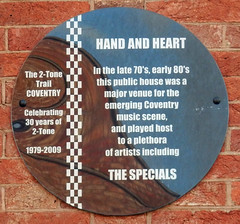
Hand and Heart. In the late 70's, early 80's this public house was a major venue for the emerging Coventry music scene and played host to a plethora of artists including The Specials
The Hand and Heart, Coventry, United Kingdom
Subjects

125 Craven Street formerly 49A Craven Street James Adams Watch Manufacturer 1874 - 1883
125 Craven Street, Coventry, United Kingdom
Subjects

Coventry Station Multi-Storey Car Park. Officially opened by The Right Worshipful the Lord Mayor of Coventry Councillor Shabbir Ahmed. 19 April 2007.
Coventry railway station, Coventry, United Kingdom

Coventry workers made the world famous Rudge on and near this site 1880-1938. Tricycles-Bicycles-Motorcycles. Patent spoked wheels. Ammunition.
Skydome, Spon Street, Coventry, United Kingdom
Subjects

The Collegiate and Parish Church of St. John the Baptist This church was founded in 1344 by Queen Isabella widow of King Edward II, on land called 'Babblake' and was granted by her to the Guild of St. John the Baptist. It was to be served by two chaplains from the 'College of Bablake'. Those priests were to say a daily mass for, the repose of the soul of her late husband King Edward II, her son King Edward III, her daughter in law Queen Phiippa, her grandson Edward the Black Prince and members of the Guild of St. John. The building was consecrated on 2nd May 1350 to God and St. John the Baptist. By the time of the dissolution of the Guilds in 1548, the church was closed and given to the Mayor of the Corporation. During the time of the Commonwealth (1642-1660), the church was used as a prison for Royalist soldiers captured at the Battle of Preston. As the sympathies of the citizens of Coventry lay with the Parliamentarians, they gave the Royalist prisoners a hostile reception giving rise to the saying 'sent to Coventry', meaning that someone is ignored or treated coldly. After many years lying empty, occasionally being used to hold markets and as a stretch yard for dyed cloth, the Corporation agreed to reopen the church as a place of worship. It was created a Parish Church on 24th July 1734. Today the church serves the spiritual and other needs of this community and the city.
St. John the Baptist Parish Church, Corporation Street, Coventry, United Kingdom
Subjects


The Architect's Vision Gibson and Coventry were seen to be pioneers in urban planning as the radically different face of their city centre took shape. 'One of the finest shopping centres in the world' The shopping precinct in Coventry has been recognised as a model for a number of similar centres throughout the world. It was the world's first large scale pedestrianised shopping area. The Planning By the end of the 1930s Coventry had outgrown it's city centre. The population had become far greater than that with which it's still largely medieval central area and road system could cope. It soon became clear that the only adequate answer would be an extensive reconstruction but there was neither the legislation nor the finance available to make this a practical proposition. In 1938, 29 year old Donald Gibson was appointed City Architect. Gibson was the first architect Coventry had ever had. He was filled with a drive and enthusiasm to experiment and also a care for the way people should live. He was surrounded by a small dedicated team and his grand scheme started to take shape for the redesign of the congested city centre. He believed there was a need to get away from the idea that motor traffic and pedestrians must mix together in a shopping street. Gibson said that pedestrians could move about freely and safely in precincts or arcades. If it had not been for the terrible blitz by the Luftwaffe he may never have had the opportunity to make his ideas a reality. However with large areas levelled by the bombing he had the chance to start with a relatively clean sheet. The Precinct The central theme of his plan was a precinct of shops to which there would be motor access to the rear for service vehicles. The idea was to bring back the comfortable and more spacious days when wondering from shop to shop was not done at the mercy of vehicles. Coventry's pedestrian precinct was designed to be aligned with the cathedral spire of St. Michael's. The use of a spire as an architectural vista was later copied by both Hanover and Japan. Two storey shops were developed in order to get more shops into a smaller walking distance. This tier system was based on Chester's Rows. The precinct was largely completed by the end of 1955. "If you cannot put up buildings of your own time, you might as well forget it. A town must live, you cannot wait until fashions change." Sir Donald Gibson
Upper Precinct Mall, Coventry, United Kingdom
Subjects
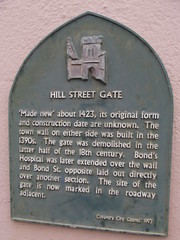
Hill Street Gate. 'Made new' about 1423, it's original form and construction date are unknown. The town wall on either side was built in the 1390s. The gate was demolished in the latter half of the 19th Century. Bond's Hospital was later extended over the wall and Bond St. opposite laid out directly over another section. The site of the gate is now marked in the roadway adjacent.
Hill Street, Coventry, United Kingdom
Subjects
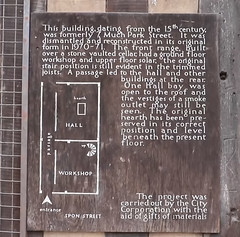
This building dating from the 15th century, was formerly 7 Much Park Street. It was dismantled and reconstructed in its original form in 1970-71. The front range, built over a stone vaulted cellar, had a ground floor workshop and upper floor solar, the original stair position is still evident in the trimmed joists. A passage led to the hall and other buildings at the rear. One hall bay was open to the roof and the vestiges of a smoke outlet may still be seen. The original hearth has been preserved in its correct position and level beneath the present floor. The project was carried out by the City Corporation with aid of gifts of materials
Aspell Jewellers, 9 Spon Street, Coventry, United Kingdom
Subjects
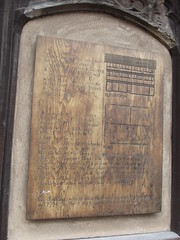
This is one of the very few surviving three-storey jettied buildings of Coventry. It dates from 1500 and was formerly at 8-10 Much Park Street next to the present 9 Spon Street. It's semi-detached plan is also notable. As a medieval city centre building it is larger and richer than the indigenous Spon Street buildings. It had a parallel hall range at the rear of two-storey height of which one bay, with a hearth in the middle of the floor. Was open on the roof while the other had an upper floor. The range was too fragile to restore but number 9 has exactly the same range. In the front range the fire-place (FP) were of a later period and were not preserved. The spiral stairs (slightly altered). The carved lintel above this plaque was and in the cellar which was earlier in date than the buildings. The building was dismantled and restored between 1970 and 1974 by the City Corporation with the aid of gifts.
Frank Harvey - 163-164 Spon Street, Coventry, United Kingdom
Subjects
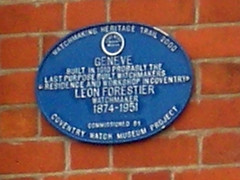
Geneve, built in 1910 probably the last purpose built watchmakers residence and workshop in Coventry, Leon Forester watchmaker 1874 - 1951
108 Earlsdon Avenue South, Coventry, United Kingdom
Erected by the Employees of The Coventry Chain Co In Memory of their 45 comrades who fell in the Great War 1914-1918
The Koco Building, Arches Industrial Estate, Spon End, Coventry, United Kingdom
I remember, i remember coming up england by a different line for once, early in the cold new year. we stopped, and, watching men with number-plates sprint down the platform to familiar gates, "why, coventry!" i exclaimed. "i was born here". philip larkin poet and coventrian ( 1922 - 1985 )
Platform 1 - Coventry Station, Coventry, United Kingdom
Subjects

10 Russell Terrace 49 Allesley Old Road William Williamson Gold Watch Dial Maker
?, Coventry, United Kingdom
Subjects
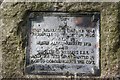
This recreation ground was presented to the city in 1926 jointly by Messrs Alfred Herbert Ltd and Sir Alfred Herbert KBE and this tree was planted in 1928 to commemorate the gift
Broomfield Place, Coventry, United Kingdom
Subjects

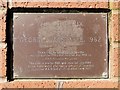
THE PHOENIX by GEORGE WAGSTAFFE 1962 This sculpture which symbolises the rebuilding of Coventry was unveiled May 1962 by H.R.H Princess Margaret. Re-cast in bronze 1983, and unveiled June 1984 by the Right Worshipful the Lord Mayor of Coventry, Councillor W.S. Brandish JP re-sited her in 1987
Hertford Street, Coventry, United Kingdom

This is the birthplace of Tom Mann. Working class leader. Born April 15th 1856. Died March 13th 1941.
177 Grange Road, Coventry, United Kingdom
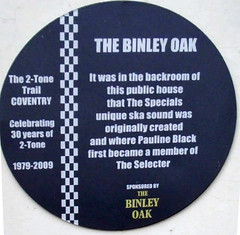
The Binley Oak. It was in the backroom of this public house that The Specials unique ska sound was originally created and where Pauline Black first became a member of The Selecter
Binley Oak, Coventry, United Kingdom
Subjects
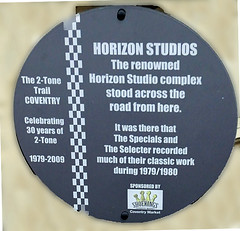
Horizon Studios The renowned Horizon Studio complex stood across the road from here. It was there that The Specials and The Selecter recorded much of their classic work during 1979/1980
Horizon Studios site on Rocket Pub, Warwick Road, Coventry, United Kingdom
Subjects
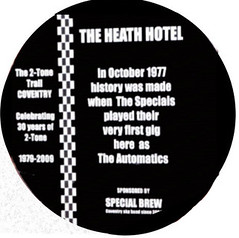
The Heath Hotel. In October 1977 history was made when The Specials played their very first gig here as The Automatics
807 Foleshill Road (ex Heath Hotel), Coventry, United Kingdom
Subjects

1912 - This building is one of three branch libraries erected in this city through the munificence of Andrew Carnegie Esq LLD
Foleshill Library, Broad Street, Coventry, United Kingdom
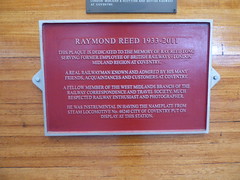
Raymond Reed 1933-2011 This plaque is dedicated to the memory of Ray Reed long serving former employee of British Railways - London Midland region at Coventry. A real railwayman known and admired by his many friends, acquaintances and customers at Coventry. A fellow member of the West Midlands Branch of the Railway Correspondence and Travel Society, much respected railway enthusiast and photographer. He was instrumental in having the nameplate from steam locomotive No. 46240 City of Coventry put on display at this station.
Platform 1 - Coventry Station, Coventry, United Kingdom
Subjects
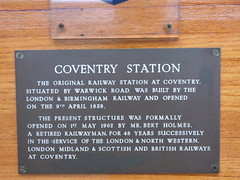
Coventry Station The original railway station at Coventry. Situated by Warwick Road was built by the London & Birmingham Railway and opened on the 9th April 1838. The present structure was formally opened on 1st May 1962 by Mr. Bert Holmes. A retired railwayman for 48 years successively in the service of the London & North Western, London Midland & Scottish and British Railways at Coventry.
Platform 1 - Coventry Station, Coventry, United Kingdom
Subjects


Willie Stanley Memorial Garden. Willie Stanley, founder of Singers FC 1883, later Coventry City FC 1898. The turf, soil and shale for this memorial garden are provided from Highfield Road, in memory of the Sky Blues supporters who had their ashes scattered at Coventry City's former home.
Coventry Building Society Arena, Coventry, United Kingdom

This foundation stone was laid by Mrs. Joshua Perkins on September 28th 1910.
50 Walsgrave Road, Coventry, United Kingdom
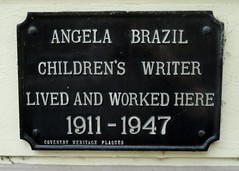
Angela Brazil Children's writer lived and worked here 1911-1947
Warwick Road, Coventry, United Kingdom
Subjects

The Freedom of the City of Coventry was granted on 14th July 2022 to University Hospitals Coventry and Warwickshire NHS Trust by Coventry City Council in recognition of its outstanding work to support the city's residents through the Covid-19 pandemic.
University Hospital, Coventry, United Kingdom

36 and 37 Much Park Street. 14th century postern gatehouse to the former Whitefriars Carmelite Priory dissolved in 1538. The remains of the priory, now a museum can be found on Gulson Road.
36 and 37 Much Park Street, Coventry, United Kingdom

George Skidmore. Watch hand maker. Wife: Sarah 39. Daughters: Sarah & Rose. Sons: William & John. 1881.
107 Craven Street, Coventry, United Kingdom

1 Russell Terrace, 31 Allesley Old Road. William Henry Hill watch manufacturer
31 Allesley Old Road, Spon End, Coventry, United Kingdom
Subjects

The Council House. Built 1913-17. The red sandstone facing and early tudor styling was chosen by a competition to be in keeping with nearby St Mary's Hall. The large porch is flanked by gilded armorial decoration under giant figures of Leofric and Godiva. Architects E. Garret & H.W. Simister of Birmingham.
Earl Street, Coventry, United Kingdom
Subjects
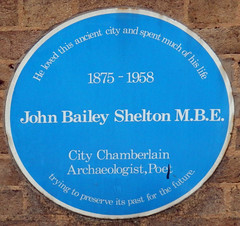
He loved this ancient city and spent much of this life trying to preserve it's past for the future. 1875-1958. John Bailey Shelton MBE City Chamberlain Archaeologist, Poet.
Market Way, Coventry, United Kingdom
Subjects

1912 - This building is one of three branch libraries erected in this city through the munificence of Andrew Carnegie Esq LLD
Stoke Library, Kingsway, Coventry, United Kingdom

This plaque was unveiled by the First Deputy Mayor of Volgograd Mikhail Zoltaryov in the presence of the Right Worshipful the Lord Mayor of Coventry Councillor Wilfred Spencer on Saturday the 25th November 1972 to mark the naming of this area Volgograd Place as a symbol of the friendship between Volgograd and Coventry born out of the sufferings of both cities during war time and now devoted to international understanding and peace
Volgograd Place - under Ringway Swanswell, Coventry, United Kingdom

On this site Siegfried Bettman founder of the Triumph company set up his Priory Street works 1896. Coventry Heritage Plaques.
Priory Street, Coventry, United Kingdom

This tree marks the site of Jabet's Ash, from ancient times a famous landmark and boundary of the City of Coventry - It was grown from the stock of the ancient tree, and was presented to the city by Henry Whiteman in 1925. to preserve the tradition of the spot and to commemorate Alderman William Hewitt Mayor of Coventry 1922-24 who resided in the neighborhood
nr 39 Binley Road, Coventry, United Kingdom
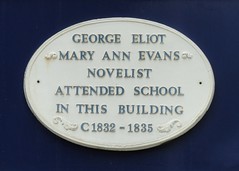
George Eliot Mary Ann Evans novelist attended school in this building c 1832-1835.
Warwick Row, Coventry, United Kingdom
Subjects
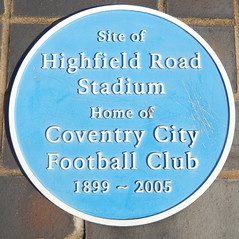
Site of Highfield Road Stadium home of Coventry City Football Club 1899-2005
Signet Square, Coventry, United Kingdom
Subjects


Coventry Technical College. This tablet commemorates the visit to this college of His Royal Highness Edward Prince of Wales. K.G. 10th July 1954.
The Butts, Coventry, United Kingdom

Coventry Technical College. This tablet commemorates the opening of the college by His Royal Highness The Duke of York K.C. 10th December 1955.
Butts Road, Coventry, United Kingdom

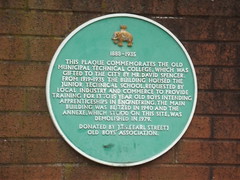
1888-1935 This plaque commemorates the old Municipal Technical College, which was gifted to the city by Mr. David Spencer. From 1919-1935 the building housed the Junior Technical School, requested by local industry and commerce to provide training for 13 to 15 year old boys intending apprenticeships in engineering. The main building was blitzed in 1940 and the annexe, which stood on this site, was demolished in 1979.
Little Park Street, Coventry, United Kingdom
Subjects
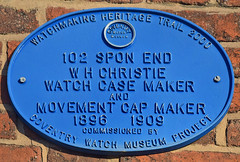
102 Spon End. W. H. Christie watch case maker and movement cap maker 1896-1909
102 Spon End, Coventry, United Kingdom
Subjects
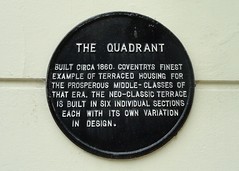
The Quadrant. Built circa 1860. Coventry's finest example of terraced housing for the prosperous middle-classes of that era. The neo-classic terrace is built in six individual sections each with it's own variation in design.
Warwick Road, Coventry, United Kingdom
Subjects

Welcome to Coventry City's memorial garden. This garden is an area of remembrance for Coventry City fans who have sadly passed away.
Coventry Building Society Arena, Coventry, United Kingdom

Greyfriars Gate Bull Yard was formerly a short street (Bull Street) leading to Barrack's Square Market (now Barracks car park), but on Samuel Bradford's 1748-9 Coventry map it was part of a much longer path leading from Greyfriars Gate to Smithford Street, beside the Black Bull Inn - "The Back Way to the Bull". The path was used by the Royalist leader, the Earl of Northampton, to escape from the Inn when troops were outnumbered by Parliamentarian forces in 1642 during the Civil War. "The Bull" a three-storey timber framed building of eight bays, mentioned in the 15th century documents was the Black Bull by the 17th century. A large field belonging to the Inn was called the Bull Field, in 1793 the "Black Bull" was replaced by the Cavalry Barracks, a five bay stone building. The plaque at the Shelton Square entrance to Bull Yard commemorates another "bull",. the Dun Cow slain by Guy of Warwick. In Coventry legend the cow was a huge wild boar, which terrorised the people and rooted up Swanswell (Swine's Well) Pool with it's snout - till Guy slew it. In the paving the outline of the Town Wall is marked: this was built between 1385 and 1391. Also depicted is Greyfriars gate, one of the principal gates out of twelve which once circuited the Wall. It's actual site was in the roadway nearby. In 1648 Royalist soldiers were imprisoned there. In 1705 it was made into a dwelling but was demolished in 1781.
Bull Yard, Coventry, United Kingdom
Subjects


This Massey Ferguson Artwork was unveiled on 6th July 2014, exactly 68 years since the first tractor left the assembly line at Banner Lane.
Banner Lane, Coventry, United Kingdom
Whitley Abbey Bridge built between 1755 and 1765 'Many feet walked here in years past and will do in years to com...' text by: Emma Stevenson (12) drawing by: Gary Piazzon (15) Whitley Abbey School 2005
Abbey Road, Whitley Village, Coventry, United Kingdom
Subjects

82 London Road. Cabin Studio and Sonar Records 1983-2010. Bands who recorded here include - Courtiers of Fashion, Furious Apples, Armalite, Pink Umbrellas, Crokodile Tears, The Primitives, Mysterious Monks and many more.
82 London Road, Coventry, United Kingdom

Holy Trinity Graveyard (extension) In the 1770s Holy Trinity created in this area an extension to the original overcrowded graveyard around the church. In 1857, following the opening of London Road Cemetery by Coventry Corporation, most burials here ceased. Excavations in 1999-2000, as part of the Phoenix Initiative, uncovered about 1,850 complete burials. These remains were re-interred in the old London Road Cemetery in June 2000. The construction of the timer bell tower in the mid 1850s and of the Holy Trinity Church Centre in the 1970s disturbed many of the gravestones. Those surviving in 1999 were recorded and details may be consulted in the Priory Visitor Centre. Some gravestones have been preserved at the top of the bank next to the house in Priory Row.
Priory Row - Priory Gardens, Coventry, United Kingdom
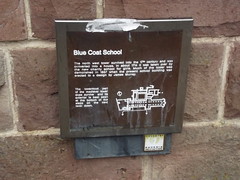
Blue Coat School The north west tower survived into the 17th century and was converted into a house. In about 1714, it was taken over by the new charity school for girls. Much of the tower was demolished in 1857 when the present school building was erected to a design by James Murray. The lowermost part of the medieval tower does survive and it's exterior is best seen at the bottom of the steps on the next level down.
Blue Coat School - Priory Gardens, Coventry, United Kingdom
Subjects
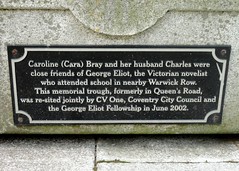
Caroline (Cara) Bray and her husband Charles were close friends of George Eliot, the Victorian novelist who attended school in nearby Warwick Row.
Greyfriars Green, Coventry, United Kingdom
Subjects

Lidice In 1942 the Nazis killed all the men in Lidice Czechoslovakia, took the women and most of the children into concentration camps and then razed the village to the ground. This crime was committed as a reprisal for the assassination of the Nazi leader Heydrich, A new Lidice has now been built and a garden of friendship and peace with roses blooming in it donated by peace loving people from all over the world. This plaque was unveile by the Mayor of Lidice Madam M Jarosova in the presence of His Excellency the Czechoslovak Ambassador Dr. M. Zemla and the Right Worshipful the Lord Mayor of Coventry Councillor W. Spencer on Monday the 19th June 1972 to mark the naming of this area Lidice Place as a symbol of the friendship link between Lidice and Coventry born out of war time destruction and now devoted to international understanding and peace.
Corporation Street, Coventry, United Kingdom
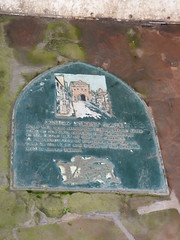
Bishop Street Cafe Near this spot stood the Bishop Street Cafe built in the 13th century and demolished in the latter half of the 18th century. A representation of the town wall can be seen to the right and a plan of the original wall is shown below.
Canal Basin Bridge - Bishop Street, Coventry, United Kingdom
Subjects
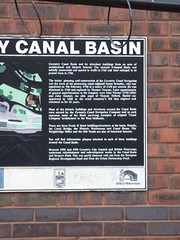
Coventry Canal Basin Coventry Canal Basin and it's attendant buildings form an area of architectural and historic interest. The unusual Y-shaped Basin was initally constructed and opened to traffic in 1769 and later enlarged to it's present form in 1788. The initial planning and construction of the Coventry Canal Navigation was the work of the pioneering canal engineer James Brindley, who was appointed on 9th February 1768 at a salary of £150 per annum. He was dismissed in 1769 and replaced by Thomas Yeoman. Later appointments of general superintendent to the company were John Warner (1795-1820) and John Sinclair. An able pupil of Thomas Telford, Sinclair was appointed in 1820 as the canal company's full time engineer and remained so for 43 years. Most of the historic buildings and structures around the Canal Basin were erected by the Coventry Canal Navigation Comapny and as such represent some of the finest surviving examples of original 'Canal Company' architecture in the West Midlands. There are three Grade II listed buildings / structures at the basin. Namley, the Canal Bridge, the Historic Warehouses and Canal House. the Weighbridge Office and Old Vaults are also of historical interest. You will find information plaques attached to each of these buildings around the Canal Basin. Between 1993 and 1995 Coventry City Council and British Waterways undertook refurbishment and redevelopment works in the Canal Basin and Drapers Field. This was partly financed with aid from the European Regional Development Fund and from the Urban Partnership Fund.
Coventry Canal Basin - Rolt House - Leicester Row, Coventry, United Kingdom
Subjects
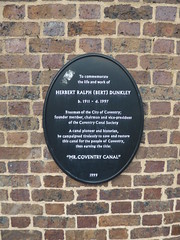
To commemorate the life and work of Herbert Ralph (Bert) Dunkley b. 1911 - d. 1997 Freeman of the City of Coventry; founder member, chairman and vice-president of the Coventry Canal Society A canal pioneer and historian, he campaigned tirelessly to save and restore this canal for the people of Coventry. thus earning the title: "Mr. Coventry Canal" 1999
Weighbridge Office - Coventry Canal Basin - Leicester Row, Coventry, United Kingdom
Subjects
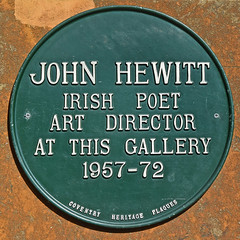
John Hewitt Irish poet art Director at this gallery 1957-72
Herbert Art Gallery & Museum, Coventry, United Kingdom
Subjects

The Coventry Theatre The New Hippodrome, as it was originally named, was opened on 1 November 1937. It was the third Hippodrome on this site, the first situated in Pool Meadow (1903) and the second (1907) built in what is now the lower part of Lady Herbert's Garden. The New Hippodrome, re-named the Coventry Theatre in 1955, provided the venue for some of the world's greatest artistes and productions. The auditorium was comfortable and impressive in size, seating 2136. The arrival of television in the 1950s and '60s caused a drastic decline in the popularity of variety theatre. In 1985 the theatre became a bingo hall and operated as such until it was demolished in 2002 to make way for Millennium Place, the Whittle Arch and the new frontage to Coventry Transport Museum.
Millennium Place - near Hales Street, Coventry, United Kingdom
Subjects
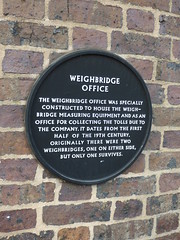
Weighbridge Office The Weighbridge Office was specially constructed to house the weighbridge measuring equipment and as an office for collecting the tolls due to the company. It dates from the first half of the 19th century. Originally there were two weighbridges, one on either side, byt only one survives.
Weighbridge Office - Coventry Canal Basin - Leicester Row, Coventry, United Kingdom
Subjects

Swanswell Gate Completed circa 1440 as part of the fortified town wall, remains of which stand in the adjoining gardens. Originally named Priory Gate it gave access to the Prior's lands outside the wall. Including Swanswell Fishpool. The archways were blocked, windows inserted and the roof raised when it was converted into a house and gardens were presented to the city and wall remains are now Scheduled Ancient Monuments.
Swanswell Gate - Hales Street, Coventry, United Kingdom
Subjects
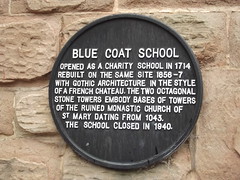
Blue Coat School. Opened as a charity school in 1714 rebuilt on the same site 1856-7 with Gothic Architecture in the style of french chateau. The two octagonal stone towers embody bases of towers of the ruined monastic church of St Mary dating from 1043. The school closed in 1940.
Priory Gardens, Coventry, United Kingdom
Subjects
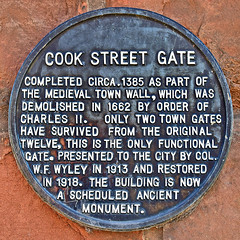
Cook Street Gate. Completed circa.1385 as part of the medieval town wall, which was demolished in 1662 by order of Charles II. Only two town gates have survived from the original twelve, this is the only functional gate. Presented to the city by Col. W. F. Wyley in 1913 and restored in 1918. The building is now a scheduled ancient monument.
Lady Herbert's Gardens, Coventry, United Kingdom
Subjects
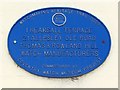
Coventry Watch Museum Project: Watchmaking Heritage Trail 2000 - 1 Hearsall Terrace 21 Allesley Old Road, Thomas &Roland Hill Watch Manufacturers
21 Allesley Old Road, Coventry, United Kingdom
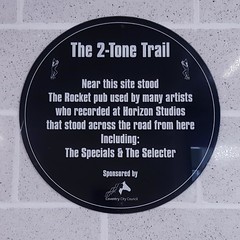
Near this site stood The Rocket pub used by many artists who recorded at Horizon Studios that stood across the road from here Including: The Specials & The Selecter
Coventry Station, Warwick Road, Coventry, United Kingdom
Subjects
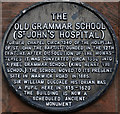
The Old Grammar School (St John's Hospital). Former chapel circa 1340 of the Hospital of St John the Baptist founded in the 12th century. After dissolution of the monastries it was converted circa 1550 into a Free Grammar School (King Henry VIII School). The school moved to its present site in Warwick Road in 1885. Sir William Dugdale historian was a pupil here in 1615-1620. The building is now a scheduled ancient monument.
Cnr Hales St and Bishop St, Coventry, United Kingdom
Subjects
_cropped.jpg?width=250)

Opposite this marker stood the Daimler car factory which made the first British production motor car in 1897. The surviving building is the Powerhouse.
Coventry Canal, Coventry, United Kingdom
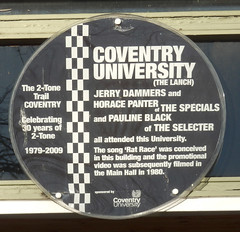
Coventry University (The Lanch) Jerry Dammers and Horace Panter of The Specials and Pauline Black of The Selecter all attended this University. The song 'Rat Race' was conceived in this building and the promotional video was subsequently filmed in the Main Hall in 1980.
Coventry University (The Lanch), Coventry, United Kingdom
Subjects


1912 - This building is one of three branch libraries erected in this city through the munificence of Andrew Carnegie Esq LLD
Earlsdon Library, Earlsdon Avenue, Coventry, United Kingdom

Chapelfields. Where the watches ticked in long rows, the looms clacked and the bells rang, Home sweet Home 1946.
Craven Street, Coventry, United Kingdom
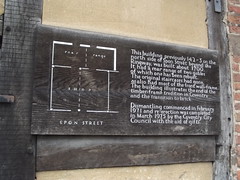
This building previously 142-3 on the north side of Spon Street beyond the Ringway, was built about 1700. It had a rear range of two gables of which one had been rebuilt. The original staircases had gone, as also ahd most of the front wall-frame. The building illustrates the end of the timber-frame tradition in Coventry and the transition to brick. Dismantling commenced in February 1971 and re-erection was completed in March 1975 by the Coventry City Council with the aid of gifts.
16 Spon Street, Coventry, United Kingdom
Subjects

Craven St Garden. In dedication of the family who lost their home on this site, during the bombing of the 2nd World War.
Craven Street, Coventry, United Kingdom

Jaguar Daimler Heritage Trust. Ernest Instone 1872-1932. Pioneer of the British Motor Industry and Motor Sport. General Manager & Engineer, Daimler, Coventry, City Councillor and JP. Lived here C 1907-1920. The Coventry Society 2022.
The Firs, Coventry, United Kingdom

Earlsdon's first Anglican church built 1913 Parish church of St. Barbara 1922-1931
4 Palmerston Road, Coventry, United Kingdom


Site of Rex Motorcycle factory 1898-1923 Alpha Engineering 1948-1987
102 Osborne Road, Coventry, United Kingdom

Coventry Watch Museum Project: Watchmaking Heritage Trail 2000 - Cambrian House 164 Allesley Old Road W.H. Adams & Son Watch Manufacturer 1889 -1953
164 Allesley Old Road, Coventry, United Kingdom
Coventry Watch Museum Project: Watchmaking Heritage Trail 2000 - 1 Oxford Terrace 13 Allesley Old Road Factory of Philip Cohen Watch Manufacturer
13 Allesley Old Road, Coventry, United Kingdom
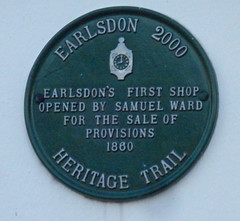
Earlsdon's first shop opened by Samuel Ward for the sale of provisions 1860
59 Moor Street, Coventry, United Kingdom
Subjects

Harrington's Tubular Bell Foundry 1900 - 1920 Engineering Works 1920 - 1962
31 Clarendon Street, Coventry, United Kingdom

One of Earlsdon's earliest houses built 1852 for Henry Bates (Dyer)
52 Earlsdon Street, Coventry, United Kingdom
Subjects

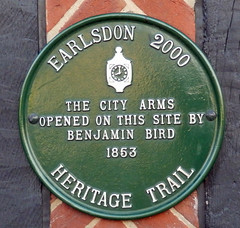
The City Arms opened on this site by Benjamin Bird 1853
1 Earlsdon Street, Coventry, United Kingdom
Subjects

Site of weaving shed 1854 - 1865; Methodist Chapel 1872 - 1884; First Day School 1882 - 1890
102 Berkeley Road South, Coventry, United Kingdom

The Earlsdon Coffee Tavern 1899 Working Men's Club 1910-1931 Albany Social Club 1931
10 Earlsdon Street, Coventry, United Kingdom
Subjects
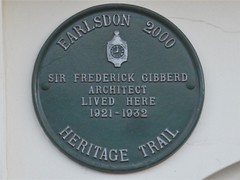
Sir Frederick Gibberd Architect lived here 1921 - 1932 (Clarendon House and Westwood House)
15 Clarendon Street, Coventry, United Kingdom
Subjects


Wesleyan Methodist Chapel: 1884 - 1923 Sunday School: 1884-1960 Criterion Theatre: 1960
Criterion Theatre, Berkeley Road South, Coventry, United Kingdom
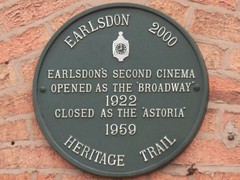
Earlsdon's second cinema opened as the "Broadway" 1922 closed as the "Astoria" 1959
69 Albany Road, Coventry, United Kingdom
Subjects

Site of farmhouse built by John Moore 1766-1846. Owner of 6 fields developed as the Earlsdon estate 1852
60 Moor Street, Coventry, United Kingdom
Subjects

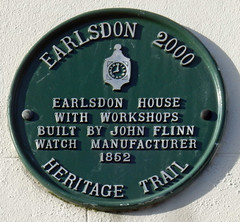
Earlsdon House with workshops built by John Flinn watch manufacturer 1862
68 Earlsdon Street, Coventry, United Kingdom
Subjects
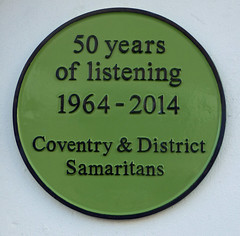
50 years of listening 1964-2014 Coventy & District Samaritans
Warwick Street, Coventry, United Kingdom
Subjects
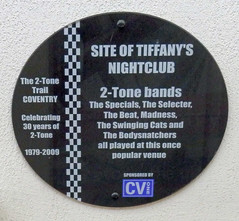
Site of Tiffany's Nightclub. 2-Tone bands The Specials, The Selecter, The Beat, Madness, The Swinging Cats and The Bodysnatchers all played at this once popular venue
Tiffany's Nightclub (Central Library), Coventry, United Kingdom
Subjects


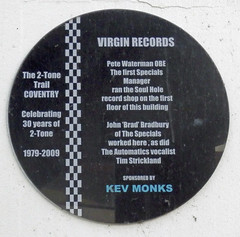
Virgin Records. Pete Waterman OBE the first Specials manager ran the Soul Hole record shop on the first floor of this building. John 'Brad' Bradbury of The Specials worked here, as did The Automatics vocalist Tom Strickland
Virgin Records/Soul Hole, Coventry, United Kingdom
Subjects


Holy Tinity Church. Constructed during the 13th and 15th Centuries on the site of a norman building as the parish church for the priors half of Coventry. The Spire. Height 237 feet (72 metres) was rebuilt in 1667 after the original was blown down. Extensive restoration and a new west front were completed in 1849 by R. C. Hussey. The interior was restored in 1855 by Gilbert Scott.
Priory Row, Coventry, United Kingdom
Subjects


Stoke Green Wall. This wall was reconstructed by Coventry City Council Task Force as part of the Manpower Services Commission Community Programme. Opened by Mrs A. Wilson on 2nd December 1984 on behalf of the Stoke Park Residents Group.
Binley Road, Coventry, United Kingdom

Coventry Watch Museum Project: Watchmaking Heritage Trail 2000 This is the only surviving building of the world famous clock & watch manufacturer H. Williamson Ltd formerly Charles H Errington
11 Lower Holyhead Road, Coventry, United Kingdom
Coventry Watch Museum Project: Watchmaking Heritage Trail 2000 - 1 Hearsall Lane , Smith & Sons Balance Works c1846
1 Hearsall Lane, Coventry, United Kingdom
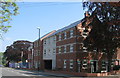
Coventry Watch Museum Project: Watchmaking Heritage Trail 2000 - 51 Allesley Old Road, Frederick Trahern watch case maker 1874 - 1970
51 Allesley Old Road, Coventry, United Kingdom

Coventry Watch Museum Project: Watchmaking Heritage Trail 2000 - 24 Bedford Street, J Player & Sons, Watch and Chronometer manufacturers
24 Bedford Street, Coventry, United Kingdom
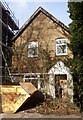
Coventry Watch Museum Project: Watchmaking Heritage Trail 2000 - 5 Broomfield Place, Henry Westrap watch manufacturer 1876 - 1890
5 Broomfield Place, Coventry, United Kingdom

Swallows & Coventry Preparatory School 1920-2021. Rev. K. Swallow MC, J. Sykes, J.O. Phipps MA Oxon, King Henry VIII School. To the many dedicated staff and owner Headmasters. Inspired teachers to many Coventry children. The Coventry Society 2022.
The Firs, Coventry, United Kingdom

Earlsdon Water Fountain This cast iron fountain was made by George Smith’s Sun Foundry in Glasgow in the 1860s, one a of a new generation of drinking fountains designed to provide clean water as part of the war against water-borne diseases such as cholera It is believed to have been purchased by Coventry Council and sited outside the church of St John the Baptist in the city centre around 1870 and was relocated to this site in 1921, shortly after the opening of the nearby War Memorial Park. It was in use until the 1970s The project to restore it has been co-ordinated by two community organisations, the Earlsdon Research Group and the South Earlsdon Neighbours Association, in partnership with Coventry City Council and Severn Trent Water, and with active support form the pupils at Hearsall Community School in Earlsdon. The restoration has been funded by the Heritage Lottery Fund, The Drinking Fountain Association and by contributions from the local community. It was carried out by The Fountain Company of Glossop in Derbyshire. After 150 years the Earlsdon fountain is again supplying fresh, clean water and supporting an important campaign, this time to reduce the production of plastic bottles, which is becoming a major environmental threat to the world. Earlsdon Fountain Group November 2015
Earlsdon Avenue South, Coventry, United Kingdom

"You can beat a club but you can't beat a club and a city" Jimmy Hill 1928-2015. "Coventry City is my club in football and always will be" Jimmy Hill - August, 1967
Coventry Building Society Arena, Coventry, United Kingdom

The Bench of Unity: Artist Maker - David Dewis - March 2018: In a time of unparalleled anguish throughout the world there has never been a more poignant time to express unity within our dic verse community. The Bench of Unity depicts three figures in silhouette form, representing an inclusive cross section of our city’s residents sitting companionably together To the left the first sitting figure represents an older lady taking a rest during a shopping trip. The centre figure is an elderly gentleman sporting a hat with a brim. A young woman in in hijab to the right makes up the trio. As Coventry celebrates being City of Culture 2012 the bench demonstrates our commitment to inclusivity and promotion of harmony with our community . Coventry City Council
Spon Street, Coventry, United Kingdom

GOSFORD GATE This plaque faces the site of Gosford Gate constructed in the latter half of the 14th century. It overlooked this ancient crossing of the River Sherbourne beyond which developed the medieval suburb of Far Gosford Street. The gate was demolished in 1965 THE TOWN WALL The town wall ran to the north of the gate and to the south, where a section was excavated in 1991. The course of the wall is now marked in the premises to the right. ST GEORGE’S CHAPEL The Chapel was built in the early 15th century against the north side of Gosford Gate. Part stood on an arch over the river. The Chapel served the Guild of journeymen tailors and shearmen. Having been in domestic use for some time the Chapel was demolished 1822 THE BRIDGES Just beyond the Gate was Callice Bridge (by the portcullis ?) later named Calais Its companion, 40 yds further on became known as Dover Bridge Coventry City Council 1991
Far Gosford Street, Coventry, United Kingdom
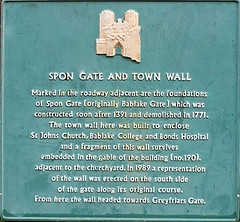
Spon Gate and Town Hall. Marked in the roadway adjacent are the foundations of Spon Gate (originally Bablake Gate) which was constructed soon after 1391 and demolished in 1771. The town wall here was built to enclose St Johns Church, Bablake College and Bonds Hospital and a fragment of the wall survives embedded in the gable of the building (no. 190) adjacent to the churchyard. In 1989 a representation of the wall was erected on the south side of the gate along it's original course. From here the wall headed towards Greyfriars Gate.
Corporation Street, Coventry, United Kingdom
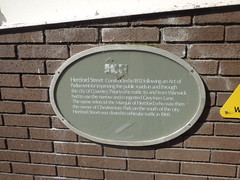
Hertford Street. Constructed in 1812 following an Act of Parliament for 'improving the public roads and through the city of Coventry'. Prior to this traffic to and from Warwick had to use the narrow congested Greyfriars Lane. The name refers to the Marquis of Hertford, who was then the owner of Cheylesmore Park, on the south of the city. Hertford Street was closed to vehicular traffic in 1969.
Hertford Street (just before the steps up to Hertford Square), Coventry, United Kingdom
Subjects

West Orchard congregational church stood on this site. Founded 1776, destroyed 1941. Re-established 1947 at Baginton Rd.
West Orchards, Coventry, United Kingdom

Dedicated to the workers at Coventry Colliery (1912-1966) Homefire Plant (1960-1999). This pit wheel was one of the four in use at the pit head at its closure. At its most productive the colliery produced 25.000 tonnes of coal per week.
Prologis Park, Coventry, United Kingdom
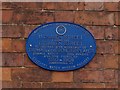
Coventry Watch Museum Project: Watchmaking Heritage Trail 2000 - 11 Craven Street formerly 6 Craven Street residence and workshop of Thomas and Ebenezer Player. Enamel watch dial makers and dial painters 1874 - 1883
11 Craven Street, Coventry, United Kingdom
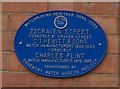
22 Craven Street formerly 81 Craven Street C T Hewitt & Sons watch manufacturers 1896 1909 formerly Charles Flint watch manufacturer 1876 1886
22 Craven Street, Coventry, United Kingdom
Subjects

SHUT LANE MILL This is the site of the pool on the River Sherbourne, which fed water to a corn mill that existed from at least the 13th century. It was situated diagonally opposite on the forecourt of the workshops. The mill was demolished in the 1930s and had many names in its history. the main owners were the Earl of Chester (to 1227), the Priory of St Mary (to 1539) and the Old grammar School (1572-end of 19th century).
Gulson Road, Coventry, United Kingdom
Subjects
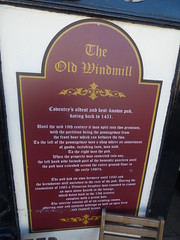
The Old Windmill Coventry's oldest and best-known pub, dating back to 1451. Until the 19th century it was split into two premises, with the partition being the passageway from the front door which ran between the two. To the left of the passageway was a shop where an assortment of goods, including toys, was sold. To the right was the pub. When the property was converted into one, the left hand side formed part of the domestic quarters until the pub was extended across the entire ground floor in the early 1980's. The pub had it's own brewery until 1930 and the brewhouse still survives to the rear of the pub. During the renovation of 1985 a Victorian fireplace was removed to expose an open stove hearth in the lounge, which dates back to the 15th century, complete with a priest hole. The interior retains all of it's existing rooms, offering cosy and intimate settings as well as open fires and exposed beams.
The Old Windmill - 21 Spon Street, Coventry, United Kingdom
Subjects

In loving memory of David Roberts 08/09/1973-10/05/2024. Cherished by his family, his colleagues from the Co-op and the whole Earlsdon community.
Earlsdon Street, Coventry, United Kingdom
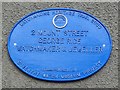
2 Mount Street George Rice Watchmaker and Jeweller
2 Mount Street, Coventry, United Kingdom
Subjects

Site of weaving shed 1854-1865 Methodist Chapel 1872-1884 First Day School 1882-1890
102 Berkeley Road South, Coventry, United Kingdom
Subjects
35 Mount Street one of the workshops of the Coventry Co Operative Watch Manufacturing Society Ltd set up by local watchmakers in 1876 about 1900 they moved to Stanley Terrace and ceased trading in 1918
35 Mount Street, Coventry, United Kingdom

Site of Earlsdon's Favourite cinema the "Imperial" known locally as "The Barn" 1911-1965
7 Earlsdon Street, Coventry, United Kingdom
Subjects

Copsewood Grange, built 1872 for James Hart, ribbon manufacturer. 1879 bought by Sir Richard Moon, chair of nearby London NW railway. Later, Peel Conner, GEC, GPT, Marconi. Restored by Morris Homes 2018. The Coventry Society.
Gwendolyn Drive, Coventry, United Kingdom

Fisherman and nymph by P.G. Bentham A.R.B.S. Presented to the city by the Coventry Boy Foundation 1968.
Coombe Abbey, Coventry, United Kingdom
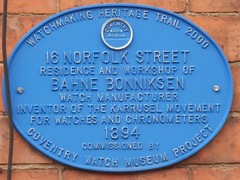
Watch Museum Heritage Trail 2000 16 Norfolk Street Residence and Workshop of Bahne Bonniksen Watch manufacturer and inventor of the Karussel Movement for watches and chronometers 1894 Coventry Watch Museum Project
16 Norfolk Street, Coventry, United Kingdom
Subjects

The University of Warwick Art Collection Tine Bech (1956) Colour Connections 2024 Coloured Glass and Mirror Panels B- 27 Commissioned by the University of Warwick Tine Bech's research takes the form of installations that explore ideas about play, realised in brilliant colours. For Warwick, she has created a work that aims to unite us in a collective, positive experience where friends and inter-generations can converge, explore and reflect. The title was inspired in part, by the Covid-19 pandemic that delayed completion of the sculpture. Tine Bech commented "In an era where shared outdoor spaces have gained heightened significance as communal meeting points, this work is a testament to our need for connection".
University House, University of Warwick, Coventry, United Kingdom

National Automotive Innovation Centre. Opened by HRH The Prince of Wales 18th February 2020.
University of Warwick, Lord Bhattacharyya Way, Coventry, United Kingdom

Mr Ratan Tata, GBE, Chairman Emeritus Tata Sons unveiled this stone to commemorate the founding of the National Automotive Innovation Centre 17th March 2015.
University of Warwick, Lord Bhattacharyya Way, Coventry, United Kingdom

Dame Ellen Terry Actress. Born 27th Feb 1847 in a house which stood nearby
Upper Precinct Mall, Coventry, United Kingdom
Subjects

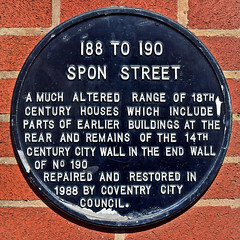
188 to 190 Spon Street. A much altered range of 18th Century houses which include parts of earlier buildings at the rear and remains of the 14th Century city wall in the end wall of No 190. Reparied and restored in 1988 by Coventry City Council.
188-190 Spon Street, Coventry, United Kingdom
Subjects

34-44 Hill Street & 1-3 Ryley Street. The finest surviving examples of 18th Century terraced houses in Coventry. They were saved from demolition and carefully restored in 1979 by Mr J. Field.
34-44 Hill Street, Coventry, United Kingdom
Subjects
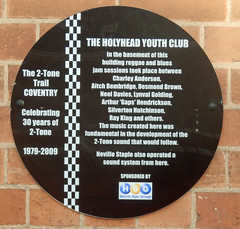
The Holyhead Youth Club. In the basement of this building reggae and blues jam sessions took place between Charley Anderson, Aitch Bembridge, Desmond Brown, Neol Davies, Lynval Golding, Arthur 'Gaps' Hendrickson, Silverton Hutchinson, Ray King and others. The music created here was fundamental in the development of the 2-Tone sound that would follow. Neville Staple also operated a sound system from here.
Holyhead Youth Club (now Artspace), Coventry, United Kingdom
Subjects


Mouldy Old Dough The first number one single by a Coventry group was recorded here in 1972 by Lieutenant Pigeon
25 Kingsway, Coventry, United Kingdom
Subjects
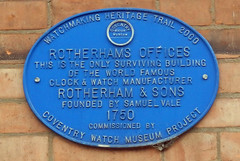
Rotherhams Offices. This is the only surviving building of the world famous clock & watch manufacturer Rotherham & Sons founded by Samuel Vale 1750
27 Spon Street, Coventry, United Kingdom
Subjects

City Wall - adjoining Salvation Army Citadel. The City Wall was 2⅛ miles in circumference when it was completed in 1534, almost 200 years after building began. This section was finished in the early 15th century and archaeological excavations on this site in 1960 revealed traces of a semi-circular bastion and a defensive ditch. In 1662, the wall was destroyed by order of Charles II, and now only fragments remain
Lamb Street, Coventry, United Kingdom
Subjects


Kirby House. Built circa 1700. Now one of two surviving examples of one of the fine town houses for gentry which used to line Little Park Street. Built partly over the "Red Ditch", a Saxon defensive earthwork. Settlement and structural damage required extensive building work in 1983-4.
Little Park Street, Coventry, United Kingdom

Vaults Two large vaults of brick construction, linked at the back, were built into the retaining wall on the north-western boundary of the canal basin in the middle of the 19th century. They were built for coal storage for the nearby gas works, when after 10 years the Coventry Canal Company won back the business from the railways.
Units 1-4 Coventry Canal Basin, Coventry, United Kingdom
Subjects

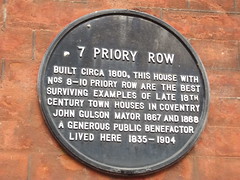
7 Priory Row. Built circa 1800, this house with Nos 8-10 are the best surviving examples of late 18th century town houses in Coventry. John Gulson Mayor 1867 and 1868, a generous public benefactor lived here 1835-1904.
7 Priory Row, Coventry, United Kingdom
Subjects
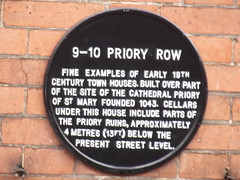
9-10 Priory Row. Fine examples of early 19th Century town houses built over part of the site of the cathedral priory of St Mary founded 1043. Cellars under this house include parts of the priory ruins, approximately 4 metres (13ft) below the present street level.
9-10 Priory Row, Coventry, United Kingdom
Subjects

11 Priory Row. Early 19th Century town house with fine brick front and stone dressings in Roman ionic style. Rebuilt and restored after extensive bomb damage this house with nearby Nos 7 and 16 Little Park Street are the only surviving examples of the grander houses of this period in Coventry.
11 Priory Row, Coventry, United Kingdom
Subjects

...nation shall not lift up sword against nation - neither shall they learn war any more. Michah 4-5- This plaque was unveiled by Her Majesty Queen Elizabeth The Queen Mother as part of the Service of Remembrance and Reconciliation on 14th November 1990.
Coventry Cathedral, Coventry, United Kingdom

You are standing upon the site of three ancient edifices. On the summit of Hill Top (approximately on this site) a convent was established about the year 650 A.D. by a Saxon lady, later canonised under the name of St Osburg + + The convent was destroyed by the Danes when they ravaged Mercia in 1016 A.D. + + + Twentyseven years later (1043A.D.) a Benedictine Abbey Church was built on the same ground by Leofric, Earl of Mercia and his Countess Godiva. Leofric and Godiva are said to have been buried respectively in the two porches which stood nearly on this spot. + + + Here about 1140 A.D. was commenced the building of the Benedictine Priory Church or Cathedral of St Mary which was completed about 1220 A.D. and demolished subsequent to 1539 A.D. It possessed three spires and a central tower. + + + Sic Transit Gloria Mundi.
8 Priory Row, Coventry, United Kingdom
Subjects


Peeping Tom. In the Godiva legend Peeping Tom was a tailor who disobeyed Lady Godiva's order to the citizens to stay behind closed shutters while she made her famous ride naked through Coventry. He looked out and was stricken with blindness. Effigies of him were displayed in the upper windows of several buildings in the City Centre before 1940. This figure was then on the Railway Inn at the end of Hertford Street.
Hertford Street, Coventry, United Kingdom
Subjects
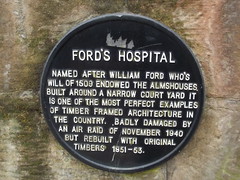
Ford's Hospital Named after William Ford who's will of 1509 endowed the almshouses. Built around a narrow court yard it is one of the most perfect examples of timber framed architecture in the country. Badly damaged by an air raid of November 1940 but rebuilt with original timbers 1951-53.
Ford's Hospital, Greyfriars Lane, Coventry, United Kingdom
Subjects


21 December 1994 For the heroic crew of five, who gave their lives whist saving ours.
Middle Ride, Coventry, United Kingdom

THIS STONE commemorates the official inauguration of the RE-BUILDING OF COVENTRY after the ENEMY ATTACKS OF 1940-1942 was laid by COUNCILLOR JOHN CHARLES LEE GORDON Mayor of Coventry 8 June 1946
Upper Precinct, Coventry, United Kingdom
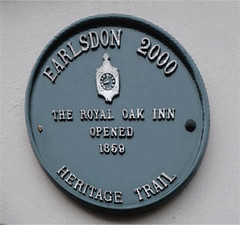

60 years of listening 1964-2024. Coventry & District Samaritans.
Warwick Street, Coventry, United Kingdom

On this Coventry University Technology Park site once stood a world famous company renowned for its expertise in the production of quality cars, aero and rocket engines. That company was Armstrong Siddeley Motors Limited 1919-1959. It merged with Bristol Engines Limited to become Bristol Siddeley Engines Limited 1959-1966 then merging with Rolls-Royce. The site was closed in 1996, the remaining production having moved to the Rolls-Royce factory in Ansty. This ironwork once formed part of No. 2 gate into the Parkside factory.
Coventry University Technology Park, Coventry, United Kingdom
Subjects


John Bailey Shelton 1875-1958. City chamberlain, historian, archaeologist. Lived here on the premises of his haulage business where, after heavy bomb damage in 1940, he set up "The Benedictine Museum", a private display of objects recovered from various excavations in the city, and now in the Herbert Museum Archaeological Collection.
Little Park Street, Coventry, United Kingdom

CALCOTT - Calcott Bros and West were established in 1885 and operated from three site before moving here in 1896 as Calcott Bros. The firm originally manufactured cycles, the 'XL' being the best known. In 1913 Calcott produced their first car and introduced the famous 'Ten' (10 h.p.) a year later. A 1921 cabriolet version can be seen in the Coventry Transport Museum, whose radiator inspired the design of this plaque. The ailing Calcott was taken over by Singer in 1926. Astleys acquired the premises a little before the 2nd World War. This well known Coventry firm originally traded as rope, canvas and paint manufacturers. Only the renaissance style office block now survives (1896) designed by E.J. Purnell. Most of the workshops at the rear were demolished to make way for student accommodation (2006-2007) - Coventry City Council & UNITE 2007
1 Far Gosford Street, Coventry, United Kingdom

This store stands on the site of Cross Cheaping, the traditional market centre of the ancient city. Here also stood the original Owen Owen store which with most of the surrounding buildings was totally destroyed by enemy action on the night of the 14th November 1940. This building was opened by the Lord Mayor of Coventry Alderman John Fennell on the 1st October 1954.
Trinity Street, Coventry, United Kingdom

Elm Bank. Founder of the Triumph companies Siegfried Bettmann (1863-1951) Mayor of Coventry 1913-14 lived here
Elm Bank, North Avenue, Stoke Park, Coventry, United Kingdom
Subjects

1. This memorial commemorates the work done on behalf of the parish and the people of Stoke by the Conservators of the ancient commons of the parish. The Conservators were in control of the commons from 1889 to 1928, when their duties were taken over by the Corporation of Coventry. Erected in 1933. 2.The Mayor of Coventry (Alderman Fred Lee); Stephen Evans Bayley, Joseph Holt & Charles Payne, councillors for Stoke ward; John Marriott Binley, Arthur Chattaway, Charles Alfred Gray, William Hodgson Malcolm, John Woodward & Robert Wormell; Clerk to the Conservators: Henry Benjamin Sparkes.
Stoke Common, Binley Road, Coventry, United Kingdom

Member of Parliament, Secretary of State and Peacemaker Marjorie (Mo) Mowlam (1949-2005) was a pupil here 1962-1968.
Coundon Court School, Northbrook Road, Coventry, United Kingdom

This stone was laid by HER ROYAL HIGHNESS the PRINCESS ELIZABETH at the opening of the New Broadgate and to mark the beginning of the Shopping Centre 22nd May 1948. Commemorated by Mr Bob Taylor LORD LIEUTENANT OF THE WEST MIDLANDS 22nd May 1998.
Precinct, Coventry, United Kingdom

Quercus Palustris - Pin Oak. Planted to commemorate the visit of the Prime Minister The Rt Hon Tony Blair MP and President of the USA William Jefferson Clinton. 14 December 2000.
University of Warwick, Coventry, United Kingdom

Jimmy Hill OBE. Manager of Coventry City 1961-1967. Sculptor Nicholas Dimbleby. A successful playing career as an inside-forward with Brentford and Fulham in the 1950s culminated in him leading the PFAs campaign to scrap the maximum wage in 1961. Over the next six seasons he transformed Coventry City from a lowly Third Division club to a first division outfit with innovations on and off the pitch. After leaving his beloved Sky Blues Jimmy had a successful forty-year career in broadcasting with ITV, BBC and Sky, interspersed with spells as chairman with Coventry, Charlton and Fulham. Player: Brentford 1949-52, Fulham 1952-61. Chairman: Professional Footballers Association 1957-61. Manager: Coventry City 1961-67. Managing Director & Chairman: Coventry City 1975-83. Chairman: Charlton Athletic 1984-85 & Fulham 1987-97. Television Executive & Pundit: ITV 1967-73, BBC 1973-99, Sky 1999-2007. Unveiled 28th July 2011.
Coventry Building Society Arena, Coventry, United Kingdom

THE ALVIS RETAIL PARK opened by HRH The Princess Margaret Countess of Snowdon on Tuesday 20th October 1992 by Longwood Alvis Retail Park Ltd.
Alvis Retail Park, Holyhead Road, Coventry, United Kingdom

Joseph Levi. Founder of the philanthropic societies in Coventry. President ALD A.R. Drinkwater J.P. Erected by public subscription 1934. The Coventry Society founded 1854. Chaplefields Society founded 1883. Earlsdon Society founded 1900. Foleshill Society founded 1904. Golden Cross Society founded 1859. Hillfields Society founded 1888. Stoke Society founded 1904. Charterhouse Society founded 1925.
Binley Road, Coventry, United Kingdom

Exhall Colliery Disaster. 21st December 1915. In memory of those who perished. Sidney Beasley, George Carding, Charles Courts, Frank Hackett, William Jackson, Charles Jennings, Ernest Marsden, James Sidwell, John Smith, William Smith, Herbert Stew, Robert Tallis, Thomas Tidman, Harry Tipple. 361 miners survived, many of them heroes, selflessly helping their colleagues to safety.
Exhall, Coventry, United Kingdom

Planted in 2018 to celebrate the Centenary of the Diocese of Coventry.
Exhall, Coventry, United Kingdom

1856-1956. This plaque was erected by the Executive Council of the Amalgamated Engineering Union to commemorate the 100th anniversary of the birth on this site on 15th April 1856 of Tom Mann who was the first General Secretary of the Amalgamated Engineering Union and who devoted his whole life to the service of the trade union and labour movement and the working glass throughout the world.
177 Grange Road, Coventry, United Kingdom

Given to Sir Alfred Herbert, K.B.E. on his 90th birthday by the employees of Alfred Herbert Ltd and the associate companies in Australia, France, India and Italy. September 1956.
Lady Herbert's Garden, Coventry, United Kingdom

Near this spot in the reign of Richard II in September 1398 (September 1397 according to local history) a wager of battle was to have been fought between the Duke of Hereford (afterwards Henry IV) and Thomas Mowbray, Duke of Norfolk. Hereford had imputed treasonable utterances to Mowbray, who demanded the privilege of acquitting himself by single combat. The King consented, and came to Coventry in great state to preside but when the combatants presented themselves on the field His Majesty stopped the encounter and pronounced degree of banishment: Hereford for ten years (afterwards remitting four years) and Mowbray for life. Mayor Mr Richard Clarke.
Gosford Green, Coventry, United Kingdom

Hawkesbury Canal Junction, "Sutton Stop". Junction of Brindley's Coventry and Oxford Canals of the 1780s, modified in the 1830s. Traditional mooring of working narrowboats.
Sutton Stop, Coventry, United Kingdom

Do you have a friend? Since 1999 the people of Coventry and visitors to the city have commemorated a friendship, a secret relationship or a memorable encounter. The invitation for everyone to contribute to The Public Bench continues until the space is covered with plaques. Jochen Gerz, The Public Bench, 1998/2004.
Millennium Place, Coventry, United Kingdom

13-29 Lower Holyhead Road. Built 1819-1837. The surviving part of a long range of 18 houses with workshops on the upper floors, known as "topshops". With large windows, used by craftsmen in the weaving and watchmaking trades before the advent of steam powered factories. Restored to residential use in 1984 by Coventry Churches Housing Association.
13-29 Lower Holyhead Road, Coventry, United Kingdom

Alice Arnold 1881-1955. Lived here when Coventry's first woman mayor in 1937. Socialist, trade union organiser and pioneer woman councillor. First elected 1919.
28 Short Street, Coventry, United Kingdom

Coventry Watch Museum Project: Watchmaking Heritage Trail 2000 - 123 Upper Spon Street, Site of Coventry Watch Movement Manufacturing Company Factory c1889
123 Upper Spon Street, Coventry, United Kingdom

On this common Frank Whittle jet pioneer First felt the power of flight 1916
Hearsall Common, Coventry, United Kingdom
Subjects

On a site adjoining this tree there stood from 1919 to 1927 a temporary cenotaph erected by the ex-servicemen of Coventry in memory of their comrades who fell in the great war of 1914-1918.
Spencer Park, Coventry, United Kingdom

Born here Sir Frank Whittle "Father of the jet engine" 1st June, 1907
72 Newcombe Road, Coventry, United Kingdom
Subjects

On this site Francis Skidmore artist in metal founded his iron works 1859.
Alma Building, Alma Street, Coventry, United Kingdom

Philip Larkin (1922-1985). Poet and Novelist. Born in this house 9 August 1922.
2 Poultney Road, Coventry, United Kingdom
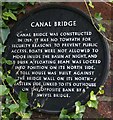
Canal Bridge - Canal Bridge was constructed in 1769. It has no towpath for security reasons to prevent public access. Boats were not allowed to moor inside the basin at night and at dusk a floating beam was locked into position on its North side. A toll house was built against the bridge wall on its North-Eastern side linked to the outhouse on the opposite bank by a swivel bridge
Canal Basin, Leicester Row, Coventry, United Kingdom
Subjects
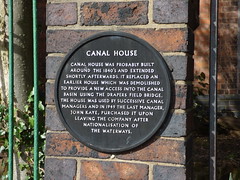
Canal House Canal House was probably built around the 1840's and extended shortly afterwards. It replaced an earlier house which was demolished to provide a new access into the Canal Basin using the Drapers Field Bridge. The house was used by successive canal managers and in 1949 the last manager, John Kaye, purchased it upon leaving the company after nationalisation of the waterways.
Canal House - Draper's Fields, Coventry, United Kingdom
Subjects
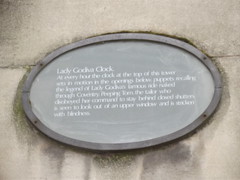
Lady Godiva Clock At every hour the clock at the top of this tower sets in motion in the openings below, puppets recalling the legend of Lady Godiva's famous ride naked through Coventry. Peeping Tom, the tailor who disobeyed her command to stay behind closed shutters is seen to look out of an upper window and is stricken with blindness.
Hertford Street Shopping, Broadgate, Coventry, United Kingdom
Subjects

Lady Herbert's Garden & Garden of International Friendship Lady Herbert's Garden was laid out in the 1930s by Alfred Herbert as a memorial to his second wife. The garden of International Friendship was opened in 2000 as part of the City Council's Millennium Scheme (Phoenix Initiative). During the medieval period the area lay on either side of the town wall (here constructed between the 1430s and 1460s). Within the wall were located the rear gardens of houses on Cook St and St Agnes Lane. A great ditch lay immediately on the outside of the wall and beyond grew the fruit trees of the Prior's Orchard. Swanswell Gate (Priory Gate) served as the Prior's own gate into the monastic precinct. As Coventry grew in the 19th century, the area was built over for the first time. In turn, much of this was cleared in the 20th century and the best preserved section of the town wall made publicly visible for the first time. A Millennium Commission Lottery Project
Lady Herbert's Garden - Hales Street, Coventry, United Kingdom

Memorial tree. This tree is dedicated to all our colleagues who have lost their lives to suicide. Planted by Professor Andy Hardy, CEO of UHCW NHS Trust and Susannah Basile, Interim CEO of Doctors in Distress. 2nd December 2024.
University Hospital Coventry & Warwickshire, Coventry, United Kingdom

George Curtis 1939 - 2021 John Sillett 1936 - 2021 FA Cup Winners 1987 Coventry City Football Club John Sillett and George Curtis are two of the most influential figures in Coventry City's history, leading the club to its greatest achievement - the 1987 FA Cup triumph. As joint managers, their leadership and determination inspired the Sky Blues to a thrilling 3-2 victory over Tottenham Hotspur at Wembley, securing the club's first major trophy. Curtis, a commanding centre-half, made 543 appearances for Coventry between 1956 and 1969 before moving into management and later becoming the club's managing director. while Sillett; a former full-back, played for the club before returning as a coach and later manager, their impact extended beyond the FA Cup win, playing crucial roles in Coventry's rise and stability in the top flight. Honoured as life presidents of the club, their legacy remains a lasting source of pride for Coventry City and its supporters: With kind thanks to all those who donated and contributed towards the making of this commemorative statue Jean Sillett Neil Sillett Dawn Sillett Jackie Sillett John Sillett Jr. Alan Sillett Inger Curtis Julie Curtis-Hicks & William Hicks Kevin & Julie Curtis Jackie Curtis & Peter Gibson Michael & Marti Curtis Leanne McKenna Danielle McKenna Charlie Curtis Danny Curtis Abbie Dobbins George Curtis Coventry City Football Club Bob Jennings & Family Grace & Joe Elliott M.B.E. John; Taylor CBS Arena.* Paul Michael Mark Hornby Predrag Mihajlovic lovie g Patricia & Roger Medwell M.B.E Dave & Lyn Willetts Paddy Lynch Richard & Gaynor Frost Genesis Employment- Ted Stocker O.B.E Clive & Paula Benfield Eric Grove. David Shortland M.B.: Cary & ortand ABOR Alan James Harringcon Mark & Sam Georgevic G P. Cooke League Managers Association Dave Grimley Tom Grennan & John Dawkins Dal Dhillon - Sky Blue Tavern. Sara Robb Mark Gould Dave Kay & The Mad Hatters Siobhan Newbold David Boddy Southam Supporters Club Patrick Baggott Terry Butler Simon Pitcher Sky Blues in the Community Matthew Benson Jas Sandhu Diane Mansell Paul & Sally Wilkinson John & Betty Green Myles Cadden Dave Kear David Mc Gee.- Bright Fyes Celeste & John Clarke O.B.E Andrew. Cook Paul Vuckovic Keaton Slater Ann Curtis-Port Emma Lockey Steve Thompson: Michael McBroom Pete Griffiths Lord Christopher Leigh Simon Poole - AJA Architects lan C Taylor Dwyer fam Pete Witherow. 5.30 Micky French Paul & Lorraine Sullivan Auto Jap Spares Robin Fletcher Alek Mihallovic Rock Solid Concrete BB Building & Timber Merchants Pirkka Kivenheimo* Anthony Evans Reg Hayre Ron Foskett. Parmy Singh Overson Family John Oughton Stephen Arotsky Scott Joyce Steve & Heather Taylor Graham Paine: Dave Busst. Paul Curtis Simon Miller Pat Moynihan & Family The Diamond Club The Sky Blue Trust lan Bullock: Moseley Sign's Bedworth & Nuneaton Supporters Club Mogan Family CV Hire Centre Daly Family, Ainscough Crane Hire Coventry City Former Players Association lan Edward Small Hawkesbridge Fencing John Nollett Alan Pickering Maro randoloMike Moore Sel Moe Kandola Darren Thompson Noel Hand John Bloxham Coventry Music Museumg: Ronald F Payne 2 Tone Village Grown Waste Keith Pearce lan Wright Johnny Reay Malik Family Professional Footballers' Association David Johnson Dal Dhilli Dillong by CFc Supporters Club Sylv McDonald founDavies Stephanie Board HVH Bronze Foundry Ray Phipkins Steele Family Bates Timber Merchants Paul Hughes Peter Shelle Sonith Coventry Cley London Supporters Club Stonecrest Stonemasons GEORGE & JOHN'S SKY BLUE ARMY Unveiled by the Curtis and Sillett families on the 17th April 2025 Sculpted by Douglas Jennings M.R.B.S
Coventry Building Society Arena, Coventry, United Kingdom

Sculptress of Sound: Delia Ann Derbyshire Born Coventry in 1937. An English composer, Delia is best known for realising the Doctor Who theme music during her time at the BBC Radiophonic Workshop. She later said that the sound of falling bombs and air raid sirens she heard as a child in the Coventry Blitz of 1940 influenced her approach to electronic music and several of her haunting compositions. Delia died in 2001. She was awarded an Honorary Doctorate of Arts from Coventry University in 2017.
Jordan Well, Coventry, United Kingdom
Subjects
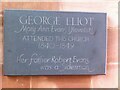
George Eliot Mary Ann Evans (novelist) attended this church 1840-1849. Her father Robert Evans was a Sidesman.
Holy Trinity Church, Priory Row, Coventry, United Kingdom

The University of Warwick Art Collection. Laura Ford Days of Judgement (Cat 1) Bronze 2012. From an edition of 5 purchased by the University, 2015. The use of large-scale animal figures, or people dressed as animals, is a strong element in Laura Ford's work; she uses these to create surreal and haunting representations of human emotions and frailties. This cat is one of a group of seven. Their different poses are inspired by the figures of Adam and Eve in a fresco by the Renaissance artist Masaccio called The Expulsion from the Garden of Eden painted in 1427. Here the single cat appears preoccupied with its own thoughts and anxieties, pacing, oblivious to the world around it.
University of Warwick, Coventry, United Kingdom

10 and 10A Hay Lane. A 16th Century timber framed merchant's house with red brick frontage. Added in the 19th Century No9 is an early 19th Century building with a similar front.
10-10a Hay Lane, Coventry, United Kingdom
Subjects

This stone commemorates the opening of the Belgrade Theatre by Her Royal Highness The Duchess of Kent 27 March 1958. In the presence of the Right Worshipful the Lord Mayor of Coventry Alderman Mrs Pearl Hyde MBE JP. [full inscription unknown]
Belgrade Theatre, Belgrade Square, Coventry, United Kingdom

This foundation stone was laid by Sir Laurence Olivier first director of the National Theatre on the 20th day of March 1965.
Belgrade Theatre, Belgrade Square, Coventry, United Kingdom

The Belgrade Theatre Trust gratefully acknowledge the grant given by the West Midlands County Council for the refurbishment of the lower foyer. Opened on 8th January 1985 by Councillor B.V. Smith West Midlands County Council.
Belgrade Theatre, Belgrade Square, Coventry, United Kingdom
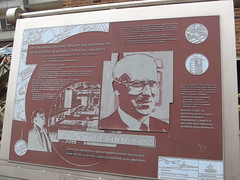
Sir Donald Gibson CBE Gibson was regarded as a pioneer modern architect and his work made him one of the most influential architects of his generation. 'He was ahead of his time. What he did astonished the world. Coventry desperately needed his inspiration' Gibson, Sir Donald Evelyn Edward, C.B.E., D.C.L., M.A., P.P.R.I.B.A., D.I.S.T., T.P., M.T.P.I., T.P.I. Born 11th October 1908, Died December 1991 Gibson was Coventry's first City Architect. He was regarded as a pioneer modern architect and his work made him one of the most influential architects of his generation. He may never have the chance to put his ideas into action, but for the terrible bombing. Within a fortnight of the November 1940 Blitz of Coventry, the City Council had set up a re-development committee and along with powerful allies and devoted members were able to begin the drive to rebuild the city. Gibson was the sort of genius who wanted to throw off sparks of imagination and his ideas. He was way ahead of his time, what he did was astonishing and Coventry desperately needed his inspiration. Many people thought that his ideas would sweep away too much of the old city, but his ideas encompassed old details amongst the open spaces and uncluttered views of his new vision. The alignment of the shopping precinct with the cathedral spire was a moment of inspiration that was to be copied by other cities worldwide. Gibson achieved many firsts as the City Architect. Apart from the first pedestrian precinct there was the first rooftop parking, the first postwar civic theatre, the circular retail market and experimental building methods. Planners and architects all around the world came to see what was happening in Coventry. Characteristically Gibson was prepared to acknowledge the fact that given his time again he might do some things differently. "If you cannot put up buildings of your own time, you might as well forget it. A town must live, you cannot wait until fashions change" In 1955 Sir Donald left Coventry, this meant that his personal vision was never completed. He became County Architect in Nottinghamshire, where he worked on radical new building techniques. Gibson went on to a Knighthood and became in effect the government's senior architect, raising architectural standards during his tenure. However it is for his pioneering work in Coventry that he will be best remembered. It made him one of the most influential architects of his generation.
Upper Precinct Mall, Coventry, United Kingdom
Subjects

B2 opened by HRH The Earl of Wessex KG KCVO 4 February 2008. Following the redevelopment of the Belgrade Theatre in 2004-07.
Belgrade Theatre, Belgrade Square, Coventry, United Kingdom

Incorporated within the original 1958 building, the Chandeliers were designed by German artist Bernard Shottlander. The commission reflected Coventry's commitment to peace and reconciliation across Europe. The refurbishment of the chandeliers in 2007 was made possible with funding from The Alan Higgs Charity.
Belgrade Theatre, Belgrade Square, Coventry, United Kingdom

City of Coventry Stivichall An animal pound existed here before 1663. To mark the restoration by Coventry Civic Amenity Society this plaque was unveiled by Councillor JD Berry Chairman of the Planning Committee. November 1975
Stivichall Animal Pound, Coat Of Arms Bridge Road, Coventry, United Kingdom
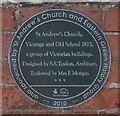
St Andrew's Church, Vicarage and Old School 1875, a group of Victorian buildings. Designed by S.S. Teulon, Architect. Endowed by Mrs. E. Morgan.
St Andrews Church, Church Lane, Coventry, United Kingdom
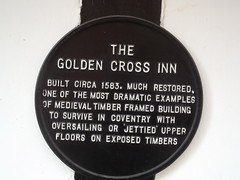
The Golden Cross Inn. Built circa 1583. Much restored, one of the most dramatic examples of medieval timber framed buildings to survive in Coventry with oversailing or 'jettied' upper floors on exposed timbers.
Bayley Lane, Coventry, United Kingdom
Subjects

Foundation stone laid by Ben Moules F.R.I.C.S 26th September 1968. Architects: Hellberg Harris & Partners. Builder: A.G. Gale & Co Ltd.
New Union Street, Coventry, United Kingdom

Cheylesmore Manor. Dating from the 13th century much altered and rebuilt in the 14th, 15th and 16th centuries. The remains of the manor and gatehouse were extensively restored 1965-1968 and a new wing added to provide offices for the city registrar. Built for the earls of Chester it passed to Queen Isabella, wife of Edward II, and later in 1338 to her grandson Edward the black prince. Both of whom were instrumental in Coventry's early municipal history.
New Union Street, Coventry, United Kingdom
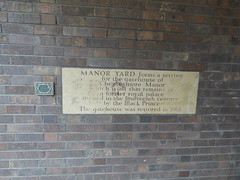
Manor Yard forms a setting for the gatehouse of Cheylesmore Manor which is all that remains of a former royal palace owned in the fourteenth century by the Black Prince. The gatehouse was restored in 1968.
Manor Yard near New Union Street, Coventry, United Kingdom
Subjects


Cheylesmore Manor House A manor house at Cheylesmore is first mentioned in the year 1250. In 1320 it passed to Queen Isabella. wife of Edward II. and from her to her grandson, the Black Prince. In 1385 the royal manor was enclosed within the city walls, then under construction. In the 16th century Leland wrote, "the King has a palace at Coventry now somewhat in ruin. The great hall was said to be down. In 1661 its other buildings were repaired by Sir Robert Townsend. In 1738 a weaver asked permission to make a tenement of one of them! In 1955 most of the South wing, which had become a range of industrial top-shops, was demolished. In 1965 Coventry Corporation undertook restoration of the gatehouse and the surviving bays of the north and South wings. The work. completed in 1968. revealed important historical features. For example. the south wing probably belongs to the original manor house of the 13th century: the ogee-headed doorway (on right) is an original entrance into the manor grounds from the Grey-Friars Monastery of which only the church steeple still stands: the open timber roofs had scarcely been altered since they were built; and of the original framework enough had survived to assure authentic restoration.
Coventry Register Office, Manor House Drive, Coventry, United Kingdom
Subjects

The College of Bablake and Bond's Hospital. The site of collegiate buildings of the Church of St John since 1344. The 14th century priests quarters were remodelled in 1560 as a boys hospital and later as a boys school which remained until 1890 when Bablake School transfered to new buildings in Coundon Road. Bond's or Bablake Hospital was endowed by the will of Thomas Bond in 1506. Much restored in 1832-34 it still provides a home for the elderly
Lower Hill Street, Spon End, Coventry, United Kingdom
Subjects

This plaque was unveiled by Mr Vladven V. Kolesnikov, interim chair of Volgograd city Duma and councillor Abdul Salam Khan J.P, deputy leader of Coventry City Council , in the presence of the right worshipful the lord mayor of Coventry, councillor Linda Bigham, on Saturday 9 November 2019 to mark the 75th anniversary of the continuing friendship between Volgograd and Coventry. A friendship born out of the suffering of both cities during wartime and now devoted to promoting international understanding and peace. This space and Volgograd Place, dedicated on Saturday 25 November 1972 in the presence of Mikhall Zolotaryov and the right worshipful the lord mayor of Coventry, councillor Wifred Spencer are places to pause and remember the importance of friendship, peace and understanding.
Trinity Street, Coventry, United Kingdom
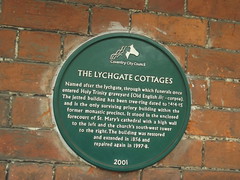
The Lychgate Cottages. Named after the lychgate, through which funerals once entered Holy Trinity graveyard (Old English lic, corpse). The jetted building has been tree-ring dated to 1414-15 and is the only surviving priory building within the former monastic precinct. It stood in the enclosed forecourt of St Mary's cathedral with a high wall to the left and the church's south-west tower to the right. The building was restored and extended in 1856 and repaired again in 1997-8.
Priory Row, Coventry, United Kingdom
Subjects
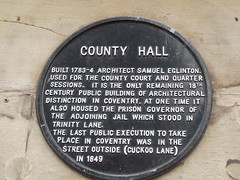
County Hall. Built 1783-4 architect Samuel Eglinton used for the County Court and Quarter Sessions. It is the only remaining 18th Century public building of architectural distinction in Coventry. At one time it also housed the prison Governor of the adjoining jail which stood in Trinity Lane. The last public execution to take place in Coventry was in the street outside (Cuckoo Lane) in 1849.
Cuckoo Lane, Coventry, United Kingdom
Subjects
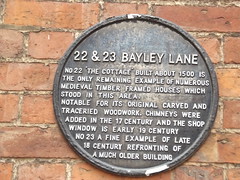
22 & 23 Bayley Lane No 22 "The Cottage" built about 1500 is the only remaining example of numerous medieval timber framed houses which stood in this area. Notable for its original carved and traceried woodwork. Chimneys were added in the 17th century and the shop window is early 19th century. No 23 is a fine example of late 18th century refronting of a much older building.
22 and 23 Bayley Lane, Coventry, United Kingdom
Subjects

"He rode into the canal , got out and jumped back in to get his bike"
Canal Bridge No.4 , Stoney Stanton Road, Coventry, United Kingdom

The Edge Mural Project 1998. Made by the pupils of Edgewick Park and Sydney Stringer Schools with artists Krishnakumar Alageswaren and Naida Hussain. Funded by ReTexs Coventry City Directorate. People discs made by children from St Barnabas, Eagle Street and Yardley Street Youth Centres with artist Kate Turner.
Foleshill Road, Coventry, United Kingdom

Holy Trinity Church. Constructed during the 13th and 15th centuries on the site of a Norman building as the parish church for the priors half of Coventry. The spire, height 237 feet (72 metres) was rebuilt in 1667 after the original was blown down. Extensive restoration and a new west front were completed in 1849 by R.C. Hussey. The interior was restored in 1855 by Gilbert Scott.
Holy Trinity Church, Priory Row, Coventry, United Kingdom
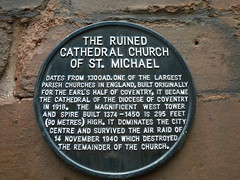
The ruined cathedral Church of St Michael. Dates from 1300AD. One of the largest parish churches in England, built originally for the Earl's half of Coventry, it became the cathedral of the Diocese of Coventry in 1918. The magnificent west tower and spire built in 1374-1450 is 295 feet (90 metres) high. It dominates the city centre and survived the air raid of 14 November 1940 which destroyed the remainder of the church
St Michael's Avenue, Coventry, United Kingdom
Subjects
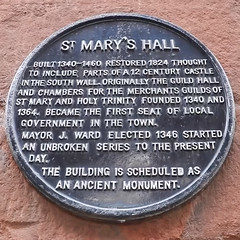
St Mary's Hall. Built 1340-1460 restored 1824 thought to include parts of a 12 century castle in the south wall. Originally the guild hall and chambers for the Merchants Guilds of St Mary and Holy Trinity founded 1340 and 1364. Became the first seat of local government int eh town. Mayor J. Ward elected 1346 started an unbroken series to the present day. The building is scheduled as an ancient monument
Bayley Lane, Coventry, United Kingdom
Subjects

Draper's Hall. Built 1832 with an east wing added 1864. The third hall on this site since 1637 for the Drapers Company, formed in 1247. Neoclassical Greek style by architects T. Rickman and H. Hutchinson. With a fine interior in Grecian decorative moulded plasterwork
St Mary Street, Coventry, United Kingdom
Subjects

The Charterhouse The Carthusian priory of St. Anne was founded in 1381and King Richard II laid the foundation stone in 1385. The Carthusians originated in Chartreuse in France, hence the name Charterhouse given to their monasteries. Unlike most monks, Carthusians were a “silent” order, only speaking to one another on special occasions. They lived alone in their cells, which were small two storey, detached houses. Twelve cells were located on the other side of the building around a courtyard or cloister in what is now the garden. The cells were demolished in the period after 1539 when Henry VIII closed the priory and evicted the monks (the Dissolution) The stone building contained the monks’ refectory (left) and the priors’ lodgings (right). The timber-framed end was probably added in the sixteenth century after the building became a. private house. One of the treasures is the lower part of a wall painting that dominated the refectory. It was probably finished about 1471 soon after the building was constructed and depicts the crucifixion of Christ. The church was situated in the open ground immediately to the left, but was also demolished in the Dissolution. Its plan was revealed in the excavations (1984-7) but these were reburied and cannot be seen. Coventry City Council 2008
London Road, Coventry, United Kingdom
Subjects

St Anne's Chapel and Bisseley, later Shortley The lost medieval village of Bisseley, later called Shortley, lay somewhere not far from here in the 12th century Bisseley Mill a water com mill was located about 100 yards upstream of the Sherboume bridge. Later known as Charterhouse Mill, it was not demolished until the 1930s. Part of the village may lie under the Charterhouse and its grounds. The medieval chapel of St Anne's stood in the field between the London road and the. Sherboume. Its origins are obscure, but in 1393 it was described as a chapel with a house entirely surrounded by water, perhaps a moat fed by the Sherbourne. It belonged to the Trinity Guild, who leased it to the Charterhouse in the early 16th century. The chapel was confiscated and sold by the Crown in 1546. The lower part of the field near the river retained the name St Anne's Grove into the 19th century. In. 1733 it contained a dyehouse, possibly the converted chapel, out by 1820 it had disappeared. The best preserved medieval boundary wall in Coventry runs around the north and east sides of the Charterhouse precinct. At this end, close by the bridge, siged an ancient house, built partly on the wall it survived into the mid-19th century and was perhaps where the Charterhouse's gatekeeper lived.
The Charterhouse, London Road, Coventry, United Kingdom
Subjects

Medieval Ruin Possibly late 13th century sandstone building revealed during wartime bombing. Some 13th & 14th century pottery was found when the site was excavated in 1971, but archaeologists have not been able to discover it's origins or purpose. It may have been a merchants house or possibly linked in some way with nearby Whitefriars Priory.
Much Park Street, Coventry, United Kingdom

Godiva, Lady of Coventry (died 10th September 1067) and her husband Leofric, Earl of Mercia (died 28th September 1057) were buried here in the church of Benedictine monastery they founded in 1043 on the site of St Osburg's nunnery, sacked by the Danes in 1016. The Saxon church, which became Coventry's first Cathedral in 1102, was replaced in the 13th century by a great church, destroyed at the Dissolution in 1539. The remains of the west end are here exposed to view: vestiges of the east and adjoin the present cathedral. No traces of the Saxon buildings have yet been discovered.
3-5 Priory Row - Priory Gardens, Coventry, United Kingdom
Subjects

This stone was unveiled by the Lord Mayor of Coventry Councillor William McKernan on 7th September 1985 to commemorate the 600th anniversary of the founding of Charterhouse
Charterhouse, London Road, Coventry, United Kingdom
Subjects


Swift Quinton Works. Originally the office block of S. & B. Gorton's Cycle Works, built in 1890 (Quinton Cycle Company 1891, New Beeston Cycle Company 1896). Under the motor entrepreneur, Harry J. Lawson, the latter company produced a 11/4 - hp motor tricycle here in August 1896, the only British-built entry in the London to Brighton 'Emancipation Run' that November. Along with the Daimler wagonettes assembled at the 'Motor Mills' in 1896, it marks the birth of the British Motor Industry in Coventry. As the Beeston Motor Company, the firm produced cars commercially from 1897-1900. The building then became Rademaker's Chocolate Factory until 1905 and the Swift Motor Company Works until 1931. It was restored and adapted for use as an hotel in 1998-99.
Parkside, Coventry, United Kingdom
Subjects

1959-1970. Tocil Farm. This is the site of Tocil Farm, which was worked by and happy home to the Clayton family. William, Minnie, Peter, Marion, David and Reg.
Warwick University, Coventry, United Kingdom

This stone is laid to the glory of God by Councillor H. Weston October 23rd 1954.
210 Ansty Road, Coventry, Coventry, United Kingdom