
Thomas Chatterton

Thomas Chatterton
(1752-1770)
Died aged c. 18
Wikidata WikipediaThomas Chatterton was one of the greatest literary geniuses that Britain has ever produced. Born three months after his father’s untimely death, the young boy attended Pile Street Charity School (established 1738), a charitable institution that took in poor boys. It was here that young Thomas met like-minded youths who wrote poetry for local magazines. He also spent many hours exploring every part of St Mary Redcliffe, Bristol, where his uncle served as Sexton (effectively the graveyard supervisor!). It seems he was particularly fascinated by William Canynges and by the chests of documents in the muniments room (situated above the north porch, now known as the "Chatterton Room"). Chatterton's experiences in the church undoubtedly fired the boy's imagination and stimulated his natural creative writing genius. He enthusiastically investigated every aspect of medieval life in Redcliffe and imagined every detail of the life and home of William Canynges, the great merchant benefactor who helped fund the building of the present church. All of this prompted his detailed dramatizations of the Canynges family and life in its household life and these an others of his imaginative writings, often under the pseudonym “Thomas Rowley”, were probably written in the “Chatterton Room”. His love of poetry continued after he left school at the age of 14, and started work at a local company, copying legal documents but spending his free time writing. He had a number of items published and was becoming an increasingly successful author when he chose to move to London and concentrate further on his writing career in the capital. He invited many of his friends and associates to St Mary Redcliffe for a farewell gathering to wish him well, serving them gingerbreads, one of his favourite food treats.Chatterton also had considerable interest in music. He wrote a Burletta called "The Revenge" for which he was paid five guineas. It was intended to be played at Marylebone Gardens in London but there are no records of the performance or of the piece itself. Chatterton himself, as a subject, inspired many musicals and operas throughout Europe.As was common at the time, Chatterton had contracted a sexually transmitted disease. He was taking medically prescribed substances (arsenic and opium!) which we now understand to be dangerous and potentially fatal if taken long term or with other risky substances, like alcohol. It was a mix of an accidental overdose of these drugs, together with alcohol, that led to his early and tragic accidental death, at the age of just 17 and at a time when his writing career was blossoming to a greater extent than ever before.
OpenPlaques
Family tree
Commemorated on 3 plaques
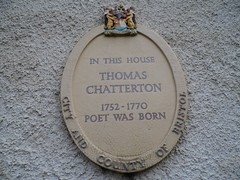
In this house Thomas Chatterton 1752-1770 poet was born
St Thomas Street, Bristol, United Kingdom where they was born (1752)
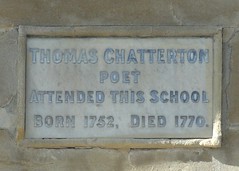
Thomas Chatterton poet attended this school, born 1752, died 1770.
Redcliffe Way, Bristol, United Kingdom where they attended school
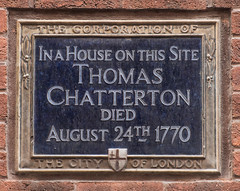
In a house on this site Thomas Chatterton died August 24th 1770
39 Brooke Street, EC1, London, United Kingdom where they died (1770)