
Commemorated on 9 plaques


Martin Luther King, Jr.. King lived three years in this community and ministered under the mentorship of J. Pius Barbour. He graduated from Crozer Theological Seminary, 1951. A leader of the 1963 March on Washington, King won a Nobel Peace Prize, 1964.
Calvary Baptist Church, 1616 W. 2nd St. (PA 291), at Baker St., Chester, PA, United States where they was
Martin Luther King, Jr.. Minister & civil rights leader. Here at Crozer Theological Seminary, he earned his Bachelor of Divinity degree, 1951. King's three years here were a key period in shaping his philosophy of nonviolent social change. Awarded the Nobel Peace Prize, 1964.
Crozer-Chester Medical Center, One Medical Center Blvd., behind parking lot, at Old Main, Upland, PA, United States where they was

Freedom Now Rally. On August 3, 1965, Dr. Martin Luther King addressed a crowd of 10,000 at this intersection. His "Freedom Now" tour to Philadelphia, Chicago, Cleveland, and Boston was in gratitude for support given to his Southern Christian Leadership Conference. King brought his message into northern Black neighborhoods, supporting local civil rights efforts and raising funds. His goal was to empower the formation of a coalition to address their common concerns.
intersection of 40th St., Lancaster Ave., and Haverford Ave., Philadelphia, PA, United States where they was
Kentucky Historical Marker #1657
Zion Baptist Church. Congregation was organized by 18 blacks in Aug., 1878. First church on Center Street, 1882; present church bought in 1927. Notable pastors have been W. H. Craighead, D. E. King, A. D. Wms. King (brother of Dr. Martin Luther King, Jr.) and H. D. Cockerham. Zion was base for local and state civil rights activities; Ky. Christian Leadership Conference office was in adjoining building.
22nd & Walnut Sts., Louisville, KY, United States where they was
Kentucky Historical Marker #1693
Green Street Baptist Church. This church was constituted on Green Street, Sept. 29, 1844, with Brother George Wells as pastor. A noted trustee and treasurer was Ben Duke, who lived to age 110. Present church built 1930 by Samuel Plato under pastorate of H. W. Jones. Scene of August 1967 rally led by Dr. Martin Luther King, Jr., to promote voter registration. Presented by Mr. Till Lecian.
519 East Gray St., Louisville, KY, United States where they was
North Carolina Highway Historical Marker #E-112
Martin Luther King Jr. 1929 1968. In his speech, Nov. 27, 1962, in gym 200 yards S.E., civil rights leader delivered refrain "I have a dream," used in Lincoln Memorial address, 1963.
Atlantic Avenue at Spruce Street, Rocky Mount, NC, United States where they was
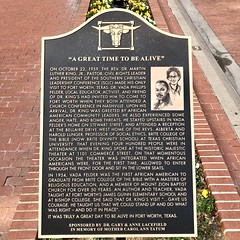
"A Great Time to Be Alive" On October 22, 1959, The Rev. Dr. Martin Luther King, Jr., pastor, civil rights leader and president of the Southern Christian Leadership Conference (SCLC) made his only visit to Fort Worth, Texas. Dr. Vada Phillips Felder, local educator, activist, and friend of Dr. King’s had invited him to Fort Worth when they both attended a church conference in Nashville. Upon his arrival, Dr. King was greeted by African American community leaders. He also experienced some anger, hate and bomb threats. He stayed upstairs in Vada Felder’s home on Stewart Street, and attended a reception at the Bellaire Drive West home of the Revs. Alberta and Harold Lunger, Professor of Social Ethics, Brite College of the Bible (now Brite Divinity School) at Texas Christian University. That evening four hundred people were in attendance when Dr. King spoke at the historic Majestic Theater at 1101 Commerce Street. On that occasion the theater was integrated when African Americans were, for the first time, allowed to enter through the front door and sit in the lower seats. In 1954 Vada Felder was the first African American to graduate from Brite College of the Bible with a Masters of Religious Education. She was a member of Mount Zion Baptist Church for over 50 years, authored Christian Education materials, founded and operated United Christian Leadership School, and taught in Fort Worth’s James Guinn Elementary School and at Bishop College. She said that Dr. King’s visit “…gave us courage. He taught us that we could stand up and do what was right – and do it in peace”. It was truly a great day to be alive in Fort Worth, Texas Sponsored by Dr. Gary & Anne Lacefield in memory of mother Carol Ann Tatum
Main Street, Fort Worth, TX, United States where they was

Carousel on the Mall, Washington D.C. On August 28, 1963, Rev. Dr. Martin Luther King, Jr., delivered his “I have a Dream” speech on the steps of the Lincoln Memorial, not far from here. On that same day, this carousel was part of a small but significant victory for Civil Rights about 40 miles away, as segregation ended at Baltimore’s Gwynn Oak Amusement Park after nearly a decade of protests there. The first African American child to go on a ride at Gwynn Oak that day was 11-month-old Sharon Langley. With her father Charles Langley, Jr., by her side, she took a spin on the park’s carousel, as news reporters snapped photos, In 1981 the Gwynn Oak carousel S.N. 105948, a classic, built by the Allan Herschell Co., was relocated here to the National Mall, where it has always been open to everyone and stands as a symbol of the harmony of which Dr. King dreamed.
The Mall, Washington, DC, United States where they was

The first sermon on British soil by The Reverend Dr Martin Luther King 1929–1968 was preached here at Bloomsbury Central Baptist Church in October 1961
235 Shaftesbury Avenue, London, United Kingdom where they was (1961)