
Gender Diversity
The top 10


Texas Historical Marker #16942
First United Methodist Church. #16942
800 West 5th, Fort Worth, TX, United States

Fort Worth Stockyards Horse and Mule Barns. The Fort Worth Stock Yard Company's wooden horse and mule barns on this site were destroyed by fire on March 14, 1911, opening day of the Feeders and Breeders show (later Southwestern Exposition & Fat Stock Show). The show opened as planned, with former President Theodore Roosevelt giving the opening address. The company announced plans to replace the destroyed barns immediately with new concrete and steel fireproof buildings. Construction was completed in March 1912, and the new barns measuring 540'x350' had a capacity for 3000 animals. With a price tag of $300,000, the buildings were described as among the finest stables in the world. Activity here increased considerably in 1914, at the outbreak of World War I. Horses and mules were needed in great supply by European armies, and agents were sent in droves to Fort Worth to buy stock, spending an estimated $11 million. During that time, Fort Worth was designated the largest horse and mule market in the world. The wide space between the buildings has over the years spawned the nickname "Mule Alley". In recent years the barns have been used for various cultural activities and annual events. Texas Sesquicentennial 1836-1986. (Note: this sign is worded the same as a different marker located on the other side of the building)
521 E Exchange Ave, Fort Worth, TX, United States
Texas Historical Marker #17355
University United Methodist Church. #17355
2416 W. Berry Street, Fort Worth, TX, United States
Subjects
Texas Historical Marker #00253
Ayres Cemetery. In 1861 Benjamin Patton Ayres (ca. 1801-62) and his wife, Emily (Cozart) (ca. 1811-63), bought a 320-acre farm and set aside two acres on this hillside as a family cemetery. Ayres, who had served as the second Tarrant County clerk and who helped organize the Fort Worth First Christian Church, was the first buried here. An unknown number of graves, which lie outside the fenced family plot, include victims of spring fevers and Trinity River floods. None of their headstones have survived, but the Ayres Cemetery remains as a symbol of the area's early settlers. (1984) #253
2500 block Scott St., Fort Worth, TX, United States
Texas Historical Marker #05833
William John Marsh. Born near Liverpool, England, William John Marsh was an accomplished organist and musician when he came to Fort Worth in 1904 to enter the cotton business. In addition to his bookkeeping work, he served as organist and choirmaster for two area churches and one synagogue, and as choral director and professor of organ at Texas Christian University. He also composed over 100 pieces of music. In 1929, his composition "Texas, our Texas" won in competition to become the official state song. March died in Fort Worth at the age of 90. #5833
3400 White Settlement Rd., in Greenwood Cemetery, Fort Worth, TX, United States
Texas Historical Marker #00124
Allen Chapel A.M.E. Church. This Tudor Gothic Revival sanctuary was constructed between 1912 and 1914, during the pastorate of the Rev. R.S. Jenkins, for the congregation of Allen Chapel A.M.E. Church. Designed by black architect William Sidney Pittman, who was a son-in-law of Booker T. Washington, the church building is representative of those erected by large black congregations in southern urban areas. Elements of the modified Gothic style are particularly visible in its tower and stained glass windows. Recorded Texas Historic Landmark- 1983. #124
116 Elm Street, Fort Worth, TX, United States
Texas Historical Marker #05864
Winfield Garage. By 1919 Fort Worth had become a booming commercial center because of the oil and cattle markets. To accommodate this growth, the Winfield Garage was opened in April 1920 and operated a livery service with 25 touring cars and limousines. Designed by the architectural firm of Sanguinet & Staats to park 325 vehicles, it was called the largest and most modern in the state. The garage hosted the city's first annual auto show, which attracted about 50,000 visitors. Later the facility housed other businesses related to the auto industry. #5864
206 E. 8th St., Fort Worth, TX, United States
Texas Historical Marker #00153
Amon Carter Riverside High School and Riverside ISD. A community school system known as Trinity Bend existed as early as 1876 in what is now the Riverside neighborhood of Fort Worth. Classes were held in a one-room schoolhouse built by Dr. Eagle, a retired physician. The Pendleton District was created for this area in 1884, and the name Riverside was adopted fifteen years later. After the City of Fort Worth annexed the Riverside Community in 1922, the school became part of the Fort Worth educational system. In 1941 the school at this site was named for Fort Worth businessman and philanthropist Amon G. Carter. (1983) #153
3301 Yucca Ave., Fort Worth, TX, United States
Texas Historical Marker #05910
Worth, Gen. William Jenkins. N/A #5910
?, Fort Worth, TX, United States
Texas Historical Marker #00200
Arlington Heights Lodge No. 1184, A.F. and A.M. Chartered on December 9, 1921, Arlington Heights Lodge No. 1184 is located on land donated by Lodge members W.C. Stonestreet and F.H. Sparrow. This building, designed by Lodge member John C. Davies (1885-1963), was dedicated January 3, 1923. The Classical Revival structure with strong Greek temple influence features pedimented gables, brick pilasters with stone capitals, round-arch upper windows and entry, stone motif details, and art glass transoms. Recorded Texas Historic Landmark-1987. #200
4600 Camp Bowie Blvd., Fort Worth, TX, United States

Texas Historical Marker #00229
Atelier Building. Developer Thomas S. Weaver had this structure built about 1905. Named "Atelier", the French word for an artist's studio, it has housed the offices of architects and contractors, a restaurant, and financial institutions, including the banking firm of W.R. Edrington, a noted Fort Worth benefactor. In 1936 the building served as the temporary location of the Carnegie Library. Built of brick, it features two chimneys with terra cotta ornamentation. Recorded Texas Historic Landmark-1980. #229
209 W. 8th, Fort Worth, TX, United States
Texas Historical Marker #00374
Benton House. Victorian Gingerbread Cottage. Erected by pioneer businessman Meredith A. Benton in 1898, when the 4-lot site was "out in the country," and young Mrs. Benton (formerly of St. Louis) feared the Wild West. Designed by builder's father, house has central hall, six rooms, tiled fireplaces. Mrs. Benton, an active civic worker, helped plant rose beds that now are part of famous Fort Worth Botanic Gardens. Benton family lived here until 1942. Recorded Texas Historic Landmark- 1971. Marked by Junior League of Fort Worth. #374
1730 Sixth Ave., Fort Worth, TX, United States
Texas Historical Marker #12917
St. Andrews United Methodist Church of Fort Worth. St. Andrews United Methodist Church of Fort Worth In 1888, under the leadership of the Rev. James W. Moore, 15 men and women organized the St. Andrews Methodist Episcopal Church. The church rehabilitated a building on Ninth Street and within a decade had a parsonage for its minister. Church programs, including a youth ministry, grew, and the congregation bought a larger structure on Rosedale, offering space for Southside Public School to hold classes. At the beginning of the 20th century, the congregation purchased a new parsonage and organized a Ladies Aid Society. The society's first president was Gracie Echols; she and the women's group worked to furnish the parsonage and raise funds for the ever-growing church, which continued to need room for expansion. Other fund-raising efforts included church bazaars, and the congregation added pews, pipe organ and pulpit furniture. In 1950, St. Andrews Methodist Church purchased the Missouri Avenue Methodist Church building, designed in 1904 by acclaimed Dallas architect James E. Flanders. The St. Andrews congregation held its first services in the yellow brick church in 1951. Over the years, church members have been strong supporters of education in the community and, early on, church facilities provided classroom space for an early black public school. A longtime minister and leader of the church, the Rev. Leonard L. Haynes, became the first African American to serve on the Tarrant County Junior College Board of Trustees, as it began its integration process in the mid to late 1960s. Church members have served as principals, nurses, doctors and civil rights leaders in Fort Worth. The congregation became the St. Andrews United Methodist Church in 1972, when churches nationwide merged into the United Methodist Church. With more than 100 years of service, St. Andrews has led its community through education, music, mission and worship. #12917
522 Missouri Ave, Fort Worth, TX, United States
Texas Historical Marker #00550
Bryce Building. Leading Fort Worth businessman and civic leader William J. Bryce (1861-1944) built this structure in 1910 to house the offices of his construction company. Bryce erected many of the city's commercial structures and served as Mayor of Fort Worth from 1927 to 1933. The Bryce Building, with its irregulare five-sided plan, is a fine example of the adaption of the Classical Revival style to a commercial structure. Recorded Texas Historic Landmark- 1983. #550
909 Throckmorton, Fort Worth, TX, United States
Texas Historical Marker #00572
Burke Cemetery. The first known burial in this graveyard was that of Mary (Overton) Burke, widow of Evan H. Burke, who came in 1851 with her children and widowed mother to settle this land previously chosen by her husband. Her death on Dec. 30, 1867, was followed two days later by that of her mother, Rachel (Cameron) Overton. On Mar. 12, 1900, this one-half acre of land was deeded as a family burial ground. Relatives of the Burkes include members of the Magers, Overton, and Edwards families. More than 100 marked and several unmarked graves have been recorded here. (1984) #572
Bryant Irvine Rd., Fort Worth, TX, United States
Texas Historical Marker #00806
Chapin School. The Chapin School was begun for Marys Creek Community in the late 1870s in a log cabin on land deeded by Ivory H. Chapin (2 mi. SE). In 1884 the school was moved one mile west to a 2-room frame house on Mary's Creek on land donated by J. Fielding Dunlap (.5 Mi. S). It was moved again in 1936, to a rock structure on Chapin Road. In 1961, the Fort Worth Independent School District annexed the Chapin Common School District. Chapin School continued to be used for an elementary school, however, until 1968, when it closed. #806
US 80, just E. of Mary's Creek Bridge, Fort Worth, TX, United States

Texas Historical Marker #00825
Chase Court. When E.E. Chase purchased the property that is now known as Chase Court, the area was some distance from the City of Fort Worth. Chase, a business man and investor, built a house in the center of the court and raised horses on his land. In 1900 his home was moved to what became lot No. 4 in 1906, when the property was bought and subdivided by the Consolidated Improvement and Construction Company of Fort Worth. Throughout its history, the neighborhood has been the home of many distinguished Fort Worth businessmen and professionals. (1984) #825
1700 block Hemphill, Fort Worth, TX, United States
Texas Historical Marker #00925
Cobb-Burney House. Prominently sited along the bluff of the Clear Fork of the Trinity River, this home was built in 1904 for mortgage company president Lyman D. Cobb and his wife, Emma. Emma Cobb sold the home in 1919 to Judge Ivy Burney, a lawyer whose special field was the cattle industry. The low-pitched roof, wide overhanging eaves, and use of multiple casement windows reflect influences of the Chicago Prairie School style of architecture. Recorded Texas Historic Landmark-1985. #925
1598 Sunset Terrace, Fort Worth, TX, United States
Texas Historical Marker #01269
Dr. George M. Munchus House. This Craftsman style house was constructed in 1922 for Dr. George Murry Munchus (1887-1952) by locally prominent black contractor George Powell. The son of former slaves from Alabama, Munchus was founder, manager, and physician for Fort Worth's Negro Community Hospital. The Munchus home is a two-story wood frame residence featuring wide overhanging eaves, stick brackets, and prominent gables. #1269
1130 E. Terrell Ave., Fort Worth, TX, United States
Texas Historical Marker #01455
Elizabeth Boulevard. This Boulevard, named the wife of developer John C. Ryan, was designed as the first phase of a residential district known as Ryan Place. Elaborate entry gates and the first house, the W.T. Fry home at 1112 Elizabeth, were built in 1911. Construction here peaked in 1920 and declined as a result of the economic depression at the end of the decade. The exclusive area was the home of many prominent Fort Worth oilmen and business leaders. Detailing of the elegant houses reflects the variety of architectural styles popular during the early 20th century. (1981) #1455
Page & College Ave., Fort Worth, TX, United States
Texas Historical Marker #04281
Riverside Methodist Church. According to local oral tradition, Riverside Methodist Episcopal Church, South, began in March 1888, when the Rev. C.F. Vance and ten people held Sunday School in an abandoned saloon at E. First and Sylvania Streets. After organizing a congregation,the members bought land at the corner of E. First and Ross Avenue (now Retta) in 1893 and built a frame sanctuary. In its early years, the congregation was served by visiting ministers and by students at Polytechnic College (now Texas Wesleyan University). The church building was moved to the southeast corner of Noble Street and Frey Avenue (now Riverside Drive) in 1907. It continued in use until 1925, when it was replaced by a basement for a new structure. The name of the church was changed in 1924 to Sylvania Heights Methodist Episcopal Church, South, but in 1935 in reverted to its original name when Frey Avenue was renamed Riverside Drive. A sanctuary was completed over the 1925 basement in 1937, and a new facility was built on adjacent lots in 1951. Highway construction and changing neighborhood dynamics led to the Church's relocation to this site in 1982. After a denominational name change in 1968, it became known as Riverside United Methodist Church. #4281
3419 E. Belknap, Fort Worth, TX, United States
Texas Historical Marker #01942
Forest Hill Cemetery. One of the oldest burial grounds in Tarrant County; named for its location and used for many years before record-keeping began. In 1883 landowner J.W. Chapman deeded the property to Forest Hill Cumberland Presbyterian Church. ("Cumberland" was later dropped from the name.) Among the many interments of pioneers were Press and Jane Farmer, who lived at site of Fort Worth before the U.S. Army established the Fort in 1849. The cemetery is full although few headstones are visible, as most graves were unmarked or marked with field stones that have since disappeared. (1974) #1942
5713 Forest Hill Dr., Fort Worth, TX, United States
Texas Historical Marker #02031
Fort Worth Public Market Building. Oklahoma City developer John J. Harden had this commercial structure built in 1930 to provide market space for local farmers, vendors, and retail businesses. Designed by B. Gaylor Noftsger, also of Oklahoma City, it features influences of the Spanish Colonial Revival, Italian Baroque Revival, and Art Deco styles. The public market remained in operation until 1941 and the building later housed a variety of businesses. Recorded Texas Historic Landmark -1980. #2031
1400 Henderson, Fort Worth, TX, United States
Texas Historical Marker #02150
George B. Monnig House. Fort Worth merchant George B. Monnig (1869-1919) and his wife, Lura (1870-1948), acquired this property in 1905 and built a two-story frame house here. In 1909, a neighborhood fire destroyed that house, and the Monnigs replaced it with this tile-roofed brick structure in 1910. Its design details, executed in corbelled brick, milled wood, and cut limestone, reflect a blend of Bungalow and Arts-and-Crafts styles. Lura remarried and moved by 1923, and the family sold the house in 1947. Recorded Texas Historic Landmark-1986. #2150
115 W. Broadway, Fort Worth, TX, United States
Texas Historical Marker #02184
Gibson Cemetery. In 1853 Garrett and James Gibson, along with other family members, came to Tarrant County and established 160-acre homesteads in a settlement that came to be known as the Gibson Community. Each brother donated land at this site for use as a cemetery. The earliest marked grave is that of Garrett Gibson's infant grandson, James Truitt (d. 1866). All but two of the seventy-three marked graves, many of which have only fieldstones, are for relatives of the Gibson family. The cemetery now serves as a reminder of one of Tarrant County's earliest settlements. (1983) #2184
7420 Gibson Cemetery Court, Fort Worth, TX, United States
Texas Historical Marker #02250
Grand United Order of Odd Fellows, Lodge No. 2144. Organized in 1880, the fraternal organization was an active force in Fort Worth's black community during the early years of the twentieth century. Associated with a national order that had been charted in 1843, the local lodge supported various charities and conducted seminars and professional business training sessions. Lodge members built this structure in 1926 and held their meetings on the second floor until they disbanded in 1937. It stands as one of the few reminders of the original black business district in Fort Worth. (1984) #2250
612 Grove, Fort Worth, TX, United States
Texas Historical Marker #02357
Handley United Methodist Church. This congregation was organized in 1877, shortly after the railroad town of Handley was established. The Rev. J.J. Cannafax, who was the first minister, also served as the town's first school teacher. Services were held in the one room schoolhouse until a Union Church was built in 1882. The Methodist congregation shared the building with Baptists, Presbyterians, and other denominations until 1907. The bell at this site is from the Old Union Church. Although Handley now is a part of Fort Worth, the Handley United Methodist Church maintains a rich heritage and tradition of service. (1985) #2357
2924 Handley Dr., Fort Worth, TX, United States

Texas Historical Marker #02394
Harrison Cemetery. When first used, this one-acre cemetery belonged to Tarrant County pioneer D.C. Harrison. The earliest known grave is that of Mary E. Harrison (1864-71). Several early settlers used this site, including R.A. Randol (1850-1922), the operator of Randol Mill, who bought this tract in 1895 and deeded it forever as a burial ground. Graves here number about sixty and include those of the Edward Deason Family, Randol's first wife Ronda (Harrison) (1859-82), his brother John C. Randol, who died in an 1894 mill accident, and Nancy Cannon Harrison (1833-83), mother of Ronda Harrison Randol. (1982) #2394
8551 Meadowbrook Rd., Fort Worth, TX, United States
Texas Historical Marker #02450
Henry M. Williams Home. A native of Georgia, Henry W. Williams (d. 1925) was the founder of the H.W. Williams Wholesale Drug Company and a prominent Fort Worth banker. This Colonial Revival residence was built for him between 1907 and 1909. Notable features include the elaborate portico with Corinthian columns and the wide veranda. Since 1925 it has been the home of several prominent area families whose lifestyles reflected cultural and social values of the community. Recorded Texas Historic Landmark-1982 #2450
4926 Crestline Rd., Fort Worth, TX, United States
Texas Historical Marker #02497
Hitch Cemetery. This cemetery was once part of a large farm owned by Kentucky native William Henry Hitch (1818-1893), who brought his family here from Tennessee in 1855. The oldest grave in the cemetery is that of Haden T. Hitch (1846-1858), son of William H. and Esther Hitch. Besides the graves of Hitch family members, the graveyard also contains the burials of relatives in the Trigg, Liggett, and Martin families, all of whom had moved to Texas at the urging of William H. Hitch. The Hitch Cemetery stands as a visible reminder of those early pioneers. Texas Sesquicentennial 1836-1986. #2497
Kings Port Rd., Fort Worth, TX, United States
Texas Historical Marker #02574
Hotel Texas. In 1919 a group of Fort Worth civic leaders began planning for a hotel that would reflect the city's dynamic growth. Their efforts resulted in construction of the Hotel Texas, which was completed in 1921. Designed under the supervision of Fort Worth architects Sanguinet and Staats, the building features a mixture of styles and elaborate terra cotta detailing. President John F. Kennedy stayed here on the eve of his assassination in 1963. Recorded Texas Historic Landmark-1982. #2574
815 Main St., Fort Worth, TX, United States
Texas Historical Marker #02741
James-Fujita House. Completed in 1915 for Thomas (d. 1935) and Annie James, this home was purchased four years later by Kanetaro Fujita. Fujita served as president of a Japanese cotton exporting firm, the Gosho Company, incorporated in 1917 and dissolved just after the U.S. entry into World War II. In 1936, after Fujita returned to Japan, he sold the home to the company. Prominent features of the James-Fujita house include its gambrel roof and front porch columns and balusters. Recorded Texas Historic Landmark-1986. #2741
2530 College Ave., Fort Worth, TX, United States
Texas Historical Marker #03033
Laneri House. Italian immigrant John B. Laneri moved to Fort Worth in 1883 and became a prominent businessman and civic leader. He founded the O.B. Macaroni Company and started a private boys school unknown as Laneri College. He had this residence built in 1904 in one of the city's most prosperous neighborhoods. The brick structure features classical detailing and fine interior woodwork. Laneri occupied the house until his death in 1935. Recorded Texas Historic Landmark-1982. #3033
902 S. Jennings Ave., Fort Worth, TX, United States
Texas Historical Marker #03035
Lanius House. A native of Bonham, Texas, Clarence Lanius (1880-1947) was a cattleman with ranches in several locations across the state. By 1922 he and his wife, Myrtle (Swecker) (1880-1958), had moved into their new home here in the city's finest residential area in the early 20th century. The Lanius house is a good example of the Bungalow style of architecture popular at the time and features broad overhanging eaves that are somewhat flared. A wide porch and porte-cochere dominate the facade. Recorded Texas Historic Landmark-1985. #3035
2420 W. Adams, Fort Worth, TX, United States
Texas Historical Marker #14340
Baker Funeral Home. After working as a Pullman porter for the Santa Fe Railroad, James Nathan Baker, Sr. decided to open a funeral home in 1917 for Cleburne's African American Community. Licensed as an embalmer in 1922, he operated a funeral home with his mother-in-law, Mattie Gaston Barnes, in their home. In 1926, he and his wife, Ransome Antoinette, moved to Fort Worth and opened a Baker Undertaking Company at this site in a house owned by his father, The Rev. Henry Baker. The Baker Funeral Home continued to grow in the 1930s. After a building expansion, Baker added a community ambulance service in 1932, and his brother opened a third funeral home, in Mineral Wells, in 1935. Together, the three businesses served African Americans throughout the region. In 1938, James Baker founded the Diamond Mutual Burial Association, which helped clients plan for funerals arrangements. During the 1940s, he purchased People's Burial Park. The funeral home was once again remodeled and enlarged. Baker's seven children had always assisted in running the business. He retired in 1967, and after his death in 1970, his son Herbert Victor Baker (d. 1989) became president. Under his leadership, the business continued to grow. Today, Baker Funeral Home is owned and operated by the third and fourth generations of family members who continue to uphold James Baker's commitment to service. A community landmark, the funeral home is a cultural resource, with connections to Fort Worth's historic African American community and its residents, leaders, churches and cemeteries. (2004) #14340
301 E. Rosedale Blvd., Fort Worth, TX, United States
Texas Historical Marker #03224
Marshall R. Sanguinet House. Noted Fort Worth architect Marshall R. Sanguinet (1859-1936) built this Shingle Style house about 1894, incorporating his earlier residence at this site which was damaged by fire. A partner in the prominent statewide architecture firm of Sanguinet and Staats, Marshall Sanguinet was associated with many of the citys early multi-story buildings and with the development of the Arlington Heights subdivision, which included his home. #3224
4729 Collinwood, Fort Worth, TX, United States
Texas Historical Marker #03422
Mitchell Cemetery. Although nearly every trace of this pioneer cemetery has been erased, about twelve burials have been identified through written records. First used in the summer of 1848 for the burial of the 18-month-old son of Peters' Colonist John B. York, the cemetery was named for a later owner of the property, Eli Mitchell. Among the Tarrant County pioneers buried here are John York, who became a County Sheriff, and Seaborne Gilmore, a Mexican War veteran who was Tarrant County's first elected County Judge. The historic cemetery is a significant part of the area's heritage. Sponsored by the North Fort Worth Historical Society. 1984 #3422
NE 28th & Decatur Ave., Fort Worth, TX, United States
Texas Historical Marker #03425
Mitchell-Schoonover House. James E. Mitchell, a jeweler, demanded a high degree of skilled craftsmanship in the construction of this house. Completed in 1907, it was designed by the Fort Worth architectural firm of Sanguinet and Staats. A friend, Dr. Charles B. Simmons, purchased the property in 1920. Ownership of the home was transferred to his daughter Maurine and her husband Dr. Frank Schoonover in 1945. The occupied the residence until 1979. Recorded Texas Historic Landmark- 1979. #3425
600 S. 8th Ave., Fort Worth, TX, United States
.jpg?width=250)
Texas Historical Marker #05167
Swift & Company. A leading national meatpacking firm by the 1880s, Swift & Co. adopted a practice of opening branch plants nearer the source of supply. Attracted to Texas by the State's vast livestock herds, the Company chose this site for a new operation as a result of efforts by the Fort Worth Stock Yards Company. The plant opened in 1903 and soon had a dramatic impact on the economy of the City and the State. It also spawned several support businesses, including a railway company and publishing firm. The Swift plant remained in operation until 1971. #5167
500 block of E. Exchange St., Fort Worth, TX, United States

Texas Historical Marker #04801
Site of Fort Worth-Dallas Interurban. In 1901 the Texas Legislature authorized the Northern Texas Traction Company of Fort Worth to extend rail service to Dallas. The interurban system, powered by overhead electrical lines, was completed one year later. The thirty-five mile trip took just over an hour. Passengers could flag the train and board at any point on the route. Each car held up to forty travelers. Rail traffic began to decline in the 1930s when paved roads were constructed between the two cities, and the last train made the interurban run on Christmas Eve, 1934. (1980) #4801
6604 E. Rosedale,, Fort Worth, TX, United States
Texas Historical Marker #04066
Pollock-Capps House. Built in 1898 for Dr. Joseph R. Pollock (1856-1941), this mansion was sold to William Capps (1858-1925) and wife Sallie (1864-1946), whose family lived here 1909 to 1971. On the grounds were a golf course, tennis court, and a 3-car garage with a ballroom above. This was in a neighborhood lined with Victorian homes of bankers, businessmen, cattlemen, lawyers, physicians,and publishers, and was nicknamed "Quality Hill". #4066
1120 Penn St., Fort Worth, TX, United States
Texas Historical Marker #04441
Saint Ignatius Academy Building. The first Catholic School in Fort Worth, St. Ignatius Academy was organized by the Sisters of St. Mary of Namur in 1885. The first classes were held in a house purchased from Jacob Smith. This four-story limestone structure, used for classrooms and chapel, was completed in 1889. J.J. Kane designed the building, a good example of the Victorian Institutional style. School classes were conducted here until 1962. #4441
1206-12 Throckmorton, Fort Worth, TX, United States
Texas Historical Marker #04565
Sandidge-Walker House. Cattleman George Sandidge (1873-1965) had this house built about 1921 and sold it four years later to Webb and Gussie Walker. Dr. Walker (1886-1962), was appointed city health officer in 1913 and served in that position for seven years. In 1954, Walker sold the house to St. John's Episcopal Church to serve as its rectory. The Sandidge-Walker house features influences of Prairie School style architecture in its horizontal lines and wide eaves. #4565
2420 College Ave., Fort Worth, TX, United States
Subjects
Texas Historical Marker #04630
Second Site of the Old Wayside School. Founded 1883 on site in Dozier community, given by W.E. Boswell. Situated 1898-1948 in 2 successive buildings on land given by A.W. Moore. Now in Eagle Mountain-Saginaw District, which includes W.E. Boswell High School, named in honor of donor of first site. #4630
?, Fort Worth, TX, United States
Texas Historical Marker #04670
Shelton Building. This building was constructed in 1900 for Robert G. Johnson, who was acting on behalf of his wards, the children of Albert D. Evans. It was first leased to G.Y. Smith, who opened the "Daylight Store", a general merchandise establishment. In 1910, after the property was purchased by John M. Shelton, a third floor was added to the original two-story structure. From that same year until 1936 the building was leased to S.H. Kress and Company. Following major architectural remodeling in 1937, the structure was occupied by another variety store, McCrorys. #4670
901 Shelton St., Fort Worth, TX, United States
Texas Historical Marker #14057
Consolidated Vultee Aircraft Corporation Plant No. 4. Prior to WWII, the U.S. aircraft industry focused primarily on producing aircraft for civilian airlines; few manufacturers specialized in military airplane construction. In the fall of 1940, the War Department determined that expected future demand for military aircraft required new defense plants, not just expansion of existing sites. This form of home front industry and the application of its product toward strategic aerial bombing grew grew exponentially as a primary weapon toward defeating an enemy's ability to wage war. Although involved in pilot training, Texas had no large-scale role in aircraft manufacturing at this time. As America recovered from the Great Depression while moving closer to war, the Fort Worth Chamber of Commerce aggressively campaigned Consolidated Vultee Aircraft Corporation (Convair) for a new plant. Their efforts proved successful and groundbreaking ceremonies took place here on April 18, 1941. The Austin Company of Cleveland, Ohio, built Convair Plant No. 4 in less than a year and the first B-24 (Liberator) bomber rolled off the assembly line on April 17, 1942 - 100 days ahead of schedule. More than 3,000 heavy bombers were produced here with a peak wartime employment of 32,000. The site also converted B-24 airframes into C-87 cargo/transports (Liberator Express), and later in the war, produced a limited number of the new B-32 heavy bombers (Dominator). Wartime mobilization was an important factor in the eventual Allied victory during World War II. This and other home front industries had a major impact on the local economy. Industrial growth brought new employers and workers to the community and added a modern industrial aspect to Fort Worth's existing Texas frontier reputation. Texas in World War II - 2008 #14057
?, Fort Worth, TX, United States
Texas Historical Marker #05196
Tarrant County Criminal Courts Building. Built in 1917-18, this structure is located on land upon which old Camp Worth was constructed in 1849. The noted Fort Worth architectural firm of Sanguinet and Staats designed the building, incorporating elements of the Beaux Arts and Classical Revival styles. In addition to a criminal courtroom, it originally housed the jail and gallows, a jail hospital, mental wards, and offices for the Sheriff, District Attorney, and District Clerk. #5196
200 W. Belknap, Fort Worth, TX, United States
Texas Historical Marker #05193
Tannahill Homestead. In 1853 Scottish-born Robert Watt Tannahill (1821-1885) and his wife Mary Catherine (Smallwood) came here from Mississippi. In 1856 Tannahill patented this 320-acre tract on the Fort Worth-Azle Road. He used rocks from a nearby creek bank to construct this house in 1874. He served as a Tarrant County Judge and used the front room of this home for a Post Office from 1878 to 1885. This was also a stagecoach station for the first stop west of Fort Worth. The house was sold in 1894 to early pioneer William Thomas Tinsley (1858-1909) and in 1945 to Mrs. Verna Burns Stubbs. #5193
9741 Verna Drive, Fort Worth, TX, United States
Texas Historical Marker #05469
Thomas G. & Marjorie Shaw House. This Monterrey style house was built in 1927 by prominent Fort Worth contractor Bert B. Adams. One of the first houses built in the fashionable Park Hill Addition, it was purchased upon completion by Thomas and Marjorie Shaw. A highly successful independent oil producer, Shaw was associated with the Standard Oil Company and founded the T.G. Shaw Oil Corporation in 1924. Hallmark features of the house include its stucco wall finish and tile roof. #5469
2404 Medford Ct. East, Fort Worth, TX, United States
Texas Historical Marker #05552
Travis Avenue Baptist Church. A Sunday school was started in 1908 in this development outside the city limits. The group became a Mission of the College Avenue Baptist Church, established in 1905 (about 3 Mi. N). By 1910 72 Mission participants were meeting in the Prairie Chapel School. In 1911 18 members formed the Southside Baptist Church and moved a building here in 1913. By 1915 the membership had grown to 231. The Church name changed to Travis Avenue Baptist in 1920 and a new sanctuary was completed in 1925. The church now serves a large area of Fort Worth, and sponsors several outreach ministries. Texas Sesquicentennial 1836-1986. #5552
700 block of W. Berry, Fort Worth, TX, United States

Texas Historical Marker #05635
Van Zandt Cottage. Built in 1860s on stage road to Weatherford, and for generations a haven to travelers during Trinity River Floods, this was the country home of Khleber Miller Van Zandt (1836-1930), who was know as "Mr. Fort Worth." A Confederate veteran, Major Van Zandt was a merchant, lawyer, banker, railroad builder, State Legislator (1873), opener of frontier lands to settlement, and leader in many civic activities. Structure was restored by the State during Texas Centennial, 1936. #5635
2900 Crestline Rd., Fort Worth, TX, United States
Texas Historical Marker #05819
William Alfred Sanderson. A native of England, William Sanderson came to Texas in 1841. He obtained a Republic of Texas land grant and in 1847 settled in Tarrant County with his wife, Isabella Francis (Ayres). Sanderson soon established himself as a farmer and stock raiser. A charter member of the First Christian Church of Fort Worth, he also was appointed Justice of the Peace and was involved in the relocation of the county seat from Birdville to Fort Worth. #5819
2500 block of Scott St., Fort Worth, TX, United States
Texas Historical Marker #05986
Administration Building. Erected by old Polytechnic College, a coeducational school organized 1890 by Bishop J. S. Key, on site given by A. S. and W. D. Hall and George Tandy. This hall, of Texas limestone, was built 1902 in presidential term of Bishop Hiram A. Boaz. Has continued in use while institution was Texas Woman's College, 1914-1934, and since it became Texas Wesleyan College. Modernized in 1963. Owned by Texas Methodist Conferences. #5986
1200 block Wesleyan St., Fort Worth, TX, United States
Texas Historical Marker #02457
Herbert M. Hinckley. Engineering innovator who designed this dome for 1936 Texas Centennial. Staked reputation on plan (which uses a unique way of connecting radial arches at peak) despite doubts of many experts. Also designed nearby tower, buildings in major cities, and many bridges. (1971) #2457
3300 block W. Lancaster, Fort Worth, TX, United States

Meacham Field On July 3, 1925, the Fort Worth city council approved a lease on 100 acres of property on Decatur Road for the city’s new municipal airport. It was built to replace the city’s first municipal airport at Barron Field, a World War I-era flying training field near Everman. After passage of the Air Mail Act (Kelly Act) in 1925, airlines began flying the mail over Contract Air Mail (CAM) routes. As headquarters of the 11th district of the U.S. Post Office Railway Mail Service, Fort Worth offered an ideal location to tie together ground and air distribution. On May 12, 1926, National Air Transport Co. (later United Airlines) flew the field’s first air mail flight to Chicago. On July 16, 1927, the airport’s name changed to Meacham Field, in honor of former Mayor H. C. Meacham. Soon several airlines began to offer passenger service on the CAM routes. By 1931, the airport had expanded to 280 acres. On April 4, 1937, Meacham Field’s new Art Moderne Terminal (the first air-conditioned passenger terminal in the U.S.) and control tower were dedicated. During World War II, in April 1943, American Airlines was awarded a contract to train U. S. Navy pilots at the airport on the Douglas R4D (DC-3) transport. In May 1943, the navy commissioned the airport as a naval auxiliary air facility and established a ferry service unit to coordinate cross-country fighter and torpedo bomber deliveries to the pacific and seaplane ferrying services at nearby Lake Worth. When Fort Worth International Airport opened in April 1953, commercial airline operations moved there. Afterward, Meacham Field Developed into one of the world's leading airports for general and corporate aviation, flight training and aircraft repair. (2015) Marker is Property of the State of Texas
3300 Ross Avenue, Fort Worth, TX, United States
Texas Historical Marker #17336
Fairfield Gates Apartments. #17336
3200 Fairfield Avenue, Fort Worth, TX, United States
Texas Historical Marker #00650
Camp Bowie Boulevard. In 1917-18, this roadway was the main artery through Camp Bowie, a World War I training center. Narrow strips of asphalt paving flanked streetcar tracks that ran the length of the avenue, then called Arlington Heights Boulevard. After the war, business and residential development spread into this area. In 1919 the street was renamed Camp Bowie Boulevard. In 1927-28, like many of the major thoroughfares in Ft. Worth, it was paved with durable Thurber bricks. Today this street is a reminder of Ft. Worth's heritage and a source of pride to area residents. (1979) #650
4100 Camp Bowie Blvd., Fort Worth, TX, United States

Texas Historical Marker #15766
Westbrook Estate. #15766
2232 Winton Terrace West, Fort Worth, TX, United States
Texas Historical Marker #01385
Eddleman-McFarland House. Designed by Howard Messer, this Victorian house was built in 1899 for Sarah C. Ball (1825-1904), widow of Galveston banker George Ball. William H. Eddelman (1850-1932), a local banker, bought the home in 1904 and in 1921 gave it to his daughter Carrie (1877-1978), wife of cattleman Frank H. McFarland (1869-1948). She lived here 75 years. The finely crafted interior retains most of the original woodwork and fixtures. The exterior features marble, sandstone, brick, and copper. Recorded Texas Historic Landmark- 1980. #1385
1110 Penn St., Fort Worth, TX, United States
Texas Historical Marker #01506
Euday Lewis Bowman. Fort Worth native Euday Bowman was a ragtime composer. His best-known song was the classic "12th Street Rag," which he wrote about his experiences in Kansas City, Kansas. Copyrighted in 1914, it did not become popular until 1948 when it was recorded by Walter "Pee Wee" Hunt. Other songs written by Bowman, including "Fort Worth Blues," were never published. He died of pneumonia while on a business trip to New York City in 1949. (1988). #1506
701 Grand Ave., Oakwood Cemetery, Fort Worth, TX, United States
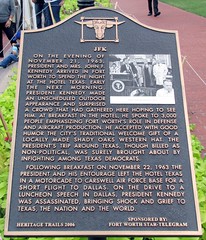
JFK On the evening of November 21, 1963, President and Mrs. John F. Kennedy arrived in Fort Worth to spend the night at the Hotel Texas. Early the next morning, President Kennedy made an unscheduled outdoor appearance and surprised a crowd that had gathered here hoping to see him. At breakfast in the hotel, he spoke to 3,000 people emphasizing Fort Worth’s role in defense and aircraft production. He accepted with good humor the city’s traditional welcome gift of a locally made Shady Oaks Western Hat. The president’s trip around Texas, though billed as non-political, was surely brought about by infighting among Texas democrats. Following breakfast on November 22, 1963 the president and his entourage left the Hotel Texas in a motorcade to Carswell Air Force Base for a short flight to Dallas. On the drive to a luncheon speech in Dallas, President Kennedy was assassinated, bringing shock and grief to Texas, the nation and the world.
999 Main St, Fort Worth, TX, United States
Subjects

Texas Historical Marker #02027
Fort Worth Elks Lodge 124. Designed by Fort Worth architect Wyatt C. Hedrick (1888-1964) and built in 1927-28, this was the headquarters of the Fort Worth Elks Lodge and served as a residence for visiting Elks members until purchased by the Fort Worth Y.W.C.A. in January 1955. Featuring Georgian Revival style elements, the five-story structure on a raised basement is of steel construction with brick and cast stone veneer, metal balustrades, and shallow-relief detail. Recorded Texas Historic Landmark -1986. #2027
512 W. 4th St., Fort Worth, TX, United States
Texas Historical Marker #02305
Gunhild Weber House. This was the first home built in a 1907 subdivision opened by D.T. Bomar and John W. Broad. It shows influences from the West Coast, where Broad lived from 1896 to 1906. Charles K. Lee, later a State Bar Association, President, bought the house in 1914. He added a room and porte cochere. The Lees lived here 15 years. Mrs. Gunhild Weber, a native of Norway and a Fort Worth business executive, has owned the house since buying it from the Lucie C. Lee estate, 1944. Recorded Texas Historical Landmark-1978. #2305
1404 S. Adams, Fort Worth, TX, United States

Robert David Law Specialist Four, United States Army Robert David Law was born on September 15, 1944, to Robert M. and Martha E. (Morris) Law in Fort Worth. He attended Fort Worth Technical High School, graduating in 1964, and was a member of Southcliff Baptist Church. Law enlisted in the U.S. Army at Dallas on October 17, 1967. He completed his basic combat training and infantry advanced individual training at Fort Polk, Louisiana, and was advanced in rank to Private First Class. He graduated from Airborne School at Fort Benning, Georgia, in summer 1968, and received orders to join F Company (Ranger), 52nd Infantry Regiment, 1st Infantry Division in combat in the Republic of (South) Vietnam. From 1968-69, Law served as a Scout Observer and was promoted in rank to E-4 as a Specialist Four (SP4). Under a February 1969 reorganization, his unit became I Company (Ranger), 75th Infantry Regiment, 1st Infantry Division. SP4 Law had been in Vietnam for eight months when he volunteered for a mission to gather intelligence near the Cambodian border, northeast of the 1st Infantry Division base camp at Lai Khe. Law paced a patrol of six Rangers beginning on February 20, 1969. Within an hour of their insertion by helicopter, the patrol was in a gunfight. Law sprayed rifle fire into the woods to cover the patrol's retreat for the night. The next day, the Rangers monitored enemy troops near a log bridge over a stream. On the morning of February 22, three Viet Cong soldiers spotted the Rangers and opened fire. During the exchange, a grenade rolled close to three of the Rangers. Law threw himself on the grenade to save his comrades and was killed instantly. When notified about her son's death, his mother remarked that his letters home indicated that "He knew what he was fighting for." In August 1970 at the White House in Washington, D.C., President Richard M. Nixon presented SP4 Law's family with a posthumous Medal of Honor for his selfless and decisive actions. (2020) Marker is Property of the State of Texas
2301 N. Sylvania Ave., Fort Worth, TX, United States

Texas Historical Marker #02658
Isham Cemetery. The Rev. W. Marion Isham (1831-1904) and his family came to Tarrant County from Georgia about 1870. Soon after arriving in the area Isham donated a one-acre plot of land to be used for a community cemetery. The oldest remaining legible grave marker here is that of N.L. Sweet (1824-1870), although earlier burials are documented by plain sandstone markers. Approximately five acres were added to the graveyard in 1941. Still in operation as a community burial ground, the historic graveyard is maintained by the Isham Cemetery Association. Texas Sesquicentennial 1836-1986. #2658
7100 block of John T. White Boulevard, Fort Worth, TX, United States
Texas Historical Marker #02720
James E. Guinn School. After Fort Worth public schools were organized in the fall of 1882, black students continued to be taught in black churches for more than a year. The city completed a schoolhouse for blacks on E. 9th Street at Elm in December 1883. The son of a former slave, James Elvis Guinn was born in Fort Worth. Though neither of them could read nor write, his parents placed a great value on education, and James attended Fort Worth's early schools for blacks. He later pursued a college degree and became a professor of chemistry at Prairie View College, now Prairie View A&M University. Guinn returned to Fort Worth as principal of South Side Colored School in 1900. Construction of a new three-story brick school building, designed by the prominent architectural firm of Sanguinet and Staats, began at the corner of Louisiana and Rosedale Avenues in April 1917. Shortly before its completion, Guinn died on July 11, 1917. Six days later the school board voted to name the new school building James E. Guinn School in his honor. It was the largest black school in Fort Worth in 1930. After sixty-three years of service it, it was closed in 1980. Texas Sesquicentennial 1836-1986. #2720
1100 Louisiana St., Fort Worth, TX, United States
Texas Historical Marker #02967
Knights of Pythias. Erected in 1881; rebuilt in 1901, following fire, by noted local architects Sanguinet and Staats. Style similar to North European city hall or medieval guild hall. This is first Pythian Castle Hall built in the United States. In third-floor niche is 7-foot suit of armor that stood above 1881 building. Fort Worth Pythian Lodge No. 101 (a fraternal group) occupies 2 floors. Became first local building named to National Register of Historic Places, 1970. Recorded Texas Historic Landmark--1962 #2967
110 East Third St., Fort Worth, TX, United States
Texas Historical Marker #03053
Lawrence Clifton Elliott. Aviation pioneer Lawrence C. Elliot was born in Greenville, Texas. During high school, Elliott exhibited early aviation talent when he built an experimental airplane. He attended Texas A&M University, participating in the Reserve Officers Training Corps. After graduating in 1924, Elliott was commissioned a 2nd Lieutenant in the Army Air Corps and trained at Brooks Field and Kelly Field in San Antonio. He earned awards in air races and became a U.S. Army flight Instructor. In 1928, Elliot began a 35-year career with the Aeronautics Branch of the U.S. Department of Commerce (Later the Civil Aeronautics Administration). Stationed at Southwest Regional Headquarters in Fort Worth for 25 years, he was instrumental in marking domestic flight routes, developing weather communication broadcast techniques, establishing standards for airplane maintenance and inspection, and recommending air facility safety modifications. During World War II, Elliott was regional manager of the U.S. Civil Aviation System. He received awards for exceptional service and impact on international aviation in 1953. Elliott was married to Mildred Leonhart Reiter (d. 1963). Their former home at 3 Chase Court was designated a Recorded Texas Historic Landmark in 1983. (1991) #3053
3400 White Settlement Rd., Fort Worth, TX, United States
Texas Historical Marker #03246
Masonic Temple Association of Fort Worth. The Masonic Temple Association was founded as the result of dramatic growth in Fort Worth's Masonic membership during the early part of the twentieth century. It was chartered in 1929 with ten member bodies for the purpose of building and maintaining a central meeting place for those organizations. Funds were raised and the new temple was completed in 1932. Since its founding, The Masonic Temple Association of Fort Worth has helped to create a common bond among its members. (1984) #3246
1100 Henderson, Fort Worth, TX, United States
Texas Historical Marker #11963
Site of Confederate Park. Local businessman Khleber M. Van Zandt organized the Robert E. Lee camp of the United Confederate Veterans in 1889. By 1900 it boasted more than 700 members. The camp received a 25-year charter to create the Confederate Park Association in 1901, then purchased 373 acres near this site for the "recreation, refuge and relief of Confederate soldiers" and their families. Opening events included a picnic for veterans and families on June 20, 1902, and a statewide reunion September 8-12, 1903, with 3,500 attendees. The park thrived as a center for the civic and social activities of Texas Confederate organizations. By 1924 the numbers of surviving veterans had greatly diminished, and the Confederate Park Association voluntarily dissolved when its charter expired in 1926. (2000) #11963
?, Fort Worth, TX, United States
Texas Historical Marker #12476
Billy Muth. William McKinley (Billy) Muth (1902-1949) made significant contributions to Texas' cultural history. Born in Allentown, Pennsylvania, Muth was a church organist at the age of nine. Nationally known as "the master of the keyboard," Muth was organist at Casa Manana during the 1936 Texas Centennial, the Worth Theatre, multi-instrument Fort Worth symphony musician and church organist. A Paramount/Publix Theatres' pipe organist, Muth opened theatres across the United States. Settling in Texas in 1926, Muth performed concerts, benefits, and taught statewide organ and music seminars. Recorded - 2001 #12476
3100 White Settlement Rd., Fort Worth, TX, United States
Texas Historical Marker #03905
Paddock Viaduct. Low-water crossing and ferries originally provided the only access across the Trinity River at this location, connecting the downtown area of Fort Worth with northern sections of the city. A two-lane suspension bridge, constructed near this site in the 1890s, proved inadequate for the growing population. This span, designed by the St. Louis firm of Brenneke and Fay, was built in 1914. It was the first reinforced concrete arch in the nation to use self-supporting, reinforcing steel. The bridge is named in honor of B.B. Paddock, former State Legislator and Mayor of the City. #3905
Main St. Bridge at Heritage Park, Fort Worth, TX, United States
Texas Historical Marker #12576
Mary Daggett Lake. (Nov. 11, 1880-Mar. 1, 1955) A botanist, musician, author and clubwoman, Fort Worth native Mary Daggett Lake played a prominent role in the civic life of her hometown throughout the first half of the 20th century. She chronicled the lives of pioneer Fort Worth families in a series of articles for the Star-Telegram in the 1920s and 1930s. Through her active involvement and leadership with the Fort Worth Garden Club, the Texas Federation of Garden Clubs, the Fort Worth Park Board and the National Council of State Garden Clubs, Mary gained widespread recognition for her efforts in landscape conservation and beautification. Her labors on behalf of the Fort Worth Garden Center led to a national award for its work. (2001) #12576
3220 Rock Springs, Fort Worth, TX, United States
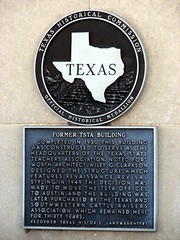
Texas Historical Marker #01956
Former TSTA Building. Completed in 1930, this building was constructed to serve as the headquarters of the Texas State Teachers Association. Noted Fort Worth architect Wiley G. Clarkson design the structure, which features Renaissance Revival styling. In 1949 the decision was made to move the TSTA offices to Austin, and the building was later purchased by the Texas and Southwestern Cattle Raisers Association which remained here for thirty years. Recorded Texas Historic Landmark- 1981. #1956
410 E. Weatherford, Fort Worth, TX, United States
Subjects
Texas Historical Marker #13228
Handley Church of Christ. Originally known as Turkey Knob, an early community in this area changed its name after 1876, when the T&P Railroad built a depot and section house nearby and named it Handley. Beginning in 1882, local Protestant denominations worshiped in a union church building. In 1905, J. Dan Thomas invited approximately 22 men and women into his home to organize the Handley Church of Christ. The congregation soon moved to a larger space and has constructed several buildings over the years, remaining at this location since 1919. Throughout the church's history, members have maintained a significant presence in the community through worship, Bible study, mission work and outreach. (2005) #13228
3029 Handley Dr, Fort Worth, TX, United States
Texas Historical Marker #14938
Texas & Pacific Railroad Passenger Terminal. #14938
?, Fort Worth, TX, United States
Texas Historical Marker #13913
Hagar Tucker. (1842-1892) Hagar Tucker was the first African American policeman in Fort Worth, notable in 1870s Texas. Born into slavery, he came here from Kentucky in 1857 and was emancipated in 1865. One of the first African Americans in the county registered to vote, he was appointed a "special policeman" in 1873, partly through influence of former master Wm. B. Tucker, then alderman. Hagar was the only black on the force, one of few until the 1950s. Paid separately from other police, he could only patrol black neighborhoods. He served a short time, later working other jobs and eventually returning to the Wm. B. Tucker household with his wife Amy and three daughters. (2007) #13913
701 Grand Ave, Fort Worth, TX, United States
Texas Historical Marker #15259
Ponton, Dr. Arvel and Faye, House. At the time of this home's c. 1920 construction, the Mistletoe Heights neighborhood was emerging as a desirable subdivision for merchants and professionals. Designed by noted local architect Joseph R. Pelich, the Spanish Eclectic style home features a clay tile roof, large arched windows and doorways, stucco walls, embellished door surrounds, chimney belvedere and wrought iron detailing. Dr. Arvel and Faye Ponton were the first occupants. Dr. Ponton helped establish Fort Worth's Protestant Hospital and later his own clinic in a building also designed by Pelich. Recorded Texas Historic Landmark - 2008 #15259
1208 Mistletoe Drive, Fort Worth, TX, United States
Texas Historical Marker #15262
1869 Independence Day Raid. On July 4, 1869, after gathering a herd of horses from the Fort Worth area, a group of eleven Indians rode north and west from the city. They were followed by a posse of Tarrant County men, who trailed them into Parker County. Along the way, the Indians raided the homes of several settlers and shot and scalped two travelers. Other posses began following the Indians, who slipped away on the night of July 5th, leaving behind most of the stock they had taken. Raids such as this were common on the North Texas frontier between the late 1850s and 1875. (1984) #15262
8001 Malaga, Fort Worth, TX, United States
Texas Historical Marker #15420
Ray-Manship Cemetery, Site of. #15420
?, Fort Worth, TX, United States
Texas Historical Marker #15871
Polytechnic Cemetery. #15871
1000 Bishop, Fort Worth, TX, United States
Subjects
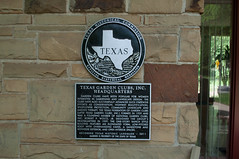
Texas Historical Marker #16969
Texas Garden Clubs, Inc., Headquarters. #16969 [full inscription unknown]
3111 Old Garden Road, Fort Worth, TX, United States
Subjects

Texas Historical Marker #04709
Sinclair Building. Pioneer oilman Richard O. Dulaney hired noted Fort Worth architect Wiley G. Clarkson to design this building. It acquired its name from the Sinclair Oil Company which leased offices here soon after the building's completion in 1930. The billion-dollar Sinclair-Prairie Oil Company moved its headquarters here in 1932. Built during the city's oil and gas-inspired golden era, this High-Rise Art Deco building features zig-zag motif, Mayan accents and terra cotta detailing. #4709
512 Main St., Fort Worth, TX, United States
Subjects
Texas Historical Marker #12202
Alice E. Carlson Elementary School. Designed by Fort Worth architect Wiley G. Clarkson and built in 1927, this building was enlarged twice, once in 1935 with Works Progress Administration funds and again in 1953 with designs by noted area architect Joseph R. Pelich, Sr. The original classrooms, principal's office and cafeteria were supplemented by additional wings. Named for a teacher who was the first woman to serve on the Fort Worth School Board, the institution shaped the growth of the neighborhood and its children. Architectural features include multilight frame windows and Spanish colonial revival details, including the tile roof and wrought iron lamps. State Archeological Landmark - 1983 Recorded Texas Historic Landmark - 2000 #12202
3320 W. Cantey St., Fort Worth, TX, United States
Subjects
Texas Historical Marker #05636
Van Zandt, Khleber Miller. N/A #5636
?, Fort Worth, TX, United States
Texas Historical Marker #00762
Cattle Brands. Proof of ownership since 600 B.C.; in Texas since 1821. Registered in counties and burned on hides of cattle. Every owner has individual brand. In Texas these aggregate several thousand. History of Texas is displayed here in brands of leaders: patriots, soldiers, bankers, rangers, industrialists. (1966) #762
East Exchange St., Fort Worth, TX, United States
Texas Historical Marker #00413
Birdville Cemetery. The oldest marked grave in this pioneer community cemetery is that of Wiley Wilda Potts (Dec. 20, 1822 - Dec. 15, 1852). The one-acre tract, then part of the George Akers Grant, was legally set aside for burial purposes before 1860. More land was later donated, and by 1910 the site included 3.27 acres. Birdville Cemetery Association, organized under a 50-year charter in 1917, was rechartered in 1967. The cemetery contained 552 known graves in 1965. Several families have four generations buried here in the same plot. The site now encompasses seven acres and is still used for burials. (1975) #413
6100 block of E. Bellknap, Fort Worth, TX, United States
Texas Historical Marker #00514
Broadway Baptist Church of Ft. Worth. On December 31, 1882, six men and three women met to organize this congregation. They called the Rev. John Smith Gillispie as their first Pastor. The name South Side Baptist Church was adopted January 14, 1883, at worship services held in a rented hall at 15th and Houston Street. In 1886 the fellowship erected a frame church building on the southwest corner of Broadway and St. Louis Avenue. Four years later the congregational name was changed to Broadway Baptist Church. As the church grew, larger facilities were needed. In 1906 a brick structure replaced the original building. On April 3, 1909, a devastating fire swept Fort Worth's South Side, destroying over 200 structures, including the church building, parsonage, and the homes of 22 member families. Rebuilding started immediately, and a new church structure was completed in 1910. The church complex expanded with the addition of educational facilities. A new sanctuary was begun in 1949 and completed by Easter Sunday in 1952. The membership of Broadway Baptist Church has grown to over 2,500 in its centennial year. At least seven other Baptist churches have been established through the efforts of this congregation. (1982) #514
305 W. Broadway, Fort Worth, TX, United States

Texas Historical Marker #01910
Flatiron Building. Known in early 1900s as the tallest building in North Texas. Erected 1907 for the renowned Dr. Bacon Saunders, Dean of City Medical College; Chief Surgeon, nine railroads; acclaimed as a pioneer of medicine in Texas. Designed by firm of Sanguinet and Staats, distinguished Fort Worth architects of reinforced concrete over steel frame, this Renaissance Revival structure was inspired by the wedge-shaped Flatiron Building in New York. Recorded Texas Historic Landmark-1970. #1910
1000 Houston St., Fort Worth, TX, United States
Texas Historical Marker #01355
Early Site of Southwestern Exposition and Livestock Show. Fort Worth became an important trading and supply depot in the 1870s for Texas cattlemen driving herds to Northern markets. With the convergence of several railroads here in the 1870s and 1880s stockyard facilities began to appear along the railroad lines. In 1893 Boston investors purchased the Stockyards and organized the Fort Worth Stock Yards Company. The Company held the first livestock show at nearby Marine Creek in March 1896. The show's initial sucess was due mainly to the participation of members of the Texas Cattle Raisers Association (TCRA) whose Annual Meeting in Fort Worth coincided with the Show. The Fort Worth Stock Yards Company built an impressive livestock exchange building in 1903. In 1908, with the help of Armour & Co., Swift & Co., and TCRA members, the National Feeders and Breeders Show opened here in new Coliseum facilities. The show offered a variety of events including a cutting horse competition and a horse show. A Wild West show was added in 1916. The show, renamed Southwestern Exposition and Fat Stock Show in 1918, developed into a premier rodeo, livestock, and exhibition event. In 1943 the facilities were converted for U.S. military purposes and in 1944 the Show relocated to a site in west Fort Worth. Sesquicentennial of Texas Statehood 1845-1995. #1355
Stockyards Blvd & Rodeo Plaza, Fort Worth, TX, United States

Texas Historical Marker #01556
Fairview, William J. Bryce House. A native of Scotland, William J. Bryce (1861-1944) moved to Fort Worth in 1883 and developed a successful brick contracting business. In 1893 he constructed this house, which was designed by the prominent architectural firm of Sanguinet & Messer. The Mayor of Fort Worth from 1927 to 1933, Bryce lived here until his death. One of the rare examples of a Chateauesque dwelling in Texas, Fairview features Richardsonian arches and gabled dormers. Recorded Texas Historic Landmark-1983. #1556
4900 Bryce St., Fort Worth, TX, United States
Texas Historical Marker #01470
Emanuel Hebrew Rest Cemetery. Fort Worth civic leader John Peter Smith donated land at this site in 1879 for use as a cemetery to serve the early Jewish residents of the City. Maintenance of the grounds was first provided by the Emanuel Hebrew Association, which was started by local families. The earliest marked grave is that of a child, Leah Kaiser, who died in 1879. Under the control of Congregation Beth-el since 1962, Emanuel Hebrew Rest Cemetery is the burial site of many prominent business, professional, and civic leaders of Fort Worth's Jewish community. (1981) #1470
1414 S. Main St., Fort Worth, TX, United States
Texas Historical Marker #01710
First Christian Church of Fort Worth. City's pioneer congregation, organized by the Rev. A.M. Dean, who with hymn book and revolver came in 1855 to the riotous six-year-old hamlet on the Trinity. He held services (at present Belknap and Houston streets) in a log house built for Post Surgeon, 2nd Dragoons, U.S. Army, stationed at fort that gave the city its name. Charter members were: Mr. and Mrs. James K. Allen, Mr. and Mrs. Benjamin P. Ayers, Mrs. Francis M. Durrett, Mrs. Alfred D. Johnson, Mrs. Florence Peak, Mr. and Mrs. William A. Sanderson, and Stephen Terry. First regular meeting place, a one-story concrete house at present Belknap and Lamar, was used on weekdays by Col. John Peter Smith (member of congregation) for sessions of the first public school established in Fort Worth. Rev. Mr. Dean, a frontier farmer, was followed as pastor by Dr. B.F. Hall, a dentist, and by Dr. Mansell Mathews, physician and judge of Red River County, and head of a large family grazing cattle in this area. Confederate General R.M Gano of Grapevine after the Civil War preached regularly at this church. In later 1860s came the Rev. Joseph Clark and sons Addison and Randolph, who in 1873 founded Add-Ran College, forerunner of Texas Christian University. First Christian is the oldest church in Fort Worth. #1710
612 throckmorton St., Fort Worth, TX, United States
Texas Historical Marker #01836
First Presbyterian Church of Fort Worth. The Fort Worth Presbyterian Church was organized in 1873 with ten charter members. Affiliated with the Presbyterian Church, U. S. ("Southern"), the congregation built a frame sanctuary at the corner of 4th and Calhoun Streets. In 1886 the name was changed to First Presbyterian Church of Fort Worth, and a new stone structure was built in 1890. A Fort Worth congregation of the Cumberland Presbyterian Church was formed in 1878. When the Cumberland Presbyterian Church affiliated with the Presbyterian Church, U.S.A. ("Northern") in 1906, the word Cumberland was dropped from the local church's name. Desiring to work together to serve the community with worship and missionary programs, the two Fort Worth congregations united in 1916 to form a federation, the first such union in Texas. The members met together and shared one pastor, but maintained separate national affiliations. The congregation erected a new edifice at this site, opening it on December 23, 1956. The "Southern" and "Northern" denominations united in 1983 to form the Presbyterian Church (U.S.A.). (1992) #1836
1000 Penn St., Fort Worth, TX, United States
Texas Historical Marker #02142
General Thomas N. Waul, C.S.A.. A native of South Carolina, Thomas Neville Waul (1813?-1903) practiced law in Mississippi before moving to Texas in 1850. After serving the Provisional Confederate Congress and signing the 1861 Confederate constitution, he organized Waul's Texas Legion, C.S.A. Waul led the Texans in Mississippi during 1862 and 1863, participating in the defense of Vickburg. He led a brigade in the Red River campaign of 1864 at Mansfield, La., and Jenkins' Ferry, Ark. Waul returned to Texas in 1865 and resumed the practice of law. He died near Greenville and was buried at this site #2142
?, Fort Worth, TX, United States
Texas Historical Marker #02233
Governor Charles A. Culberson. A native of Alabama, Charles A. Culberson grew up in Jefferson, Texas. He married Sallie Harrison (1861-1926) in 1882 after earning his law degree at the University of Virginia. During two terms as Attorney General of Texas, Culberson enforced the reform policies of Gov. James S. Hogg. He succeeded Hogg as Governor, 1895-99. Culberson served four terms in the United States Senate, winning the post of Democratic Minority Leader in 1907. Renowned for his knowledge of the law, he chaired the Senate Judiciary Committee from 1913-1919. (1979) #2233
Oakwood Cemetery, 700 Grand Ave., Fort Worth, TX, United States
Texas Historical Marker #02936
Khleber Miller Van Zandt (1836-1930). Tennessee native Khleber Miller Van Zandt moved to East Texas as a child. After serving as a Major in the 7th Texas Infantry Regiment, C.S.A., he came to Fort Worth in 1865. A merchant, banker, and rancher, he was instrumental in making the city a major rail center and helped establish early newspaper, the public schools, public transportation, and the First Christian Church. He served in the 13th Texas Legislature of 1875. A member of the United Confederate Veterans, he held the office of National Commander-in-Chief (1918-1921). Texas Sesquicentennial 1836-1986 #2936
700 Grand Ave., Fort Worth, TX, United States
Texas Historical Marker #04877
Site of Randol Mill. In 1856 Archibald F. Leonard (1816-1876) built a dam and grain mill at this site. Hiram Crowley became a partner. The mill became a community center and county voting place. During widespread abolition violence in 1860, Leonard's Mill was burned. It reopened by 1862 and operated during the Civil War. Owners after 1867 were H.B. Alverson and J.H. Wheeler. In 1876 R.A. (Bob) Randol (1850-1922) acquired Wheeler's Mill. A water-driven turbine powered the mill, a circular saw,and a cotton gin. Randol Mill played an important role in the area economy and closed after Randol's death. #4877
Precinct Line Rd. at Trinity River, Fort Worth, TX, United States
Texas Historical Marker #03659
Oakwood Cemetery. Founded 1879 by John Peter Smith, one of Fort Worth's first settlers, who became a civic leader, Mayor, philanthropist. He gave 20 acres to City; cemetery since enlarged to 100. The area contains three cemeteries: Oakwood, Calvary, Trinity. Many Fort Worth and Tarrant County men and women of destiny are buried here. Plots are owned by lodges, unions, Catholic, Protestant, Negro, and White. Tracts are dedicated to Union and Confederate soldiers. The Chapel was built in 1914. Oakwood, Calvary Associations, and City provide care. Recorded Texas Historic Landmark, 1966 #3659
Oakwood Cemetery at Grand and Gould Ave., Fort Worth, TX, United States
Texas Historical Marker #04453
Saint John's Evangelical and Reform Church. A United Church of Christ, this congregation was chartered October 1882 under the direction of the Rev. F. Werning, a pioneer missionary from Waco. It grew from early worship services in the home of Mr. and Mrs. H. Raab, conducted for twelve families of German descent. The Church's original sancturary was built on Calhoun Street, but was moved to the corner of Texas and Taylor streets before being relocated here in 1915. For over a century St. John's Evangelical and Reformed Church has played in an important role in the area's development. #4453
908 Pennsylvania Ave., Fort Worth, TX, United States
Texas Historical Marker #05244
Texas & Southwestern Cattle Raisers Association. On February 15, 1877, a large number of stock raisers from northwest Texas assembled in the Young County Courthouse in Graham to address the problem of cattle rustling. Their solution was the creation of the "Stock-Raisers' Association of North-West Texas." The organization worked to promote the interests of stock raisers and initiated a system of tracking stray or stolen cattle. Names, marks, brands, locations of ranches, and addresses of individual stock raisers were made available to each member. C.L. (Kit) Carter of Palo Pinto County served as the association's first president. Other prominent cattlemen involved in the group's formative years were C.C. Slaughter, Samuel Burk Burnett, and James C. Loving. During the 1893 Annual Convention, membership in the organization was opened to the entire state, and its name was changed to the "Cattle Raisers Association of Texas." In the same year, Fort Worth became the location of its permanent headquarters. The current name was adopted in 1921, when the Panhandle and Southwestern Stockmen's Association joined the Texas organization. Throughout its history, the association has provided significant service and leadership to the cattle industry of Texas. #5244
1301 W. 7th St., Fort Worth, TX, United States
Texas Historical Marker #05263
Texas Log Cabins. These authentic log cabins, built by pioneers 100 years ago, recall a way of life in early Texas when great courage was required to meet the hardships of frontier existence. Constant threats from Indians, poor crops, adverse weather, primitive living conditions did not stop these ingenious people from developing a wilderness into a land of opportunity. The log cabin, a familiar sight in Cross Timbers country of North Texas, was most readily available type of construction to the pioneer and his family. He was too far from a mill to obtain "box lumber." Skill, stamina were needed when preparing logs with such tools as the axe, broad and adze. Styles of fitting corners included "quarter notch" and "dovetail." Oak, cedar and heart pine woods were used. The cabin was a welcome sight to neighbors and saddle-sore travelers. Each told a personal story of frontier life and the family that lived within. The Tomkins cabin was a landmark on Ft. Worth-Belknap Road; visitors were welcome. Isaac Parker cabin was the last home of Cynthia Ann Parker after she was taken from her Comanche family in 1860. This Log Cabin Village was created so that part of the spirit of the Texas frontier would survive. #5263
University & Colonial Parkway, Fort Worth, TX, United States
Texas Historical Marker #05423
The Sanctuary - Gustavaus Adolphus Church. The Swedish Evangelical Lutheran Church of Gustavus Adolphus Synod was organized in 1905 to serve Swedish settlers in the City of Fort Worth. In 1912 the congregation, which later became known as Grace Lutheran, constructed this sanctuary and held worship services here until it moved to another site in 1957. The Lombard Romanesque style building features fine brickwork in the tower and over the arches. #5423
400 Hemphill, Fort Worth, TX, United States
Texas Historical Marker #05680
WBAP-TV - Channel 5, First Television Station in Texas. Founded by Amon G. Carter, noted publisher of the "Fort Worth Star-Telegram", the first progam--a public appearance, Sept. 27, 1948, by President Harry Truman--made Texas the sixteenth state in the nation to open a commercial station. Among other "Firsts" of WBAP-TV are the first live entertainment in Texas ("Flying X Ranchboys"), and first Texas colorcast via NBC-TV, 1954. Today Channel 5 serves aproximately 60 counties in Texas and Oklahoma. Since its birth, television has made many advances. In Washington, D.C., 1927, Herbert Hoover (at that time Secretary of Commerce) appeared on the first major telecast in the nation. In 1931, H. & W. Corset Company in New York conducted the first experimental use of closed-circuit television to display its models to a buyer and sold $5,000 worth of merchandise. Modern commercial telecasting did not begin, however, until 10 years later, when New York opened the first station in the country. After a slow start, major strides were made in 1947 and 1948. As of July 1, 1967, the U.S. had 628 commercial and 128 educational stations, with 224 under construction. Of these, Texas had 49 commercial and 5 educational. #5680
3900 Barnett St., Fort Worth, TX, United States

Fairmount-Southside Historic District The Fairmount-Southside Historic District is a predominately residential area in the center of Fort Worth's Historic Southside. Located approximately two miles south of present-day downtown, the district is comprised of 22 separate additions containing more than 1,200 contributing residences, commercial buildings and other structures. It emcompasses nearly 375 acres in about 100 square blocks. Most residences were built as wood-framed single-family cottages, bungalows and two-story foursquare homes. Fort Worth was incorporated in 1873 in anticipation of the first railroad, which came through in 1876. Speculators bought and sold land they believed would turn the most profit if Fort Worth's economy was bolstered by the railroad. During the post-railroad boom, the city began to quickly expand south. Developers planned the additions that now comprise the Fairmount-Southside Historic District during the years 1883-1907. The largest was the Fairmount Addition, platted in 1890, which encompasses much of the western half of the district. When developed, the land on which the Fairmount-Southside Historic District now rests was on the southernmost edge of the city. The district grew rapidly in its formative years, as many middle-income workers moved to Fort Worth for various employment opportunities. Within the first two decades of the 20th Century, streetcar lines ran down major district thoroughfares, including College and Fairmount Avenues, carrying railroad employees, doctors, lawyers, salesmen and merchants to and from their homes built on the Southside to their areas of employment. Beginning with Queen Anne and ending in the Craftsman style, the homes built by the original residents now showcase the evolution of domestic architecture of early 20th Century suburban America. (2016) Marker is property of the State of Texas
Allen Street, Fort Worth, TX, United States
Texas Historical Marker #12201
Blackstone Hotel. The first art deco skyscraper in Fort Worth, the Blackstone Hotel was erected in 1929 for wealthy cattleman C. A. "Gus" O'Keefe, who named it after a visit to the Blackstone Hotel in Chicago. The St. Louis architectural firm of Mauran, Russell, and Crowell designed the structure. The city's first radio station, WBAP, once occupied the 22nd floor. A five-story annex was added in the 1950s by the Hilton Hotel chain, which occupied the building from 1952 to 1962. Featuring original sash windows, irregular setbacks, and ornamental terra cotta detailing, the Blackstone Hotel remains the city's tallest pre-World War II structure. Recorded Texas Historic Landmark - 1998 #12201
601-615 Main St., Fort Worth, TX, United States
Texas Historical Marker #04828
Site of Majestic Theatre. At the turn of the century Ft. Worth's live entertainment consisted chiefly of saloon, dance hall, church, and school presentations. Matters changed in 1905 when Karl Hoblitzelle founded the Interstate Amusement Company and chose Ft. Worth for its Southwest Vaudeville Theater Circuit. One of Interstate's famous "Atmospheric" Majestic Theaters was built at Tenth and Commerce streets (one block south) in 1910-11. The Majestic's lavish interior included Turkish rugs, French doors and mirrors, plush Spanish leather upholstery and a lobby with marble floors, hand-painted walls ,and 18 karat gold leaf ceilings. The 1,356-seat theater reportedly contained the country's first indirect stage lighting system and the country's largest concrete arch, an 80-foot balcony support beam. Performers on Ft. Worth's Majestic stage included Will Rogers, Walter Huston, Tallulah Bankhead, and Fred Allen. The Theater added feature movies to its Vaudeville program in 1922 and in 1932 discontinued its Vaudeville presentations. Thereafter strictly a motion picture theater the Majestic fell on hard times and closed in 1953. Despite efforts to restore it, the Majestic was razed in 1970 to make room for the new Tarrant County Convention Center. (1993) #4828
9th & Commerce St., Fort Worth, TX, United States
Texas Historical Marker #05280
The 1865 Indian Creek Raid. During the late 1850s Indians on the north Texas frontier became increasingly restive about continued white settlement on their lands. As a result, numerous attacks on Anglos occurred during the years form 1859 to 1875. One such incident took place in Sept. 1865 near this site when 15 mounted Indians attacked two Denton County residents by the names of Smith and Wright. Wright was killed, and Smith, wounded by an arrow, rode to Denton for help. Within a short time, Smith died from blood poisoning caused by his wound. (1983) #5280
On Morris - Dido - Newark Rd., Fort Worth, TX, United States
Texas Historical Marker #05845
William Reeves House. Prominent businessman and philanthropist William Reeves built this home for himself and his wife, Mattie Hosea, in 1907-08. He served as President of Reeves Investments and was President and founder of the First Fort Worth Bank and Trust. The Reeves house exhibits characteristics of the Neo-Classical Revival and Queen Anne styles of architecture. Prominent features include the round pavilion at the entrance and the wrap-around porches with Doric columns. #5845
2200 Hemphill, Fort Worth, TX, United States
Texas Historical Marker #05771
Westover Manor. Built in 1929-30 as the flagship for development of Westover Hills, this Norman-Jacobethan revival mansion was selected as the Fort Worth Star-Telegram newspaper's "Home Beautiful". John E. Farrell (1891-1946), first Mayor of Westover Hills and co-discover of the vast east Texas oil field in 1931, lived here from 1930 until his death. Designed by architect Victor Marr Curtis, the house exhibits picturesque blend of materials, including brick and rough-cut limestone, and features a bell-cast tower roof, Tudor chimneys, half-timbered gables, and vari-shaded roof tile. Recorded Texas Historic Landmark-1988 #5771
8 Westover Rd., Fort Worth, TX, United States
Texas Historical Marker #05815
Willburn Cemetery. Many of the individuals buried in this pioneer cemetery are descendants of Edward Willburn (1805-82) and his wife Nancy (Overton) (ca. 1811-87), immigrants from the upper south who settled here in the 1850s. The earliest marked grave, dated 1867, is for the infant child of William and Cassandra (Williams) Willburn. Also interred here: Rachael M. (Wilburn) Snyder, donor of property for a church, school, and cemetery in Benbrook; Church Willburn, a cowboy on several cattle drives in the 1860s; Civil War veterans; and other pioneers of southwestern Tarrant County. Texas Sesquicentennial 1836-1986 #5815
3720 Streamwood Rd., Fort Worth, TX, United States
Texas Historical Marker #05883
Witten Cemetery. This cemetery was established for the family of Samuel Cecil Holiday Witten (1819-91), who came to Texas in 1854. A successful landowner, he also served as a Justice of the Peace and Deputy County Surveyor. Witten first used this burial site in 1857 for the interment of his son, William. Also buried here is another son, George (1841-68), who drowned while on a cattle drive, and a son-in-law, Ryan Harrington (1829-84), a participant in the 1849 California Gold Rush. Samuel Witten and his wife moved to Corpus Christi in 1890 and the cemetery was later used by family descendants. #5883
Colleyville Cr. at Jackson Court, Fort Worth, TX, United States

Grammer-Pierce House This California style Craftsman bungalow was built in 1915 by A.H. Richter and his wife, Violet (Murdock) Richter, in what is now the Fairmount Historic District. It was purchased in 1917 by Mrs. N.E. Grammer, widow of Nathaniel Grammer. Nathaniel was a prominent Fort Worth businessman, owning the largest and oldest drug store in the city. Mrs. Grammer sold the house in 1940. In 1948, Alice (Lewis) Pierce, who was part Choctaw Indian, purchased the house after she and her husband, Mark, moved to Fort Worth to reestablish themselves following the Stock Market Crash of 1929, they sold the house in 1970. Recorded Texas Historic Landmark - 2015 Marker is Property of the State of Texas
2232 College Ave., Fort Worth, TX, United States
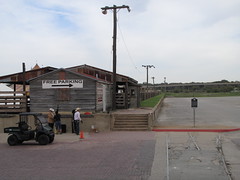
Fort Worth Belt Railway Beginning in 1904, the Belt Railway serviced the Fort Worth Stock Yards. The arrival of the railroad in Fort Worth in 1876 moved the cow town from a regional economic player to a national force. The Stockyards Corporation, chartered in 1895, created a belt railway system to handle the movement of livestock and supplies into the yards and finished products out to the national market. As road traffic grew in the mid-1920s, the Belt's role began to diminish. By 1978, the Texas & Pacific and the Missouri Pacific railroads gained full control of the Belt. In 1988, the Fort Worth and Western Railroad purchased what was left of the Belt. The remaining two miles of line are not used as an access route by an excursion train to the National Historic District. Marker is property of the State of Texas (2014)
Exchange Avenue, Fort Worth, TX, United States
Subjects

Founding Fort Worth Major General William J. Worth was the commanding officer of the eighth military district including Texas and Mexico. His responsibility was to maintain peace between settlers and the plains Indians. His plan was to establish a new post on the Trinity River to extend the line of defense. Worth died suddenly of cholera and did not get to see his plan come to light. Major Ripley Arnold was given the duty of establishing a fort by the acting commander, General Harney. This site would close the gap between the Brazos and Red Rivers. Arnold’s dragoons met with Col. Middleton Tate Johnson, a citizen with great influence, at the ranger’s station on Marrow Bone Springs. Along with Johnson were Joseph R. Parker, Dr. William B. Echols, Charles Turner and Simon Farrar. Along with his five guides, Arnold and his men set out to locate the ideal site for the new fort. The barracks of the fort were first located at the present-day site of the Tarrant County Courthouse. The land was described by Simon Farrar as “the most beautiful and grand country the sun had ever shone on…in view of all advantages of a natural point of defense.” After learning that Major General Worth, a hero in the recent Mexican War, had passed away, it was relatively easy for Arnold to name the new post after him even though he never saw the place named in his honor. Remembering his part in the founding of Fort Worth, Farrar stated in 1893, “it is the prayer and wish of your humble correspondent that Fort Worth may be the capital of northwest Texas, for i have at all times entertained great confidence in the people of Fort Worth.” (2012) Marker is Property of the State of Texas
360-398 North Taylor Street, Fort Worth, TX, United States

This stone marks the site of Camp Worth, a United States Military Post, named in honor of General William J. Worth, and Commanded by Major Ripley A. Arnold, 1849-1853. The camp protected the frontier against Indians, and was the beginning of the City of Fort Worth. Erected by Mary Isham Keith Chapter Daughters of the American Revolution, 1921
200 West Belknap, Fort Worth, TX, United States

In 1901, local business leaders G. W. Simpson and L. V. Niles began negotiating with Armour & Co. one of the nation' four largest meatpacking firms, to encourage establishment of a branch plant in Fort Worth. The Fort Worth Stock Yards Co. offered land and other incentives and by 1902, construction of a plant just north of this site was underway. The new operation was instrumental in the city's development as the livestock center of the Southwest, creating a number of support businesses. It remained in operation for over 50 years, closing in 1962. Texas Sesquicentennial 1836-1986
500 block E. Exchange Ave., Fort Worth, TX, United States

Texas Historical Marker #05278
Thannisch Block Building. The eastern portion of this structure was built in 1906-07 by Col. Thomas Marion Thannisch (1853-1935), one of north Fort Worth's early developers. Designed for use as a hotel and office space to serve the Stockyards community and trade, the building was expanded in 1913. The three-story commercial structure features decorative brickwork, chevron designs in the upper story, and a corbeled parapet. #5278
109 E. Exchange Ave., Fort Worth, TX, United States
Texas Historical Marker #05198
Tarrant, General Edward H.. N/A #5198
?, Fort Worth, TX, United States

Texas Historical Marker #17360
Fort Worth's First Flight. #17360
Carroll and Mercedes Streets, Fort Worth, TX, United States
Texas Historical Marker #12697
Texas in the Civil War: Confederate Veterans. From 1865 until World War I, Civil War veterans were leaders in economic and public life in Texas. Every locality had its United Confederate Veterans Camp, with yearly reunions. Texas railroads gave free passes to veterans and widows. but while the U.S. Treasury gave ample pensions to Federals, the Confederates depended on state bounties. Texas in 1881-1883 gave 1280-acre land grants to widows of men who died in service and to disabled veterans and their servants. Pensions were approved in 1899; 91% of Texas pensioners had served in the war from other states, but met residential requirements here. Confederate homes for veterans, their wives and widows were located in Austin. John B. Hood Camp, U.C.V., founded the men's home in 1886, gave it to the state in 1891. Daughters of the Confederacy built the woman's home in 1907 and gave it to the state in 1911. The men's home lost its last veteran in 1954 with the death of Thomas Riddle. in 1965 at least 47 Confederate widows survived. Last Civil War soldier of either army, the Texas Confederate Walter Williams, died in Houston in 1959, aged 117. By 1965, Texas had spent $71,106,648 to maintain homes and pension benefits. #12697
?, Fort Worth, TX, United States

Texas Historical Marker #17337
Curzon Place. #17337
3108 Winthrop Ave., Fort Worth, TX, United States
Texas Historical Marker #04577
Santa Fe Depot. Built 1899. Beaux Arts design features native stone banding. When intact, north windows of painted glass depicted travel from Pony Express to steam locomotives. Visitors here have included such world figures as Presidents Franklin D. Roosevelt, Dwight D. Eisenhower and Lyndon B. Johnson. Depot was used by six railroad companies. As of 1970, Santa Fe served Texas with greater trackage than any other railroad, 5102 miles. #4577
1501 Jones, Fort Worth, TX, United States
Subjects


Texas Historical Marker #15744
Douglass and McGar Parks. From the late 1800's, through the 1920's, during a time of Jim Crow segregation, Douglass and McGar parks served as recreational grounds for African Americans in Fort Worth. In 1895 Thomas Mason, an African-American entrepreneur, with J.D. Johnson and A. Sumlin, purchased land in the Trinity River Bottoms. The property soon became known as Douglass Park (about 300 yards south), named for abolitionist Frederick Douglass. That same year, the Park hosted a Juneteenth Celebration; this became an annual event that thousands attended. The city commissioned a special officer to patrol Douglass Park. Many noted black churches used the property, as did the Prince Hall Masons, who built a lodge on it. In 1918, Fort Worth's Park Board purchased Douglass park; despite an attempt to revitalize the park, it fell into disrepair and in 1925, the Texas Electric Service Company purchased the property and oficially closed it. Douglass Park led directly to the creation of another African-American Park. Crowds who gathered at Douglass Park to watch Negro baseball teams play became so large that the games moved to the Texas & Pacific Ballpark, which sat on a railroad right of way across) North Main Street. The ballpark was upgraded between 1907 and 1909 and changed names to McGar Park (McGar's Field), after businessman Hiram McGar. Both black and white fans came to watch McGar's Wonders (later the Black Panthers) play. Industrial development, the 1922 flood and other factors led up to the demise of the Park during the 1920's. Today, no remnant remains of the Parks, though they continue to be remembered as vital community institutions for Fort Worth African American Americans in the early 20th Century.
7th and Jones, Fort Worth, TX, United States

Texas Historical Marker #14515
Grace Lutheran Church. This congregation was organized formally in 1905 to serve the Swedish-American Lutheran community in Fort Worth. The Rev. Theo Seashore served as first pastor. In 1912, during the pastorate of Dr. Martin Noyd, the congregation built a sanctuary at the corner of Hemphill and Broadway. Services were conducted in Swedish until 1918, when the members agreed to suspend use of the language for the duration of World War I. They continued this practice after the close of the war. Known until 1928 as the Swedish Evangelical Lutheran Church, the congregation relocated to this site in 1957. (1984) supplemental: Congregation relocated to this site November 29, 1998 and dedicated to another 100 years of grace to the glory of God on November 6, 2005. #14515
7900 McCart Ave., Fort Worth, TX, United States

Texas Historical Marker #04991
Southwest Baptist Theological Seminary. Chartered March 14, 1908, for graduate education in Christian ministries. Moved here in 1910 from Waco, Texas. Original 200-acre campus tract and first building, Fort Worth Hall, were gifts of people of Fort Worth. Control passed from Baptist General Convention of Texas to Southern Baptist Convention in 1925. First president (1908-14) was B.H. Carroll. Successors: L.R. Scarborough, 1914-42; E.D. Head, 1942-53; J. Howard Williams, 1953-58; Robert E. Naylor, 1958-. #4991
Jame & W. Seminary St., Fort Worth, TX, United States

Texas Historical Marker #05195
Tarrant County Courthouse. Designed by firm of Gunn & Curtis and built by the Probst Construction Company of Chicago, 1893-1895. This red Texas granite building, in Renaissance Revival style, closely resembles the Texas State Capital with the exception of the clock tower. The cost was $408,840 and citizens considered it such a public extravagance that a new County Commissioners' Court was elected in 1894. #5195
Main & Weatherford Streets, Fort Worth, TX, United States

Texas Historical Marker #02029
Fort Worth Livestock Exchange. Headquarters, one of greatest cattle markets in the world. In late 1860s Fort Worth was stop on cattle trails. Market for West Texas organized 1870s. First trader, T. B. Saunders, Sr., soon was joined by others. First small packing houses were followed (early 1900s) by multi-million dollar plants. By 1910 trading almost doubled. This structure was erected in 1902-03 to house the Stockyards Company, Livestock Commission, and buyers officers, surrounded by lawns (now parking lots). In 1944, was purchased by United Stockyards Corporation. #2029
201 E. Exchange St., Fort Worth, TX, United States

Texas Historical Marker #05984
Tarrant County Criminal Courts Building. N/A #5984
200 W. Belknap, Fort Worth, TX, United States

Texas Historical Marker #13486
Site of the First Masonic Hall in Fort Worth. After many years of debate, Fort Worth researchers identified this site in 1957 as the location of the city's first Masonic lodge. For more than twenty years, lodge members met in a two-story hall at this location. The group organized in 1854 and received its charter the following year as Fort Worth Masonic Lodge No. 148, A.F. & A.M. Members initially rented space for meetings and began construction on their own lodge hall in 1857. The new building offered space for lodge functions on the second floor, which was a single room, and the Masonic group operated a school on the ground level. The first floor space was divided into two rooms and was available for public meetings and church services. Donated to the lodge by Middleton T. Johnson, the site of the lodge once lay outside the city's populated area. The hall sat well beyond the old fort grounds, and even at about four blocks east of the public square it was built on unplatted land outside the city's business district. Although plain in appearance, the red-brick building signified progress and civilization. Its two stories faced west with a bell tower over the main entrance. In 1871, Lawrence Steel, a member, sold the lodge an English-made bell (c. 1782) that became known as the Masonic bell. It rang to announce stagecoach arrivals, fires and the start of the school day. By 1878, the Masons had outgrown their lodge hall at this site, and they moved to a new building at Second and Main. Lodge No. 148 has continued to be a strong presence in the community, spawning an additional fifteen lodges in Fort Worth. (2006) #13486
315 E Belknap, Fort Worth, TX, United States

Texas Historical Marker #03265
Maxwell-Liston House. This late Queen Anne style residence was built in 1904 by Charles W. Maxwell (1850-1912). A contractor and carpenter by trade, Maxwell lived here with his wife, Katie, until 1907. The home then was sold to James Liston (d. 1917), and it remained in the Liston Family until 1941. Elements of the Queen Anne style represented in the Maxwell-Liston House include the corner turret, the wraparound porch, and the wreath and scroll decorative work in the front gables. Recorded Texas Historic Landmark-1985. #3265
712 May St., Fort Worth, TX, United States

Texas Historical Marker #13585
Zion Missionary Baptist Church. Founded in 1919, this church has played an important role in the African American community of Lake Como in Fort Worth. The congregation erected this building in 1923, and that same year, the Rev. G. W. Burton began his long pastorate through 1966, years in which the church grew as a leader in the community. He was followed by the Rev. J. W. Briscoe, Sr., who served until 1992. Over the years, the congregation deeply affected the city through social, civic and public involvement. Members also contributed to the economy through Lake Como entrepreneurship. A spiritual leader in the Civil Rights era, the church today continues to play a vital spiritual role in the community. (2006) #13585
4100 Horne St, Fort Worth, TX, United States
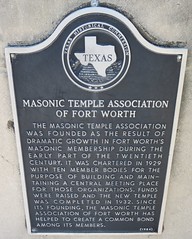
Texas Historical Marker #03247
Masonic Temple of Fort Worth. This building was constructed for the Masonic Temple Association of Fort Worth provide a single meeting place for all member bodies. Completed in 1932, it was designed by the Fort Worth architectural firm of Wiley G. Clarkson & Co. The Temple exhibits Neo-Classical styling with Art Moderne influences and features upper-story ionic columns and Monel bas-relief doors. Recorded Texas Historic Landmark-1984. #3247
1100 Henderson, Fort Worth, TX, United States
Subjects
_plaque_01.jpg?width=250)
Texas Historical Marker #03030
Land Title Building. Pioneer architects Haggart and Sanguinet designed this brick, sandstone and cast iron building with rounded arched windows and other ornate details. It featured the first known stone carving in Fort Worth, the figure of an owl, and displayed the initials of the lawyers Ross, Head and Ross, who occupied the second floor, above the title firm. The structure is architecturally important because its style was rare in this region when it was built in 1889. Recorded Texas Historic Landmark-1977. #3030
111 W. 4th St., Fort Worth, TX, United States

Texas Historical Marker #05349
The Handley Power Plant & Lake Erie. The Northern Texas Traction Company built the original plant at this location to generate electrical power for the Fort Worth-Dallas Interurban. Lake Erie provided water for plant operations. The area developed as a park and became popular for local outings and social events. A two-story auditorium extended over the edge of the lake. When interurban traffic declined the park was closed. The power plant was expanded to meet increased electrical demands. In 1956 Lake Arlington became the new source of water for the Handley Plant, and Lake Erie was drained. (1980) #5349
6604 E. Rosedale, Fort Worth, TX, United States

Texas Historical Marker #04992
Southwestern Exposition and Livestock Show. Fort Worth Stock Yards Company publicist Charles C. French and local cattleman Charles C. McFarland oranized the first livestock show in north Fort Worth in 1896. Members of the Texas Cattle Raisers Association (TCRA) participated in the initial show. The Fort Worth Stock Yards Company built a new coliseum in north Fort Worth in 1908 with the help of TCRA members. That year the National Feeders and Breeders Show opened with various events including a cutting horse competition and a horse show. The event, renamed the Southwestern Exposition and Fat Stock Show in 1918, included an indoor rodeo competition, youth activities, and a debutante social pagent popularized by the City's more prominent citizens. In 1943 the show's facilities were converted for U.S. military purposes and the show was canceled. In 1944 the show relocated to this site which included a coliseum, auditorium,and a memorial Tower erected in 1936 as part of the Texas Centennial celebration. The show was renamed the Southwestern Exposition and Livestock Show in 1988. By 1995 the Show had become a 17-day multimillion-dollar premier rodeo, equine, livestock, and exhibition event with an annual draw of about 800,000 people. Sesquicentennial of Texas Statehood 1845-1995. #4992
3300 Crestline Rd., Fort Worth, TX, United States
Texas Historical Marker #02431
Hell's Half Acre. A notorious red light district known as Hell's Half Acre developed in this section of Fort Worth after the arrival of the Texas and Pacific Railway in 1876 launched a local economic boom. Fort Worth was soon the favorite destination for hundreds of cowboys, buffalo hunters, railroad workers, and freighters eager to wash off the trail dust and enjoy themselves. To meet the demand, a large number of saloons, dance halls, gambling houses, and bordellos opened between the Courthouse Square and the railroad depot. Illegal activities in Hell's Half Acre were tolerated by city officials because of their importance to the town's economy. The district prospered in the 1880s and added to Fort Worth's growing reputation as a rowdy frontier town. Famous gamblers Luke Short, Bat Masterson and Wyatt Earp and outlaws Sam Bass, Eugene Bunch, Butch Cassidy and the Sundance Kid are known to have spent time in Hell's Half Acre. A 1906 newspaper headline calling the district Fort Worth's den of sin and refuge of criminals was representative of periodic efforts to clean up the district. These efforts proved unsuccessful until Army officials at Camp Bowie, established here during World War I, helped local officials shut the district down. (1993) #2431
12th & Houston, Fort Worth, TX, United States
Subjects


Comanche chief Quanah Parker was a son of two cultures. He was born about 1845 along Elk Creek, Indian Territory (Oklahoma). His Anglo mother was Cynthia Ann Parker, taken captive in a May 1836 raid and adopted by Qua-Ha-Di (Antelope) Comanches, and his father was Comanche chief Peta Nocona. Texas Rangers reclaimed Cynthia Ann in an 1860 fight at the Pease River. Nocona died soon after, and Cynthia Ann lived with relatives near Birdville in Tarrant County before dying with no further contact with her Comanche family. Becoming chief upon his father's death, Quanah refused to sign the 1867 Medicine Lodge Treaty that sent many Plains Indians to reservations. Instead, he led raids in texas and Mexico for another seven years, likely including the last foray into Tarrant County in June 1871. That winter, Quanah's band eluded Col. Ranald MacKenzie's Fourth U.S. Cavalry across the Texas panhandle. Comanche losses during the 1874 Panhandle Battle of Adobe Walls, in which Quanah was wounded, followed by a harsh winter, finally brought him and fewer than 100 remaining Qua-Ha-Di to the reservation at Fort Sill, Indian Territory in May 1875. Quanah served as liaison between his people and the Bureau of Indian Affairs. He proved to be a pragmatic leader, encouraging the Comanches to take up ranching and farming, and to educate their children in government schools. Quanah prospered through his investments and built his spacious Star House near Cache, OK. He traveled widely, giving speeches and interviews and participating in wild west shows, the Texas State Fair, Texas Cattle Raisers Association gathering and the Fort Worth Fat Stock Show. Quanah visited Fort Worth and the Stockyards on many occasions. He died in 1911 and is buried at Fort Sill. (2007)
131 E. Exchange St, Fort Worth, TX, United States

Texas Historical Marker #05243
Texas & Pacific Terminal Building. A line of the Texas & Pacific Railroad was extended to Fort Worth in 1876 and proved vital to the economic growth of the City. Company officials, led by the President John L. Lancaster, had this Passenger Terminal Building constructed in 1931. Designed by Wyatt C. Hedrick (1888-1964), it is a good example of the Art Deco style. Rail traffic began to decline during the 1950s and the last T&P passenger train to the city stopped here on March 22, 1967. #5243
Lancaster & Throckmorton St., Fort Worth, TX, United States
Texas Historical Marker #17028
Raymond C. Morrison. #17028
3220 Rock Springs Road, Fort Worth, TX, United States
Subjects

Texas Historical Marker #00804
Chapel Cemetery. This cemetery traces its origin to the settlement here in the mid 1850s of the pioneer families of John A. and Rhoda Raibourn Fanning, Mitchell and Eliny Jane Raibourn, and Thomas Raibourn. According to Fanning family tradition the cemetery began with the burial of Eliny Raibourn at this site in 1856 and the subsequent donation of the land for cemetery purposes by her brother-in-law, John Fanning. Afterwards the site became known as the Fanning burying grounds. A one-room school house known as Horse Creek School or Lone Star School, located about a mile south of here, was the sole communal structure in this area until a chapel was built next to the burying ground. In 1893 T.A. and Catherine Sweet transferred ownership of the chapel and surrounding land to the Sweet Chapel Methodist Church, and the burying grounds became known as Sweet Chapel Cemetery. By 1938 the Sweet family had moved to Fort Worth, the chapel had disappeared, and the cemetery was known simply as Chapel Cemetery. Burials continued on an informal basis and for many years the graveyard was cared for by members of the Francisco family. The Cemetery was acquired by the Mount Olivet Cemetery Association in 1985. (1993) #804
On Old Denton Highway, 20 mi. N of Fort Worth, Fort Worth, TX, United States

Texas Historical Marker #01266
Dr. Clay Johnson House. Completed in 1912 for Dr. Clay Johnson, this house was designed by the Fort Worth architectural firm of Waller and Field. The Prairie School influence is visible in the home's horizontal roof line and broad cornices, while more Classical detailing appears in the semi-circular windows and the balustrade around the roof. Dr. Johnson, Chief Surgeon for the Fort Worth and Denver City Railroad's Wichita Valley Line, lived here until his death in 1948. Recorded Texas Historic Landmark-1983. #1266
#3 Chase Ct., Fort Worth, TX, United States

Texas Historical Marker #05272
Texas Spring Palace. Following a suggestion by General R.A. Cameron, an officer of the Fort Worth & Denver Railway, city promoters developed the idea of an annual exhibition for the display of Texas agricultural products. In 1889 they constructed the Texas Spring Palace near this site to house the exhibits. Designed by the Fort Worth firm of Armstrong and Messer, it was a two-story wooden structure featuring influences of Oriental and Moorish styles. Women's groups added ornamentation using flowers, seeds, and grasses. On the evening of May 30, 1890, during the second season of the exhibition, a fire swept through the Spring Palace, completely destroying the structure. A number of people who crowded the building at the time had to leap from the second floor to escape the flames. Alfred S. Hayne (b. 1849), a native of England, returned to the burning Palace to help others who were still trapped inside. The only fatality of the fire, he died the next day of burns suffered in the rescue effort. In 1893 the Women's Humane Association dedicated a monument near this site in memory of his heroism and courage. Efforts to rebuild the Texas Spring Palace failed because of economic problems in the Panic of 1893. #5272
100 Block of W. Lancaster, Fort Worth, TX, United States

Texas Historical Marker #02435
Hemphill Presbyterian Church. This Neo-Classical auditorium was built in 1925 to serve the increasing membership of Hemphill Presbyterian Church. Dedicated the following year, the building features a brick parapet and a bay window on the north corner. The imposing entrance consists of three open oval brick arches flanked by large pilasters. The neighborhood landmark continues to serve a large congregation. Recorded Texas Historic Landmark - 1984. #2435
1701 Hemphill St., Fort Worth, TX, United States
Texas Historical Marker #00286
Baldridge House. This property was part of the original Chamerlain-Arlington Heights development of the 1890s. Earl and Florence Baldridge built this elegant residence in 1910-13. Designed by the architectural firm of Sanguinet & Staats, it was a showplace of the time. Massive limestone columns line of the line facade. Carved oak woodwork decorates the interior. The home was occupied for many years by W.C. Stonestreet, a prominent Fort Worth clothier. Recorded Texas Historic Landmark - 1978. #286
5100 Crestline Rd., Fort Worth, TX, United States

Texas Historical Marker #04038
Pioneer's Rest Cemetery. This burial ground was started in the summer of 1850 upon the deaths of Sophie and Willis Arnold, children of Major Ripley A. Arnold (1817-1853), commander of the troops at Fort Worth. Arnold's friend, Doctor Adolphus Gouhenant, set aside a three-acre burial site at that time. In 1871, after a cemetery association was begun, Baldwin Samuels gave three adjoining acres. Many early Fort Worth settlers, including 75 Civil War veterans, are buried here. This site also contains the graves of Major Arnold and General Edward H.Tarrant (1799-1858), for whom Tarrant County was named. #4038
600 block Samuels Ave., Pioneer's Rest Cemetery, Fort Worth, TX, United States

Texas Historical Marker #02033
Fort Worth Stock Yards Entrance. Spanning Exchange Avenue, this gateway to the Fort Worth Stock Yard was completed in 1910. Constructed by the Topeka Bridge & Land Co. for the Fort Worth Stock Yards Co., it was a significant feat of concrete work for that era. The columns are 22 feet high and 13 feet in circumference. The sign is 36 feet long and 4 feet high. The entrance is a significant landmark in this historic area of Fort Worth. Recorded Texas Historic Landmark-1985. #2033
100 block E. Exchange St., Fort Worth, TX, United States

Texas Historical Marker #02126
General Edward H. Tarrant. South Carolina native Edward H. Tarrant enlisted in the Kentucky Militia in 1814 and served under Gen. Andrew Jackson in the Battle of New Orleans. Moving to Tennessee after 1816, he was elected Colonel of the Henry County Militia and served as County Sheriff. Tarrant arrived in Texas in November 1835, settling in Red River County. He served in the Republic of Texas Congress and became a Brigadier General in the Texas Militia in 1839. He commanded the Texas Rangers at the Battle of Village Creek in present Tarrant County in 1841 and, with George W. Terrell, negotiated treaties with many of the Texas Indian tribes at Bird's Fort in 1843. Tarrant represented Bowie County at the Annexation Convention of 1845. By February 1846, he had moved to Navarro County, where he became Chief Justice and was elected to the 3rd and 4th Texas Legislatures. In the 1850s, Tarrant commanded a force of Texas Rangers defending the frontier at Fort Belknap. He died in Parker County in 1858 and was buried there. The next year, his remains were moved to his farm in Ellis County. In 1928, his body was reinterred here by the Daughters of the Republic of Texas. Tarrant County, created in 1849, was named in his honor. #2126
626 Samuels Ave., Fort Worth, TX, United States
Texas Historical Marker #04475
Saint Patrick's Cathedral. Erected 1888-1892 under the direction of the parish priest, the Rev. Jean M. Guyot, a native of France. Stone for walls was quarried locally. Improvised, horse-powered lathes were used to turn and polish the eighteen interior pillars. Ceilings and window frames are wood grained. Stained glass windows were imported from Munich, Germany. Bell, cast in Troy, New York, has been in use since 1888. #4475
1206 Throckmorton, Fort Worth, TX, United States

Texas Historical Marker #00945
Coliseum. Until 1908, The Annual Fort Worth Fat Stock Show was held in a variety of locations. As interest increased in the event and its educational and promotional values were realized, livestock exhibitors sought a permanent home for the show. The coliseum was constructed in 1907-08 to provide such an exhibition hall. Construction costs were borne by the Swift and Armour Packing Companies, and by the Fort Worth Stock Yards Company, which owned the property. The stock show was held here annually for 34 years. This site has been within three separate cities: North Fort Worth until 1909; Niles City, 1911-23; and in Fort Worth since 1923. It is the birthplace of the indoor rodeo, and the first live radio broadcast of a rodeo was transmitted here on WBAP Radio in 1923. The Coliseum also has served as a place for cultural, educational, religious, social, and civic events. In 1911, former President Theodore Roosevelt spoke here. Numerous Texas Governors, performing artists, grand operas, entertainers and evangelists have appeared here. The great Italian tenor, Enrico Caruso, performed here in 1920. In 1936, the Stock Yards Company sold the coliseum to the City of Fort Worth. Historically it has been an important part of the city and the livestock industry. (1984) #945
123 E. Exchange Ave., Fort Worth, TX, United States
Subjects

Texas Historical Marker #00125
Allen Chapel African Methodist Episcopal Church. The oldest and largest African Methodist Episcopal Church in Fort Worth. This church organization was organized about 1870 by the Rev. Moody, pioneer circuit rider, and five area settlers. Members met in homes until facilities were built at this site soon after it was purchased in 1878. The name Allen was adopted as part of the congregational title in 1879 to honor Richard Allen, a former slave who became the first Bishop of the A.M.E. faith. Led by 29 pastors in over a century of service, Allen Chapel has played a significant role in Fort Worth's development. (1982) #125
116 Elm Street, Fort Worth, TX, United States

Texas Historical Marker #02131
General H.P. Mabry. A Georgian. Came to Texas 1851. Admitted to bar. Texas Legislator 1856-60. With Confederate expedition capturing Forts Washita and Arbuckle, Indian Territory, April-May 1861. June 1861 joined 3rd Tex. Cav. Helped win Wilson's Creek battle, in campaign to keep Missouri in Confederate fold. Late 1861 scouted U.S. Gen. Fremont's Army, Springfield, Mo. Had arm shattered in Bowie knife fray with 7 out to take him as spy. Led regiment at Pea Ridge, Ark., March 1862. At Luka, Miss., Sept. 1862, lost a third of unit, was shot 3 times and was taken captive. Back of Marker: Exchanged at Vicksburg late 1862, Mabry refused to sign parole until slur on Confederacy was removed. In command of Mississippi Cavalry, led patrols repulsing Federals from rich Yazoo Valley breadbasket 1863-64. Guarded food, forage for supplying Confederacy. Commanded Calvary that took, dismantled, burned U.S. Gunboat "Petrel" on Yazoo River. Attached to Gen. Forrest's Division, helped bottle enemy in Memphis, formed rear guard for offensives, destroyed Sherman communications, fought pitched battles. Spies would report Mabry's horsemen in 3 different spots hundreds of miles apart on same day. Assigned to move Texas cattle, men, supplies across tightly guarded Mississippi River. 1866 was elected District Judge, but removed by Radical Reconstruction authorities. 1879-1885 practiced law Fort Worth. Buried in Oakwood Cemetery, Jefferson. #2131
2900 Crestline Rd., Fort Worth, TX, United States

Texas Historical Marker #02026
Fort Worth "Where the West Begins". Founded June 6, 1849, as frontier post of Co. F., 2nd Dragoons, 8th Dept., U.S. Army. The commander, Maj. Ripley Arnold, named camp for his former superior officer, Maj. Gen William Jenkins Worth. In 4 years of operations, the post had but one serious Indian encounter. A town grew up alongside the fort, as center for supply stores and stagecoach routes. In 1856 Fort Worth became county seat of Tarrant County. A boom started after 1867 when millions of longhorns were driven through town en route to Red River Crossing and Chisholm Traill. Herds forded the Trinity below Courthouse Bluff, one block north of this site. Cowboys got supplies for the long uptrail drive and caroused in taverns and dance halls. After railroad arrived in 1876, increased cattle traffic won city the nickname of "Cowtown". By 1900, Fort Worth was one of world's largest cattle markets. Population tripled between 1900 and 1910. Growth continued, based on varied multimillion-dollar industries of meat packing, flour milling, grain storage, oil, aircraft plants and military bases. Fort Worth also has developed as a center of culture, with universities, museums, art galleries, theatres and a botanic garden. #2026
200 W. Belknap, Fort Worth, TX, United States

Texas Historical Marker #02034
Fort Worth Stockyards Hog and Sheep Markets. Early attempts by the Fort Worth Union Stock Yards Corporation, established in 1887, to persuade Texans to produce more hogs proved unsuccessful. In 1903 the Fort Worth Stockyards constructed new hog and sheep pens and launched a promotional campaign, which included cash and livestock prizes and a youth Pig Club program, to persuade ranchers to raise more hogs. The number of hogs processed at the stockyards increased from 150,527 in 1903 to 1,062,021 in 1917. The number of sheep processed at the stockyards ranged from about 100,000 to 400,00 per year from 1903 through the 1920s . By 1936 Texas had become the largest producing state for both cattle and sheep. For one week in the spring of 1937 Fort Worth received more sheep than any other principal U.S. market. During World War II cattle, sheep, and hog numbers at the Fort Worth Stockyards increased dramatically. Hog totals topped 1 million in both 1943 and 1944 and from 1943 through 1946 more than 2 million sheep were processed annually at Fort Worth's Stockyards. The Sheep and Hog Markets were a significant factor in Fort Worth's development into one of the nation's largest livestock centers during the 1940s and 1950s. Sesquicentennial of Texas Statehood 1845-1995. #2034
140 E. Exchange St., Fort Worth, TX, United States

Texas Historical Marker #02032
Fort Worth Stock Yards Company. The Fort Worth Stock Yards Company was created in 1893, when Boston capitalist Greenlief W. Simpson led a group of investors in purchasing the Fort Worth Union Stock Yards. Under Simpson's leadership, the Company earned the support of the Texas Cattle Raisers Association and lured the prominent meatpacking companies of Armour and Swift to open plants here. Publicity through the Company's market newspaper and annual Fat Stock Show, both begun in 1896, resulted in a significant increase in the number of animals brought to market. The Stock Yards Co. built the area's livestock-related facilities and had controlling interest in many North Fort Worth businesses and properties. The first five decades of the 20th Century were the most successful for the Fort Worth Stock Yards Co. During World War I, foreign governments purchased draft animals, making Fort Worth the largest horse and mule market in the world. In 1917, overall livestock market receipts reached 3,500,000 and in 1944, sales exceeded 5,000,000 head of livestock. However, by the 1950s, local auctions were drawing sellers away from this central market. Today the Fort Worth Stock Yards Co. continues as a significant part of the city's unique heritage. Texas Sesquicentennial 1836-1986. #2032
131 E. Exchange St., Fort Worth, TX, United States

Texas Historical Marker #04964
Smith-Burnett Home. This area of Fort Worth became a fashionable subdivision during the early part of the twentieth century and attracted many prominent residents. In 1906 Fort Worth banker Ben O. Smith (1867-1932) purchased land at this site. He built a home here for his wife, Frances, who hosted many Fort Worth social gatherings. In 1916, the home was purchased by Tom Burnett, a prominent cattleman and the son of rancher S. Burk Burnett. The site retains historical significance for its association with these two prominent Fort Worth families. #4964
4910 Crestline Rd., Fort Worth, TX, United States

Texas Historical Marker #01369
Eastern Cattle Trail. This native stone, dug from the Trinity River Valley, marks the route of the Eastern Cattle Trail, where cattle were driven north on Rusk Street, now Commerce Street, through the City of Fort Worth, Texas, to the bluff and then across the Trinity River to the broad valley below, where they rested before continuing their long drive north. From the end of the Civil War to the bringing of the railroad in 1876, great herds of cattle passed this way to Abilene, Kansas. The Eastern Trail, also called the McCoy Trail, became the Chisholm Trail when it reached the Red River. Fort Worth, the last place for provisions before Indian Country, received its name, 'Cow Town', and it first major industry, from this period. #1369
Heritage Park, 100 N. Commerce, Fort Worth, TX, United States

Texas Historical Marker #03877
Ormer Leslie Locklear. A native of Greenville, Texas, Ormer Leslie Locklear moved to Fort Worth with his family in 1906. He worked for his father's construction company until 1914, when he and his brother opened an automobile repair shop. Locklear enlisted in the U.S. Army Air Service in 1917, soon after the U.S. enter World War I. He trained in San Antonio and Austin before being assigned to Barron Field near Fort Worth as a flight instructor. He soon became known for his daring feats of precision flying and performed in barnstorming air shows to recruit pilots for military service. Locklear resigned his Army commission in 1919 to fly in the commercial air show circuit. Hired by the Universal Film Company as a stunt pilot for motion pictures, he moved to Hollywood and in 1920 was killed flying a stunt pilot for his second feature, "The Skywayman". The accident, believed to have been caused when the bright lights illuminating the night sky for filming blinded the pilot, was recorded on film and used in the movie's final scene. Thousands of mourners attended Locklear's Fort Worth funeral, which the Fox Film Corporation filmed and released later as a newsreel. (1992) #3877
3400 White Settlement Rd., Fort Worth, TX, United States

Texas Historical Marker #04881
Site of Saint Stanislaus Kostka Catholic Church. Catholics in Fort Worth began meeting together for regular worship services by 1875. They met in private homes, and were served by traveling priests. In 1876 Bishop Claude Dubuis of the Diocese of Galveston assigned a young Irish priest, Father Thomas Loughrey, to establish a parish in Fort Worth. In July 1876 the Diocese purchased two lots at this site for a church to be named for Polish Jesuit Saint Stanislaus Kostka. Within three months, on October 29, 1876, Father Laughry said the first High Mass in the frame structure. He continued to serve the church until 1884, when Father Jean Marie Guyot was assigned as Pastor. The church opened a Catholic School in the parish. Classes initially were taught by Father Loughrey and the Sisters of Mercy. After 1885 the school was operated by the Sisters of St. Mary. By 1885 plans were underway for a new church structure. Completed in 1892, it was named for Saint Patrick. The original Saint Stanislaus building became part of the school. After serving the parish for over three decades, it was removed between 1908 and 1909 to make way for a new parish rectory. #4881
1206 Throckmorton, Fort Worth, TX, United States
Texas Historical Marker #02030
Fort Worth Main Post Office Buiding. The Fort Worth Post Office was established in 1856 with pioneer settler Julian Field serving as Postmaster. The central offices were moved here in 1933 when this building was completed. Designed by the Fort Worth firm of Wyatt C. Hedrick, it features interior detailing of marble, bronze, and gold leaf. Exterior ornamentation reflects the significance of the cattle industry in the development of the area. Recorded Texas Historic Landmark-1980. #2030
300 block W Lancaster, Fort Worth, TX, United States
Texas Historical Marker #02028
Fort Worth Library. Seeking funds for a public library, local woman asked the philanthropist, Andrew Carnegie, to donate "The price of a good cigar". He gave $50,000. With that and substantial local gifts, including land donated by Mrs. Sarah J. Jennings, the first City Library opened on this site, 1901. First Librarian, Mrs. Charles Schevber, was active in parks movement and local art circles. She was Vice President, 1911-1917, American Federation of Art. The old library was razed in 1938. This building in modern Classic style is four times as large as the original Library. (1968) #2028
Houston & 9th St., Fort Worth, TX, United States
Subjects


Texas Historical Marker #05465
Thomas B. Saunders Family. A native of North Carolina, Thomas Bailey Saunders (1816-1902) migrated to Texas in 1850 and started a cattle ranch near Gonzales. After the Civil War he completed cattle drives to markets in New Orleans and Kansas before settling in Bexar County. Two of Saunders' twelve children were also involved in the cattle industry. William David Harris Saunders (1845-1922) helped supply beef for Confederate forces during the Civil War and later became a successful Goliad merchant and rancher. Another son, George Washington Saunders (1854-1933), became a noted trail driver of the 1870s. He later opened a livestock commission in San Antonio. Thomas B. Saunders, II (1872-1929), the son of William, owned a livestock firm in Houston. He later moved here and in 1902 became the first cattle dealer on the Fort Worth Stockyards. He was a pioneer in the transporting of cattle by truck. His son Thomas B. Saunders, III (1906-1974), was involved in extensive ranching operations throughout the Southwest. During the 1930s economic depression, he started a cattle clearinghouse for traders, order buyers, and commission companies. Since the 1850s, Saunders family members have been actively involved in the Texas cattle industry. #5465
100 block of E. Exchange St., Fort Worth, TX, United States
Texas Historical Marker #03495
Mount Olivet Cemetery. Encompassing almost 130 acres, the Mount Olivet Cemetery was founded in 1907 by Flavious G. McPeak (1858-1933) and his wife, Johnnie Clara Lester McPeak (1858-1936), who arrived in Fort Worth in 1894 from Tennessee. The land on which the cemetery is located was purchased by Mrs. McPeak in 1895, and the family built a two-story home in 1896. The parents of ten children, the McPeaks moved to a home on Lake Street when they founded this cemetery. Flavious McPeak, a respected Fort Worth businessman, had visited the Mount Olivet Cemetery in Nashville, Tennessee, and was so impressed with its design that many of its features were incorporated here. A mausoleum was completed in 1909, but only served as a temporary receiving vault. It was torn down when a new mausoleum was built in 1983. A variety of free-standing and relief sculpture can be seen throughout the grounds. Containing over 47,000 burials, this was the first perpetual care cemetery in the county. The oldest marked grave is that of Zenas Ewin Kerr, buried April 11, 1907. Also interred here are 594 victims of the flu epidemic of 1918, the McPeaks and members of their family, and many Tarrant County pioneers. Texas Sesquicentennial 1836-1986. #3495
2205 N. Sylvania, Fort Worth, TX, United States
Texas Historical Marker #04377
Royal Flying Corps. In 1917, during World War I, the U.S., British, and Canadian Governments entered into a reciprocal agreement to train military pilots for combat duty. Foreign troops trained in Texas during the winter and in Canada in the summer. Camp Taliaferro in Tarrant County, consisting of three air fields, provided training facilities for members of the Royal Flying Corp and U.S. forces from October 1917 to November 1918. Each field accommodated an average of 2,000 men. Royal Flying Corps expertise and skilled instructors enabled large numbers of Americans to receive excellent flight training in a short time. During the months British and Canadian troops were stationed in Fort Worth, 39 officers and cadets were killed during flight training. Eleven of the men were buried at the three Air Fields; in 1924 the Imperial War Graves Commission purchased a plot at Greenwood Cemetery for reinterment. A monument was later erected at the site, which now has twelve graves since a veteran who died in 1975 requested burial here with his friends. The Royal Flying Corps, although in Texas for only a short time, had a beneficial and lasting influence on aviation in this country. #4377
3400 White Settlement Rd., Fort Worth, TX, United States
Texas Historical Marker #04464
Saint Mary of the Assumption Roman Catholic Church. The first Mass for this Roman Catholic parish was held in 1909 in a small wooden church which burned in 1922. This Romanesque Revival structure was designed by the well-known firm of Sanguinet, Staats and Hedrick. It was dedicated July 20, 1924, by the most Rev. Joseph P. Lynch, Bishop of Dallas. The bells were installed in 1956. This parish has been guided by the Vincentian, Benedictine, and Salvatorian religious orders. #4464
509 W. Magnolia Ave., Fort Worth, TX, United States
Texas Historical Marker #04479
Saint Paul Lutheran Church. In 1892 the Rev. Johann Christian Schulenburg (1840-1922), a Lutheran Church-Missouri Synod missionary, conducted services in German at the Knights of Honor Hall in downtown Fort Worth. In 1896 the Mission was chartered as the Evangelisch Lutherische St. Paulus Gemeinde, and a chapel was erected on Hemphill and Railroad (now Vickery) avenues. In 1919 the congregation erected a new church building on May Street. With continued growth of membership a larger facility became necessary, and the church relocated on the West Freeway in 1954. #4479
1800 West Freeway, Fort Worth, TX, United States
.jpg?width=250)
Texas Historical Marker #02035
Fort Worth Stockyards Horse and Mule Barns. The Fort Worth Stock Yard Company's wooden horse and mule barns on this site were destroyed by fire on March 14, 1911, opening day of the Feeders and Breeders show (later Southwestern Exposition & Fat Stock Show). The show opened as planned, with former President Theodore Roosevelt giving the opening address. The company announced plans to replace the destroyed barns immediately with new concrete and steel fireproof buildings. Construction was completed in March 1912, and the new barns measuring 540'x350' had a capacity for 3000 animals. With a price tag of $300,000, the buildings were described as among the finest stables in the world. Activity here increased considerably in 1914, at the outbreak of World War I. Horses and mules were needed in great supply by European armies, and agents were sent in droves to Fort Worth to buy stock, spending an estimated $11 million. During that time, Fort Worth was designated the largest horse and mule market in the world. The wide space between the buildings has over the years spawned the nickname "Mule Alley". In recent years the barns have been used for various cultural activities and annual events. Texas Sesquicentennial 1836-1986. #2035
120 E. Exchange St., Fort Worth, TX, United States
Subjects
Texas Historical Marker #04800
Site of Fort Worth's First Telephone Exchange. #4800
W. 2nd & Houston, Fort Worth, TX, United States
Texas Historical Marker #05463
Thistle Hill, The Cattle Baron's Mansion. Designed by Sanguinet & Staats, this Georgian Revival structure was built in 1903 for A.B. Wharton (1878-1963) and his bride Electra (1882-1925), daughter of rancher W.T. Waggoner (1852-1934). Electra named the mansion "Thistle Hill". Cattlemen-investor Winfield Scott (1849-1911) bought the home in 1910 but died before he moved in. His wife Elizabeth (1861-1935) lived here until her death. Occupied by the Girls' Service League, 1940-1968, the house was purchased in 1976 by "Save the Scott Home!" Inc. #5463
1509 Pennsylvania Ave., Fort Worth, TX, United States
Texas Historical Marker #05839
William Madison McDonald (June 22, 1866-July 4, 1950). Born in Kaufman County, William "Gooseneck Bill" McDonald became active in politics in 1890. His ability to unite black and white voters led to his prominence as a leader of the "Black and Tan" faction of the Republican Party. He remained influential, serving as a delegate to many state and national conventions, until the decline of the Republican Party in Texas in the early 1900s. Also active in black Masonic societies, he served as State Secretary for 47 years. He moved to Fort Worth in 1906, founded the Fraternal Bank and Trust Company, and was a prominent civic leader. (1982) #5839
700 Grand Ave., Fort Worth, TX, United States
Texas Historical Marker #04456
Saint Joseph Hospital. In the 1880s Fort Worth was a thriving railroad town. The Missouri Pacific Railroad Company established an infirmary near its headquarters to care for its employees. In 1885 the Congregation of Sisters of Charity of Incarnate Word, based in San Antonio, was asked to take over operation of the infirmary. Ten nuns traveled to Fort Worth to begin work at the Infirmary. When the work of the railroad was completed in 1889, the Congregation purchased the facility and it was renamed St. Joseph's Infirmary. St. Joseph's was Fort Worth's first general hospital, and from the outset ministered to charity patients. A new three-story brick structure was built in 1898, and over the years additional facilities were built to house the hospital's expanding services. The name was changed in 1930 to St. Joseph's Hospital, and again in 1966 to Saint Joseph Hospital. In addition to direct medical care, the hospital's programs have grown to include training for health care professionals as well as educational and counseling services for patients and their families. The county's first hospice program for terminally ill patients was inaugurated here in 1980. For over 100 years this hospital has served the community. #4456
1401 S. Main St., Fort Worth, TX, United States
Texas Historical Marker #04462
Saint Mark United Methodist Church. This congregation was formed in 1940 by the merger of several historic Fort Worth Methodist Churches. The Swedish Methodist Episcopal Church was organized in 1883 with twenty charter members under the leadership of the Rev. P.S. Juhline. Use of the Swedish language during worship services continued until 1920. In 1924 the name of the congregation was changed to Broadway Methodist Episcopal Church. Six years later, St. Paul Methodist Episcopal Church merged with the Broadway Congregation. St. Paul's had been organized in 1877 with thirty charter members under the leadership of the Rev. Harvey Webb. Mulkey Memorial Methodist Episcopal Church began in the late 1880s as a mission of the First Methodist Episcopal Church of Fort Worth. The church was named for the Rev. and Mrs. William Mulkey, parents of George Mulkey, who was a charter member of the new church. The Rev. John M. Barcus served as first pastor. At the 1940 Annual Conference these historic congregations merged to become the Broadway-Mulkey Methodist Episcopal Church, South. The name St. Mark was adopted in 1945. The congregation has worshiped at this site since 1960. [Now renamed Christ-Life Church] #4462
1200 Wesleyan St., Fort Worth, TX, United States
Texas Historical Marker #00094
Ahavath Sholom Hebrew Cemetery. Wishing to have their own cemetery, congregation Ahavath Sholom, the first Jewish congregation in Fort Worth, purchased a six-acre tract from the Greenwood Cemetery Association at this location and dedicated Ahavath Sholom Hebrew Cemetery in 1909. A Ladies Cemetery Society was formed in that year to oversee the upkeep of the graveyard; Rebecca Goldstein served as its initial president. The first person buried here was Charles Hurwitz in 1910. In 1929 an agreement between the congregation and the Greenwood Cemetery Association resulted in the enlargement of this Jewish cemetary. Three soldiers who perished during World War II are buried side by side in the north section of the cemetery. A large monument memorializing the millions of Jewish victims of the German Nazi Regime in World War II Europe (1939-1945) was erected by members of the congregation who lost relatives in the Holocaust. The Kornbleet Chapel, which contains seating for one hundred persons, was dedicated in 1988. The chapel is used for funeral services as well as other religious services pertaining to the cemetery. The congregation established a trust fund for the long-term maintenance of the cemetery. (1993) (1992) #94
415 N. University, Fort Worth, TX, United States
Texas Historical Marker #00154
Amon G. Carter. Born in Wise County, Texas, on December 11, 1879, Amon Giles Carter left home at an early age and worked at a variety of odd jobs around the country before his arrival in Fort Worth in 1905. Carter became the advertising manager of the "Fort Worth Star", which published its first issue on February 1, 1906. Thus began a career in journalism that by 1925 had taken him to the position of president and publisher of the "Fort Worth Star-Telegram," the newspaper with the largest circulation in Texas for many years. Carter's involvement in a wide variety of interests left its mark on many Texas institutions. In 1921, he authorized the purchase of equipment that resulted in the establishment of WBAP Radio in Fort Worth. An aviation enthusiast, Carter brought numerous early aviators to Fort Worth to demonstrate their skills and helped attract aviation industry to the area. His promotion of Fort Worth and the entire West Texas region attracted widespread attention. Much of the fortune he earned in oil was spent on philanthropic interests, including establishment of the Amon Carter Museum as a gift to Fort Worth. Amon G. Carter died in Fort Worth on June 23, 1955, and is buried in Greenwood Cemetery. (1985) #154
400 W. 7th, Fort Worth, TX, United States
Texas Historical Marker #00387
Beth-el Congregation. The beginnings of a Reform Jewish Community in Fort Worth date to 1879, when the Hebrew Benevolent Society opened a Sabbath School, and early services were held in homes. About 1900, under the leadership of Henry Gernsbacher (1858-1936), enthusiasm began to grow,and in 1902 a call was issued in the area for the organization of a formal congregation. Forty-three people gathered to found the Beth-el Congregation, and Sam Levy (1856-1927) was elected president. The Fort Worth section of the National Counsel of Jewish Women donated funds to bring a Rabbi to conduct High Holy Days services. The early days of the congregation were difficult ones, with services being held sporadically. For a time, student Rabbis from Hebrew Union College in Cincinnati conducted services for High Holy Days. In 1904 a Rabbi was hired, and the congregation met in rented quarters. A lot was bought on the corner of Fifth and Taylor streets in 1907, and a Temple was built in 1908. By 1919 the congregation had outgrown the buildings and a new Temple was built on this site. Soon after a 25th Anniversary Celebration, the temple was destroyed by fire on August 29, 1946. Beth-El Temple was rebuilt, and dedicated on January 7, 1949. Texas Sesquicentennial 1836-1986. #387
207 W. Broadway, Fort Worth, TX, United States
Texas Historical Marker #00651
Camp Bowie in World War I. Headquarters, 36th Division, United States Army, 1917-1919. Established to train Texas National Guard and Oklahoma National Guard, after the U.S. entered World War I April 1917. Named for James Bowie (1795-1836), one of the commanders who died at the Alamo in Texas War for Independence, Camp Bowie was occupied in July 1917. First troops to arrive slept in deep Johnson grass that covered the site, an undeveloped suburb. By Nov. 1917, the 36th Division had 25,000 men here, and on July 8, 1918, they were shipped to France, to form reserve for French Armies of the Center. After nightfall, Oct. 6, the 36th occupied a segment of the fighting front; on Oct. 8 joined by elements of the U.S. 2nd Division, it captured St. Etienne-A-Arnes. It fought Oct. 10-28 in the Meuse-Argonne operation that shattered the German Army and assured victory to the Allies, bringing Armistice on Nov. 11, 1918. The 36th Division, embarking for home the next May, had all its men on U.S. soil by June 11, 1919. Soon demobilized, it saw its "Home" at Camp Bowie revert to civilian uses between July 1919 and Aug. 1920. When the Texas National Guard entered World War II its new camp at Brownwood was also named Bowie. (1973) #651
4100 block Camp Bowie Blvd., Fort Worth, TX, United States
Texas Historical Marker #01035
Congregation Ahavath Sholom. Recognized as Fort Worth's first Jewish congregation, Congregation Ahavath Sholom, meaning "Love of Peace", was organized in 1892. William Goldstein served as its first president. The first synagogue, a wooden structure built in 1893 and located at the corner of Hemphill and Jarvis Streets, was relocated to downtown Fort Worth (819 Taylor Street) in 1901. Subsequent growth in the congregation's membership led to the construction of a brick structure at the Taylor site in 1906. An adjoining building, which housed the congregation's Hebrew Institute, was built in 1914. The Institute's Ladies Auxiliary, organized in 1915, sponsored a Sunday school and assisted charity organizations. Mrs. Sam Rosen was its first president. The Institute served as a community center for military personnel during World Wars I and II. The Men's Club, organized in 1944 with Maurice Rabinowtz as president, develops cultural, social, and athletic interests. A new synagogue, erected at the corner of 8th and Myrtle Streets, was dedicated in 1952. A synagogue was constructed at this site in 1980. Although the location of the synagogue has changed, it continues to be the focal point for the religious observances of the congregation. (1993) #1035
4050 S Hulen St, Fort Worth, TX, United States
Texas Historical Marker #01490
Ephraim Merrill Daggett. Canadian born Ephraim Merrill Daggett was reared on a farm in Indiana. He traded with the Indians at Fort Dearborn (Chicago) in the early 1830s then moved to Shelby County, Republic of Texas, in 1838. There he and his family became involved in the East Texas Regulator-Moderator feud (1839-1844). He later served as a Captain in the Mexican War of 1846. While serving as State Legislator from Shelby County (1851-53), he established a mercantile business and a hotel in the frontier town of Fort Worth. In 1854 he moved his family here and soon thereafter began purchasing large tracts of Tarrant County real estate. Daggett used his influence as a former legislator to help secure Fort Worth's selection as County Seat in 1860. After serving as Brigadier General during the Civil War, he engaged in the mercantile and cattle business in Fort Worth. In 1873 Daggett's likeness was chosen to adorn the City's first seal. His role in bringing the Texas & Pacific Railroad here in 1876, developing a downtown district, and in helping transform Fort Worth from an abandoned military post to a center of commerce earned Daggett reknown as "The Father of Fort Worth". He is buried in the City's Pioneer's Cemetery. (1993) #1490
9th and Houston St., Fort Worth, TX, United States
Texas Historical Marker #02038
Fort Worth-Yuma Mail (Star Post Route No. 31454). By the 1870s remote areas of the frontier not served by the railroads needed mail delivery routes. In response the U.S. Post Office Department, in 1873, began establishing Star Post Routes. On Aug. 15, 1878, Star Route No. 31454 was opened between Fort Worth and Yuma, Arizona Terr., under contract to J.T. Chidester. Stagecoaches carried the mail along much the same route used by the Butterfield Overland Mail in the late 1850s. Fort Worth to Yuma mail was discontinued after completion of the southern transcontinental railroad in 1881. (1976) #2038
Spur 520 & IH 820, Fort Worth, TX, United States
Texas Historical Marker #02057
Freese & Nichols, Inc.. Engineer John B. Hawley, designer and builder of Fort Worth's first city water system in 1892, was joined by Simon W. Freese in 1927 and Marvin C. Nichols in 1930 to form Hawley, Freese, and Nichols. The firm designed the nation's first dual-purpose reservoirs and pioneered the use of environmental engineering concepts in water treatment. One of Texas' oldest engineering firms, Freese and Nichols, Inc. is noted for developing water for West Texas by designing regional supplies to serve several cities and industries. It continues to play a vital role in the development of Texas. (1994) #2057
4055 International Plaza, Fort Worth, TX, United States
Texas Historical Marker #02036
Fort Worth Zoological Park. The oldest continuous Zoo site in Texas, the Fort Worth Zoological Park has provided its visitors with many recreational and educational opportunities since 1909. The first Zoo in Fort Worth was a small menagerie then located in an old City Park and operated by the newly established Park Board. After a 1909 flood destroyed the animal collection, George Vinnedge, the city's first Park Superintendent, chose this site for a new Zoo. Over the years, the Zoo has experience a steady growth in facilities and additions to its collection, largely due to community support and concern. (1983) #2036
2727 Zoological Park Dr., Fort Worth, TX, United States
Texas Historical Marker #02117
General William Jenkins Worth (1794-1849). During the War of 1812, William Jenkins Worth, a native of Hudson, New York, was aide-de-camp to Generals Morgan Lewis and Winfield Scott. Severely wounded at Lundy's Lane, Worth remained in the Army after the war and later served as Commandant of Cadets at West Point, 1820-28. In 1832 he fought in Illinois against the Sac and Fox Indians, led by Black Hawk. Involved in defenses along the Canadian border in the 1830s, Worth also participated in the removal of Cherokee Indians from the Southeastern United States. In 1842 Worth led an expedition against Florida Seminole Indians, defeating the last hostile band at Palaklakha Hammock. During the Mexican War, 1846-48, he fought with Zachary Taylor's forces at the Battle of Monterrey and received a Sword of Honor from Congress and a promotion to Major General. He was also a leader in the 1847 conquest of Mexico City. Worth died of cholera at San Antonio while serving as Commander of the Texas and New Mexico Military Districts. Although he never visited this area, a frontier post named in his honor, Fort Worth, was established here after his death. His grave in New York City is marked by a granite monument, fifty feet tall, at Broadway and Fifth Avenue. #2117
800 Main St., Fort Worth, TX, United States
Texas Historical Marker #02799
John Peter Smith. A native of Kentucky, John Peter Smith migrated to Fort Worth in 1853. He worked as a teacher, clerk, and surveyor before his appointment as Deputy Surveyor of the Denton Land Department in 1855, for which he received payment in property. Also a student of law, he was later admitted to the bar. Although opposed to the secession of Texas during the Civil War, Smith raised a company of Tarrant County men for the Confederacy and joined Sibley's Brigade in 1861. While in the war he served in the unsuccessful invasion of New Mexico, the recapture of Galveston in 1863, and was severely wounded at Donaldsville, Louisiana, later that year. After the war Smith returned to Fort Worth, where he became involved in the development of the City. He helped organize a bank, gas light company, and street railway. He also donated land for parks, cemeteries,and a hospital, later named John Peter Smith Hospital. In 1882 he became Mayor and directed the establishment of many public services, including the school system and the water department. In 1901 Smith died in St. Louis, Missouri, while on a promotional trip for Fort Worth. He is buried in Oakwood Cemetery, a site he donated to the city. #2799
1100 Throckmorton, Fort Worth, TX, United States
Texas Historical Marker #02800
John Peter Smith, Founder of Oakwood Cemetery. Pioneer area settler John Peter Smith (1831-1901), who donated twenty acres for the establishment of this cemetery, came to Fort Worth from Kentucky in 1853. He served the community as a teacher, clerk, surveyor, and attorney, and became a noted civic leader. Although opposed to the secession of Texas during the Civil War, Smith raised a company of Tarrant County men for the Confederacy and joined Sibley's Brigade in 1861. While in the war he served in the unsuccessful invasion of New Mexico, the recapture of Galveston in 1863, and was severely wounded at Donaldsville, Louisiana, later that year. After the war Smith returned to Fort Worth, where be became involved in the development of the city. He helped organize a bank, gas light company,and street railway. He also gave land for city parks, cemeteries, including this site in 1879, and a hospital, later named in his honor. In 1882 he became Mayor and directed the establishment of many public services, such as the school system and the water department. In 1901 Smith died in St. Louis, Missouri, while on a promotional trip for Fort Worth. He is buried in a section of Oakwood Cemetery that is part of the original acreage he donated to the city. #2800
700 Grand Ave., Fort Worth, TX, United States
Texas Historical Marker #03569
Neil P. Anderson Building. Neil P. Anderson (1847-1912) lived in Fort Worth by 1882. A talented broker, he helped this city set the pace for cotton trading in the inland markets of the Southwest. His firm had Sanguinet & Staats design this "Cotton Exchange" with seven skylights over top floor showrooms. Completed in 1921, it housed some of the city's leading businesses. The Exchange closed in 1939, but the Anderson interests owned the building until 1963. Recorded Texas Historic Landmark- 1978. #3569
411 West 7th, Fort Worth, TX, United States
Texas Historical Marker #01731
First Hundred Years of Texas Christian University. Founded during 19th century Christian Restoration Movement, by Joseph Addison Clark (1815-1901) and sons Addison (1842-1911) and Randolph (1844-1935). Joseph A. Clark, born in Illinois, came to Republic of Texas in 1839. A teacher, preacher, lawyer, surveyor, editor and publisher, he also was Fort Worth Postmaster in noisy cattle-trail and early railroad era. His sons, home from the Civil War, established a school in this city in 1869, on site which proved unsuitable. The family moved the school to Thorp Springs (33 MI. SW), where they founded Add-Ran Male and Female College in 1873. Church-related from its origin, the college was given in 1889 to the Christian Church Convention of Texas, and renamed Addran Christian University. Moved to Waco on Christmas Day, 1895, the school was renamed Texas Christian University (1902), and stayed there until the main building was destroyed by fire in 1910. When Fort Worth offered 52 acres of land for a campus and funds of $200,000 for building, Texas Christian University returned (1910) to the city first chosen as its location. By 1973, TCU had grown to 243 acres, 60 buildings, seven schools and colleges, and an average fall enrollment of 6500 students. Erected during Centennial Observance - 1973. #1731
2800 S. University, Fort Worth, TX, United States
Texas Historical Marker #02105
Garvey-Veihl House. Early landowner Baldwin L. Samuel deeded land in this area to his daughter Mary and her husband Isaac Foster in 1876. The Fosters and their daughter Lucy (Lula) and her husband William B. Garvey moved here from Kentucky in 1882 and built a home overlooking the Trinity River on a lot adjacent to this home site. At that time many of the city's wealthiest families were building impressive homes along Samuels Avenue and the bluff of the Trinity River. The Garveys bought this lot from the Fosters in 1883 and in 1884 built a small 1-story frame residence. By the late 1890s they had enlarged the house to its current 2-story Queen Anne style appearance. The house exhibits hallmark features of the style, including asymmetrical massing, porches, dormers, and beehive turrets. The house was bequeathed to Baptist Church Charities following the Garvey's deaths in 1915. Merchant Robert C. Veihl and his wife, Lena B., bought the home in 1918. It was maintained by the Veihl family until 1959, but was subsequently abandoned and in 1972 faced condemnation. The house is representative of the grand homes that lined Samuels Avenue at the turn of the century. Recorded Texas Historic Landmark- 1993. #2105
769 Samuels Ave., Fort Worth, TX, United States
Texas Historical Marker #02524
Home Town of Texas Confederate Major K.M. Van Zandt (1836-1930). Born in Tennessee. Came to Texas 1839. Was son of Republic of Texas Minister to the United States. K.M. Van Zandt was admitted to the Bar in 1858. Raised Co. D, 7th Tex. Inf., 1861. Fought in snows at Fort Donelson, Tenn., Feb. 1862. Captured in surrender there. During imprisonment at Camps Douglas, Chase, Johnson Island, Ill., 5 Co. D men died. The rest were exchanged at Vicksburg in Sept. 1862. In the campaign to prevent the split of the Confederacy along the Mississippi River, Van Zandt and Co. D Fought many Battles to the east of Vicksburg. (Back of Monument) Van Zandt was promoted to Major in 1863 in Granbury's Brigade. Granbury led 306 men into battle at Raymond, Miss., came out with only 148. Van Zandt led 7th Tex. After Granbury was wounded at the Battle of Chickamauga. Went farthest of any Confederate unit into enemy lines. At Missionary Ridge, saved the heavy guns of his unit by pushing them by hand when horses wavered under fire. Van Zandt was in retreat to Atlanta, May 1864, and in the Nov. 1864 carnage at Franklin, Tenn. Late 1864 and 1865 he was in Trans-Mississippi department in Tax services for Gen. Kirby Smith. After the war he moved from Marshall to Fort Worth and became a Merchant. When big Eastern bankers failed to put railroad into Fort Worth, he founded a firm for railroad construction. Was president of Fort Worth National Bank for 56 years, and city benefactor to such an extent that he was called "Mr. Fort Worth." Erected by the State of Texas 1963. #2524
2900 Crestline Rd., Fort Worth, TX, United States
Texas Historical Marker #03310
Meadowbrook Methodist Church. This congregation traces its original to the establishment in 1911 of the Sycamore Heights Methodist Episcopal Church, South, and the Sagamore Hill Methodist Episcopal Church, South. These two small mission congregations, initially led by theology student Alonzo Monk, Jr., were located in the Meadowbrook section of the former Polytechnic Community of eastern Fort Worth. Having outgrown their respective facilities by 1925, the two churches, located within the same residential district, merged in 1928 to form the Meadowbrook Methodist Episcopal Church, South. That year, 475 charter members held their first church services in a newly built two-story frame sanctuary located in the 3900 block of Meadowbrook Drive. The Rev. Jesse Herman Baldridge was the congregation's First Pastor. In 1939 the Meadowbrook Methodist Episcopal Church, South, became the Meadowbrook Methodist Episcopal Church. The frame building was converted to a Sunday school and a new Gothic-style stone sanctuary was completed in 1949. Subsequent building programs over the next two decade resulted in the improvement of classroom facilities and the construction of a fellowship hall. Meadowbrook United Methodist Church continues to serve the community with a variety of programs. (1993) #3310
3900 Meadowbrook Dr., Fort Worth, TX, United States
Texas Historical Marker #05326
The Edna Gladney Home. The Rev. Issac Z.T. Morris and his wife began in 1887 to care for orphans and abandoned children in Fort Worth, keeping them in their family home. Their work led to chartering (1904) of the Texas Children's Home & Aid Society, with J.B. Baker, J.N. Brown, William Bryce, E.R. Conner, J.C. Conner, J.V. Dealey, Irby Dunklin, H.B.Francis, H.H. Halsell, J. Lee Johnson, E.H. McCuistion, Mr. Morris, G. H. Mulkey, J.W. Robbins, L. A. Suggs, and R.M. Wynne as directors. The Society engaged primarily in placing children in well-chosen adoptive homes. Mrs Edna Gladney (1889-1961) became a director in 1910. A crusader in behalf of waifs, foundlings and unwed mothers, she joined the staff as superintendent in 1927. By her efforts, permanent housing was acquired and services enlarged. Her influence extended beyond her own office, into securing legislation and social reform. Her work received wide public notice; it was dramatized (1941) in the motion picture "Blossoms in the Dust". The home was renamed (1950) in her honor. Progress continued. A hospital unit was added (1954) and named for veteran Board Chairman A. J. Duncan. In 1962, the Gladney home was accredited by the Child Welfare League of America, Inc. Auxiliaries have been formed and facilities added to promote the work. (1974) #5326
2110 Hemphill, Fort Worth, TX, United States
Texas Historical Marker #03499
Mount Zion Baptist Church. On Dec. 25, 1894, State Evangelist the Rev. Frank Tribune organized this Baptist church with five members: Ella and Lee Brooks, Katie Patterson, Laura Purvis, and Josephine Wells. With help from the Rev. Dr. A. R. Griggs, the members built a frame structure in 1907 at the corner of Louisiana and Rosedale. In 1915 the present site was acquired and a tabernacle erected. This brick church building was begun in 1919 under the Rev. M. K. Curry. The church debt was paid during the Rev. A. W. Pryor's pastorate, 1924-1949. While the Rev. S. T. Alexander was Pastor, 1949-1968, an education building was added.
1101 Evans St., Fort Worth, TX, United States
Subjects

Texas Historical Marker #03596
Niles City. Incorporated in 1911, the City of Niles was called the "Richest Little Town in the World" because of its size and the number of large businesses located here. Included in the townsite, which eventually covered 1.5 square miles, were major meat packing firms, the Fort Worth Stockyards, two grain elevators, a cotton seed oil company, and a petroleum refinery and pipeline plant. By the early 1920s the town's taxable property was valued at $30,000,000. Niles was named for Louville Veranus Niles (1839-1928), a successful Boston businessman who first visited Fort Worth in 1893. His reorganization of the Fort Worth Packing Company in 1899 led the firms of Swift and Armour to locate their plants in this area in 1902, rapidly increasing nearby business development. Substantial muncipal tax revenues helped make the city of Niles a progressive community. Under the supervision of a Mayor and five Aldermen, funds were used for improvements in roads, utilities,and city services. The two school districts which served the town also benefited from the large tax base. Despite legal efforts beginning in 1921 to remain incorporated and avoid annexation, the City of Niles became part of Fort Worth in 1923. (1981) #3596
500 block of E. Exchange St., Fort Worth, TX, United States

Texas Historical Marker #02610
I. M. Terrell High School. In 1882, the Fort Worth school system opened its first free public school for black students, called "East Ninth Street Colored School." It was moved to the corner of East Twelfth Street and Steadman in a property trade with the Fort Worth and Denver Railroad in 1906, and renamed "North Side Colored School No. 11." Isaiah Milligan Terrell was named principal and served until 1915. A 1909 bond election provided funds for a new building, which opened in May 1910. In honor of its former principal, the school was named "I.M. Terrell High School" in 1921. The school at twelfth and Steadman became a Junior High and Elementary in 1938, when Terrell High School was moved to its present location at 1411 E. 18th Street, site of a former white elementary school. Isaiah Milligan Terrell was born in Grimes County in 1859. Named one of the first four black teachers in Fort Worth in 1882, he served as principal and supervisor of black schools. He was married in 1883 to Marcelite Landry, a respected music teacher. Terrell became President of Prairie View State Normal and Industrial College (now Prairie View A&M University) in 1915, and later became an active leader in Houston's black community. He died in 1931. #2610
1411 E. 18th Street, Fort Worth, TX, United States

Tim Cole Timothy Brian Cole, born in Brenham in 1960, served in the U.S. Army and attended Texas Tech University in Lubbock. While there, Cole was accused of assaulting a fellow student in September 1986. A jury convicted him and sentenced him to 25 years in prison. Prior to the trial, he was offered probation in exchange for a guilty plea, and while in prison, he was offered parole if he would admit guilt. He refused to take blame for a crime he did not commit. In December 1999, he died in prison at age 39 from complications from asthma. In 2007, the Innocence Project of Texas received a letter from an inmate confessing to the crime for which Cole was convicted. Physical evidence confirmed that this man was guilty and Cole was innocent. The crime victim joined Cole's family in the effort to clear his name. In district court in Travis County, Cole's advocates successfully used a court of inquiry to obtain a hearing on his innocence. In April 2009, the court declared that Cole was innocent of the crime "to a 100% moral, legal and factual certainty." Following this opinion and order of the court, the other two branches of state government also cleared Cole's name and record. In 2009, the 81st Texas Legislature enacted the Tim Cole Act, to compensate wrongly convicted individuals, and created the Timothy Cole Advisory Panel on wrongful convictions to reverse other wrongful imprisonments and prevent future miscarriages of justice. In March 2010, the Texas Governor's Office issued the first posthumous pardon in state history. This promise of fairness for all Texans is the legacy of a man who once wrote from prison that "I still believe in the justice system, even though it doesn't believe in me." 175 Years of Texas Independence * 1836 - 2011 Marker is property of the State of Texas
2301 N. Sylvania Avenue, Fort Worth, TX, United States

Texas Historical Marker #04990
Southside Church of Christ. This congregation, initially led by Dr. I.L. Van Zandt and other elders, was established in a fast growing southern area of Fort Worth in 1892. Named Southside Church of Christ, the new congregation experienced several decades of steady growth before purchasing a church building and merging with another congregation known as the Central Church of Christ in 1916. The congregation incorporated in 1917 under the name Southside Central Church Christ. The congregation relocated to this site in 1959. The church sponsors community outreach and missionary programs. #4990
2101 Hemphill, Fort Worth, TX, United States

Texas Historical Marker #04339
Rogers-O'Daniel House. William Joseph Rogers built this residence after purchasing a 137-acre farm here in 1901. Originally a three-story, Queen Anne style frame structure, it was remodeled by W. Lee "Pappy" O'Daniel (1890-1969) in 1925, after the farm was subdivided. O'Daniel had moved to Fort Worth as sales manager for Burrus Mills. He sponsored the Light Crust Doughboys, won election as Governor of Texas, 1939-1941, and sold this property in 1945 while serving as U.S. Senator, 1941-1949. #4339
2230 Warner Rd., Fort Worth, TX, United States

Texas Historical Marker #02266
Greater Saint James Baptist Church. Founded in 1895 by the Rev. J. Francis Robinson and members of Mt. Gilead Baptist Church, St. James Baptist Church, first met in the local Y.M.C.A. building. Construction of this building began in 1913, and services were held in the basement until the sanctuary was completed in 1918. The red brick building, featuring elements of the Gothic Revival style, is simply detailed with shallow brick reliefs and patters, cast stone, and art glass windows. Recorded Texas Historic Landmark-1986. #2266
210 Harding St., Fort Worth, TX, United States

Racial Terrorism: The Abduction of Mr. Fred Rouse On Tuesday, December 6, 1921, Mr. Fred Rouse, an African-American husband, father of three, and non-union butcher for Swift & Co., was attacked by white union strikers and agitators in the Niles City Stockyards (now part of Fort Worth). Mr. Rouse sustained stab wounds and broken bones. His skull was fractured in two places. He was then brought here to the basement Negro Ward of the former city & county hospital. At 11pm on Sunday, December 11, 1921, a mob of ~30 white men arrived at the hospital, forced their way past the superintendent, surgeon, and night nurse, entered the Negro Ward, and tore Mr. Rouse from his corner cot. When the nurse called their attention to the fact that he had no clothes, they jokingly replied that "He would not need any." The mob abducted Mr. Rouse from the hospital "almost in a run." They forced him into a car and drove north on Samuels Ave. to meet another group of white men at the corner of NE 12th St. There Mr. Rouse was hanged from a hackberry tree. His body was riddled with bullets. A bloody pistol was left under his feet. Three white men were charged in the murder of Mr. Rouse, including the acting Niles City police chief and another officer. No one was ever convicted. Our community memorializes Mr. Fred Rouse as a call to remain vigilant in the pursuit of racial justice. Sponsored by: The Rouse Family Tarrant County Coalition for Peace and Justice Performing Arts Fort Worth, Inc. Hertiage Trails 2021
Intersection of East 4th Street and Jones Street, Fort Worth, TX, United States

Texas Historical Marker #04001
Peterson Family Cemetery. Swedish native John Peterson (1840-1925) came to the United States in 1868. His wife, Thilda (Mossberg) (1848-1912), joined him two years later. They lived in Nebraska before coming to Texas in 1872. Peterson acquired several hundred acres in this part of Tarrant County and made his living by farming the land. His granddaughter Grace (1902-1903) was the first to be buried in this cemetery plot set aside for the family. A reminder of Tarrant County's early Swedish settlements, the Peterson Family Cemetery contains a total of ten graves. Texas Sesquicentennial 1836-1986. #4001
Off IH-35 and Old Denton Road, Fort Worth, TX, United States

Woody-Kutch Livestock Commission Company In 1920, brothers-in-law Joseph Casner Woody (1880-1950) and Jefferson Davis Kutch, Jr. (1890-1990) were both active in the Fort Worth Stock Yards Company, a central buying location for regional cattle and sheep ranchers and hog farmers. They incorporated the Woody-Kutch Livestock Commission Company of North Fort Worth in 1923, with Woody as president and Kutch as vice president. Their office in the Livestock Exchange Building was a clearinghouse to process receipts of sales. For all its activity and volume of business, the building which housed 48 livestock commission companies was known as the "Wall Street of the West." After Woody's death, Kutch and J.D. Farmer started Farmer-Kutch Livestock Commission Company, which operated until 1981. (2019) Marker is property of the State of Texas
131 East Exchange Avenue, Fort Worth, TX, United States

Daggett's Crossing Among the early settlers of Fort Worth, Charles Biggers (C.B.) Daggett (1812-1888) was born in Canada and moved to Indiana when he was eight years old. Around 1839–40, His family moved to Shelby County, Texas, where they participated in the Regulator–Moderator War. C.B. Daggett then fought in the U.S.-Mexico War. For his military service, he received a 320-acre land grant in Tarrant County which became the C.B. Daggett Survey. On his land situated north of the West Fork of the Trinity, Daggett farmed with his sons and maintained a small herd of cattle. Daggett and his sons also operated a ferry across the West Fork, near present-day Samuels Avenue and Cold Springs Road. It was one of only two across the river at the time, with the other being Eagle Ford Ferry in Dallas County. Local boosters claimed that Daggett's Ferry was superior, causing hundreds of immigrants and trail drivers in the late 1860s and early 1870s to bypass Dallas in favor of the Fort Worth crossing. C.B. Daggett reported that more than 40,000 cattle passed through annually during the 1870s. The operation of the ferry was carefully choreographed with teams of mules positioned on opposite riverbanks. Once the cargo or passengers were loaded on the ferry raft, ropes were thrown across the river to the mule skinner on the other side to then pull the ferry across, an entertaining sight according to reports. The ferry operated until 1877, when a bridge was built nearby to serve the community and region. Daggett's Crossing is remembered for its significance and heritage in the area's settlement, transportation and commerce. (2019)
Trinity Trails near Northside Dr., Fort Worth, TX, United States

Texas Historical Marker #14114
Newby, W.G., Memorial Building. #14114
?, Fort Worth, TX, United States

Texas Historical Marker #02614
Ida Saunders Hall. Old home of Wm. Edrington Scott (1899-1961), who gave to Fort Worth the unique Scott Theater for all the performing arts. Built in 1903 and bought by Woman's Club in 1929. Named for a leader in the Fort Worth Woman's Club. #2614
1300 block Pennsylvania Ave., Fort Worth, TX, United States

Texas Historical Marker #03210
Margaret Meacham Hall. Named in honor of Mrs. H.C. Meacham, charter member and many years a Director of Fort Worth Woman's Club. House built, 1905, by J.F. Moore; sold, 1920, to Baptist Hospital as Nurses Residence. Bought by Woman's Club, 1949, giving club entire block. Recorded Texas Historic Landmark, 1967. #3210
1326 Pennsylvania Ave., Fort Worth, TX, United States

Texas Historical Marker #05889
Woman's Club of Fort Worth. Women from eleven social and study groups, some formed before 1900, joined in 1923 to create the Woman's Club of Fort Worth. Miss Anna Shelton, who led the unification drive, served as the first President of the club. The charter members first met in a house donated by Etta O. (Mrs. William G.) Newby. As the club grew, it acquired other buildings. The organization performs many civic, charitable, and educational activities and maintains a Texana library collection. Membership in 1975 totaled about 3000. #5889
1316 Pennsylvania Ave., Fort Worth, TX, United States

Texas Historical Marker #01921
Florence Shuman Hall. Named for charter member of Fort Worth Woman's Club. Early cottage, built here, 1905, was rebuilt by pioneer civic leader, W.R. Edrington, in 1910. Woman's Club, formed in 1923, bought house year later as a center for its groups devoted to civic projects. #1921
1300 Pennsylvania Ave., Fort Worth, TX, United States
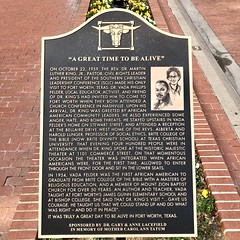
"A Great Time to Be Alive" On October 22, 1959, The Rev. Dr. Martin Luther King, Jr., pastor, civil rights leader and president of the Southern Christian Leadership Conference (SCLC) made his only visit to Fort Worth, Texas. Dr. Vada Phillips Felder, local educator, activist, and friend of Dr. King’s had invited him to Fort Worth when they both attended a church conference in Nashville. Upon his arrival, Dr. King was greeted by African American community leaders. He also experienced some anger, hate and bomb threats. He stayed upstairs in Vada Felder’s home on Stewart Street, and attended a reception at the Bellaire Drive West home of the Revs. Alberta and Harold Lunger, Professor of Social Ethics, Brite College of the Bible (now Brite Divinity School) at Texas Christian University. That evening four hundred people were in attendance when Dr. King spoke at the historic Majestic Theater at 1101 Commerce Street. On that occasion the theater was integrated when African Americans were, for the first time, allowed to enter through the front door and sit in the lower seats. In 1954 Vada Felder was the first African American to graduate from Brite College of the Bible with a Masters of Religious Education. She was a member of Mount Zion Baptist Church for over 50 years, authored Christian Education materials, founded and operated United Christian Leadership School, and taught in Fort Worth’s James Guinn Elementary School and at Bishop College. She said that Dr. King’s visit “…gave us courage. He taught us that we could stand up and do what was right – and do it in peace”. It was truly a great day to be alive in Fort Worth, Texas Sponsored by Dr. Gary & Anne Lacefield in memory of mother Carol Ann Tatum
Main Street, Fort Worth, TX, United States

.jpg)


_plaque_01.jpg)


.jpg)
