
Wyatt Earp

Wyatt Earp
(1848-1929)
businessman, lawman, gun-fighter, gambler, and miner
Family tree
friend of John Henry Holliday
Commemorated on 5 plaques

Wyatt Berry Stapp Earp (1848-1929) Josephine Sarah Marcus Earp (1861-1944) Earp Cottage Vidal, California. The legendary lawman, gun-fighter, gambler, businessman and miner along with his wife Josephine inhabited this "dream-come-true" cottage from 1925-1928. During the fall, winter and spring months while he worked his "happy days" mines in the Whipple Mountains a few miles north of this site. This is the only permanent residence they owned in their long lives together. Their ashes are buried in the hills of Eternity Memorial Park, Colma, California.
Earp Cottage, Vidal, CA, United States where they lived (1925-1928)
Wyatt Earp plaque marks the location of the house in which Earp spent the last years of his life [full inscription unknown]
4004 W. 17th Street, Los Angeles, CA, United States where they lived
Wyatt Earp was born in Illinois March 19, 1848. In 1864 he came west with his family, settling near San Bernardino. He later served as lawman in Wichita and Dodge City, then came to Tombstone in 1879. After the gunfight at the O.K. Corral in 1881, he fled Arizona to avoid prosecution. He frequented the western boom camps, including Alaska, and in later years retired on income from Kern County Oil and the Happy Day Gold Mine group in the nearby Whipple Mountains. He and his wife Josephine spent their winters here for over two decades. He died peacefully in Los Angles January 13, 1929. soon after, this little community, formerly Drennan, was renamed in his honor when Earp Post Office was established in 1930. He is buried next to his wife, who died in 1944, in Colma, California.
Wyatt Earp Post Office, 144977 Aqueduct Road, Earp, CA, United States where they stayed
Wyatt Earp called to Dodge City in 1876 and established law and order in a few years. He did the same thing for other cities and became known as the best law officer in the West. He was a quiet and decent man and caused considerable publicity for Dodge City. Wyatt Earp died in Cailfornia at the age of 81 in 1921.
TBC, Dodge City, KS, United States where they estblished law and order (1876)
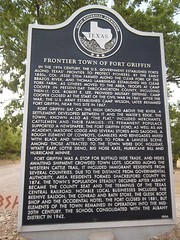
Texas Historical Marker #13028
Frontier Town of Fort Griffin. In the 19th century, the U.S. government established forts along Texas' frontier to protect pioneers. By the early 1850s, Col. Jesse Stem farmed along the Clear Fork of the Brazos River, and Thomas Lambshead established his Clear Fork Farm. As others moved to the area, troops at Camp Cooper in present-day Throckmorton County, including then-Lt. Col. Robert E. Lee, provided military defense. Camp Cooper closed at the start of the Civil War in 1861. After the war, the U.S. Army established Camp Wilson, later renamed Fort Griffin, near this site in 1867. Fort Griffin sat on the high ground above the river. A settlement developed between it and the water's edge. The town, known also as "The Flat," included merchants, cattlemen and their families. Its permanent populace supported a newspaper, the Fort Griffin Echo, as well as an academy, Masonic lodge and several stores and saloons. A rough element of cowboys, gamblers and renegades mixed with black and white troops to form a lawless scene. Among those attracted to the town were Doc Holliday, Wyatt Earp, Lottie Deno, Big Nose Kate, Hurricane Bill and Hurricane Minnie. Fort Griffin was a stop for buffalo hide trade, and hides awaiting shipment crowded town lots. Located along the Western cattle trail, it included immigrant residents from several countries. Due to the distance from governmental authority, area residents formed Shackelford County in 1874. The town's population steadily declined after Albany became the county seat and the terminus of the Texas Central Railroad. Notable local businesses included the Beehive Saloon, The Conrad and Rath Store, the Glesk Boot Shop and the Occidental Hotel. The fort closed in 1881, but elements of the town remained in operation into the mid-20th century. The school consolidated with the Albany district in 1942. (2004) #13028
US 283, CR 184, Albany, TX, United States where they was