

Lamps such as this one have been a familiar sight in Hamburg, Germany, since 1869, where they grace the famous Lombard Bridge. This Lombard Lamp is presented to the City of Chicago by the people of the free and Hanseatic City of Hamburg so that it may forever brighten a bridge of friendship in human relations, trade, and commerce. March 1979
4731 N Lincoln Avenue, Chicago, United States
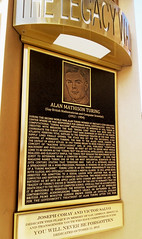
Alan Mathison Turing (Gay British Mathematician and Computer Scientist) (1912-1954). During the Second World War, Alan Turing worked at Britain's code-breaking center where he was responsible for German naval cryptanalysis. Using the computational “Turing Machine” methodology he invented in 1936, Turing is credited with breaking the Nazi “Enigma Code” which had been used to coordinate the U-boat juggernaut that sank hundreds of ships in the North Atlantic ferrying vital supplies to the European theater of the war. With supply lines finally opened, the stage was set for the successful D-Day landing at Normandy, turning the war to the Allies favor, leading to the defeat of Adolf Hitler. In 1947 Turing began to muse publicly about the concept of “machine intelligence” and, in 1950, published “Computing Machinery and Intelligence” where he first set out to devise what would come to be known as the “Turing Test” for Artificial Intelligence. Brilliantly realized and elegantly simple, the Turing Test remains the benchmark in the quest to determine when a computer becomes “self-aware.” In 1999, TIME magazine named Turing one of the 100 most influential scientists of the 20th century, stating that "everyone who taps at a keyboard, opening a spreadsheet or a word-processing program, is working on an incarnation of a ‘Turing Machine’." Turing lived in an era when homosexuality was still both illegal and officially considered a mental illness. In 1952, after being arrested for admitting to a sexual liaison with another man, he was convicted and sentenced to chemical castration. Two weeks before his 42nd birthday he bit into an apple laced with cyanide and ended his life. The tragedy of Turing’s suicide is trumped only by the loss to humanity that his death dealt to the field of Computer Science. Given all that he accomplished, it is impossible to overstate the potential magnitude of his unrealized contributions. Acknowledging Turing’s legacy, on September 10, 2009, British Prime Minister Gordon Brown issued an official apology for the government’s treatment of Alan Turing after the war.
3345 N. Halsted Street, Chicago, United States