
Places, subjects, or plaques matching "c s forester"
1 subject matching "c s forester"
23 plaque matching "c s forester"

Texas Historical Marker #01944
Forester Ranch. William S. Forester brought his family to Denton County from Tennessee in the early 1850s, and established a ranch about 1852. He was assisted in his ranching operation by his sons, one of whom, Sol, was killed by Indians at the age of sixteen while herding cattle on the ranch. Following William Forester's death the ranch was operated by his son, Lock S. Forester (1844-1913). A Confederate veteran, Lock Forester increased the size of the ranch to over 6,000 acres. Under his management the ranch's "Two I Jinglebob" brand became well known. He supervised the ranch interests until 1890, when he moved to Denton. Ed W. Forester, son of Lock Forester, assumed management of the ranch in 1890. In 1913 the ranch was divided into sections, with Lock S. Forester's three children each receiving one-third of the ranch property. Ed Forester became a successful rancher in his own right, raising champion shorthorn cattle as well as quarter horses, sheep, and other livestock. He served two terms as Denton County Commissioner. The Forester Ranch has been an important part of the history of Denton County for over a century. (1987) #1944
?, Sanger, TX, United States
Texas Historical Marker #06488
Site of the Organization of the Texas Forestry Association. One of Texas' oldest conservation organiations. W. Goodrich Jones (1860-1950), who came to Temple as a banker in 1888, felt need for trees in this prairie town. He led planting drives in Temple, and in 1889 saw to the establishment of a statewide Arbor Day. Asked by the Chief U.S. Forester to survey Texas forest resources, Jones later enlisted aid of friends. On Nov. 1, 1914, he and about 20 associates met in the Carnegie Library, then adjacent to the Temple public square, and organized the Texas Forestry Association. This body's original aim, to gain public support for a state Department of Forestry, was accomplished within a year. The Department was created by law in 1915; it was later retitled "Texas Forest Service". The Texas Forestry Association has since aided in the restoration of 11,500,000 acres of commercial forests--lifeblood of a large segment of the Texas economy. Over 2,000 woodland owners, tree farmers, industrialists, professional foresters, and concerned citizens are TFA members. Under such leaders as Jones, who served as president in 1914-21, the TFA has been the voice of forestry in Texas, urging expansin, protection, proper management, and wise use of all forests and related resources. (1974) (1974) #6488
?, Temple, TX, United States
Texas Historical Marker #06982
Angelina County Lumber Company. One of the first individuals to recognize the economic potential of the east Texas forests was German native Joseph H. Kurth, who came to Angelina County in 1887. He bought a sawmill from charles L. Kelty and in 1890, with Sam Wiener and S. W. Henderson of Corrigan, formed the Angelina County Lumber Company. A leader in innovative forestry, including reforestation and employment of professional foresters, the firm played a vital role in the early growth of Lufkin and area industries. Kurth family members headed the company until it was sold in 1966. #6982
?, Lufkin, TX, United States
Texas Historical Marker #07722
Duck Creek Soil Erosion Project. In 1929, one of ten erosion control research stations in the United States was set up southeast of this site for the purpose of studying erosion problems and the effectiveness of erosion control methods. This was one of the first organized efforts to solve the nation's soil erosion problems in a planned, scientific manner. Five years later, in 1934, the Duck Creek watershed near this site was approved as a demonstrational project for working with all known methods of erosion control. In cooperation with the landowners in the 25,000-acre area, a plan of conservation treatment was devised for each farm. Much of the labor used in carrying out these plans, such as building dams and fences and planting trees and pasture grass, was provided by a nearby Civilian Conservation Corps (CCC) camp. The success of the Duck Creek project attracted much attention and many visitors to the area. Duck Creek was used by the Soil Conservation Service as a training ground for agronomists, soil surveyors, engineers, biologists, foresters, economists, and others who carried knowledge learned here to many other states across the country. #7722
?, Lindale, TX, United States
Texas Historical Marker #10375
Davis Reynolds. Henderson County pioneer Davis Reynolds (1800-1869) came to Texas in 1856 with his wife Catherine (1802-1871), their unmarried children, James, Julia, Catherine, and John H.; and several slaves. Traveling by wagon and foot, they journeyed from Gordon County, Georgia. Three married children, Almira Otts, Eliza Forester and George W., came later. Reynolds named his settlement New York as a sign of his hopes for its growth and prosperity. Reynolds donated land for the first community cemetery which came to be used by all neighboring families. The first marked grave is that of Reynolds' daughter Almira Otts (1838-1863). Davis and Catherine are among the many other members of the Reynolds family buried there. A combination school and church, used for many years by both Baptists and Methodists, was built on land given by the Reynolds' son John Harrison (1843-1903) in 1873. Reynolds' hopes for a big city were dashed when the railroad bypassed New York in 1901 and the town lost its post office. The village now consists of the Baptist church, cemetery, and the store at this site. Owned by Reynolds descendants, the store continues to serve the New York community and its neighbors in the same spirit in which it was founded. #10375
?, New York, TX, United States
Texas Historical Marker #11465
The Yale Summer Forestry Camp and Gifford Pinchot. In 1909 at Mooney's Lake, now known as Twin Lakes (2 mi. WSW), senior students from the Yale University (New Haven, Ct.) School of Forestry met for their annual spring camp to study local timber management and lumber operations. In April that year the camp was visited by Gifford Pinchot (1865-1946), who served as the first chief forester of the U. S. from 1895 to 1910. He was accompanied by members of the newly appointed Yellow Pine Manufacturers Assn. Conservation Committee, including Yale Forest School director Henry Solon Graves (1871-1951), and Texas lumberman John Lewis Thompson (1875-1938). Both Pinchot and Thompson had studied forestry in Europe and advocated the adoption of conservation in American forest lands. Pinchot, whose family founded the Yale Forestry School in 1900, remarked that this committee meeting was the first accord among foresters and lumbermen. The group proposed that pine manufacturers support federal and state legislation to discourage clear cutting, assure forest fire prevention, and revise taxation of forest lands. Six years later the state of Texas prescribed that forestry courses be taught at its A & M College, and established a forestry agency, renamed the Texas Forest Service in 1926. Texas sesquicentennial 1836-1986 #11465
?, Woodville, TX, United States
Texas Historical Marker #13907
Martin-Russell House. This prominent residence was built in 1925-27 at a cost of $30,000 for Dr. M.L. Martin (1869-1941) and his wife, Ailsey (Forester) Martin (1890-1968). Ailsey grew up on the nearby Forester Ranch (established 1852) and received one-third of the ranch of the famous "Two-I-Jinglebob" brand when it was divided in 1913. Dr. Martin was born in South Carolina and received degrees from Peabody College (Nashville, TN) in 1892 and the University of Texas at Austin in 1899. He served in the medical corps during World War I and was a doctor in Denton for forty years until his death. Pilot Point native James Holford Russell and wife, Ava Lee (Mars) Russell, bought this property in 1945. J.H. Russell earned a degree from the University of Texas at Austin in 1919 and for decades managed Russell's Department Store, part of a family business that debuted in Denton in 1925. He was also a civic leader and Texas Woman's University Regent. The Russells lived here until 1967. Fort Worth architect J.B. Davies designed the house, with H.F. Davidson as carpenter and Charles N. Davis in charge of brick and concrete work. The home has an attic and basement and 14 rooms, with a sun parlor, living room, dining room, breakfast room, kitchen and reception hall on the first floor, and four bedrooms, a sleeping porch, library and two bathrooms upstairs. Prominent features of the Georgian Revival style house include its red brick veneer and white stone trim, green-tinted metal tile roof with dormers, arched windows with keystones, pedimented entryway door surround, wrought iron balconies and symmetrical massing. Since its construction, the house has been the scene of numerous social and community events. Recorded Texas Historic Landmark - 2007 #13907
811 W Oak, Denton, TX, United States
Kentucky Historical Marker #2103
Bottled Bourbon. Before 1870 Louisville distillers sold bourbon by the barrel to taverns and retailers who made their own blends. Doctors who used whiskey for medical purposes complained of unreliable quality. As a solution, Geo. Garvin Brown created Old Forester, first bourbon sold only in bottles by wholesaler, thus insuring dependable quality. Presented by Brown-Forman Corporation. (Reverse) Old Forester Bourbon - Old Forester bourbon was developed in 1870 by J.T.S. Brown and Bro. Company at 322 W. Main St. in Louisville. Innovations included selling the product only in sealed bottles and registering the brand name under the U.S. Trademark Act. Brand has been continuously marketed by Brown family company, known today as Brown-Forman Corp. Presented by Brown-Forman Distillery.
West Main St., Louisville, KY, United States
Kentucky Historical Marker #2105
Brown-Forman Established. George Garvin Brown and his half brother J.T.S. Jr. founded J.T.S. Brown and Bro. Co. in 1870, producing bourbon whiskey for doctors and pharmacies, later for general public. Company became Brown-Chambers, then Brown-Thompson. Current name adopted in 1890 at 117 W. Main when Geo. Brown partnered with George Forman. Presented by Brown-Forman Corporation. (Reverse) George Garvin Brown - Distiller George Garvin Brown was born 1846 in Munfordville and attended school in Louisville. An innovator in whiskey industry, he advocated for product qualtiy and brand advertising. Created Old Forester, his company's premier bourbon, and was first president of Nat'l Liquor Dealers' Assoc., 1894. Died 1917; buried Cave Hill Cem. Presented by Brown-Forman Corporation.
West Main St., Louisville, KY, United States
Ralph Elwood Brock. The first African American graduate of the Pennsylvania State Forest Academy here at Mont Alto and a member of the original class of 1906. A student & associate of Dr. J.T. Rothrock, Brock was Mont Alto State Forest Nursery superintendent until 1911 and then a successful consulting forester for public and private gardens and landscapes in New York City and Philadelphia.
Park St. (Rt. 233) at Slabtown Rd., entrance to PSU, Mont Alto, PA, United States
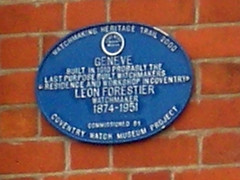
Geneve, built in 1910 probably the last purpose built watchmakers residence and workshop in Coventry, Leon Forester watchmaker 1874 - 1951
108 Earlsdon Avenue South, Coventry, United Kingdom

Site of Maryland's First State Tree Nursery, 1914-1950. In 1914, the University of Maryland, originally the Maryland Agricultural College, donated this land to establish the first state tree nursery. Fred W. Besley, student of Gifford Pinchot (father of American forestry), brought tree nursery science to Maryland as its first state forester. Silas Sines Sr., head nurseryman, pioneered methods for economically growing and replanting large numbers of trees. Thousands of trees grown here were replanted in Maryland's forests and along its roads. This contributed to the ecological restoration and beauty of landscape devastated from abusive logging and agricultural practices in the lath 19th century, Collaborations between the University of Maryland (est. 1956) and the Maryland State Board of Forestry (est. 1906) led to important initiatives in the education that continue today.
, College Park, United States

Circa 1888 Cuthbert’s Store This store was established on land owned by William Macintosh who came to Knysna in August 1849 from Kirkcaldy in Scotland. His daughter, Jessie Amelia, ran this shop after the death of her first husband Thomas Armstrong, a forester, in 1888. She married William Patrick Cuthbert, on 4 October 1892, who had come to the Knysna District in 1880, first settling at Kruis Valley. The shop become known as Cuthbert’s Store and was renowned for high quality drapery, groceries and hardware. William Cuthbert, who died in 1917, was a member of the Municipal Council. Jessie continued to run the store until 1922, after which it was run by John Terblanche for his own account.
Sun Valley Road, Knysna, South Africa
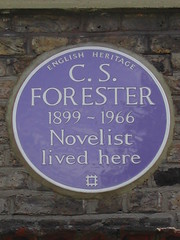
C. S. Forester 1899-1966 novelist lived here
58 Underhill Road, Dulwich, Southwark, SE22, London, United Kingdom
Subjects
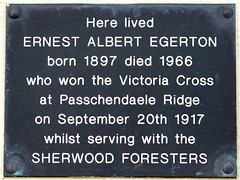
Here lived Ernest Albert Egerton born 1897 died 1966 who won the Victoria Cross at Passchendaele Ridge on September 20th 1917 whilst serving with the Sherwood Foresters
350 Uttoxeter Road, Blythe Bridge, Stoke-on-Trent, United Kingdom
Subjects
How Head. People have lived here for over a thousand years. Behind you is How Head, the oldest lived-in building in Ambleside. Once the lodge of the Master Forester of the Barony of Kendal, parts date back to the 16th century. In front of you is the rebuilt pre-Tudor St. Anne's Chapel, formerly Ambleside's only place of worship. For many years, it was not registered to record marriages and deaths. This part of town was "Above Stock" and in the parish of Grasmere for burial. In the 19th century many small schools were sited here. Kelsick Cottages from the 18th century housed the ancient Kelsick Free School endowed in the 1723 will of local grocer's son John Kelsick.
Fair View Road, Ambleside, United Kingdom
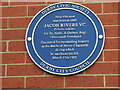
Near this spot was born in 1881 Jacob Rivers VC Private soldier, 1st Bn. Notts.. & Derbys. Regt. (Sherwood Foresters) Decorated for outstanding bravery at the Battle of Neuve Chapelle during which he sacrificed his life March 12th 1915
Corner of King Street and Queen Street, Derby, United Kingdom
Subjects


Ici vécut de 1743 a 1782 Henry-Louis Duhamel du Monceau. Membre de l'Académie des Sciences. Inspecteur Général de la Marine. Initiateur de l'agronomie modern et de la foresterie.
English translation: Here lived from 1743 to 1782 Henry-Louis Duhamel du Monceau. Member of the Academy of Sciences. Inspector General of the Navy. Initiator of modern agronomy and forestry. [AWS Translate]
13 quai d'Anjou, Paris, France

3 Church Street This building stands on land that was first transferred in 1873 from the estate of John Sullivan to William Charles Guest, and subsequently to Llewellyn Edwards, manager of the Standard Bank, in 1890. In 1901 Mrs Andrew Hepburn lived in this house, which was named "Belmont". The building was later occupied by Archie Benn. The property was purchased by Philip Rudolph Schoeman in 1929, who then sold it to a forester Alfred J. Herion in 1937. Sister Louise Herion ran a private nursing home here during the 1930's and 1940's. In 1981 the property was purchased by the State, consolidated with the adjacent Police Station and Court House property, and was renovated as part of the Police Station extensions in 1998-2000 by the Public Works Department.
3 Church Street, Knysna, South Africa
North Carolina Highway Historical Marker #P-59
Forestry School. First U.S. school of forestry. Established 1898 by Dr. C. A. Schenck, chief forester, Biltmore estate. Location until 1909 was nearby.
US 276 in Pisgah National Forest, NC, ,
In diesem Wald zeigte wie an vielen weiteren Orten in Deutschland der Nationalsozialismus sein wahres verbrecherisches Gesicht. Wegen „Fahnenflucht“ wurden am 26.März 1945 nicht weit von dieser Stelle der achtzehnjährige und zuvor aus einem Wehrertüchtigungslager nach Hause entlassener Hunsrücker Wendelin Bauer und ein weiterer unterwegs aufgegriffener unbekannter Junge von einem Exekutionskommando der SS erschossen. Am Ort des Verbrechens hat der damalige Förster dieses Waldes einen Gedenkstein aufgestellt, der haute noch steht. In mahnender Erinnerung, dass niemals mehr ein Unrechtssystem in unserem Land Fuß greift.
English translation: In this forest, as in many other places in Germany, National Socialism showed its true criminal face. On March 26, 1945, not far from this place, the eighteen-year-old and previously released from a military training camp, Wendelin Bauer Hunsrück and another unknown boy who was taken up on the way were shot dead by an SS executive command. At the site of the crime, the former forester of this forest has erected a memorial stone that is still standing. Remembering that there will never be a system of injustice in our country. [AWS Translate]
, Bad Soden, Germany

Obok stoi kamień z napisem: xxi zjazdowi niemieckich leśników poświęca pomorskie towarzystwo leśne 1892 ten kamień utonął przed laty w morzu. potem udało się go wydobyć. polscy leśnicy ustawili go tutaj w roku 1992. jednocześnie został uroczyście odsłonięty pamiątkowy kamień z okazji xcii-go zjazdu polskich leśników dla podkreślenia długoletniej współpracy między polskimi i niemieckimi leśnikami
English translation: Next to the stone stands with the inscription: XXI German Downhill foresters sacrifices Pomeranian Society Forest 1892 this stone drowned before years in the sea. then managed to extract it. Polish foresters set it up here in the year 1992. simultaneously was solemnly unveiled commemorative stone with xcii-go reunion Polish foresters for emphasis long-term cooperation between Polish and German forester [AWS Translate]
, Międzyzdroje, Poland

Významný slovenský architekt, predstaviteľ funkcionalizmu, vysokoškolský pedagóg a akademik prof. Ing. arch. EMIL BELLUŠ, DrSc. (1899 - 1979) vypracoval v roku 1928 projekt budovy, ktorá sa stala 1. januára 1942 sídlom riaditeľstva Štátnych lesov a majetkov a dodnes slúži slovenským lesníkom.
English translation: Distinguished Slovak architect, representative of functionalism, university educator and academician prof. Ing. arch. EMIL BELLUŠ, DrSc. (1899 - 1979) drew up a building project in 1928, which became on 1 January 1942 the seat of the Directorate of State Forests and Property and still serves Slovak foresters.
Sokolská 2, Zvolen, Slovakia