

Ship Inn. The present-day appearance of the Ship Inn dates from a major alteration of 1905. Sited close to the upper tidal reach of the Ouseburn, its name recalls the importance of river craft to the industrial development of the valley.
Stepney Bank, Newcastle upon Tyne, United Kingdom

Stepney Bank Stables 1897. Built by the Globe Parcel Express Company, and later owned by Frank Wouter, a local horse dealer, these are the last of the Ouseburn’s once numerous working stables.
Stepney Bank, Newcastle upon Tyne, United Kingdom

Warburton’s Buildings 1838-1935. This small plot of land was once home to as many as thirty-three people. They lived in a tenement comprising 21-24 Stepney Bank and 2 & 4 Lime Street. The total number of rooms was eleven, giving an average of three people per room. A common yard faced the Ship Inn, and a passageway led through the tenement to the open space around the chimney. The water supply was a tap in the yard. There was no electricity.
Stepney Bank, Newcastle upon Tyne, United Kingdom

Steenbergs 1900. Originally built as a boot making works by the Newcastle Co-operative Society. Conversion by Home Housing Association for flats and workshops opened by Jim Cousins MP in July 2000.
Stepney Bank, Newcastle upon Tyne, United Kingdom

Jocker Wood 1854-1937. This is the one surviving pub formerly owned by John (Jocker) Wood, a noted sportsman and publican. Others were the Masons Arms on Quality Row and the Duke of York on Back Maling Street.
The Cumberland Arms, James Place Street, Newcastle upon Tyne, United Kingdom
Subjects

Glasshouse Bridge 1878. A bridge has spanned the Ouseburn at this point since the 1640s when glass works became established along the St. Lawrence shore. This present bridge is similar in design to the larger Byker Bridge.
Maling Street, Newcastle upon Tyne, United Kingdom
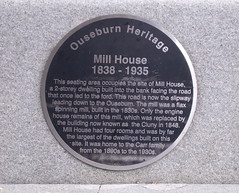
Mill House 1838-1935. This seating area occupies the site of Mill House, a 2-storey dwelling built into the bank facing the road that once led to the ford. This road is now the slipway leading down to the Ouseburn. The mill was a flax spinning mill, built in the 1830s. Only the engine house remains of this mill, which was replaced by the building now known as the Cluny in 1848. Mill House had four rooms and was by far the largest of the dwellings built on this site. It was home to the Carr family from the 1890s to the 1930s.
Stepney Bank, Newcastle upon Tyne, United Kingdom
Subjects
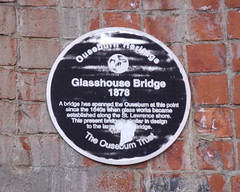
Glasshouse Bridge 1878. A bridge has spanned the Ouseburn at this point since the 1640s when glass works became established along the St. Lawrence shore. This present bridge [is similar] in design to the [larger Byker] Bridge.
Maling Street, Newcastle upon Tyne, United Kingdom