

Texas Historical Marker #00824
Charter Oak. In 1856, Live Oak County organized, first officers elected, at this site. Scene of picnics, horse races, school programs. #824
FM 799, 6 mi. E. of George West, George West, TX, United States
Texas Historical Marker #05623
VFW and American Legion War Mantial. In memory of those who served, and gave their lives for freedom and defense of their country. #5623
Houston and Guadalupe St., George West, TX, United States
Texas Historical Marker #06291
Old Dobie Ranch, Birthplace of J. Frank Dobie (Sept. 26, 1888-Sept. 18, 1964). A strong individualist and noted folklorist who added a new dimension to literature of Southwest. Collected and published more than 30 volumes of folk tales and legends. His works best preserve the heritage of people of the brush country--the rancher, the miner and the cowboy. (1970) #6291
FM 3162, off US 281, 23 mi. SE of George West, George West, TX, United States
Texas Historical Marker #03104
Live Oak County. Created by legislature Feb. 2, 1856, and organized August 4 with Oakville as county seat. Formed from San Patricio and Nueces Counties. Named for its Live Oak trees. County seat moved, 1919, to George West on railroad. Center for ranching, farming, petroleum production and processing. Recreation areas include Tips State Park and Lake Corpus Christi. Historic sites are Fort Ramirez, first settlement; Fort Merrill, built 1850 to protect early settlers; Brownsville-San Antonio Oxcart Road, used by general Santa Anna on the way to the Alamo. Other sites marked. #3104
US 281, s. of George West, George West, TX, United States

Texas Historical Marker #01363
Early Schools in Live Oak County. Until the 1870's, Live Oak county had private schools taught by clergymen and ranch employees in cabins, brush arbors, dugouts. County Judge G.W. Jones initiated (1876) community schools with tuition set at 71/2 cents a day per student. In time there were 43 of these small schools. Oakville in 1881 erected the county's first building for a free school and in 1899 had the first independent district. By 1917 George West and Three Rivers also had independent districts. Consolidations began in 1940, when the county had 9,799 people. By 1970, two consolidated schools served the entire county. #1363
Houston Street, in front of High School, George West, TX, United States
Texas Historical Marker #03893
Crossing of Old Ox-Cart Roads. From the early days of spanish colonial Texas well into statehood, the only "Highways" in the area were primitive dirt roads. Although many had names, others were simply called "ox-cart roads" for the sturdy mexican carts so frequently seen on them. In the 19th century this site was a junction for two of these roads, one extending from Brownsville to San Antonio, the other from Laredo to Goliad, then over to Indianola on the Gulf Coast. This strategic location helped Oakville grow into a thriving town and become county seat of Live Oak County in 1856. Ox-carts were unique in being constructed entirely of wood, fastened by wooden pins and rawhide thongs. The two wheels stood taller than a man and the bed was usually 15 feet long, covered by a thatched roof. To stop the deafening squeak of the wheels, drivers greased the hubs with prickly pear leaves. Pulled by several yoke of oxen, the carts usually traveled in groups. Their arrival meant fresh coffee, beans, salt, and sugar for isolated settlers. Although gradually replaced by wagons, carts were for two centuries almost the only freight vehicles in Texas. Reminders of their former importance long remained in the names of these two old roads. #3893
US 281, 4 mi. N. of George West, George West, TX, United States
Texas Historical Marker #01376
Echo Stagecoach Depot and Post Office. Known as "Mount Echo" or "The Point", this site once belonged to Empresario James McGloin. His daughter and son-in-law, Elizabeth and Patrick Murphy, ran a general store at Echo. John Bernard Murphy (1822?-1884) and his wife Margaret Mary (Healy) (1833-1907), both born in Ireland, settled here in the 1850's and built a two story ranch house. J.B. Murphy, who was not related to Patrick Murphy, was later mayor of Corpus Christi. A one-story building near the J.B. Murphy ranch house served as a station for stagecoach lines from San Antonio to Corpus Christi and south Texas. It housed the Echo Post Office from 1858 until 1879. The stage road through echo was a dry weather route along the East Bank of the Nueces River. A higher caliche road that was passable in wet seasons served stage stops on the west side of the river. Until the arrival of the railroad in this area, the echo depot and post office provided a vital link with the outside world. In the 1880's, Margaret Mary Murphy moved to San Antonio and founded the Sisters of the Holy Ghost. She used the ranch as a retreat for nuns and converted the echo depot into a chapel. R.F. sellers bought the property in 1906 and used the building for storage. It was demolished by hurricane Celia in 1970. #1376
On FM 888 about 17 mi. SE of George West, George West, TX, United States

Texas Historical Marker #06295
City of George West. Founded 1913 by George Washington West, rancher and civic leader, who secured railroad route through Live Oak County and provided several municipal buildings and plots for others. Became county seat in 1919. Market and shipping point for cattle and cotton. (1967) #6295
Houston and Guadalupe St., George West, TX, United States
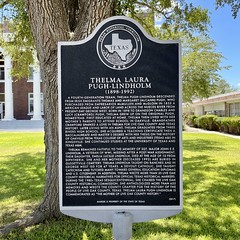
Thelma Laura Pugh-Lindholm (1898-1992) A fourth-generation Texan, Thelma Pugh-Lindholm descended from Irish emigrants Thomas and Margaret (McCann) Pugh, who purchased from Empresarios McMullen and McGloin in 1835 a Mexican league and labor of land across the Nueces River from present-day George West. Born in 1898 to grandson Charles and Lucy (Crawford) Pugh, Thelma grew up on the original Pugh homestead. First educated at home, Thelma then lived with her mother’s parents to attend school in Oakville. Grandfather Crawford sparked a love in Thelma for Live Oak County and Texas History. Later living with an aunt, Thelma graduated from Three Rivers High School. She acquired a teaching certificate then a baccalaureate and master’s degree with her thesis on the history of Oakville from Texas College of Arts and Industries (Texas A&I) in Kingsville. She continued studies at the University of Texas and Texas A&M. Thelma remained faithful to the memory of Sgt. Major John E.E. Lindholm, a veteran of WWI, missing after a post-war assignment. Their daughter, Emelia Lucille Lindholm, died at the age of 10 from diphtheria. She and her mother (deceased 1992) are buried in Gussettville Cemetery. Thelma Lindholm taught on ranches and in George West ISD for 47 years. A devout Catholic, she taught catechism and tutored many toward general education diplomas and U.S. Citizenship. In addition, Thelma wrote more than 20 Live Oak County historical narratives for official Texas historical markers. During the 1980s Texas Sesquicentennial, she chaired the Live Oak County Historical Commission. She anthologized more than 655 memoirs and wrote the county chapter for The History of the People of Live Oak County, Texas. Thelma Laura Pugh-Lindholm is commemorated as “The Mother of Live Oak County History.” (2017)
301 Houston Street, George West, TX, United States