
4 out of 5 (80%) plaques have been curated
5 subjects all or unphotographedGender Diversity
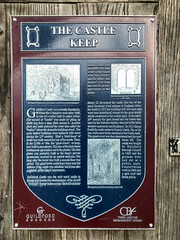
Guildford Castle was probably founded by William the conqueror soon after 1066, as one of a series built in major towns. The mound or ‘motte’ was made by pulling up chalk dug from a deep ditch around it. Another ditch and bank enclosed the outer area called the “bailey” where the domestic building stood. The early timber buildings were replaced with stone during the 12th century. First a ‘shell-like’ of chalk was built around the top of the motte. Then, in the 1130s or 40s, the ‘great tower’, or keep, was built in two phases. The line of the first-phase battlements are marked out in plaster. The first phase was probably built as the king's private apartments, reached by an outside staircase. Not long after the tower was built a second floor was added. The great tower could have been used for defence if the castle was attacked, but it was also a symbol of the kings importance. Guildford Castle was the only royal castle Surrey and became the headquarters of the sheriff the king’s deputy in the county. He held trials for serious crimes, and prisoners were held the keep, which was the county gaol for Surrey and Sussex. The king had moved to new apartments the bailey. Henry III developed the castle into one of the most luxurious role palaces. in England. After his death in 1272 buildings fell into ruins and were later abandoned, except for the great tower which continued as the county gaol. In the early 16th century the gaol closed and the tower was used by the Daborne family, who put in the brick window surrounds and fireplaces. In 1611 James I sold the castle estate to Francis Carter. He, or his son, built a new house attached to the Castle Arch. The great tower was then abandoned and then roof taken off. The castle was bought by Guildford Borough Council 1885 and the grounds were laid out as a public park. Conservation work in 2004 saw a new roof and floors put in.
Castle Street, Guildford, United Kingdom
Subjects


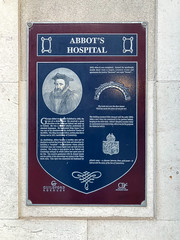
Abbot's Hospital. George Abbot was born in Guildford in 1562, the son of a cloth-worker. He received a good education at the Grammar School and went up to Oxford. He was a talented scholar, particularly of classical languages. He befriended King James I and was one of the translators of the Authorised Version of the Bible. The King favoured Abbot, making him first a bishop and in 1611 Archbishop of Canterbury. As Archbishop, Abbot became a wealthy man and he decided to reward the town of his birth and education by building a 'hospital' - an almshouse where elderly Guildford men and women could lead out their lives in comfort. The design is very similar to the Oxford and Cambridge colleges in which Abbot had spent most of his life. The massive gatehouse with its domed turrets and the gables of the crosswings are typical of the Tudor brick style. This style was somewhat old fashioned by 1622 when it was completed. Around the quadrangle inside there was a chapel, common rooms and apartments for twelve "Brothers" and eight "Sisters". The building remained little changed until the early 1980's when a new wing was constructed in the gardens behind, keeping to the same style. Abbot's Hospital remains today as a permanent memorial to him, still in use for the purpose for which he built it. The Latin text over the door means 'God has made this place of ease for us'.
159 High St, Guildford, United Kingdom
Subjects


ALICE AND THE LOOKING GLASS The statue of Alice looking through the looking glass was made by Jean Argent in 1990 and presented to the town by Municipal General Insurance Ltd, to mark the link between Lewis Carroll and Guildford. Lewis Carroll was the pen-name of the Rev. Charles Lutwidge-Dodgson, an Oxford mathematics tutor. He acquired the lease of the Chestnuts, the house visible beyond the sloping brick wall, in 1868. The death of his father had left him, as eldest brother, the head of the family which included six unmarried sisters. A home was needed for them, and the Chestnuts was ideal. Lewis Carroll was already famous as the author of 'Alice's Adventures in Wonderland'. He did not actually live in Guildford - his home was in Christchurch, Oxford - but was the householder, and spent much of the university vacations here. In 1871 he completed the second Alice book, "Through the Looking Glass" while staying at Guildford. As a clergyman, the Rev. Dodgson would sometimes preach at St Mary's church in nearby Quarry Street. He would take long walks in the area: during one of these, the inspiration for 'The Hunting of the Snark' occurred to him. The statue stands in what was the garden of Castle Gate, The house beyond the railings. Lewis Carroll had many child friends and was a frequent visitor to little Miss Edith Haydon, who lived at Castle Gate. A keen amateur photographer, he took a picture of her standing against the sloping garden wall. While spending Christmas at The Chestnuts, he caught flu and died in January 1898. He was buried in the Mount Cemetery, across the river valley from his family home. His sisters continued to live at The Chestnuts until 1919.
Unnamed Road, Guildford GU1 3QS, Guildford, United Kingdom
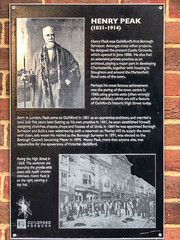
Henry Peak (1831-1914) Henry Peak was Guildford's first Borough Surveyor. Amongst many other projects, he designed the present Castle Grounds, which opened in June 1888. He also had an extensive private practice as an architect, playing a major part in developing Charlotteville, together with housing in Stoughton and around the Marketfield Road area of the town. Perhaps his most famous achievement was the paving of the town centre in 1868, using granite setts (often wrongly called cobbles), which are still a feature of Guildford's historic High Street today. Born in London, Peak came to Guildford in 1851 as an apprentice architect, and married a local lady five years later. Setting up his own practice in 1864 he was appointed Borough Surveyor and built a new waterworks, with on Pewley Hill to supply the town with clean, safe water. He retired as the Borough Surveyor in 1891, was elected to the Borough Council, becoming Mayor in 1899. Henry Peak, more than anyone else, was responsible for the appearance of Victorian Guildford.
Castle Street, Guildford, United Kingdom
Subjects
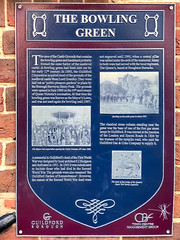
The Bowling Green The area of the Castle Grounds that contains the bowling green and bandstand probably formed the outer bailey of the medieval castle. A bowling green had been laid out by the early 17th century. In 1885, the Guildford Corporation acquired most of the grounds of the medieval castle from Lord Grantley. They were laid out as 'public pleasure gardens' to plans by the Borough Surveyor, Henry Peak. The grounds were opened in 1888 on the 50th anniversary of Queen Victoria's coronation. At the time the bowling green was known as the Mayor's Lawn, and was not used again for bowling until 1907. A memorial to Guildford's dead of the First World Was was designed by local architect F.J. Hodgson and dedicated in 192. In 1952 it was rededicated to include those who had died in the Second World War. The grounds were also renamed 'the Guildford Garden of Remembrance'. However, the names of the Second World War dead were not engraved until 1995, when a central pillar was added under the arch of the memorial. Many in both wars had served with the local regiment, The Queen's, based at Stoughton Barracks. The classical stone column standing near the gates was the base of one of the first gas street lamps in Guildford. It was erected at the junction of the London and Epsom Roads in 1824 by the trustees of the turnpike road, who paid the Guidlford Gas & Coke Company to supply it.
Castle Street, Guildford, United Kingdom