
41 out of 78 (52%) plaques have been curated
55 subjects all or unphotographedGender Diversity

The Great Western Society For its work in preserving and recreating the heritage of the Great Western Railway, allowing future generations to enjoy the work of Brunel, Gooch and Churchward, to participate and to learn engineering skills.
Didcot Railway Centre, Didcot Parkway Station, Didcot, United Kingdom
Subjects
Robert Stephenson's Works The Stephenson Works on South Street in Newcastle housed the world's first purpose-built locomotive works. These building were the birth of the steam locomotive, which revolutionised the railway industry worldwide.
The Stephenson Works, 20 South Street, Newcastle upon Tyne, United Kingdom
Subjects

Rolls Royce RB211 Engine The RB211 is the first, and at present the only, three-shaft, high bypass ratio aero engine in the world to go into production. 25 years on, it is still setting new standards of reliability and durability.
Rolls Royce Heritage Centre, Derby, United Kingdom
Subjects
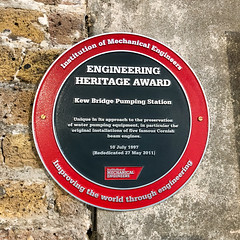
Kew Bridge Pumping Station Unique in its approach to the preservation of water pumping equipment, in particular the original installations of five famous Cornish beam engines.
Kew Bridge Steam Museum, Green Dragon Lane, Brentford, TW8 0EN, London, United Kingdom
Subjects
Float Glass Process Invented by Sir Alastair Pilkington and his team of engineers, scientists and production workers in 1953 at Pilkington Brothers, St Helens. This process has revolutionised window and automotive glass production throughout the world since the 1960s.
Pilkington Group Limited, Prescott Road, St Helens, Merseyside, United Kingdom
Subjects
Quarry Bank Mill A unique collection of working textile and power machinery enabling visitors to experience the whole process from spinning raw cotton to weaving finished cloth. Quarry Bank Mill is a site of educational importance, providing a link for the children of today with children of a bygone era.
Quarry Bank Mill and Styal Estate, Styal, Wilmslow, United Kingdom

Bursledon Brickworks The steam driven extrusion plant was installed in 1897 and operated for over 70 years. Restored by the Hampshire Buildings Preservation Trust, this is thought to be the only working example in the country. Brick making machinery such as this was key to the expansion of our towns and cities.
Bursledon Brickworks Industrial Museum, Swanwick Lane, Swanwick, United Kingdom

Holland 1 Designer: John Philip Holland Built by Vickers Maxim at Barrow-in-Furness and launched in 1901, this pioneer submarine was powered by a 160hp petrol engine and had a surface speed of 8 knots. A 70hp electric motor gave a submerged speed of 7 knots. Holland 1 was the Royal Navy's first operational submarine.
Royal Navy Submarine Museum, Haslar Jetty Road, Gosport, United Kingdom
Subjects

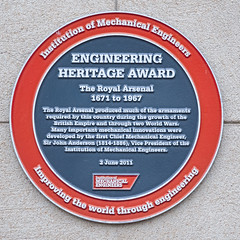
The Royal Arsenal 1671 to 1967 The Royal Arsenal produced much of the armaments required by this country during the growth of the British Empire and through two World Wars. Many important mechanical innovations were developed by the first Chief Mechanical Engineer, Sir John Anderson (1814-1886), Vice President of the Institution of Mechanical Engineers.
The Royal Arsenal, Woolwich, London, United Kingdom
Subjects
PS Waverley A & J Inglis Ltd - Glasgow Built in 1946 for the London & North Eastern Railway, Waverley is the last seagoing paddle steamer in the world. She has a displacement of 693 tons and Rankin & Blackmore triple expansion steam engine producing 2100 ihp at 58 rpm. In acceptance trials she achieved a speed of 18 knots.
, ,
Avro Vulcan XH558 Designed by Roy Chadwick and Stuart Davies The last airworthy representative of the RAF's V-bomber fleet, the British strategic deterrent from 1955 to 1969, the Vulcan is a stirring example of British leadership in aviation. XH558 was in service until 1993 and is powered by four Rolls-Royce Olympus engines.
Vulcan to the Sky, Robin Hood Airport, Doncaster, United Kingdom
Talyllyn Railway Opened in 1866, the Talyllyn Railway is the oldest continuously operated narrow gauge railway in Britain. In 1951 it became the world's first volunteer operated preserved railway. At 7.25 miles long and with a gauge of 2 feet and 3 inches, the Talyllyn Railway is an important part of Welsh industrial heritage.
Talyllyn Railway, Wharf Station, Tywyn, United Kingdom
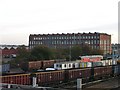
Central Valve Steam Engine Willans & Robinson Built in 1901 at Rugby, this 140hp three crank compound engine was in service for 57 years. Willans engines ran at 350 to 500rpm and could be direct-coupled to generators. In 1892 they accounted for 68% of all electricity generated in Britain, dominating this market until the advent of steam turbines.
Alstom Power, Willans Works, Newbold Road, Rugby, United Kingdom
Subjects
Jaguar E-type Designed by Malcolm Sayer under the direction of Sir William Lyons (HonFIMechE) the Jaguar E-type is a direct descendant of the cars which won five Le Mans 24 hour races during the 1950s. It introduced breakthrough motor engineering technology such as the combined monocoque-spaceframe which in later years was adopted by Formula one.
Jaguar Heritage, Browns Lane, Allesley, Coventry, United Kingdom
Boulton and Watt Engine The oldest rotative steam engine in the world. Built in 1785, it powered Whitbread's London Brewary until 1887. James Watt demonstrated this engine to King George III when he visited the brewary in 1787. This engine marks the start of mass industrialisation and the exponential increase in our use of fossil fuel.
Powerhouse Museum, 500 Harris Street, Ultimo, Sydney, New South Wales, Australia
Subjects


The Humphrey Pump H A Humphrey MIMechE A four-stroke engine with no pistons or crankshaft, Humphrey's ingenious invention patented in 1906 acts directly upon the water it pumps. This gas fuelled example, built by William Beardmore & Co., served Cobdogla from 1927 to 1965. Restored in 1985, it is the only working Humphrey Pump in the world.
Cobdogla Irrigation Museum, Cobdogla, SA, Australia
Locomotive No.1 The oldest surviving steam locomotive in Australia Built by Robert Stephenson & Co. in 1854, this is the only locomotive designed by James McConnell, one of the founders of the Institution of Mechanical Engineers, to have been preserved. Locomotive No.1 symbolises the transformation of social, industrial and commercial life in New South Wales through British railway technology.
Powerhouse Museum, 500 Harris Street, Ultimo, Sydney, New South Wales, Australia
MS Yavari The world's oldest iron kit-built ship. Designed by James Watt & Co and built in 1862 by the Thames Ironworks & Shipbuilding Co, she was assembled on the shores of Lake Titicaca, Peru and launched in 1870. Now powered by a 1914 4-cylinder Bolinder hot bulb semi-diesel engine producing 320bhp at 225rpm, MS Yavari is an enduring symbol of the ingenuity and global reach of British engineering.
Yavari, Puno Bay, Lake Titicaca, Peru
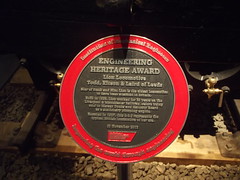
Engineering Heritage Award Lion Locomotive Todd, Kitson & Laird of Leeds Star of track and film, Lion is the oldest locomotive to have been steamed in Britain. Built in 1838, Lion worked for 20 years on the Liverpool & Manchester Railway, before being sold to Mersey Docks and Harbour Board as a stationary pumping engine. Rescued in 1927, this 0-4-2 represents the typical British locomotive of her era
The Great Port, Museum of Liverpool, Pier Head, Liverpool Waterfront, Liverpool, United Kingdom
Subjects
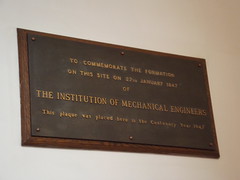
To commemorate the formation on this site on 27th January 1847 of The Institution of Mechanical Engineers This plaque was placed here in the Centenary Year 1947
Curzon Street Station, New Canal Street, Birmingham, United Kingdom
Subjects

Volk's Electric Railway, Brighton. The world's oldest electric railway opened on 4 August 1883. Constructed by pioneering electrical engineer Magnus Volk, the line still follows much of the original route. The continued operation of this railway is a tribute to his life and work
Seafront, Brighton, United Kingdom
Subjects

Engineering Heritage Award. Anderton Boat Lift. The worlds oldest operational boat lift. Designed by Edwin Clark and opened in 1875 to raise boats 50 feet from the River Weaver to the Trent & Mersey Canal using hydraulic power. Later converted to electric drive, it was restored to hydraulic operation in 2002 and continues to provide a navigable link between the two waterways. 21 March 2014
Lift Lane, Northwich, United Kingdom
Subjects
.JPG?width=250)
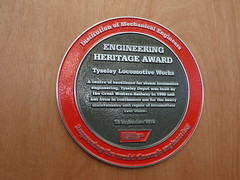
Engineering Heritage Award Tyseley Locomotive Works A centre of excellence for steam locomotive engineering. Tyseley Depot was built by the Great Western Railway in 1908 and has been in continuous use for the heavy maintenance and repair of locomotives ever since.
Tyseley Locomotive Works, Birmingham, United Kingdom
Subjects


Engineering Heritage Award SR.N5 Hovercraft. A new way of travelling. Built in 1963 and powered by a 900 horsepower Bristol Siddeley Gnome gas turbine, Saunders Row Nautical 5 was the first production hovercraft in the world. This particular hovercraft was used to demonstrate SR.N5 worldwide and train all the pilots for the Inter-Service Hovercraft Trials Unit based at Lee-on-Solent. This is the last example in the world 13 Sept 2013
, Lee-on-the-Solent, United Kingdom
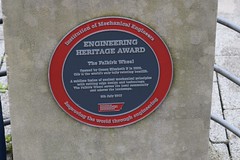
Engineering Heritage Award. The Falkirk Wheel. Opened by Queen Elizabeth II in 2002, this is the world's only fully rotating boatlift. A sublime fusion of ancient mechanical principles with cutting edge design and technology, The Falkirk Wheel serves the local community and adorns the landscape
Lime Road, Falkirk, United Kingdom
Subjects

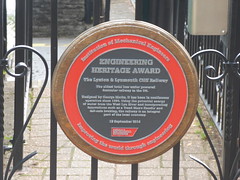
Engineering Heritage Award The Lynton & Lynmouth Cliff Railway The oldest total loss water powered funicular railway in the UK. Designed by George Marks, it has been in continuous operation since 1890. Using the potential energy of water from the West Lyn River and incorporating innovation such as a 'Dead Man's Handle' and fail-safe braking, the railway is an integral part of the local company.
Lynton Village Station - Lynton & Lynmouth Cliff Railway, Lynton, United Kingdom
Subjects


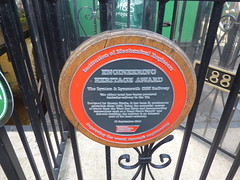
Engineering Heritage Award The Lynton & Lynmouth Cliff Railway The oldest total loss water powered funicular railway in the UK. Designed by George Marks, it has been in continuous operation since 1890. Using the potential energy of water from the West Lyn River and incorporating innovation such as a 'Dead Man's Handle' and fail-safe braking, the railway is an integral part of the local company.
Lynmouth Bay Station - Lynton & Lynmouth Cliff Railway, Lynmouth, United Kingdom
Subjects
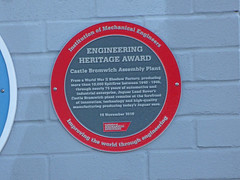
Engineering Heritage Award Castle Bromwich Assembly Plant From a World War II Shadow Factory, producing more than 10,000 Spitfires between 1940 - 1945, through nearly 75 years of automotive and industrial enterprise, Jaguar Land Rover's Castle Bromwich plant remains at the forefront of innovation, technology and high-quality manufacturing producing today's Jaguar cars.
Jaguar Land Rover Castle Bromwich - Chester Road, Birmingham, United Kingdom