
Gender Diversity
The top 10


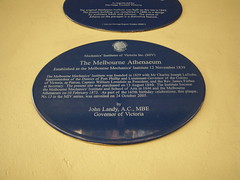
MIV Historical Plaques Program #0013
The Melbourne Athenaeum. Established as the Melbourne Mechanics' Institute 12 November 1839. The Melbourne Mechanics' Institute was founded in 1839 with Mr Charles Joseph LaTrobe, Superintendent of the District of Port Phillip and Lieutenant-Governor of the Colony of Victoria, as Patron. Captain William Lonsdale as President, and the Rev. James Forbes as Secretary. The present site was purchased on 13 August 1840. The Institute became the Melbourne Mechanics' Institute and School of Arts in 1846 and the Melbourne Athenaeum on 10 February 1873. As part of the 165th birthday celebrations, this plaque, No. 13 in the MIV series, was unveiled on 24 October 2005 by John Landy, A.C., MBE Governor of Victoria
188 Collins Street, Melbourne, Victoria, Australia
Subjects
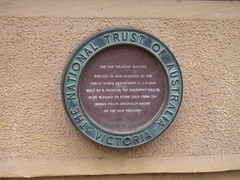
The Old Treasury Building erected in 1858 designed by the public works department (J. J. Clark) built by R. Huckson. The basement vaults were planned to store gold from the mining fields. Originally known as the New Treasury.
Spring Street, Melbourne, Victoria, Australia
Subjects
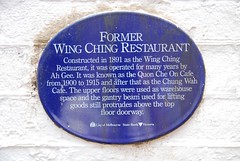
Former Wing Ching Restaurant Constructed in 1891 as the Wing Ching Restaurant, it was operated for many years by Ah Gee. It was known as the Quon Che On Cafe from 1900 to 1915 and after that as the Chung Wah Cafe. The upper floors were used as warehouse space and the gantry beam used for lifting goods still protrudes above the top floor doorway.
Heffernan Lane, Melbourne, Victoria, Australia
Subjects
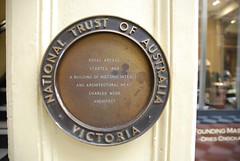
Royal Arcade started 1869 A building of historic interest and architectural merit Charles Webb Architect
Royal Arcade, Melbourne, Victoria, Australia
Subjects
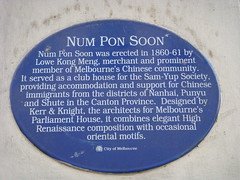
Num Pon Soon was erected in 1860-61 by Lowe Kong Meng, merchant and prominent member of Melbourne's Chinese community. It served as a club house for the Sam-Yup Society, providing accommodation and support for Chinese immigrants from the districts of Nanhai, Punyu and Shute in the Canton Province. Designed by Kerr & Knight, the architects for Melbourne's Parliament House, it combines elegant High Renaissance composition with occasional oriental motifs.
Little Bourke St, Chinatown, Melbourne, Victoria, Australia
Subjects
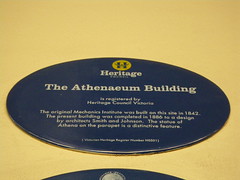
The Athenaeum Building is registered by Heritage Council Victoria. The original Mechanics Institute was built on this site in 1842. The present building was completed in 1886 to a design by architects Smith and Johnson. The statue of Athena on the parapet is a distinctive featured. (Victorian Heritage Register Number H0501)
188 Collins Street, Melbourne, Victoria, Australia
Subjects

In memory of Dr. CONSTANCE STONE, the first Australian woman to qualify as a medical practitioner. Because Australian medical schools were closed to women, she studied overseas. In 1896, together with some of the first women medical graduates of the University of Melbourne, she established the Queen Victoria Hospital, Melbourne, initially as an outpatients' clinic in St. David's Hall, Welsh Church, LaTrobe Street.
320 Latrobe Street, Melbourne, Victoria, Australia

Dadorchuddiwyd y plac hun gan Mrs E. Warburton a Mr E.J. Hughes ar Orffennaf 20fed. 2003 i ddathly sefydlu'r eglwys hon ganrif a hanner yn ol. "O herwydd efe a gadarnhaodd farrau dy byrth: efe a fendithiodd dy blant o'th fewn" Ps. 147 v 13. This plaque was unveiled by Mrs E. Warburton and Mr E.J. Hughes on July 20th 2003 to commemorate the 150th anniversary of the church. "For he hath strengthened the bars of the gates and hath blessed thy children with thee" Ps. 147 v 13
English translation:
320 Latrobe Street, Melbourne, Victoria, Australia

Royal Society of Victoria. Hall built 1859. Architect Joseph Reed. Extended in later years. Classified.
9 Victoria Street, Melbourne, Victoria, Australia

Block Arcade. Designed by architects Twentyman and Askew the arcade was constructed in two sections in 1891 and 1893. Melbourne's grandest arcade reflects the wealth of Marvellous Melbourne with it's opulent design and finishes. The name derives from the tradition of 'doing the Block', promenading around Melbourne's fashionable shopping street. Restored in 1988. Owned Since 1993 by John F. and Alison Kearney.
282 Collins Street, Melbourne, Victoria, Australia
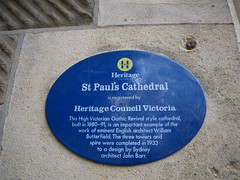
St Paul's Cathedral is registered by Heritage Council Victoria. This High Victorian Gothic Revival style cathedral, built in 1880-91, is an important example of the work of eminent English architect William Butterfield. The three towers and spire were completed in 1933 to a design by Sydney architect John Barr.
Corner Flinders and Swanston Streets, Melbourne, Victoria, Australia
Subjects

Newspaper House. In 1933 the newspaper publishers' Herald and Weekly Times, acquired the W.H. Rocke Ltd building and conducted an architectural competition for the redesign of the building for its city offices. The competition was won by architects Stephenson and Meldrum with a design which incorporated a glass mosaic by M. Napier Waller based on the text "I'll put a girdle around the earth."
247-249 Collins Street, Melbourne, Victoria, Australia

Scots' Church and Assembly Hall. In 1873 the Scots' Church was built in sandstone and limestone in the Gothic Revival style to the design of Joseph Reed, Architect. The Assembly Hall, constructed in 1914-15 by Swanson Bros., was designed by H.H. Kemp to blend with the Church. In 1981 Georges Ltd. donated the fountain designed by Peter Staughton, Architect.
99 Russell Street, Melbourne, Victoria, Australia
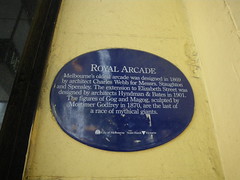
Royal Arcade. Melbourne's oldest arcade was designed in 1869 by architect Charles Webb for Messrs. Staughton and Spensley. The extension to Elizabeth Street was designed by architects Hyndman & Bates in 1901. The figures of Gog and Magog, sculpted by Mordimer Godfrey in 1870, are the last of a race of mythical giants.
335 Bourke Street Mall, Melbourne, Victoria, Australia
Subjects

Former Independent Church. This is the site of Melbourne's earliest permanent church built in 1839 for the Independent or Congregational Church, which earlier had held services in John Pascoe Fawkner's Tavern. The present polychrome brick church was designed by Reed and Barnes, Architects, and built in 1866/7 by John Young. The robust external design is complemented by the splendour of its interior.
Corner Collins and Russell Streets, Melbourne, Victoria, Australia
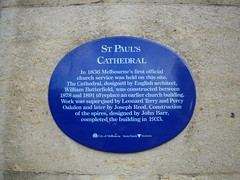
St Paul's Cathedral. In 1836 Melbourne's first official church service was held on this site. The Cathedral, designed by English architect, William Butterfield, was constructed between 1878 and 1891 to replace an earlier church building. Work was supervised by Joseph Reed. Construction of the spires, designed by John Barr, completed the building in 1933.
Corner Flinders and Swanston Streets, Melbourne, Victoria, Australia
Subjects

The Block Arcade. Built 1890-93 for The City Property Company. Architects Twentyman & Askew. Builder J. G. McLean. Classified.
282 Collins Street, Melbourne, Victoria, Australia

Melbourne Town Hall. This building, designed by Reed and Barnes, Architects, was begun in 1867 on the site of the original Melbourne Town Hall. The clocktower, completed in 1869, was named in the honour of the visit of Prince Alfred. The design was completed in 1887 with the addition of the portico over the footpath. The fine masonry and classical detailing express the civic pride of "Marvellous Melbourne".
Corner of Collins and Swanston Streets, Melbourne, Victoria, Australia

St. Francis Church. St. Francis is the oldest Roman Catholic Church in Victoria. Built between 1841 and 1845 on the site of an earlier church, it began as a simple brick Gothic style church designed by architect Samuel Jackson. It has since had many additions, including the cedar ceiling in 1850, a chapel in 1856, sanctuary in 1879 and front porch in 1956.
326 Lonsdale Street, Melbourne, Victoria, Australia

Flinders Street Railway Station. Since 1854, the station has been the focal point of the rail system. The present building, began in 1901 and completed in 1911, is the result of a design competition won by J.W. Fawcett and H.P.C. Ashworth. The building is a symbol of Melbourne and "under the clocks" is a traditional meeting place.
Corner of Flinders and Swanston Streets, Melbourne, Victoria, Australia
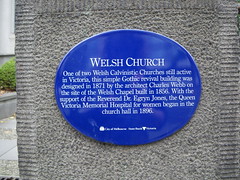
Welsh Church. One of two Welsh Calvinistic Churches still active in Victoria, this simple Gothic revival building was designed in 1871 by the architect Charles Webb on the site of the Welsh Chapel built in 1856. With the support of the Reverend Dr. Egryn Jones, the Queen Victoria Memorial Hospital for women began in the church hall in 1896.
320 Latrobe Street, Melbourne, Victoria, Australia
Subjects

Princes Bridge Hotel Building erected 1853 Hotel liscensed 1861 Leased to Henry Figsby Young and Thomas Joshua Jackson 1875 Classified
NW Corner Flinders Street and Swanston Street, Melbourne, Victoria, Australia

City Court Designed by G.B.H. Austin of the Public Works Department and built by Swanston Bros in 1911, the building originally accommodated three large courtrooms and offices with a two storey octagonal main vestibule. The facades, faced in Moorabool sandstone, focus on the entrance where gables, turrets, and arches produce an exceptional Romanesque composition.
?, Melbourne, Victoria, Australia

Former Working Men's College The Working Men's College, which later became the Royal Melbourne Institute of Technology was founded by Francis Ormond. It was built in two stages: the Bowen Street frontage was constructed in 1883/87 to a design by Nahum Barnett and Terry & Oakden, the LaTrobe Street frontage and tower were constructed in 1891 to a design by Oakden, Addison and Kemp.
LaTrobe Street, Melbourne, Victoria, Australia

Dame Nellie Melba was born on this site May 19 - 1861
David Street, Richmond, Melbourne, Victoria, Australia
Subjects


A tribute to an early pioneer This plaque commemorates James Harrison inventor of the refrigeration process and founder of the Victoria Ice Works on this site 1859
Franklin Street, Melbourne, Victoria, Australia
Subjects

Royal Australasian College of Surgeons. Architects Leighton, Irwin & Stevenson successfully designed the building for the isolated site which has four visible facades, Built in 1934/35, the design, incorporating coloured brickwork and central massing, won the Royal Victorian Institute of Architects Street Architecture medal in 1937.
Victoria Parade, Melbourne, Victoria, Australia