
Wakefield
Gender Diversity
The top 10


Mary Frances Heaton (1801-1878) "The Tragic Patient". Declared insane after a dispute over money she was owed. Committed to the West Riding Pauper Lunatic Asylum from 1837 to 1873. Created a legacy of needlework samplers that are early examples of how art therapy was used as a treatment for mental ill health
, Wakefield, United Kingdom
Subjects
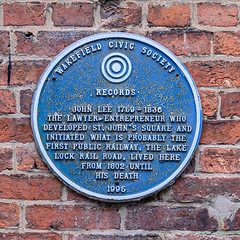
John Lee 1759-1836 the lawyer-entrepeneur who developed St. John's Square and initiated what is probably the first public railway, the Lake Lock Rail Road, lived here from 1802 until his death
2 St Johns Square, Wakefield, United Kingdom
Subjects
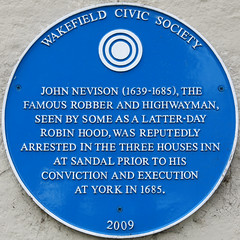
John Nevison (1639-1685), the famous robber and highwayman, seen by some as a latter-day Robin Hood, was reputedly arrested in The Three Houses Inn at Sandal prior to his conviction and execution at York in 1685
Three Houses Inn, 379 Barnsley Rd, Wakefield, United Kingdom
Subjects
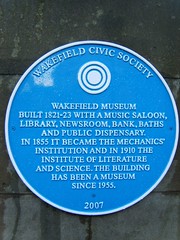
Wakefield Museum built 1821-23 with a music saloon, library, newsroom, bank, baths and public dispensary. In 1855 it became the mechanics' institution and in 1910 the institute of literature and science. The building has been a museum since 1955.
2 Wood Street, Wakefield, United Kingdom
Subjects

Dame Marjorie Williamson (1913-2002) University administrator and physicist, lived here as a child. [full inscription unknown]
Belgrave Terrace, Wakefield, United Kingdom
Subjects

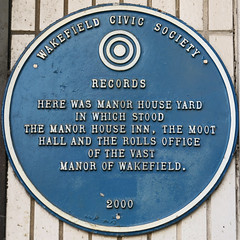
Here was Manor House Yard in which stood the Manor House Inn, the Moot Hall and the Rolls Office of the vast manor of Wakefield.
entrance of Boots, Kirkgate, Wakefield, United Kingdom
Subjects
This was the boyhood home of Kenneth Leighton (1929-1988) composer, pianist and Reid Professor of Music at Edinburgh University
21 Denstone Street, Wakefield, United Kingdom
Subjects
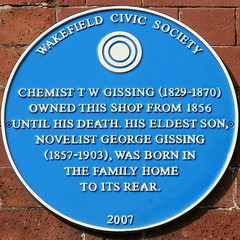
Chemist T. W. Gissing (1829-1870) owned this shop from 1856 until his death. His eldest son, novelist George Gissing (1857-1903), was born in the family home to its rear.
Natwest Bank, Westgate, Wakefield, United Kingdom
Subjects
The West Riding House of Correction (prison) opened on this site in 1595. It came under government management in 1878.
Corner of Back Lane and Westgate, Wakefield, United Kingdom
Subjects
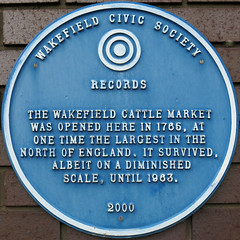
The Wakefield Cattle Market was opened here in 1765, at one time the largest in the North of England, it survived, albeit on a diminished scale, until 1963.
Royal Mail Sorting Office, Denby Dale Road, Wakefield, United Kingdom
Subjects
The West Riding Registry of Deeds, opened in 1704 and moved here in 1932, was sited in Wakefield as the ancient administrative capital of the county.
Corner of Newstead Road and Margaret Street, Wakefield, United Kingdom
Subjects
The Lake Lock Railroad, probably the world's first public railway, crossed Aberford Road here. It was opened in 1798 to carry coals from the Outwood area to the Aire and Calder Navigation at Lake Lock.
The Sycamores, corner of Aberford Road and Lake Lock Road, Wakefield, United Kingdom
Subjects
Stanley Hall, built about 1802 for the cloth-merchant Benjamin Heywood, was the home of William Shaw (1804-1859), a successful contractor during the great age of railway building in the 1840s
Stanley Hall, Wakefield, United Kingdom
Subjects
Potteries were a feature of this area from medieval times, giving rise to the old name of 'Potovens'. Opposite this site Robert Glover's potter's cottage, built in 1679, together with several 17th century pottery kilns.
Wrenthorpe Potteries, Wakefield, United Kingdom
Subjects
John Wolfenden Kt (1906-1985), lived near here as a boy at 196 Alverthorpe Road. He became a distinguished figure nationally in education and administration and is most remembered for the 1957 'Wolfenden' Report.
196 Alverthorpe Road, Wakefield, United Kingdom
Subjects
The boyhood home of David Storey (1933-), rugby footballer, novelist and playwright, much of whose work reflects his years in Wakefield.
91 Manor Haigh Road, Wakefield, United Kingdom
Subjects
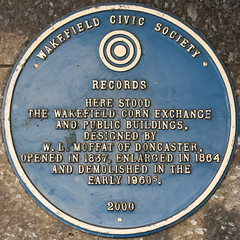
Here stood the Wakefield Corn Exchange and public buildings. Designed by W. L. Moffat of Doncaster, opened in 1837, enlarged in 1864 and demolished in the early 1960s.
Argos store, Westgate, Wakefield, United Kingdom
Subjects
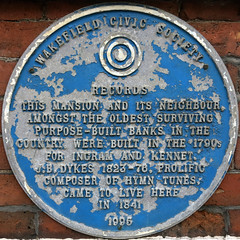
This mansion and its neighbour, amongst the oldest surviving purpose-built banks in the country, were built in the 1790s for Ingram and Kennet. J. B. Dykes 1823-76, prolific composer of hymn tunes came to live here in 1841
67 Westgate, Wakefield, United Kingdom
Subjects


Noel Gay (1898-1954), lyricist and popular-song writer and composer of the Lambeth Walk was a chorister at Wakefield Cathedral in his teenage years.
Wakefield Cathedral, Wakefield, United Kingdom
Subjects
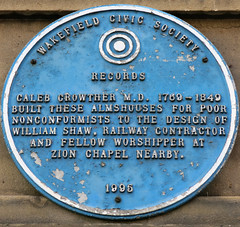
Caleb Crowther MD 1769-1849 built these almshouses for poor nonconformists to the design of William Shaw, railway contractor and fellow worshipper at Zion Chapel nearby.
Dr. Crowther's Almshouse, George Street, Wakefield, United Kingdom
Subjects
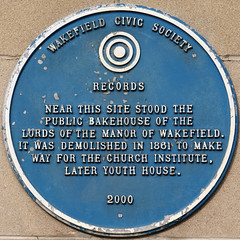
Near this site stood the public bakehouse of the lords of the manor of Wakefield. It was demolished in 1861 to make way for the Church Institute, later Youth House.
Marygate, Wakefield, United Kingdom
Subjects

Wakefield's wool market was held here in Westgate, latterly on Thursdays, from medieval times until the business transferred to the wool warehouses built in Cheapside and the surrounding yards.
HSBC, Westgate, Wakefield, United Kingdom
Subjects

John Potter DD 1674-1747, Bishop of Oxford and from 1737 Archbishop of Canterbury, lived as a boy in the family home here above his father's draper's shop
The Black Rock, Cross Square, Wakefield, United Kingdom
Subjects

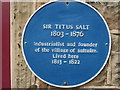
Sir Titus Salt 1803-1876 Industrialist and founder of the village of Saltaire. Lived here 1813-1822
The Lord of the Manor pub, New Crofton, Wakefield, United Kingdom
Subjects

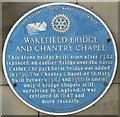
Wakefield Bridge and Chantry Chapel This stone bridge, built soon after 1342, replaced an earlier bridge over the River Calder. The packhorse bridge was added in 1730. The Chantry Chapel of St. Mary, built between 1342 and 1356 is one of only 4 bridge chapels still surviving in England. It was restored in 1847 and more recently.
Chantry Bridge, Wakefield, United Kingdom
Subjects
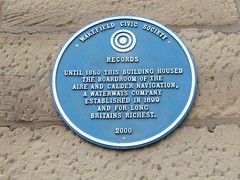
Until 1860 this building housed the boardroom of the Aire and Calder Navigation, a waterways company established in 1699 and for long Britain's richest.
Aire and Calder Navigation, Navigation Yard, Wakefield, United Kingdom
Subjects

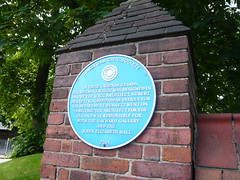
In these grounds stands the building which was designed in 1950 by the WRCC architect Hubert Bennett Kt (1909-2000) as offices for his department. Bennett went on to become the architect for the GLC and was responsible for both the Hayward Gallery and the Queen Elizabeth Hall
Bishopgarth, Westfield Road, Wakefield, United Kingdom
Subjects
Dame Barbara Hepworth (1903-1975) sculptor was born in this house 10 January 1903
15 Duke of York Street, Wakefield, United Kingdom
Subjects
_by_Erling_Mandelmann.jpg?width=250)
William Alfred Ismay MBE [full inscription unknown]
14 Welbeck Street, Wakefield, United Kingdom
Subjects
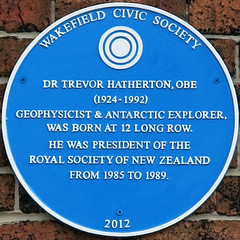
Dr Trevor Hatherton, OBE (1924-1992) geophysicist & antarctic explorer, was born at 12 Long Row. He was President of The Royal Society of New Zealand from 1985 to 1989
Long Row, Wakefield, United Kingdom
Subjects
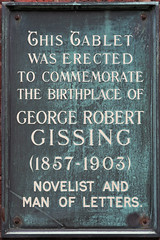
This tablet was erected to commemorate the birthplace of George Robert Gissing (1857-1903) novelist and man of letters.
Thompson's Yard , Wakefield, United Kingdom
Subjects

Gertrude McCroben (1863-1933) Headteacher of Wakefield Girls' High School from 1894 to 1920. As President of the English Association, and elite Mosely-commissioned teacher and Inspector of Schools, her reforms, which included the introduction of art, history and games for girls, were implemented nationwide. 'Better not be at all than not be noble'
Wentworth Street, Wakefield, United Kingdom
Subjects

Wentworth House Built in 1803 by Barrister and educationalist John Pemberton Heywood as a family home. Since September 1878 the building has been home to Wakefield Girls' High School. Between 1917-1919 it served as St. John's Auxiliary Hospital housing casualties from the Great War.
Wentworth Street, Wakefield, United Kingdom
Subjects


Edith Grace Mackie (1853-1941) Philanthropist, lived here, founder and president of Wakefield Victoria Nursing Association. Raised funds for Clayton Hospital Children's Ward and funded extension and reconstruction of St. John's Church. Donated funds and land to Wakefield Girls' High School. Raised funds for the Paxton Society, Creating Green Spaces in Wakefield. 'Deeds not words'
1 St John's Square, Wakefield, United Kingdom
Subjects
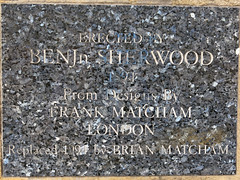
Erected by Benj'n Sherwood 1984 From Designs By Frank Matcham London. Replaced 1994 by Brian Matcham.
Theatre Royal, Drury Lane, Wakefield, United Kingdom
Subjects
Wakefield Anti-Slavery Association was established 12th January 1860 at the Corn Exchange after a lecture delivered by Sarah Parker Remond, renowned transatlantic abolitionist, campaigner of suffrage, human rights activist & physician. This event was enabled by the Wakefield Ladies' Anti-Slavery Society constituted in 1857. Elizabeth Dawson 1829-1894 was the secretary of both organisations
, Wakefield, United Kingdom
Subjects


Arthur Greenwood (1880-1954) Member of Parliament for Wakefield 1932-1954 and a Cabinet Member during World War II. As Chairman of the Cabinet Social Services Committee, he was instrumental in founding the National Health Service and the National Insurance Scheme
Greenwood House, George Street, Wakefield, United Kingdom
Subjects

Built as Assembly Rooms in 1798, offices for Wakefield's first newspaper from 1803, and home of Wakefield Church Institution from 1845 to 1858, these premises were leased by Wakefield Corporation as their Town Hall from 1861 to 1880.
Crown Court, Wakefield, United Kingdom
Subjects
Denise Castle (nee Ramsden) 1951-2003 [full inscription unknown]
Stanley St Peter’s Primary School, Wakefield, United Kingdom
Subjects
Designed by H. F. Lockwood, these premises were built in 1877-8 for the Wakefield and Barnsley Union Bank, which was founded in 1832 and remained independent until 1906
57 Westgate, Wakefield, United Kingdom
Subjects
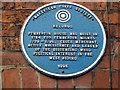
Pemberton House was built in 1754 for Pemberton Milnes 1729-1795, cloth merchant, active magistrate and leader of the dissenting Whig political interest in the West Riding
Pemberton House, Wakefield, United Kingdom
Subjects
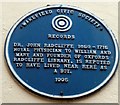
Dr John Radcliffe 1650-1715 Royal Physician to William and Mary and founder of Oxford's Radcliffe Library, is reputed to have lived near here as a boy.
Radcliffe Place, the Bull Ring, Wakefield, United Kingdom
Subjects

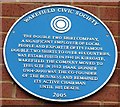
The Double Two Shirt Company, a significant employer of local people and exporter of its famous Double Two Shirts to over 40 countries, was established in 1940 in Kirkgate, Wakefield. The company moved to this site in 1952. Isaak Donner (1904-2000) was the co-founder of the business and remained its active chairman until his death.
Thornes Lane Wharf, Wakefield, United Kingdom
Subjects
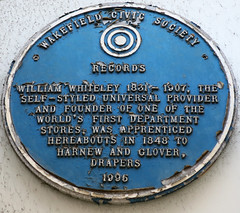
William Whiteley 1831-1907, the self-styled universal provider and founder of one of the world's first department stores, was apprenticed hereabouts in 1848 to Harnew and Clover, drapers
Central Chambers, the Bull Ring, Wakefield, United Kingdom
Subjects
1-3 Wood Street. The Bank of Leathem, Tew and Co. opened a branch on this site in ??. The current building designed by... [full inscription unknown]
Qubana Restaurant, Wood Street, Wakefield, United Kingdom
Subjects

Theatre Royal. A Theatre has stood on this site since 1776. The current building was designed by the famous theatre architect Frank Matcham (1854-1920) and opened on 15th October 1894. This Grade II* Listed Building is Matcham's smallest surviving theatre in the British Isles
Drury Lane, Wakefield, United Kingdom
Subjects
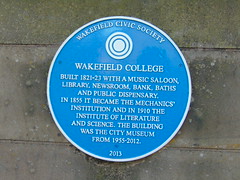
Wakefield College built 1821-23 with a music saloon, library, newsroom, bank, baths and public dispensary. In 1855 it became the Mechanics' Institute and in 1910 the Institute of Literature and Science. The building was the city museum from 1955-2012.
, Wakefield, United Kingdom
Subjects
In these premises, built in 1962 for the West Riding County Council, was the office of Alec Clegg (1909-1984), Chief Education Officer of the WRCC from 1945-1974 and one of the foremost influences nationally on comprehensive education.
Bond Street, Wakefield, United Kingdom
Subjects
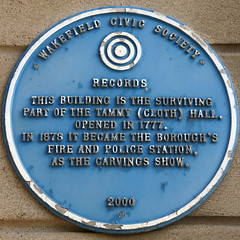
This building is the surviving part of the Tammy (Cloth) Hall, opened in 1777. In 1878 it became the borough's fire and police station, as the carvings show.
Cliff Parade, Wakefield, United Kingdom
Subjects
Staff Nurse Nellie Spindler (1891-1917) lived at 104 Stanley Road and worked as a nurse at the City Fever Hospital, later joining Queen Alexandra's Imperial Military Nursing Service. Killed by shell-fire on 21st August 1917 at Brandhoek, Belgium, she is buried with full military honours, the only woman amongst 10,000 men, at the Commonwealth Military Cemetery at Lijssenthosk.
Stanley Road, Wakefield, United Kingdom
Subjects
The Wakefield Ings turnpike 1831-1863 here crossed the Wakefield and Denby Dale turnpike 1825-1874. Both were new roads financed by tolls.
Junction of Ings Road and Denby Dale Road, Wakefield, United Kingdom
Subjects
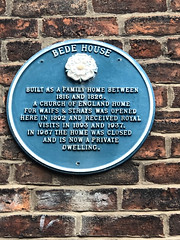
Bede House Built as a family home between 1815 and 1826. A Church of England Home for Waifs & Strays was opened here in 1892 and received Royal visits in 1893 and 1937. In 1967 the home was closed and is now a private dwelling.
Bede House, College Grove Road, Wakefield, United Kingdom
Subjects

Baroness Alice Martha Bacon 1909-1993 CBE PC (1909-1993) Yorkshire's first woman MP (1945-1970). Responsible for the introduction of comprehensive schools, she was also a powerful force behind the groundbreaking social reforms which led to the abolition of the death penalty, decriminalisation of homosexuality and the legalisation of abortion. 'A pioneer from Normanton'
Wakefield One, Wakefield, United Kingdom
Subjects
Constance Edith Heward (1884-1968) author of the Ameliaranne series of children's books who ran a small and successful private school here in the 1930s and prior to that at Bromley Mount
8 St John's Square, Wakefield, United Kingdom
Subjects
Clara Maria Clarkson (1811-1889) Unitarian and diarist. Born at Alverthorpe Hall and associated with Flanshaw Hall, she lived here until her death in 1889. A lifelong Unitarian who attended Westgate Chapel and signed the 1866 Suffrage Petition. Her social commentary provides a valuable insight into local history and the lived of Victorian women. 'Merrie Wakefield' by Ann K. Jacques published 1971, was based on her journals
Hatfield Street, Wakefield, United Kingdom
Subjects
Phyliss Lett (c.1883-1962) acclaimed contralto [full inscription unknown]
South Parade, Wakefield, United Kingdom
Subjects
Louisa Fennell (1847-1930) renowned Wakefield-born watercolourist, whose work included paintings of Wakefield scenes, lived at this address from 1919 until her death and is buried in St John's Church Yard opposite
21 St John's Square, Wakefield, United Kingdom
Subjects
The Gissing Sisters Margaret (1863-1930) & Ellen (1867-1938). In 1896 the Gissing Sisters moved to this address where they opened Wakefield's first Preparatory School for Boys in 1898. Both were visionary educationalists and introduced, for the first time onto a boys' curriculum, art, culture and music. They were known to referee football matches at the school
Wentworth Terrace, Wakefield, United Kingdom
Subjects
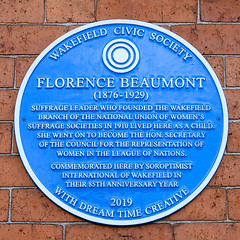
Florence Beaumont (1876-1929) Suffrage leader who founded the Wakefield branch of the National Union of Women's Suffrage Societies in 1910 lived here as a child. She went on to become the Hon. Secretary of the Council for the Representation of Women in the League of Nations. Commemorated here by Soroptimist International of Wakefield in their 85th anniversary year
38 Bond Street, Wakefield, United Kingdom
Subjects


Fanny Wordsworth Stott (Nee Haslegrave) (1882-1961) Lived here at Grove House from 1925 to 1950. The first female Mayor of Wakefield City Council (1940-41)-with her daughter ‘Betty’ Stott serving as her Mayoress. She trained as a nurse before becoming a councillor for the Eastmoor and St John's ward in 1929. Elevated to the aldermanic bench in 1938, she became a magistrate in 1939. A prolific fundraiser and campaigner who sat on many committees.
1 College Grove Road, Wakefield, United Kingdom

Miners' Welfare Fund Caphouse Colliery Pithead Baths. These baths were erected by the Miners' Welfare Committee in pursuance of the Mining Industry Act 1926 were opened and handed over to the Trustees on 5th November 1938
, Wakefield, United Kingdom

Clayton Hospital The Wakefield dispensary moved to this site in 1854 when gifts from Thomas Clayton enabled in-patient care in 1863. A new wing was added and the name changed to the Clayton Hospital and Wakefield Dispensary. The building was later converted to offices (city chambers) and was demolished in 1973.
Cross Street, Wakefield, United Kingdom