
Carson City, NV
Gender Diversity
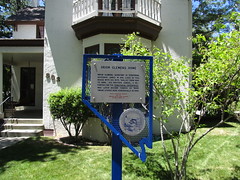
Nevada Historical Marker #78
Orion Clemens Home. Orion Clemens, secretary to territorial Governor James W. Nye, lived in this house with his wife, “Mollie,” from 1864 to 1866. Samuel, his brother who was a reporter for the Territorial Enterprise, stayed here periodically until leaving the territory in May 1864. He became famous as “Mark Twain.”
, Carson City, NV, United States
Subjects


Nevada Historical Marker #76
Eagle Valley. Centrally located between one of the first Nevada settlements at Genoa and the gold and silver of the Comstock Lode, Eagle Valley, site of present Carson City, was a vital link inland communications.One of the key California emigrant routes, the Carson branch of the California Emigrant Trail crossed the Sierra Nevada at Kit Carson Pass and came through Eagle Valley roughly along Sage Drive, a block east of this point.The first overland telegraph, colloquially known as Fred Bees “Grapevine” was completed from Placerville to Carson City in 1859. In this area, the line followed what is now highway U.S. 395. The Pony Express (1860-1861) and the Butterfield-Wells Fargo Overland Stages (1862-1868) followed the same route.The Virginia & Truckee Railway in its extension to Carson Valley and Minden in 1906 used the route about six blocks east of Bigelow Drive.
, Carson City, NV, United States

Nevada Historical Marker #180
The Warm Springs Hotel And Nevada State Prison. Proposed Text, new Marker Text Plate in Production:Built near this site around 1860, Nevada’s first Territorial Legislature met in the Warm Springs Hotel in 1861. Abraham Curry, noted entrepreneur and co-founder of Carson City, built the hotel from hand-hewn sandstone taken from the quarry southeast of here, now inside the old Nevada State Prison complex. An imposing edifice in its day, the hotel was one of several buildings throughout Carson constructed of this unique sandstone.The sandstone quarry remained a significant piece of the prison’s operation from the 1860s to the 1950s as prisoners cut stone for prison buildings and for other nearby state facilities, such as the State Capitol and the U.S. Mint, now the Nevada State Museum. Prison administrators hoped that work in the quarry, or the prison farm three miles south, would rehabilitate prisoners to return to society.In 1862, Abe Curry leased a portion of the hotel to the Nevada Territory to hold prisoners. Two years later, the State of Nevada purchased the property for use as a prison. The title to the property was disputed for years afterwards and finally settled by the Legislature in 1879.During 1867, a fire destroyed the portion of the hotel the state purchased from Curry. After the fire, the State of Nevada rebuilt the prison campus, beginning a tradition of redeveloping the prison that continued into the 1980s. The prison continued to operate until 2012 and was listed in the National Register of Historic Places in 2015.
, Carson City, NV, United States

Nevada Historical Marker #44
Carson City. Nevada's State Capital, one of the state's oldest communities, was established in 1851 as Eagle Station, a trading post and ranch on the Carson Branch of the California Immigrant Trail, by Frank and Warren L. Hall, George Follansbee, Joe and Frank Barnard and A. J. Rollins. The station and surrounding valley took their name from an easgle skin stretched on the wall of the trading post. In 1858, Abraham Curry purchased much of the Eagle Ranch after finding that lots in Genoa were too expensive. Together with his friends, Jon Musser, Frank Proctor and Ben Green, Curry platted a town he called Carson City. Curry left a plaza in the center of the planned community for a capitol building should a territorial state seat of government eventually be located in his town. In March 1861, Congress created the Nevada Territory. Seven months later in November, Carson City became the capital of the territory due to the efforts of Curry and William M. Stewart, a prominent lawyer. When Nevada became a state three years later, Carson City was selected as the state capital, and by 1871, the present capitol building was completed in the plaza Curry had reserved for it.
, Carson City, NV, United States

Nevada Historical Marker #75
Federal Government Building (1888 1970). Following the mining boom in the Aurora District in 1860, Jack Wright and Leonard Hamilton built a bridge across the West Walker River and established a stage station at this location. Wagons and stages were repaired and horses shod. The station soon became a trading center for nearby ranches and farms.In 1863, Daniel Wellington bought Wright and Hamilton’s interests and the place became known as “Wellington’s Station”. The Wellington Hotel, located about a half mile south of the station, was constructed by wagonmaster Zadok Pierce in 1875. Over the years it has served as a livery stable, freight station, general store, and post office.
, Carson City, NV, United States

Nevada Historical Marker #71
Methodist Church Of Carson City. Dedicated in 1867, this church serves a congregation that dates to 1859. Like many other buildings in Carson City, the stone used in its construction was quarried at the nearby State Prison. Reverend Warren Nims (Pastor 1863-1866) was responsible for much of the original construction. Altered extensively over the years, the structure, with its octagonal porch posts and pointed-arch windows, is one of Nevada’s oldest religious structures.
, Carson City, NV, United States

Nevada Historical Marker #70
Bliss Mansion. BUILT BY DUANE L. BLISS LUMBER & RAILROAD MAGNATE 1879. In its time the most modern & largest home in Nevada. Entirely constructed of clear lumber & square nails. First home in Nevada entirely piped for gas lighting.
, Carson City, NV, United States

Nevada Historical Marker #77
Dat So La Lee. Famed Washoe basket maker, Datsolalee, is buried in this cemetery along with many other Washoe weavers. Also known as Louisa Keyser. Dat So La Lee, and Dabuda, over 120 of her major documented baskets were made expressly for sale to Arts and Crafts collectors from 1895 until her death in 1925 under patronage of the Cohn family. Datsolalee’s baskets are prized by collectors and displayed in museums across the country.Utilitarian, straight-walled, decorated coiled willow basketry is a Washoe tradition extending back thousands of years. Datsolalee brought international fame to the spherical Washoe degikup willow basket and highlighted the form with innovative decorative motifs in bracken fern and redbud Fibers. She and her patrons promoted this craft to the public, elevated it to an art form, and, most importantly, motivated basketry production by other tribal members during a period when the Washoe were recovering from mid-nineteenth- century loss of their homelands and aboriginal life ways.
, Carson City, NV, United States

Nevada Historical Marker #134
Tran Sierran Pioneer Flight. The first authenticated air flight over the Sierra Nevada was successfully completed when four U.S. Army planes touched down here on an improvised field.Originating at Mather Field, Sacramento, and led by Lt. Col. Henry L. Watson, the squadron was made up of three Liberty-powered Dehavillands and one 90 hp Curtiss Trainer.The fliers, personally welcomed by Governor Emmet D. Boyle, were Watson, Lts. Ruggles, Curtis, Krull, Schwartz, and Haggett, and Sgt. Conway. Haggett introduced an added surprise by landing his small trainer, unannounced, some minutes after the main flight.The flight concluded in Reno that afternoon.Governor Boyle flew as a passenger in one of the planes on its return flight to Sacramento, thus making him the first civilian ever to cross the Sierra in flight.
, Carson City, NV, United States

Nevada Historical Marker #175
Stewart Nye Residence. This house was built about 1860 of local sandstone for William Morris Stewart who lived here until 1862. He sold it to the territorial governor of Nevada, James W. Nye. The two men were elected as Nevada’s first United States senators after the territory achieved statehood in 1864. Stewart served from 1864 to1875 and again from 1887 to 1905. Nye served from 1864 to 1873. Both men were originally from New York.The house later became the home of Nevada Supreme Court Chief Justice George F. Talbot. In 1917 he sold the house and block to the Catholic diocese and it served as the rectory for the Catholic Church. It was subsequently sold for commercial use.
West King St, Carson City, NV, United States

Nevada Historical Marker #181
Washo Indians. This marker has removed; on Maintenance List for ReplacementLong before the coming of emigrant wagon trains, this site overlooked the lands of the Washo Indians. A valley, a town, and a county still bear their name. A nearby trail marks their ancient route from the lowlands to Lake Tahoe and California. The Washo language is distinct from both Shoshone and Paiute. For many years, the Washo people remained isolated, roaming their native high Sierra and descending into the valleys for winter. Their pine nut ceremony is still held before harvest time, with men and women working together at this enterprise. The departure for the pine nut groves is celebrated by singing and dancing during the Pine nut ceremony called Goomsabyi. Their basketry, now world famous, is one aspect of Washo culture that has been preserved for generations. The beautiful work of their most celebrated artist, Dat-So-La-Lee is exhibited at the Nevada State Museum, Carson City, and the Nevada Historical Society, Reno, along with other equally talented basket weavers exhibits.
, Carson City, NV, United States
Nevada Historical Marker #179
First Air Flight Over Nevada Nevada June 23, 1910. The first air flight in Nevada took place on the old Raycraft Ranch immediately to the west. The flight was of national interest, not only because an air journey had never before been made at such an altitude (4,675 feet), but also because Ivy Baldwin, a nationally-known parachutist and balloonist, would make the flight.This was a trial flight, as stipulated by the Sagebrush Carnival Committee of Carson City. It was followed by exhibition flights on July 3, 4 and 5 at the Carson City racetrack.Baldwin made the flight in a 48-horsepower Curtiss Paulham biplane, reaching a height of 50 feet and covering one-half mile before returning to the starting point.HISTORICAL
, Carson City, NV, United States

Nevada Historical Marker #194
Gardner’s Ranch. On this site in the period from 1870 until 1918 stood the ornate two-story home of Matthew Culbertson Gardner, rancher and lumberman. The residence was headquarters for Gardner’s 300-acre ranch in the meadows to the southward.Here was located, 1870 to 1898, the Carson-Tahoe Lumber and Fluming Company large lumberyard here. During the 1870s and 1880s, Gardner logged south of Lake Tahoe for the company and built the only standard gauge logging railroad in the Tahoe Basin. He maintained his home here.Gardner died in 1908. The residence was destroyed by a fire August 20, 1918. Many of the old trees on the ground once shaded the Gardner family.
S Carson St (Lincoln Hwy), Carson City, NV, United States

Nevada Historical Marker #196
The United States Mint Carson City, Nevada. The original Carson City building is a formal balanced, sandstone block edifice. Two stories high with a centrally located cupola. The sandstone blocks were quarried at the Nevada State Prison.On March 3, 1862, Congress passed a bill establishing a branch mint in the Territory of Nevada.The output of the Comstock Lode coupled with the high bullion transportation costs to San Francisco proved the necessity of a branch in Nevada.From its opening in 1870 to the closing of the coin operations in 1893, coinage amounted to $49,274,434.30.
, Carson City, NV, United States

Nevada Historical Marker #193
Historic Flume And Lumberyard. Approximately one-half mile south of this point and west of the present highway lay the immense yard of the Carson-Tahoe Lumber and Fluming Company, the greatest of the Comstock timber companies operating in the Lake Tahoe Basin during 1870-1898.Situated at the terminus of the 12 mile V flume from Spooners Summit in the Sierra Nevada, the lumberyard was approximately one mile long and one-half mile wide. A spur line of the Virginia and Truckee Railroad served the yard. The spur ran adjacent to this site and carried rough lumber to the company’s planing mill and box factory, one-half mile north on Stewart Street. It also transported timbers and cordwood to the Carson yards to be hauled to the Comstock mines and mills.
Office Depot, Carson City, NV, United States

Nevada Historical Marker #235
Camp Nye 1864 1865. Established one-half mile to the north in October 1864, Camp Nye served as the home base for the men of companies “D” and “E,” 1st Nevada Volunteer Cavalry. During the Civil War, troopers from Camp Nye took an active role in struggles with American Indians, and Company “D” suffered the only two combat deaths incurred by Nevada units during the war in a battle at Table Mountain in the Tuscarora Range in Elko County on May 20, 1865. Camp Nye was deactivated in August 1865. Time has obliterated all vestiges of the barracks, stables and other facilities.
Kings Canyon Road, Carson City, NV, United States

Nevada Historical Marker #250
State Printing Building. Completed in 1886, the State Printing Building is the second oldest structure built by the State within the Capitol Complex. Architects Morrill J. Curtis and Seymore Pixley, designed the Italianate structure to compliment the older State Capitol (1870). Curtis was responsible for many significant buildings throughout Nevada and the West, including the octagonal library annex to the rear of the State Capitol (1906). Like many important structures in Carson City, this building was constructed of sandstone ashlar quarried at the nearby State Prison and is a significant example of state governmental architecture for the period. From 1886 to 1964, this building housed the offices and presses of the State Printer.
, Carson City, NV, United States

Nevada Historical Marker #258
Charles W. Friend House, Observatory & Weather Station. This is the site of the house and observatory of Nevada’s first weatherman, astronomer, and seismologist, Charles William Friend. Born in Prussia in 1835, Friend immigrated by way of South America to California during the 1849 Gold Rush. In 1867, he moved from Folsom to Carson City where he set up his own jewelery and optical store.Friend built Nevada’s first observatory located southwest of his house and east of the Nevada State Capitol. Nevada’s U.S. Senator William Stewart helped him obtain the use of a six-inch equatorial mount telescope and other instruments from the federal government.Charles Friend also established Nevada’s first weather service. In 1887, the Nevada Legislature passed authorization for a weather service station in Carson City. Friend became its director and created volunteer weather stations throughout the state. He compiled the data into reports that are still referenced today. Charles W. Friend died in 1907. Since his death, the Association of Weather Services has recognized him as a pioneer in weather service west of the Rockies.
, Carson City, NV, United States

Nevada Historical Marker #252
Rinckel Mansion. Completed in 1876, this palatial residence is an excellent example of High Victorian Italianate architecture in Carson City. Charles H. Jones, a French-schooled designer, constructed the residence for Mathias Rinckel using European craftsmen. The mansion is constructed of pressed brick resting upon a sandstone ashlar foundation. The sandstone originated from the Nevada State Prison quarry. The brick came from Carson Valley and knot-free lumber was obtained from the pine forests of Lake Tahoe.Rinckel, a German immigrant and pioneer Carson City merchant, accumulated a degree of wealth in the gold fields in the Feather River District of California from 1849 to 1859. He increased his fortune in mining at Virginia City during that city’s infancy. In 1863, Rinckel settled in Carson City, where he engaged in raising livestock and butchering. As a successful merchant, he supplied the mining and timber districts surrounding Eagle Valley with meat.
, Carson City, NV, United States

Nevada Historical Marker #25
Nevada’s Capitol. Completed in 1871, Nevada’s splendid Victorian-era Capitol was built of sandstone from the quarry of the town’s founder, Abe Curry. The octagon annex was added in 1907, the north and south wings in 1915. Notable features are its Alaskan marble walls, French crystal windows, and elegant interior.
, Carson City, NV, United States

Nevada Historical Marker #1
Empire And The Carson River Mills. When the Comstock Lode was discovered in 1859, the problem of reducing the ore from the fabulously rich Virginia City mines had to be solved. Mills were built in Gold Canyon and Six Mile Canyon, in Washoe Valley, at Dayton, and on the Carson River which offered the most abundant source of water to operate the mills.On the east shore of the river near the town of Empire the first small mill, built in 1860, was later enlarged to become the Mexican. The site of this mill lies to the southwest. Other large mills were then constructed farther downstream, spurring the growth of the town of Empire. Ore was hauled to the mills at first by wagon and later by the famous Virginia and Truckee Railroad built in 1869. Fortunes in gold and silver were produced in over 40 years of operation by the Carson River mills including the Mexican, Yellow Jacket, Brunswick, Merrimac, Vivian, and Santiago. Traces of Empire and its mills can still be seen today.
, Carson City, NV, United States

Nevada Historical Marker #72
Nevada Children’s Home. The Nevada Orphans’ Asylum, a privately funded institution, was opened in Virginia City in 1864 by the Daughters of Charity. By 1870, most of its functions were taken over by the Nevada State Orphans’ Home at Carson City, authorized in 1869 by the legislature and constructed on this site. The first child was admitted October 28, 1870.In 1903, the first building gave way to a larger one, constructed of sandstone from the state prison quarry east of Carson City. This edifice served until 1963 as Nevada’s home for dependent and neglected children. In 1951, its name was changed to the Nevada State Children’s Home. The stone building was in turn replaced in 1963, in accordance with the modern concept of family-sized groups housed in cottages. The facility closed in 1992.
, Carson City, NV, United States
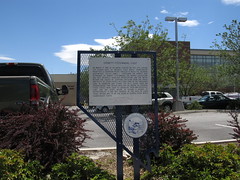
Nevada Historical Marker #243
On March 17, 1897, at an arena located on this site, Carson City played host to Nevada's first world championship prizefight, a fourteen-round thriller in which the reigning heavyweight titlist, James J. "Gentleman Jim" Corbett, was dethroned by Robert Fitzsimmons. The Nevada Legislature had only recently legalized prizefighting and the match became the object of scathing criticism from the press and pulpit of other states, but fight fans by the thousands came in. Promoter Dan Stuart put on a clean show and demonstrated that boxing need not be brutal or crooked. Other states were soon to liberalize their own prizefight laws and the sport began to assume a degree of respectability it had not enjoyed in the past. In later years, Nevada was to be the scene of several other world championship fights.
, Carson City, NV, United States
Subjects


Nevada Historical Marker #259
The Governor’s Mansion. Reno architect George A. Ferris designed this neoclassical mansion, which cost $22,700. It is the only home ever built for Nevada’s highest elected official. In July 1909, acting Governor Denver Dickerson and his wife Una became the first residents of the mansion. Two months later, June Dickerson was born here. From 1909 to 1999, sixteen families have occupied the mansion. In 2000, first lady Dema Guinn began a revitalization of the grounds. Private funds supported many of the improvements, including this fence extension donated by Steel Engineers, Inc., Las Vegas and Blue Mountain Steel, Inc., Carson City
, Carson City, NV, United States