
Georgetown, TX
Gender Diversity

Texas Historical Marker #13878
Jessie Daniel Ames. (1883-1972) A native of Palestine, Texas, Jessie Daniel came to Georgetown in 1893. She graduated from Southwestern University in 1902. In 1904 she moved to Laredo, where she married Roger Post Ames (d. 1914), and Army surgeon. They were the parents of three children. Following her husband's death, Jessie operated the Georgetown Telephone Company with her mother and became active in civic projects, including the Woman's Club. She joined the Texas Equal Suffrage Association and worked to acquire voting rights for women. She led a large group of women to the Williamson County Courthouse to register to vote for the first time in 1918. The Texas Equal Suffrage Association reorganized as the Texas League of Women Voters in 1919, and she served as its first president until 1924. A champion of civil rights causes, Ames was active in the Commission on Interracial Cooperation. Opposed to the use of chivalry as a justification for lynching, she moved to Atlanta, Georgia, and formed the Association of Southern Women for the Prevention of Lynching in 1930. She retired in 1944 and moved to Tryon, North Carolina. Ames later returned to central Texas and died in an Austin nursing home in 1972. She is buried in the I.O.O.F. Cemetery in Georgetown. (1988) #13878
1004 Church St, Georgetown, TX, United States
Subjects
Texas Historical Marker #15064
St. John's Cemetery. This burial ground is located on the site where the first Swedish Methodist church in the Brushy Creek area was located. In the early 1870s, Swedish immigrants began to settle in this area and by the early 1880s, Pastor C.C. Charmquist and residents established a church and cemetery here. The earliest known burial is of an infant, dating to 1881. In 1906, the congregation moved and was ultimately named St. John's United Methodist Church. In 1984, the St. John's Cemetery Association began to maintain the burial ground, though the graveyard continued to be closely related to the church. Early pioneers, community leaders and veterans of military conflicts dating to World War I are among those interred here. Historic Texas Cemetery - 2006 Marker is Property of the State of Texas #15064
?, Georgetown, TX, United States

Texas Historical Marker #12307
San Gabriel Park. The land and springs around this site made it a favored camping site for local Indian tribes for centuries before the Spanish discovered it. Raids, drought and conflict led the Spanish to abandon the area in 1756. The Mexican State of Coahuila and Texas granted a colonization contract to Robert Leftwich in 1825. Conflicting contracts were granted to Stephen F. Austin and Sterling C. Robertson. George W. Glasscock, Sr. (1810-1868) purchased the land while speculating for Thomas B. Huling and Company. In 1839 Glasscock received two headrights including this land as part of his share of assets when the company dissolved. The site had become a popular gathering place for settlers when Sam Houston spoke here in 1859. It became known as "The Fairgrounds." Large annual fairs, reunions and religious revivals drew crowds from surrounding areas. The county's first public hanging took place here in 1886. Williamson County Old Settlers' Association, formed in 1904, used the area for annual gatherings, eventually leasing 33 acres and building reunion structures. Helen Glasscock, the widow of George Glasscock, Jr., sold the site to I. M. Williams in 1912. A devastating flood in 1921 swept away the fairgrounds. Georgetown citizens requested that the city buy the site from the Williams family and name it San Gabriel Park in 1933. Under the direction of R. E. Ward, the city improved the park in the 1930s and 1940s. A river wall, low water crossing, large building and rest rooms were erected with funding and labor from the Federal Works Progress Administration. Rodeo pens, sports fields and further land acquisitions continue to ensure that the park provides recreation and shelter for area citizens. (1999) #12307
?, Georgetown, TX, United States
Subjects


Texas Historical Marker #09098
Georgetown High School Building. Built in 1923-24 on the original site of Southwestern University, this structure served as Georgetown High School for over fifty years. Designed by Austin architect Charles H. Page and exhibiting influences of the Spanish Colonial Revival style of architecture, the building features a Baroque entryway with cast stone detailing that includes motifs of shells, flowers, urns, and garlands. A gymnasium was added to the back of the building in the 1940s. Recorded Texas Historic Landmark - 1988 #9098
507 E. University Ave., Georgetown, TX, United States
Texas Historical Marker #09111
George Irvine House. Scottish native George Irvine (1841-1936) built this two-story frame home for his family in 1886. The founder of the Irvine Brothers Lumber Co. (later the Belford Lumber Co.), Irvine was a civic leader who served on the school board, the city council, and the vestry of Grace Episcopal Church. In 1922 he sold the house to postmaster Simon J. Enochs, who made modifications to its original Italianate detailing in the 1930s. #9111
409 E. University, Georgetown, TX, United States
Texas Historical Marker #09297
J. A. McDougle Home. One of the many fine structures erected by C. S. Belford Lumber Co., this house was built in 1895 for grocer J. A. McDougle (d. 1939). the Victorian styling included ornate stained glass windows. The home was bought in 1901 by John R. Allen and in 1910 by W. J. Flanagan, who was county treasurer for several terms. His family lived here until Mr. and Mrs. Halsell P. Armstrong became owners (1945). The property was acquired and restored in 1969 by Neil and Joyce Adams. Recorded Texas Historic Landmark - 1975 #9297
1312 Elm Street, Georgetown, TX, United States
Texas Historical Marker #09309
Site of Neusser (Naizerville). Moravian immigrant Johann Neusser came to Texas in 1872 and settled in Fayette County. In 1881, he and a number of fellow immigrants moved their families to this area. The Georgetown and Granger Railroad Company built a line through Neusser's land in 1890, and soon a general store and dance hall were built on the rail line. Initially surveyed as Keliehor for another area landowner, the community officially was named Neusser in 1892 when a post office was established. The construction of a depot in nearby Granger led to the demise of Neusser by the early 1900s. #9309
FM 971, Georgetown, TX, United States
Texas Historical Marker #09338
A. W. Sillure House. Built in 1912 for Alexander W. and Eva Sillure, this house is representative of the city's early 20th-century architectural heritage. Sillure, general manager and vice president of the Belford Lumber Company, personally supervised construction of this house and drew the plans for many other homes built by the company in Georgetown. The Sillure House reflects the American Foursquare and Prairie School styles in its full-width porch and broad eaves. Recorded Texas Historic Landmark - 1990 #9338
1414 Ash St., Georgetown, TX, United States
Texas Historical Marker #09319
Pennington Family Cemetery. Born in Fannin County, Texas, during the Republic of Texas period, John Parker Pennington (1840-1904), lived as a young man in Arizona Territory. As a member of one of the first families to settle in the territory he survived several deadly encounters with the region's Native Americans. He participated in the Civil War then moved his family to Texas in 1867. The first recorded burial was that of Pennington's sister, Margaret (Mag) Dennison, in 1872. John Pennington, his two wives, Emily J. McAllister (d. 1880) and Isabelle Purcell (d. 1916), and their descendants are interred here. (1995) #9319
Founders Oak Way, Georgetown, TX, United States
Texas Historical Marker #09363
Community of Theon. Attracted to the rich farm land, immigrants from Austria, Bohemia, Germany, Moravia and Silesia came here in the 1880s-90s. This community grew around a cotton gin built about 1883. A Catholic church and school operated at nearby Corn Hill. A post office, named "Theon" for the Greek "to God", opened in 1890. A rifle club sponsored dances, rifle contests and other socials. Farmers started a beef club, butchered mean monthly and shared it with all families. After the post office and school closed, the cotton gin continued to serve this area. #9363
FM 1105, 10 mi. NW, Georgetown, TX, United States
Texas Historical Marker #09371
Williamson County. Williamson County Formed from Milam County. Created March 12, 1848; organized August 7, 1848. Named in honor of Robert McAlpin Williamson, 1806-1859, pioneer editor, lawyer, patriot and statesman, veteran of San Jacinto. Georgetown, the county seat. #9371
?, Georgetown, TX, United States
Texas Historical Marker #12305
Railroad Produce Warehouse. Built in 1904 by William Pearce to provide storage space for a wholesale grocery company, this building was part of a larger industrial complex. A number of buildings were constructed along nearby railroad lines, including an ice plant and bottling works, grist and planing mills, and a passenger and freight depot. Thick stone walls and spring water channeled through the basement of the structure helped to cool produce. This site is a reminder of the role industry and the railroad played in the economic development of Georgetown. (1997) Incise on base: Preserved for the future by Karalei Nunn and Tom Nichols #12305
401 W. Sixth, Georgetown, TX, United States
Texas Historical Marker #12306
San Gabriel Lodge No. 89, A. F. & A. M.. Organized in 1851, three years after the creation of Williamson County, San Gabriel Lodge No. 89 was chartered in January 1852 with John T. Cox, a Methodist minister from South Carolina, as worshipful master. The lodge grew rapidly with the new county seat. An Eastern Star chapter was formed and met in the Masonic Lodge. San Gabriel Lodge No. 89 assisted in laying the cornerstone for the State Capitol building in Austin in 1885. The lodge has long been involved in such Williamson County matters as public education, its members serving on the board of education as well as in the roles of superintendents, teachers and patrons. One hundred and forty-eight years after its inception, San Gabriel Lodge No. 89 continues in the traditions of its founders. (1999) #12306
800 N. College St., Georgetown, TX, United States
Texas Historical Marker #15136
Amos-Godbey House. Built in 1909 by the C.S. Belford Lumber Company, this was originally the home of Southwestern University German professor Martin C. Amos (d. 1911) and his family. It was later purchased by another member of the University faculty, chemistry professor John Campbell Godbey, who lived here until 1965. Features of the home include a gambrel roof and three-bay inset front porch with stone piers. Recorded Texas Historic Landmark - 1988. #15136
1408 Olive, Georgetown, TX, United States
Texas Historical Marker #13925
Evangelical Free Church. Swedish immigrant settlers in Williamson County met together in homes for worship services as early as 1884. In 1891 this congregation was organized in the home of Mr. and Mrs. Sven Peterson by 21 charter members. Known as Brushy Evangelical Free Church, the congregation built a sanctuary in 1892 on land southeast of Georgetown donated by C.J. Gustafson. This Georgetown site was acquired in 1960, and a new sanctuary was dedicated in 1963. This church has been part of Williamson County history for nearly a century. (1988) #13925
1322 E University Ave, Georgetown, TX, United States
Texas Historical Marker #14595
Robert J. Rivers. In Memory of Robert Jones Rivers Pioneer patriot, lawyer and orator. Born in Virginia in 1806. Died in Georgetown, December 14, 1854. His eloquence protected the helpless, his wit charmed all. #14595
710 Main St., Georgetown, TX, United States

Texas Historical Marker #09042
Jesse Cooper House. Tennessee native Jesse Eugene Cooper (1855-1944) came to Texas in 1876. The following year he helped establish a Georgetown newspaper, the "Williamson County Sun." In addition to his role as editor, he also founded a local bank and cottonseed oil mill. The C. S. Belford Lumber Co. built this home for Cooper and his second wife, Sara (Wilbarger) (d. 1935), in 1911-12. The American Foursquare design features rustic detailing of native limestone. Recorded Texas Historic Landmark - 1988 #9042
Wilbarger Point, off SH 29, 1.5 mi. E, Georgetown, TX, United States
Subjects
Texas Historical Marker #15385
Taylor, John McQueen. (April 24, 1812 - March 14, 1887) Tennessee native John McQueen Taylor came to Texas with his family in 1829 as a settler in the empresario grant of Lorenzo de Zavala. Taylor fought in the Anahuac disturbances of 1834 and later, as a soldier in the Texas Army, he participated in the Grass Fight and the Siege of Bexar. An early justice of the peace in both Tyler and Orange counties, he later settled in Williamson County. He and his wife Nancy Ann had four children. Recorded - 1982. #15385
?, Georgetown, TX, United States
Subjects
Texas Historical Marker #13558
Judge Harry N. Graves. Born April 4, 1877 in La Vernia (Wilson County), Harry Graves attended Southwestern University in Georgetown and later served three terms as city attorney. As Williamson County attorney, he aided the prosecution in a landmark trial against the Ku Klux Klan, 1923-24 (he lived at this site at the time). District attorney and future governor Dan Moody led the team. In 1929, voters elected Graves to the Texas house of Representatives, where in 1930 he wrote the bill establishing the Texas Highway Patrol. In 1937, he became a judge on the Texas Court of Criminal Appeals. Graves died in 1957 and was buried in the State Cemetery, Austin, leaving a legacy of civil rights and public safety for Texas. (2006) #13558
1409 Olive St, Georgetown, TX, United States
Texas Historical Marker #13895
Wesley Chapel A.M.E. Church. This congregation was organized in 1869 by the Rev. Richard Robert Haywood, an early Texas missionary in the African Methodist Episcopal church. Trustees of the church bought land at this site in 1881, and worship services were held in a small wooden building until this sanctuary was constructed in 1904. Erected during the Rev. J.A. Jones' pastorate, the Carpenter Gothic style building features a corner tower and lancet windows. Recorded Texas Historic Landmark - 1984 #13895
508 W 4th, Georgetown, TX, United States
Texas Historical Marker #14933
Inner Space Cavern (Laubach Cave). #14933
?, Georgetown, TX, United States
Texas Historical Marker #13876
C.A.D. Clamp. (1827-1915) Christian Augustus Daniel Clamp was born in Thorn, Prussia (now Torun, Poland). He came to Texas in 1846 and moved to Georgetown in 1851, a year after his marriage to Asenath C. Davis (d. 1917). A skilled carpenter and cabinetmaker, Clamp became one of the city's earliest builders and developers. His work included residences as well as commercial, religious, and governmental buildings. He also owned a furniture business in this block for many years. An active Presbyterian and civic leader, Clamp served as mayor of the city from 1878 to 1880. He is buried in the I.O.O.F. Cemetery. (1990) #13876
705 Main St, Georgetown, TX, United States
Texas Historical Marker #13871
Iota Chapter, Kappa Sigma Fraternity. The Iota Chapter of the Kappa Sigma Fraternity was chartered at Southwestern University on October 12, 1886. Iota became an official chapter on October 15, 1886, following the initiations of Iverson B. Lane, Jesse C. Baker, Jasper B. Gibbs, and John S. Moss. Beginning as an unauthorized group on campus, the chapter did not receive university recognition until June 20, 1887. It was the 27th chapter chartered in the United States and the second organized in Texas. In Iota's first century over 975 members have worn the star and crescent, the symbol of Kappa Sigma. Texas Sesquicentennial 1836-1986 #13871
1003 McKenzie, Georgetown, TX, United States
Texas Historical Marker #13874
H.C. Craig Building. Built in 1903, this ornate Victorian structure originally housed the furniture store of Hugh Clifford Craig (1850-1938). Craig sold his business to local competitor W.H. Davis in 1906, but retained ownership of the building. In 1936, after the Davis Furniture Company moved, Craig sold the structure to S.W. Henderson, who ran a variety store here for many years. Elaborately designed, the building features iron columns and pressed metal ornamentation. Recorded Texas Historic Landmark - 1990 #13874
115 W 7th St, Georgetown, TX, United States
Texas Historical Marker #13893
Emzy Taylor. (1841-1895) Arkansas native Emzy Taylor clerked in his father's Georgetown square mercantile store before serving as a Confederate Captain in the Red River valley during the Civil War. He married Margaret Henderson in 1864 while on furlough and after the war returned to Georgetown and took over the family business. At the forefront of Georgetown's early development, Taylor led efforts to establish the first college, national bank, regional railroad line, and water utility service. He took special pride in his formation and service as chief of the city's volunteer fire department. (1994) #13893
?, Georgetown, TX, United States
Texas Historical Marker #13921
Old Dimmitt Home. Built in 1866 by John Jones Dimmitt; of native limestone hauled by ox-drawn wagons. Home of prominent citizens in Georgetown over 100 years. Dimmitt -- a surveyor, lawyer, mathematician, linguist, one time county attorney, and partner in building of Georgetown Railroad -- was civic leader; instrumental in getting Southwestern University moved to Georgetown. Preserved since 1948 by Dr. and Mrs. R.W. Gamble. Recorded Texas Historic Landmark - 1967 #13921
921 W. University, Georgetown, TX, United States

Texas Historical Marker #13882
Shafer Saddlery. On site of cabin used (1848) as first county courthouse. This frontier saddlery, erected 1870 of hand-cut limestone by John H. Shafer, had living quarters upstairs. Since 1872 occupants have been attorneys, a newspaper, and many other tenants. Recorded Texas Historic Landmark - 1971 #13882
711 Main St, Georgetown, TX, United States

Texas Historical Marker #13916
Lesesne-Stone Building. (The KGTN Building) This limestone commercial structure was built in 1884 to house the Sanders & Lesesne Drugstore. It remained in use as a pharmacy for the next 76 years. William D. Nichols operated the drugstore from 1887 until 1892. In that year, Dr. Thomas B. Stone acquired the business, which was known as Stone's for more than 50 years. The Georgetown landmark, which exhibits Italianate influences, features arched windows and a pressed metal cornice. Recorded Texas Historic Landmark - 1983 #13916
102 W 8th, Georgetown, TX, United States

Texas Historical Marker #13923
St. John's United Methodist Church. As early as 1871, pioneer Swedish settlers near Union Hill (4 mi. S), also known as the Brushy area, were holding Methodist worship services in homes. In 1882, they formally organized as a Swedish Methodist Episcopal church. The congregation moved to this site in 1906, when the present native stone sanctuary was completed. The name St. John's was adopted in 1939, and regular Swedish language services ended in the 1940s. Church programs, however, continue to reflect the ideals, traditions and rich heritage of the pioneer founders. (1983) #13923
311 E University Ave, Georgetown, TX, United States
Texas Historical Marker #13919
Judge Greenleaf Fisk. (May 19, 1807 - Jan. 26, 1888) Born in Albany, New York, Greenleaf Fisk was the son of a Presbyterian minister. He began preparation for the ministry himself but left his studies to migrate to the Texas frontier. In 1834 he settled in Bastrop. There he joined a company of volunteers and fought at the Battle of San Jacinto, April 21, 1836. Later he was elected to the Republic of Texas Senate. In the 1840s Fisk moved his family to a log house on the South San Gabriel River near present Leander. When Williamson County was organized in 1848, Fisk was the first "chief justice," as the office of county judge was then called, a position he had held in Bastrop County. It is said that he often waled the 11 or 12 miles from his home to the courthouse in Georgetown. Fisk was also a surveyor, and many land records in Williamson County bear his name. In 1860 Fisk moved to Brown County, where he again served as county judge and held other county offices. He donated 60 acres for the townsite of Brownwood and additional acreage for county use. His grave is in Brownwood's Greenleaf Cemetery. Fisk was married first to Mary Manlove, who is buried near Leander. After her death, he married Mary Hawkins. He had 15 children. (1976) #13919
?, Georgetown, TX, United States
Texas Historical Marker #15002
Dalrymple, William Cornelius. (August 3, 1814 - March 29, 1898) North Carolina native William Cornelius Dalrymple served in the Texas Revolutionary forces and as a Texas Ranger during the 1830s. He married Elizabeth Wilbarger in Bastrop County, Texas, in 1840, and settled on the San Gabriel River in 1846. He served Williamson County as one of six commissioners to select the county seat, as Tax Assessor/Collector, and as State Representative in 1855 and 1857. In 1860 Texas Governor Sam Houston appointed him his aide-de-camp and Commander in Chief of the Texas Militia. In 1865 he served as State Senator and delegate to Texas' Constitutional Convention. (1995) #15002
?, Georgetown, TX, United States
Texas Historical Marker #14990
In Memory of George Washington Glasscock, Sr.. In Memory of George Washington Glasscock, Sr., for whom the city of Georgetown and the county of Glasscock, Texas are named. Born in Kentucky April 11, 1810. Participated in the Black Hawk War, 1832. Came to Texas in 1834 amd fought for its independence from Mexico 1835-1836. Surveyor, soldier, legislator, helped to organize Williamson County and donated 172 acres of land for the county site. Died at Austin, Texas February 28, 1868. #14990
?, Georgetown, TX, United States
Texas Historical Marker #15185
Macedonia Baptist Church. #15185
Martin Luther King Street, Georgetown, TX, United States
Texas Historical Marker #15217
Hall Named for Laura L. Kuykendall. (1883-1935) Southwestern University dean of women, 1918-1935. Descendant of pre-1820 Texas settlers. An artist and teacher of dramatic interpretation. In tribute to her exemplary Christian life, her influence on students, and her love for Southwestern, the board of trustees in 1935 named this women's building in her honor. (1968) #15217
?, Georgetown, TX, United States
Texas Historical Marker #09036
A. M. Brown Cabin. When Asa M. Brown cut cedar, elm, and oak trees and built this cabin on his 317-acre State of Texas claim in 1853, this land was on the frontier. His chimney and fireplace were of hand-hewn native stone, the floor of dirt. William Wood, one of the many later owners, enlarged the home. In 1909-66, L. M., T. L., Annie, and Charles Hughes by turns owned and occupied the property. Mr. and Mrs. Jack Garey restored the cabin after their purchase, 1966. Recorded Texas Historic Landmark - 1974 #9036
FM 2243, 6 mi. W, Georgetown, TX, United States
Texas Historical Marker #12517
First Presbyterian Church. The Rev. William Mumford Baker presided over this congregation's organization in 1854 at the Round Rock home of Richard and Mary Agnes (Cooper) Sansom. By 1856, the church was meeting in Georgetown, where C.A.D. Clamp deeded a site (at 4th and Myrtle streets) for a sanctuary and one of the town's first schools. In 1866, following the Civil War, the membership split into separate Northern and Southern congregations. The division continued into the 1890s, when the Northern church disbanded and sold the present building to the Southern congregation. Georgetown Presbyterians have met in this building since 1873. The Northern and Southern denominations reunited in 1983 as Presbyterian Church (USA). (2004) #12517
703 Church St., Georgetown, TX, United States
Texas Historical Marker #15009
Xi Chapter, Kappa Alpha Order. This fraternity was founded in 1865 by former Confederate soldiers at Washington College in Lexington, Virginia, during the administration of Robert E. Lee. XI Chapter was founded at Southwestern University on November 28, 1883, by Alexander S. Walker and Frederick C. Procter of the Kappa Alpha Chapter at the University of Texas. XI Chapter met secretly until 1887 when faculty anti-fraternity laws were rescinded. The first fraternity house was built in 1895. Throughout its history XI Chapter has produced numerous distinguished alumni. (1983) #15009
?, Georgetown, TX, United States
Texas Historical Marker #14218
Easley Home. A native of South Carolina, Samuel Allen Easley (1851-1933) came to Texas with his parents at the age of one. They settled on a large amount of acreage along the San Gabriel River in Williamson County. After managing the family farm for much of his life, Easley and his wife, Roberta (Crow), moved to Georgetown in 1913 and built this bungalow. The house, which features a broad hip roof, bracketed eaves, and wraparound porch, remained in the Easley family until 1968. Recorded Texas Historic Landmark - 1984. #14218
1310 Olive St, Georgetown, TX, United States
Texas Historical Marker #17038
Grace Episcopal Church. #17038
811 S. Main St., Georgetown, TX, United States
Subjects
Texas Historical Marker #09103
The Harrell-Stone House. Built about 1895 for lumberman Henry W. Harrell, this Victorian house resembles others erected in this neighborhood by the C. S. Belford Lumber Co. It was sold in 1907 to storekeeper W. F. Magee. In 1937 the structure was purchased by Judge Samuel Vaughan Stone, civic leader and county judge for 35 years, and his wife Berenice, who restored it. Occupied by three prominent families, this residence has been the scene of numerous social and church gatherings. Recorded Texas Historic Landmark - 1976 #9103
1404 Elm Street, Georgetown, TX, United States

Texas Historical Marker #13875
Williamson County Sun. First published on May 19, 1877, the "Williamson County Sun" was founded by Jessie E. Cooper (1855-1944). In its first century of operation, the "Sun" initiated numerous civic projects, such as the building of the first railroad in Georgetown, Wesleyan Retirement Home, and low cost housing. Editors of the paper included Frank T. Roche, John R. Allen, John M. Sharpe, and Robert W. Cooper, son of the founder. Donald and Clara Scarbrough became the second full owners of the enterprise in 1948. The oldest newspaper in Williamson County, the weekly "Sun" became a semi-weekly in 1974. (1978) #13875
709 Main St, Georgetown, TX, United States
Texas Historical Marker #13699
C.B. and Lilburn Atkinson House. Belford Lumber Co. built this house in 1915 for real estate businessman Charles Byron Atkinson and his wife, Lilburn (Dimmit), daughter of a prominent local family. C.B. died at the age of 35, five years after its completion. Lilburn later remarried, continuing as owner of the home until 1976. An outstanding example of Craftsman bungalow architecture, the house features transoms, an inset porch with gabled roof, and cobblestone piers and chimney. Other noteworthy details include a three-sided window bay, bracketed eaves, a low overhanging roofline and a shingled foundation skirt. Recorded Texas Historic Landmark - 2006 #13699
911 S. Walnut St, Georgetown, TX, United States

Texas Historical Marker #13924
Founding of Georgetown. According to local tradition Williamson County's first six commissioners met here under a stately oak tree in May 1848 to decide where the county seat should be located. Prominent local landowner George Washington Glasscock, Sr., later joined them and offered to donate an area of land bounded by the tree at one corner and the San Gabriel River to the north and west as a site for the county seat. The commissioners accepted his offer and in July 1848 named the town Georgetown in Glasscock's honor. The landmark oak tree was felled by a storm in 1886. (1994) #13924
?, Georgetown, TX, United States
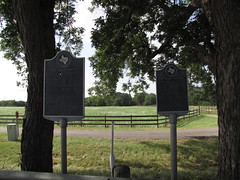
Texas Historical Marker #09362
Texan Santa Fe Expedition. A dramatic chapter in administration (1838-1841) of Republic of Texas president Mirabeau B. Lamar. Aware of United States-Mexico commerce crossing Texas by the Santa Fe Trail near the Canadian River, President Lamar sought similar trade advantages for Texas. He initiated the Texan Santa Fe Expedition early in 1841, with Dr. Richard F. Brenham, Col. Wm. G. Cooke and Jose Antonio Navarro as commissioners. Cooke began recruiting in April, forming an artillery and five infantry companies. Remainder of 321 members included merchants (with $200,000 worth of goods), teamsters, guides and others. George W. Kendall, of the New Orleans "Picayune", joined to write classic book on the venture. Travel was by 21 slow ox-wagons. First day's march, June 19, 1841, ended on the San Gabriel, and expedition's campsite is near here. Before reaching the Santa Fe Trail some 600 miles north, the men were to have torturing experiences with drouth and unknown terrain. Ill from hardships, the group was betrayed into the hands of Mexican authorities and sent as prisoners to Mexico City. However, this penetration of upper Texas gave the Republic stronger claims to her northern lands. #9362
3 mi. E on SH 29, Georgetown, TX, United States
Subjects


Texas Historical Marker #09049
Double File Trail. Laid out about 1828 by Delaware Indians, "The Double File Trail" got its name because two horsemen could ride it side by side. The Delawares carved this trace migrating ahead of expanding white settlements. They moved from what they called "the Redlands" in East Texas to Mexico near present Nuevo Laredo. Of the 200 to 250 families reported in East Texas in the 1820s, only about 150 remained after the move. Early sites in Williamson County were settled where this trail crossed waterways. Texas Rangers and the Santa Fe Expedition also traveled the track. (1978) #9049
SH 29, Georgetown, TX, United States

Texas Historical Marker #13444
C.C. and Mattie Hughes Cody House. Georgia native Claude Carr Cody (1854-1923) worked at Southwestern University for 37 years, serving as a mathematics professor and university administrator. He was known as the "Grand Old Man of Southwestern." He wed Martha "Mattie" Hughes in 1883, and her father, judge and legislator Thomas P. Hughes, gave them this lot, adjacent to one he had given to another daughter, Lonetta Booty. The Codys completed their home by 1897. The Free Classic Queen Anne house features Doric columns, an octagonal corner bay and a distinctive oval window. Recorded Texas Historic Landmark - 2005 #13444
304 E University, Georgetown, TX, United States

Texas Historical Marker #09318
W. Y. Penn Home. This house was erected in 1895 for William Y. Penn (1860-1951), a local merchant who also served as city alderman and mayor. Like several other Victorian homes here, it was built by C. S. Belford Lumber Co. In 1907 the structure became the residence of the presiding elder of the Georgetown District of the Methodist Church. It was sold in 1945 to druggist M. C. Hodges (1889-1965) and in 1966 to Dr. Van C. Tipton. In 1973 it was purchased by Mr. and Mrs. Robert V. Allen. Recorded Texas Historic Landmark - 1975 #9318
1304 Elm St, Georgetown, TX, United States

Texas Historical Marker #13897
W.C. Vaden House. Prominent local builder Charles S. Belford completed this home for Wesley Carrol Vaden and his wife Kate (Lockett) in 1908. Eclectic in design, the residence features Queen Anne styling with classical influences favored by Vaden, a Virginia native and a professor of Latin and Greek at Southwestern University for over 40 years. The home's notable elements include inset balconies, an oval window, elliptical arched openings, and shingled gable detailing. Recorded Texas Historic Landmark - 1992 #13897
711 E University, Georgetown, TX, United States

Texas Historical Marker #13896
Southwestern University. Mother of all Texas colleges and universities. Absorbed charters of Rutersville College, Fayette County (1840), and Wesleyan Male and Female College, San Augustine (1844), chartered by the Republic of Texas; McKenzie College, Clarksville (1848), and Soule University, Chappell Hill (1856). Georgetown citizens offered land, money and moral support when about 1870 it seemed wise to supplant the several pioneer Methodist institutions with a single church-related university. The community's work with church leaders resulted in location of "Texas University" here. A distinguished and devoted educator, Dr. Francis Asbury Mood (1830-1884), was the founding regent (or administrator). The Georgetown College plant (7 blocks W) was donated by the city. Classes began Oct. 6, 1873. Upon ceding the name "Texas University" to the state, Southwestern University was chartered on Feb. 6, 1875, and specifically granted all rights and privileges given earlier to Rutersville, Wesleyan, and McKenzie colleges, and Soule University. Women students were first admitted in 1878. The "Ladies Annex" was opened (1889) on present campus. This became permanent site of Southwestern University with construction of present Main Building, 1898-1900. (1973) #13896
University Ave, Georgetown, TX, United States

Negro Fine Arts School Twenty years before the integration of the Georgetown public school district, a progressive music professor and her three students embarked on a program to explore a new musical teaching theory and give African American children a chance to learn music. In the fall of 1946, Southwestern University professor Iola Bowden Chambers and her students began teaching piano lessons to children in the African American community. Through the cooperation of the Georgetown school board, the First Methodist Church of Georgetown and the Christian Student Association of Southwestern University, the Negro Fine Arts School was funded and championed. During the school’s existence, the First Methodist Church, which housed the school, welcomed over 200 students through its doors who participated in the program. The school expanded to provide voice and art lessons, produced a recital at the end of every year, and provided scholarships to its students. The scholarship program provided assistance for every year the recipient was enrolled in college. The school also produced several distinguished alumni who pursued degrees in music and taught other young aspiring musicians. The Negro Fine Arts School not only provided musical avenues and self esteem for its students, but opportunities for other community members to interact with African Americans and to understand the injustice of racial segregation. The Negro Fine Arts School introduced children to the universal language of music and helped pave the way for peaceful school integration that would begin in 1965. (2009)
410 E. University Avenue, Georgetown, TX, United States

Texas Historical Marker #09090
First United Methodist Church. Organized in 1897; served by circuit riders until 1880, when first building was erected. The Rev. H. A. Boaz, later bishop, preached here at opening of his career. Present church was built during 1891-92, of native limestone, hand-cut at this site. Robert S. Hyer, Southwestern University physics professor, was both architect and supervisor. Floor plan is that of the Greek cross. Former ministers include brothers A. Frank and W. Angie Smith, both later bishops. Recorded Texas Historic Landmark - 1970 #9090
University Ave. & Ash Street, Georgetown, TX, United States
Texas Historical Marker #09314
North Fork of the San Gabriel River. The North Fork of the San Gabriel River, part of the Brazos River system, flows east across Williamson County to join with the Middle and South forks at Georgetown. Abundant fish and wildlife attracted numerous Indian tribes to the areas along the stream in historic times. Named Rio de San Xavier by Spanish explorer and priest Fray Isidro Felix Espinosa in 1716, it was known as the San Gabriel River by the time Williamson County was created in 1848. Anglo settlements along the river in the 1800s led to the establishment of four major crossings which took the names of families living at the sites: Booty, Russell (later Jenkins), Box, and Hunt. Located along the stream near the crossings were homes, mills, schools, churches, cemeteries, postal stations, and a gin. Booty, Russell, and Box Crossings were inundated by the waters of Lake Georgetown, but Hunt Crossing remains above the reservoir. Planned as part of a flood control measure for the Brazos River system, a dam creating Lake Georgetown was completed by the U.S. Army Corps of Engineers in 1979. The lake and adjoining parks and recreational facilities were opened in 1981. (1988) #9314
CR 264, Georgetown, TX, United States
Texas Historical Marker #12302
Site of Marshall-Carver High School. The first school for African American students in Georgetown was established in the early 20th century. Called "The Colored School," the institution served grades 1 through 8 and provided the only local educational opportunities for African Americans. The school's principal, Mr. S. C. Marshall, was an outspoken advocate of higher education. A scholar himself, he persuaded the school board to allow him to provide classes through the high school level. He named the new program "The Georgetown Colored High School," and the first student enrolled in 1913. A new high school building was erected in 1923 due to increasing enrollment. When Marshall left the school in 1930, it was renamed Marshall School in his honor. The name was changed to George Washington Carver in the 1940s. In 1962, the parents of seventeen Carver students who had been denied admission to Georgetown's white schools filed a lawsuit in U. S. District Court to force integration. The court ordered the Georgetown Independent School District to integrate one grade level per year beginning with the first grad.e Partial integration began in the fall of 1964. Convinced that gradual integration would not benefit their children, African American parents appealed the decision to the Fifth Circuit Court which upheld the lower court's verdict. Proponents of full and immediate integration engaged in a letter-writing campaign to the U. S. Attorney General, the U. S. Department of Health, education and Welfare, and the Federal Assistance Program urging another review of the case. In the fall of 1965, the Georgetown School Board agreed to a plan to complete integration of the school system by September 1967. The Carver School was permanently closed due to integration. (1999) #12302
?, Georgetown, TX, United States

Texas Historical Marker #09307
Mankins Crossing. (100 yards west) This historic crossing on the San Gabriel River was named for pioneer settler Samuel Mankins, who purchased land along the river in 1849. The limestone bed in the river provided a convenient crossing for area farmers. A nearby community included a school, church, and cotton gin. A 1914 concrete and gravel causeway was replaced by a State Highway Department concrete bridge in 1931. After the Highway Department built a new bridge on higher ground at Highway 29 in 1958, the Mankins Crossing bridge became a popular recreational site for area residents. #9307
SH 29, Georgetown, TX, United States
Texas Historical Marker #13898
Chief Justice John Edward Hickman. (1883-1962) A distinguished chief justice of the Texas Supreme Court, and a native of Williamson County. Descendant of 1849 settlers from Alabama, he was a son of Nathaniel Franklin and Mary J. Porterfield Hickman. He attended the Liberty Hill Normal and Commercial College, and (with interruptions to teach school) earned a law degree at the University of Texas in 1910. For 16 years he was an attorney in Dublin (Erath County) and Breckenridge (Stephens County). Oil was discovered in both areas, and with boom conditions his practice included some historic cases. Elected Associate Justice (1926), he became in 1928 Chief Justice, Court of Civil Appeals, Eastland. He was appointed to the Supreme Court Commission of Appeals in 1935; became an associate justice of the Texas Supreme Court in 1945; and on Jan. 7, 1948, was appointed Chief Justice -- a post he filled until 1961. He is credited with 433 opinions of the Texas Supreme Court. A devout Christian, he taught a Bible class about 50 years, and served 1921-62 as a trustee of Southern Methodist University. He married (1) Ethel Markward (d. 1921) and (2) Lena Pettit, who survived him. (1971) #13898
?, Georgetown, TX, United States
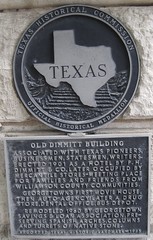
Texas Historical Marker #13920
Old Dimmitt Building. Associated with Texas pioneers, businessmen, statesmen, writers. Erected 1901 as a hotel by P.H. Dimmitt & Co. Later occupied by mercantile stores -- meeting place for families and friends from Williamson County communities. Georgetown's first movie house, then auto agency; later a drug store, dental office, bus depot. Remodelled 1960 by Georgetown Savings & Loan Association, preserving Spanish arches, columns, and turrets of native stone. Recorded Texas Historic Landmark - 1965 #13920
801 N Main, Georgetown, TX, United States

Texas Historical Marker #09039
Burcham House. Designed by noted Austin architect Charles H. Page, this home was built for the family of Georgetown dentist William Joseph Burcham (1876-1932) in 1908-09. Both Dr. Burcham and his wife Mayme (1882-1962) were civic and cultural leaders of the community. Features of the Dutch Colonial Revival home include a cross gambrel roof, square brick piers, wraparound porch, and shingled gable ends. The home remained in the Burcham family until 1981. Recorded Texas Historic Landmark - 1988 #9039
1310 College, Georgetown, TX, United States

Texas Historical Marker #14481
Williamson County Jail. In continuous use since 1888. Native limestone. Cost $22,000. Replaced 1848 frame jail at grand jury request. Financed without a bond issue. French Bastille styling, unchanged at remodeling, at cost of $40,000, in 1934. Recorded Texas Historic Landmark - 1965. #14481
312 N. Main St., Georgetown, TX, United States

Texas Historical Marker #13881
Steele Store-Makemson Hotel Building. Built about 1870 by M.E. Steele on the site of an early log hotel, this is one of Georgetown's oldest commercial structures. During Steele's ownership it housed a mercantile and a bank. Emma Dickman Makemson later operated a hotel here from the early 1900s until 1924. Exhibiting influences of the Italianate style, the building features a truncated roof, corner entry, ornate frieze below the roofline, and finely crafted stonework. Recorded Texas Historic Landmark - 1988 #13881
?, Georgetown, TX, United States

Texas Historical Marker #13880
Williamson County Courthouse. Completed in 1911, this is the fifth courthouse to serve the citizens of Williamson County. It was designed by the Austin architectural firm of Charles H. Page & Bro. Although some of the building's detailing was removed in the 1960s, it remains a fine Classical Revival structure featuring giant order Ionic columns and a copper dome with four-faced clock and a Justice statue. It serves as a focal point for Georgetown's town square. Recorded Texas Historic Landmark - 1988 #13880
710 Main St., Georgetown, TX, United States

Texas Historical Marker #13918
Georgetown Fire House and Old City Hall. Designed by C.I. Belford and constructed in 1892 by C.W. Schell, this building originally housed the mayor's office, city council chambers, city jail, fire department, and the Georgetown Water Co. Over the years, it also has served as a meeting place for the Second Baptist Church and as chamber of commerce offices. The building, which features some Italianate detailing, is one of few remaining examples of 19th-century city hall-fire stations in Texas. Recorded Texas Historic Landmark - 1984 #13918
?, Georgetown, TX, United States

Texas Historical Marker #13879
Williamson County. Created March 13, 1848, and organized by a special committee approved by Gov. George T. Wood and the 2nd Legislature of the State of Texas, with Georgetown designated as county seat. The county was named for Robert McAlpin Williamson (nicknamed "Three-Legged Willie", because of his pegleg), a veteran of Battle of San Jacinto, and one of the original members of the Supreme Court of the Republic of Texas. Lying in the Brazos River watershed and in basin of San Gabriel River, county has widely varied soils of blackland, limestone, and prairie types. Before the creation of Williamson County, settlements were situated at Tumlinson's Fort, Kenney's Fort, and other locations. Early mills made lumber, flour, and cloth. Southwestern University, heir to charter granted by the Republic of Texas in 1840 to Rutersville College, was established in Georgetown in 1877. Settlers were mainly of Anglo-American, Czech, German, Mexican, and Swedish ethnic groups. Eight incorporated towns and many smaller communities have developed. Population increased to 38,000 (with 15,000 registered voters) by 1970. This courthouse -- built in 1910 at cost of $96,000 -- is the third for the county. C.H. Page was architect. (1970) Supplemental plaque: African Americans, the largest ethnic group among pioneer settlers, comprised ten percent of the county's population in 1850 and more than nineteen percent by 1860. #13879
?, Georgetown, TX, United States

Texas Historical Marker #14860
First Presbyterian Church (Georgetown). ----- #14860
703 Church Street, Georgetown, TX, United States

Texas Historical Marker #13873
M.B. Lockett Building. Located on the site of an 1840s store, this structure was built after the Civil War. In the 1880s it housed the mercantile firm of Rucker & Montgomery. Ohio native Melville Beveridge Lockett opened his store here in 1889 and remodeled the building to its present Victorian design in 1896. Prominent architectural features include cast iron columns, an elaborate pressed metal parapet, and a corner turret with a domed oriel bay. Recorded Texas Historic Landmark - 1991 #13873
119 W 7th, Georgetown, TX, United States

Texas Historical Marker #16261
Ku Klux Klan Trials. In the 1920s, the Ku Klux Klan (KKK) was a nationwide organization that openly preached white supremacy and hatred for Blacks, Jews, Catholics, and Immigrants. In Texas, Klan membership peaked in 1923 with upwards of 150,000 members. Klansmen influenced and held positions in local and state government and in law enforcement. Their power allowed members to engage in acts of vigilante violence without fear of prosecution. Although their primary targets were people of color, the Klan also threatened Anglos who disagreed with the KKK’s core values. On Easter Sunday 1923, ten Klansmen flogged and tarred Robert Burleson, a white traveling salesman, after Burleson ignored their warning to leave Georgetown. District Attorney Dan Moody, a Taylor native, led prosecution against the Klansmen in a series of trials between September 1923 and February 1924. Moody tried his strongest case first against Klansman Murray Jackson. After seven days of arguments, the jurors deliberated for twenty minutes before returning a guilty verdict and offering the maximum punishment for the crime. Moody’s initial conviction led to four additional convictions and four prison sentences for the other Georgetown Klansmen on trial at the Williamson County Courthouse. These trials were considered the first prosecutorial success in the United States against members of the 1920s Klan and quickly weakened the Klan’s political influence in Texas. Further, the publicity garnered by Moody following the trial led to his successful runs for State Attorney General in 1924 and Texas Governor in 1926 and 1928. He was the youngest person ever elected to both statewide offices.
?, Georgetown, TX, United States

Texas Historical Marker #13877
John Berry, Frontiersman. (1786-1866) A native of Kentucky and veteran of the War of 1812, John Berry moved in 1816 to Indiana. In 1827 he brought his family to the Atascosito District of Texas. Mexico awarded him lots in Liberty and Mina (Bastrop) when those towns were founded. Berry's oldest sons, Joseph (1811-1842), John Bate (1813-1891), and Andrew Jackson (1816-1899), served in the Republic of Texas Army. All three were Texas Rangers before and after the War for Independence (1836) and in the Battle of Plum Creek (1840). Joseph was the first casualty in the Mier Expedition (1842), and John Bate was in Perote Prison for a year. A Williamson County pioneer, John Berry settled three miles northeast of Georgetown in 1846. He built a blacksmith and gun shop and a spring-driven grist mill near Berry Creek. Berry had 18 children by his three wives: Betsy Smeathers (d. 1818), daughter of pioneer Texan William Smeathers (Smothers); Gracie Treat (d. 1830); and Hannah Devore (1812-1904). Five sons and three sons-in-law served in the Confederate Army during the Civil War (1861-1865). Berry died at age 80 and was buried near his home. His descendants include a great-grandson, Audie Murphy, the most decorated soldier in American history. (1978) #13877
1800 CR 152, Georgetown, TX, United States

Texas Historical Marker #12301
Jonah Cemetery. Jonah Cemetery was established in 1902 when community leaders J. M. Barrington, W. S. McMakins, C. Brady, A. J. McDonald, and R. H. Northcutt purchased two acres near the San Gabriel River to be used as a cemetery. Burials were free to area residents. The earliest marked grave is that of George N. Northcutt. Other graves of interest are those of Confederate veterans Isiah S. Hicks and M. G. Walton. Twin sisters Sarah E. (Yoes) Robbins and Margaret (Yoes) Barrington are interred here near many of their 22 children. One of the last physical remnants of a once-thriving rural community, the Jonah Cemetery continues to serve the area. (1998) #12301
?, Georgetown, TX, United States

David Love Store South Carolina native David M. Love (1821-1892) was an early settler of Williamson County. He was engaged in farming and ranching before moving to Georgetown in the 1860s. A prominent local business leader, he had this Victorian commercial structure built for his mercantile business in the mid-1880s. Features of the building include an ornate metal façade on the second floor, square pilasters, a decorative cornice, and a restored first-floor storefront. Recorded Texas Historic Landmark - 1988
706 S Austin Ave, Georgetown, TX, United States

Texas Historical Marker #09328
The G. W. Riley House. Built 1872 by the Rev. S. J. Lane, chaplain, Southwestern University; founder, First Methodist church, Georgetown. Bought 1903 by the Rev. George W. Riley (1853-1925), a grandson of Llano County Indians' 1859 victim, the Rev. Jonas Dancer. G. W. Riley founded or served Methodist churches in Abilene, Beaumont, Douglassville, Mineral Wells, Tyler, and other towns for 48 years. He and wife, Beulah G. (Matthews) moved here to educate children; house remains in family. Recorded Texas Historic Landmark - 1972 #9328
1302 College St, Georgetown, TX, United States

Texas Historical Marker #09341
Original Site of Southwestern University. The Methodist church established four colleges in Texas prior to the Civil War: Rutersville College (1840), Wesleyan College (1844), McKenzie Institute (1848), and Soule University (1856). The Rev. Dr. Francis Asbury Mood (1830-1884) was named president of Soule University in Washington County in 1868. Soon after he took office, plans were begun to relocate the school and develop a centralized Methodist university. About the same time, city leaders in Georgetown began plans to establish a college. This site was donated for that purpose by John J. Dimmitt and G. W. Glasscock, Jr., and a community school, instead of a college, opened in 1870. Georgetown was among the cities competing for the site of the planned Methodist university. In 1873 this property was chosen as the site of the new institution, which was granted a union charter (with the four earlier colleges) in 1875 as Southwestern University. Dr. Mood served as president until his death. Buildings added to the campus after 1873 included a young ladies school, a chapel, a boys dormitory (Giddings Hall), and a gymnasium. Southwestern University moved to its present site in 1900 but continued to operate a preparatory department here until 1916. #9341
507 E. University, Georgetown, TX, United States
Texas Historical Marker #09370
Page-Decrow-Weir House. Built in 1903, this house was owned by a succession of area ranchers. J. M. Page had the home built for his family, but sold it to his brother-in-law Thomas Decrow in 1903. The home was purchased in 1920 by Horace M. Weir, and in the 1930s a polo training center was operated on the property. A Georgetown landmark, the Queen Anne style house features an octagonal tower, two-tiered wraparound porch, and a two-story bay window. Recorded Texas Historic Landmark - 1988 #9370
N of FM 2243 (Leander Road) on W side of IH-35, Georgetown, TX, United States
Texas Historical Marker #09340
Marsh F. Smith House. This Foursquare house was built in 1908 by the Belford Lumber Co. for Marsh Fawn Smith (1875-1961), operator of a local cottonseed oil mill, and his wife Jessie (Cooper) (1879-1963). Smith served as mayor of Georgetown from 1926 to 1946, important years in the economic development of the city. Elements of the Marsh F. Smith House, including the broad eaves and wraparound porch with square columns, reflect the influence of Prairie School architecture. Recorded Texas Historic Landmark - 1988 #9340
1242 Austin Ave., Georgetown, TX, United States

Texas Historical Marker #09342
Southwestern University Main Building. Oldest structure on permanent campus. Planned 1895-97 as chapel, library, classrooms, offices, when the regent (president) was Dr. J. H. McLean (1838-1925); built 1898-1900 under regent R. S. Hyer (1860-1929). From throughout the state came building fund gifts, which even included land from plantation of late Texas president Sam Houston. Neo-Romanesque style. Builders, Flume & Waterston (from British Isles), had worked on State Capitol. Recorded Texas Historic Landmark - 1962 #9342
1000 E. University, Georgetown, TX, United States