
Pittsburgh, PA
Gender Diversity

Barry Dreyfuss (1865-1932) Owner of the Pittsburgh Pirates, 1900-1932, and legendary baseball leader influential in initiating the first World series, 1903. He led Pirates to 6 National League and 2 World series titles and was vital to building Forbes Field here 1909
Schenley drive, Pittsburgh, PA, United States
Subjects
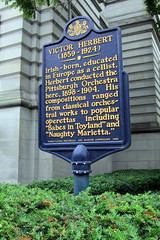
Victor Herbert (1859-1924), Irish-born, was educated in Europe as a cellist. Herbert conducted the Pittsburgh Orchestra here, from 1898-1904. His compositions ranged from classical orchestral works to popular operattas including "Babes in Toyland" and "Naughty Marletta."
Forbes Avenue, North Oakland, Pittsburgh, PA, United States
Subjects

The First all steel and concrete ballpark in the nation, Forbes Field was home to the Pirates, site of four World Series in 1909, 1925, 1927, & 1960 and two All-Star games. Hosted the Homestead Greys, Steelers, and Pitt Panthers, as well as Political rallies and boxing matches. Site of Bill Mazeroski's game seven, ninth inning, world series winning home run on October 13, 1960 and Babe Ruth's last 3 home runs. Damaged by fire; razed 1972
Roberto Clemente Dr, Pittsburgh, PA, United States
Joshua (Josh) Gibson (1911-1947) Hailed as Negro league's greatest slugger, he hit some 800 home runs in a baseball career that began here at Ammon's Field in 1929. Played for the Homestaed Greys and Pittsburgh Crawfords, 1930-46. elected to the Baseball Hall of Fame, '72
2217 bedford Ave, Pittsburgh, PA, United States
First World Series In October 1903, National League Champion Pittsburgh played American League Champion Boston in major league baseball's first modern World Series. Boston won the best-of-9 series, 5 games to 3; prominent players included Pittsburgh Honus Wagner and Boston's Cy Young. Games 4 through 7 were played near this site at Exposition Park, Pittsburgh's home from 1891 to 1909.
Roberto Clemente Memorial Park, Pittsburgh, PA, United States
Founding Convention of the CIO. Near here on Nov. 14, 1938, the first convention of the Congress of Industrial Organizations was held. 34 international unions were represented. Pittsburgh's Philip Murray was president from 1940 to 1952.
North Commons Drive, at MLK Elementary, near Allegheny Center, Pittsburgh, PA, United States
Founding Convention of the AFL. On Nov. 15, 1881, in nearby Turner Hall, a convention was held to form the organization which became the American Federation of Labor. Soon it was the nation's largest labor federation. It became part of the merged AFL-CIO in 1955.
NW corner of Mellon Park, between 5th & 6th, opposite Wm Penn Hotel, Pittsburgh, PA, United States
Fort Prince George. Name intended for fort begun here by Virginia force early in 1754 on site noted by Washington as "well situated for a Fort." Captured by the French, April 17, 1754, before its completion.
Point State Park, Pittsburgh, PA, United States
Frank Vittor (1888-1968). Pittsburgh sculptor whose subjects included American presidents and public figures such as Abraham Lincoln, Honus Wagner, and Mark Twain. He devoted his life to sculpting and teaching, and founded the city's Society of Sculptors. An Italian immigrant, Vittor sculpted Christopher Columbus here, one of his best-known works. He created it with the support of the Sons of Columbus of America and in honor of his Italian heritage.
At Columbus statue in Schenley Park, One Schenley Dr., Oakland, Pittsburgh, PA, United States
Fort Pitt Blockhouse. One of Fort Pitt's outworks, this blockhouse or redoubt stood near the western bastions and is the only surviving structure of that fort. Built in 1764 by Col. Henry Bouquet.
Point State Park, next to the Blockhouse, Pittsburgh, PA, United States
Fort Pitt. Built by the English, 1759-61, to replace Mercer's Fort of 1758-59. Named for Prime Minister William Pitt of Great Britain. British stronghold in Ohio Valley and center for settlement.
Point State Park, Pittsburgh, PA, United States
Fort Duquesne. Begun here April, 1754, by French after taking Virginia's fort. Key French position on the Ohio and base for raids on frontier after 1755. Burned by French before Forbes' army occupied it, November, 1758.
Point State Park, Pittsburgh, PA, United States
Westinghouse Electric Corporation. Pioneer in development of alternating current, permitting transmission of electricity over long distances. Founded 1886 by George Westinghouse, it first made AC motors, generators, transformers in a plant at Garrison Place and Penn Avenue.
Westinghouse Plaza, 6 Gateway Center, Pittsburgh, PA, United States

V.F.W.. The Veterans of Foreign Wars organized September 14-17, 1914, at the former Schenley Hotel near here. Veterans who had served in Cuba, Puerto Rico, the Philippines and China were among its founders.
5th Ave. & Bigelow Blvd., at Wm. Pitt Union by bus stop, Oakland, Pittsburgh, PA, United States

Pittsburgh Agreement (The). Signed here, on May 31, 1918, this document declared the intent of Czechs and Slovaks to form a new democratic nation in Europe, free from outside rule. Later that year, Thomas Garrigue Masaryk, an author of the agreement, became the 1st president of Czechoslovakia.
Penn Avenue & 7th Street, Pittsburgh, PA, United States
Founding of Ironworkers Union. On Feb.4, 1896, sixteen delegates met at Moorheads Hall here to form the International Association of Bridge, Structural, Ornamental, & Reinforcing Iron Workers. Active in the struggle for health & safety standards; by 1996 it had 140,000 members.
Grant St., betw. Blvd. of the Allies and 1st Ave., Pittsburgh, PA, United States
Pennsylvania Canal. The loading basin and western terminus of the State-built railroad, canal, and Portage over the Alleghenies uniting eastern and western Pennsylvania was here. Built in 1826-34. In 1857 sold to the Pennsylvania R.R.
Liberty Ave. /Grant St. at 10th St. (at the Pennsylvanian), Pittsburgh, PA, United States
Kier Refinery. Using a five-barrel still, Samuel M. Kier erected on this site about 1854 the first commercial refinery to produce illuminating oil from petroleum. He used crude oil from salt wells at Tarentum.
small park near Chatham/Bigelow Sq., betw. Bigelow Blvd. & 7th Ave., Pittsburgh, PA, United States
Work Accidents and the Law (1910). The pioneering study of industrial conditions in Allegheny County by Crystal Eastman documented 526 workplace deaths in one year. A component of the land-mark Pittsburgh Survey, it led to industrial accident prevention programs and workers' compensation laws.
Market Square near PPG Place, Pittsburgh, PA, United States
Pittsburgh Platform. This defining document of American Reform Judaism was signed by eighteen rabbis at the Concordia Club near here, November, 1885. The 8-point statement encouraged ecumenical dialogue, emphasized the progressive nature of Reform Judaism, and identified Judaism as a religion.
Stockton Ave. at Concordia Club, East Park (north side), Pittsburgh, PA, United States

Pittsburgh Plate Glass Company. First commercially successful U.S. plate glass maker, founded 1883 by John Ford, John Pitcairn and others. First plant was at Creighton; office was half a block east of here on Fourth Avenue. The company became PPG Industries in 1968.
Plaza of PPG Place, between 4th Ave. & Market Sq., Pittsburgh, PA, United States
Pittsburgh Glass Works. First glass factory in Pittsburgh was established on this site by James O'Hara and Isaac Craig in 1797. It manufactured bottles and window glass until the 1880s. A precursor of Pittsburgh's rise as the nation's largest glass producer.
Foot of Duquesne Incline, West Carson St., Pittsburgh, PA, United States
Allegheny Observatory. Part of the University of Pittsburgh. Chartered 1860; located here since 1912. At the original site nearby, Professor Samuel P. Langley conducted experiments that would lead to the first sustained, mechanically powered flight in 1896.
Riverview Ave. in Riverview Park (off US 19) near Observatory, Observatory Hill, Pittsburgh, PA, United States
Shadyside Iron Furnace. Built on lowlands here in 1792. Birth of the iron industry in the Pittsburgh region. It made stove and grate castings. Closed about a year later due to lack of ore and wood.
SE corner of Bayard St. & Amberson Ave., at Winchester-Thurston H.S. field, Pittsburgh, PA, United States
Railroad Strike of 1877. In July, unrest hit U.S. rail lines. Pennsylvania Railroad workers struck to resist wage and job cuts. Here, on July 21, militia fatally shot some 26 people. A battle followed; rail property was burned. The strike was finally broken by U.S. troops.
Liberty Ave. at 28th St. (on traffic island), Pittsburgh, PA, United States
Radio Station KDKA. World's first commercial station began operating November 2, 1920, when KDKA reported Harding-Cox election returns from a makeshift studio at the East Pittsburgh Works of Westinghouse. Music, sports, talks, and special events were soon being regularly aired.
KDKA Headquarters, 1 Gateway Center, Pittsburgh, PA, United States
Polish Army. At hall on this site on April 3, 1917, a speech by I. J. Paderewski to delegates at convention of the Polish Falcons began the movement to recruit a Polish army in U.S. to fight in Europe with Allies for creating an independent Poland.
97 S. 18th St., South Side Flats, Pittsburgh, PA, United States
Union Local 471, American Federation of Musicians. Organized in 1908, this local was one of the first African American musicians unions in Pennsylvania. Pittsburgh was at the forefront of the jazz world in the mid-20th century, and jazz greats Mary Lou Williams, Art Blakey, Ray Brown, and George Benson, among others, were members. A controversial merger with the white union local in the 1960s ended one of the oldest black union organizations in the US. Headquarters was nearby, 1940-1954.
Crawford St., between Wiley & Webster Aves., Pittsburgh, PA, United States

United Steelworkers of America. In the Grant Building here on June 17, 1936, the Steel Workers Organizing Committee was founded. Renamed in 1942, the USWA became one of the world's largest unions, embracing over a million workers. Philip Murray was its first president.
Grant St. between 3rd & 4th Aves., Pittsburgh, PA, United States

Fort Lafayette. Stood on this site. It was completed in 1792. Built to protect Pittsburgh against Indian attacks and to serve as a chief supply base for Gen. Wayne's army, 1792-94. Reactivated during the War of 1812. Site sold in 1813.
9th St. just N of Penn Ave., Pittsburgh, PA, United States

Allegheny County. Formed September 24, 1788 out of Westmoreland and Washington counties. Named for the Allegheny River. County seat of Pittsburgh was laid out 1764; became a city in 1816. A center of the iron, steel and other industries and "Workshop of the World."
County Courthouse, Grant St. between 5th & Forbes Aves., Pittsburgh, PA, United States
John T. Comès (1873-1922). A nationally influential church architect and a prolific writer and lecturer, Comès was recognized for his philosophy regarding design and decoration of Catholic churches. A Pittsburgh resident, his commissions, including St. Agnes here, are located in Pa. and other states.
St. Agnes Ctr. at Carlow Univ., 3219 5th Ave., Pittsburgh, PA, United States
K. Leroy Irvis (1916-2006). Member of Pa. House of Reps., serving 15 consecutive terms. In 1977 he became the first African American Speaker of a state legislature since the era of Reconstruction, and was the state's longest serving Speaker. He was influential in enacting 264 bills including establishment of the Pa. Human Relations Commission and laws enhancing equal access to education. Active in state and national Democratic Party politics, his office was here.
2170 Centre Ave., Hill Dist., Pittsburgh, PA, United States
Lewis and Clark Expedition. On Aug. 31, 1803, Capt. Meriwether Lewis launched a 50-foot 'keeled boat' from Ft. Fayette, 100 yards downriver. This marked the beginning of the 3-year expedition commissioned by President Jefferson, which opened America to westward expansion.
1 block N of 10th St. Bypass & Waterfront Dr. intersection, Pittsburgh, PA, United States
Martin R. Delany (1812-1885). A promoter of African-American nationalism, Delany published a Black newspaper, The Mystery, at an office near here. He attended Harvard Medical School, practiced medicine in Pittsburgh, and was commissioned as a major in the Civil War.
5 PPG Place, 3rd Ave. & Market St., Pittsburgh, PA, United States
Subjects


Henry Clay Frick (1848-1919). Pittsburgh industrialist and philanthropist, Frick was instrumental in the organization of the coke and steel industries. His controversial management style while chairman of Carnegie Steel led to the bloody Homestead Strike, 1892.
Grant St. near 5th Ave., in median at Frick Bldg., Pittsburgh, PA, United States
Steamboat "New Orleans". The first steamboat built west of the Alleghenies, the "New Orleans" was launched Oct. 15, 1811, near this site at Suke's Run. Pittsburgh became a center for steamboat construction & a gateway for 19th-century westward expansion.
First Ave. at Try St., Pittsburgh, PA, United States
Mercy Hospital. Founded in 1847 by the Sisters of Mercy as Pittsburgh's first hospital. Medical internships began in 1848, and the nursing school in 1893. This was the first Mercy hospital worldwide, caring for all patients, especially the community's poor.
1400 Locust St., Pittsburgh, PA, United States
Johnny Unitas (1933-2002). Pittsburgh native & Pro Football Hall of Fame inductee, 1979. Here Unitas quarterbacked semi-pro Bloomfield Rams to a Steel Bowl Football Conference championship, 1955. Signed with Baltimore Colts, 1956, leading them to an NFL championship, 1958.
Arsenal Middle School Field, 40th and Butler Sts., Lawrenceville section, Pittsburgh, PA, United States
John Scull (1765-1828). Pioneering editor and publisher who issued first edition of Pittsburgh Gazette, 1786. First newspaper west of Alleghenies, it became the Post-Gazette, 1927. A Berks County native, he was active in Western PA's civic affairs; home and print shop were here.
Blvd. of the Allies, just W of Market St., Pittsburgh, PA, United States