
Places, subjects, or plaques matching "chartist"
3 subject matching "chartist"
23 plaque matching "chartist"

Gwlad Arwystli Angel Hotel Built in 1748 Local Chartists held meetings during 1833-1839 Gwesty'r Angel 1748 Lleoliad Cyfarfodydd y siartwyr ym 1838-9
3 High St, Llanidloes, United Kingdom
Subjects

Scene of the Chartist outbreak on 30th April 1839 when a section of the townsfolk released three men arrested and detained in the hotel for their alleged Chartist activities. This event led to their eventual re-arrest, together with thirty two others, three of whom were transported while others received heavy prison sentences.
Trewythen Hotel, Great Oak St, Llanidloes, United Kingdom
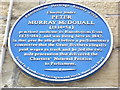
Chartist leader. Peter Murray McDouall (1814-54) practised medicine in Ramsbottom from 1835-42, and was living here in 1842. In that year he alleged before a parliamentary committee that the Grant Brothers illegally paid wages in truck and led the two mile procession that delivered the Chartists' National Petition to Parliament.
18 Bolton Street Ramsbottom Bury Lancashire BL0 9HX, Ramsbottom, United Kingdom
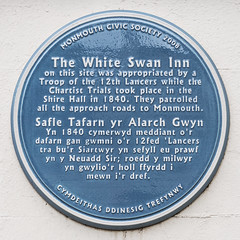
The White Swan Inn on this site was appropriated by a Troop of the 12th Lancers while the Chartist Trials took place in the Shire Hall in 1840. They patrolled all the approach roads to Monmouth.
White Swan Court, Monmouth, United Kingdom
Subjects
Kersal Moor This Moor was the site of the first Manchester Racecourse (c1687-1846) and the great Chartist rallies of 1838 and 1839, when over 30,000 workers met to demand the rights to vote and the reform of Parliament.
Kersal Moor, Salford, United Kingdom
Subjects

_Chartist_leader_and_barrister_at_law_practised_from_chambers_here_c1863_-_1869.jpg?width=250)
Ernest Jones (1819 - 1869) Chartist leader and barrister at law practised from chambers here c1863 - 1869.
Bow Chambers, Bow Lane, Manchester, United Kingdom
Subjects

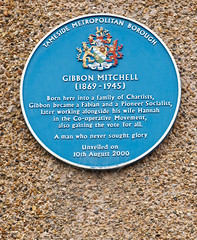
Gibbon Mitchell (1869-1945) Born here into a family of Chartists, Gibbon became a Fabian and a Pioneer Socialist, later working alongside his wife Hannah in the Co-operative Movement, also gaining the vote for all. A man who never sought glory.
Malakoff Street, Stalybridge, United Kingdom
Subjects
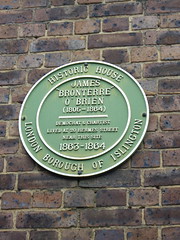
James "Bronterre" O'Brien (1805-1864) democrat & chartist lived at 20 Hermes Street near this site 1863-1864
Elizabeth Garrett Anderson School, Donegal Street, N1, London, United Kingdom
Subjects

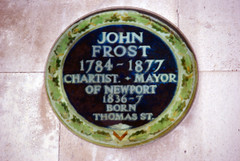
John Frost 1784-1877 Chartist. Mayor of Newport 1836-7 Born Thomas St.
glazed facade linking the Old Post Office with the re-built Corn Exchange offices, Newport, Gwent, United Kingdom
Subjects


John Frost 1784-1877 Chartist leader and social revolutionary buried at Horfield Parish church lived here from 1855 to 1877
68 Park Road, Stapleton, Bristol, United Kingdom
Subjects

The Chartists From this riverside on 3rd February 1840, John Frost, William Jones, and Zephaniah Williams, the convicted leaders of the chartist march on Newport, sailed to begin their transportation to Van Diemen's Land (Tasmania)
The Back, Chepstow, United Kingdom
Subjects

John Sketchley (1823-1913) Lived in a house in Baines Lane A Chartist, Republican, Secularist and Socialist
Baines Lane, Hinckley, United Kingdom
Subjects
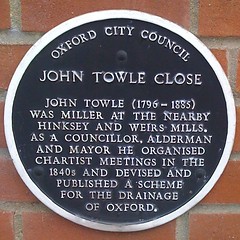
John Towle (1796-1885) was miller at the nearby Hinksey and Weirs Mills. As a councillor, alderman and mayor he organised Chartist meetings in the 1840s and devised and published a scheme for the drainage of Oxford.
John Towle Close, Oxford, United Kingdom
Subjects
.jpg?width=250)

Joseph Rayner Stephens 1805-1879 Trained in the Ministry Joseph Rayner Stephens came to Ashton in 1832. He became an important Chartist Leader who campaigned against the Poor Law and for factory reform. His greatness was in his instinctive reaction to human distress and social injustice. In later life he lived in Stalybridge where he established a People's School and is buried in St John's Church, Dukinfield
Town Hall Frontage, Waterloo Road, Stalybridge, United Kingdom
Subjects

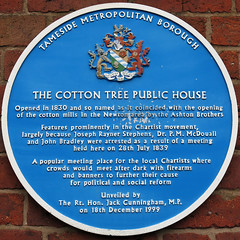
The Cotton Tree public house Opened in 1830 and so named as it coincided with the opening of the cotton mills in the Newton area by the Ashton Brothers. Features prominently in the Chartist movement, largely because Joseph Rayner Stephens, Dr. P. M. McDouall and John Bradley were arrested as a result of a meeting held here on 28th July 1839 A popular meeting place for the local Chartists where crowds would meet after dark with firearms and banners to further their cause for political and social reform
Cotton Tree Public House, Markham Street, Newton, Hyde, United Kingdom
Subjects

The Red Lion. This site has been an inn since the mid-1700s, possibly earlier. At one time it combined a blacksmith's shop with accommodation and stabling. The musical Weatherhead family were landlords at the Red Lion throughout the 19th century. They hosted concerts, self-improvement classes, Chartist meetings and early Friendly Societies. Charles Weatherhead, Silsden's first civic leader, was born here in 1828
Red Lion, Silsden, United Kingdom
Subjects

These Cascades are dedicated to the memory of SAMUEL HOLBERRY Sheffield Chartist Leader. 1814-1840. He died in York Castle on the 21st of June 1842 after suffering two years imprisonment for his part in the Sheffield rising of January 1840. He gave his life for what he believed to be the true interest of the people of England, a democratic society that would guarantee freedom equality and security for all
Peace Gardens, Sheffield, United Kingdom
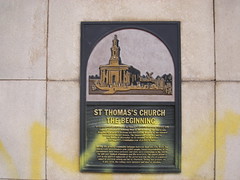
St Thomas's Church the beginning. A contemporary illustration of St Thomas's shows an imposing building with Chipman's windmill at Holloway Head in the distance. The church was designed by architects Rickman and Hutchinson, inspired by the classical buildings of ancient Greece. The foundation stone was laid by the Bishop of Worcester on 22 October 1829. It cost His Majesty's Commission pver £14,000 to build. Serving the growing community between Holloway Head and Five Ways, the church could accommodate over 2,000 people. Social responsibilities to its parishioners were taken seriously and clubs were established in the 1830s for sick pay, medical attendance and life assurance. The church played a part in the political upheavals of the period and was the site of a protest aimed at electoral reform and led by Chartists. During the protest, on 4 July 1839, the railings were uprooted and used as missiles.
The Peace Garden, Granville Street, Birmingham, United Kingdom
Subjects
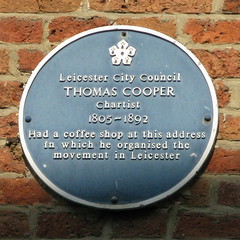
Thomas Cooper, Chartist, 1805-1892 had a coffee shop at this address in which he organised the movement in Leicester
11 Church Gate, Leicester, United Kingdom
Subjects
.jpg?width=250)
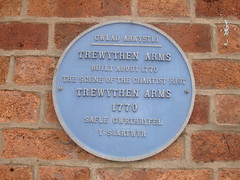
Trewythen Arms built about 1770 the scene of the Chartist riot Trewythen Arms 1770 safle gwrthryfel y siartwyr
Llanidloes, Llanidloes, United Kingdom
Subjects
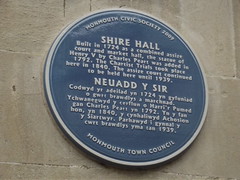
Neuadd Y Sir Codwyd yr adeilad yn 1724 yn gyfuniad o gwrt brawdlys a marchnad. Ychwanegwyd y cerflun o Harri'r Pumed gan Charles Peart yn 1792. Yn y fan hon, yn 1840, y cynhaliwyd Achosion y Siartwyr. Parhawyd i gynnal y cwrt brawdlys yma tan 1939.
English translation: Shire Hall Built in 1724 as a combined assize court and market hall, the statue of Henry V by Charles Peart was added in 1792. The Chartist Trials took place here in 1840. The assize court continued to be held here until 1939.
Shire Hall - Agincourt Square, Monmouth, United Kingdom
Subjects


Chartist & druid. Pioneer of a co-operative society, socialised medical care & cremation built these houses Dr William Price 1800-1893. Siartydd a derwydd. Adeiladwyd y tai yma gan arloeswr ym meysydd cymdeithas gydweithredol, gofal meddygol sosialaidd ac amlosgiad
English translation: Chartist & druid. Pioneer of a co-operative society, socialised medical care & cremation built these houses Dr William Price 1800-1893
Round Houses, Glyntaff, Pontypridd, United Kingdom
Subjects


THE MYNDE WALL CHARTIST UPRISING In the last quarter of the twentieth century we have taken the Right to Vote for granted. This was not always so and in 1839 after the failure of petitioning the Government of the day, the men of Britain and South Wales sought to change the system through marches and demonstration - this was known as The Chartist Uprising. John Jenkins the owner of the Mynde House and Master of the Ponthir Tin Plate Works, concerned for his property, constructed the Mynde Wall in order to keep marauding demonstrators out. The wall in front of you is what remains of his efforts.
High Street, Caerleon, United Kingdom