

Salisbury Woodland Pill Box - Type 22 [full inscription unknown]
Woodside Drive, Blackpool, United Kingdom
Swallow Side Car & Coach Building Company [full inscription unknown]
Cocker Street, Blackpool, United Kingdom

Robert's Oyster Rooms Oysters, and sea food generally, have been sold on this site since 1876. John Roberts of Preston set up the business in that year when customers could buy seven oysters for a shilling (5p) and bring along their own 'black velvet' - a mixture of stout and champagne - to wash them down. Little has changed in the business since those early days which has remained a family concern. Todays oysters generally come from Anglesey or Ireland. The building today remains as one of the oldest survivors on the Promenade.
Promenade, Blackpool, United Kingdom

The Big Wheel On this site stood a famous Blackpool landmark, the Big (or Great) Wheel. Opened on the 22nd August 1896, it was a massive structure rising to almost 230 feet and weighing around 1000 tons. It had 30 large carriages and over its 32 year life it carried millions of passengers giving them fine views of the Fylde. Never really a serious rival to its neighbour the Tower, it made its last revolution on the 20th October 1928 and was subsequently demolished.
Coronation Street, Blackpool, United Kingdom

Blackpool Civic Trust Heritage Trail Saddle Inn The present building dates back to around 1776 and was owned by Richard Hall, a 'saddler'. Known at one time as the 'Roundabout House' travellers had to go round (about) it to get to Preston Road. The well known Leigh family were landlords from 1892 until Jim (the Beekeeper) retired in 1967. Today it still retains a splendid air of yesteryear and is now the oldest continuously licensed premises in Blackpool. Kindly donated by Bass
286 Whitegate Drive, Blackpool, United Kingdom

The Town Hall (Grade II Listed) Built on the site of the former Town Hall demolished in 1895, it was completed in 1900. Designed by Potts, Son and Hemmings, built in Jacobean style of brick, faced with Yorkshire stone and originally topped with a spire and weather-vane. These were taken down in 1966 on the grounds of structural safety. Comprehensive restoration took place in 1985/86 and the building now stands as the focal point of the surrounding Conservation Area. Kindly donated by Blackpool Borough Council.
Talbot Square, Blackpool, United Kingdom
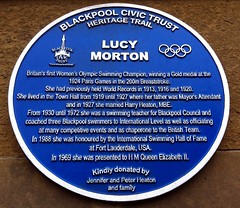
Lucy Morton Britain's first Women's Olympic Swimming Champion, winning a Gold medal at the 1924 Paris Games in the 200m Breastroke. She had previously held World Records in 1914, 1916 and 1920. She lived in the Town Hall from 1919 until 1927 where her father was Mayor's Attendant and in 1927 she married Harry Heaton, MBE. From 1930 until 1972 she was a swimming teacher for Blackpool Council and coached three Blackpool swimmers to International Level as well as officiating at many competitive events and as chaperone to the British Team. In 1988 she was honoured by the International Swimming Hall of Fame at Fort Lauderdale, USA. In 1969 she was presented to H M Queen Elizabeth II. Kindly donated by Jennifer and Peter Heaton and family.
Talbot Square, Blackpool, United Kingdom
Subjects

Blowing Sands (Grade II Listed) This cottage is one of the few remaining early agricultural dwellings on the area known as Blowing Sands, Marton Moss. Soundings made in the 1930's revealed that there have been at least 11 periods in history when the sea shore occupied this site. It now stands as a representative of several similar dwellings from the late 18th century in this area. Kindly donated by Stanley Ward Conservative Club.
Junction Common Edge Road with Progress Way, Blackpool, United Kingdom
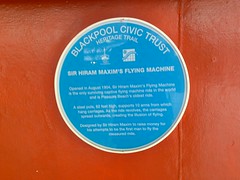
Sir Hiram Maxim's Flying Machine. Opened in August 1904, Sir Hiram Maxim's Flying Machine is the only surviving captive flying machine ride in the world and is Pleasure Beach's oldest ride. A steel pole, 62 feet high, supports 10 arms from which hang carriages, creating an illusion of flying. Designed by Sir Hiram Maxim to raise money for his attempts to be the first man to fly the measured mile.
Blackpool Pleasure Beach, Blackpool, United Kingdom
Subjects


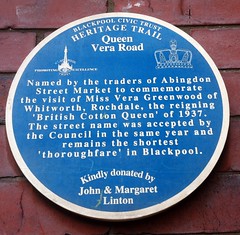
Queen Vera Road. Named by the traders of Abingdon Street Market to commemorate the visit of Miss Vera Greenwood of Whitworth, Rochdale, the reigning 'British Cotton Queen' of 1937. The street name was accepted by the Council in the same year and remains the shortest 'thoroughfare' in Blackpool.
Queen Vera Road, Blackpool, United Kingdom
Subjects

The Central Picture Theatre This purpose built cinema opened in July 1913 and originally seated around a thousand patrons. It subsequently changed its name to the King Edward and opened, it remains a fine example of the first phase of cinema building in the Art Nouveau style. It showed its last film in 1972 and has since been known by a variety of names, used mainly as a nightclub.
Central Drive, Blackpool, United Kingdom
Subjects
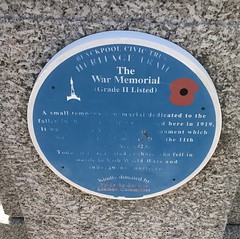
The War Memorial (Grade II Listed) A small temporary memorial dedicated to the fallen in the Great War was erected here in 1919. It was replaced by the present monument which was unveiled on Armistice Day, the 11th November 1923. Today it is dedicated to those who fell in battle in both World Wars and subsequent conflicts. Kindly donated by Fylde Ex-Service Liaison Committee.
Cenotaph, Blackpool, United Kingdom
Subjects
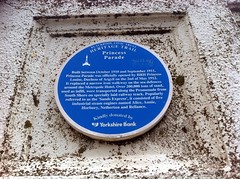
Princess Parade. Built between October 1910 and September 1911, Princess Parade was officially opened by HRH Princess Louise, Duchess of Argyll on 2nd May 1912. It replaced a narrow iron walkway on the sea defences around the Metropole Hotel. Over 200,000 tons of sand, used as infill, were transported along the Promenade from South Shore on specially laid railway track. Popularly referred to as the 'Sands Express', it consisted of five industrial steam engines named Alice, Annie, Horbury, Netherton and Reliance.
Princess Parade, Blackpool, United Kingdom
Subjects

Bailey's Hotel The original building (one of Blackpool's earliest hotels) was erected circa 1776 by Lawrence Bailey a local farmer. Over the years it has been known as Bailey's Hotel, Rossall's Hotel, Dickson's Hotel and the Metropole. Unique in Blackpool's history, it is the only hotel situated on the seaward side of the tram tracks.
Princess Promenade, Blackpool, United Kingdom
Subjects
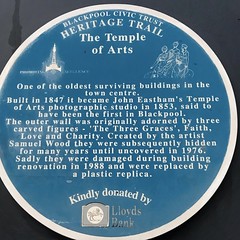
The Temple of Arts. One of the oldest surviving buildings in the town centre. Built in 1847 it became John Eastham's Temple of Arts photographic studio in 1853, said to have been the first in Blackpool. The outer wall was originally adorned by three carved figures - 'The Three Graces', Faith, Love and Charity. Created by the artist for many years until uncovered in 1976. Sadly they were damaged during building renovation in 1988 and were replaced by a plastic replica. Kindly donated by Lloyds Bank.
Temple Street, Blackpool, United Kingdom
Subjects
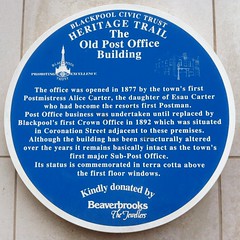
The Old Post Office Building The office was opened in 1877 by the town's first Postmistress Alice Carter, the daughter of Esau Carter who had become the resorts first Postman. Post Office business was undertaken until replaced by Blackpool's first Crown Office in 1892 which was situated in Coronation Street adjacent to these premises. Although the building has been structurally altered over the years it remains basically intact as the town's first major Sub-Post Office. Its status is commemorated in terra cotta above the first floor windows.
57/59 Church Street, Blackpool, United Kingdom
Subjects
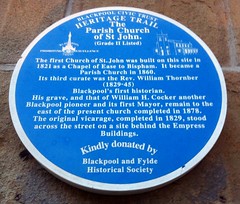
The Parish Church of St John The first Church of St.John was built on this site in 1821 as a Chapel of Ease to Bispham. It became a Parish Church in 1860 Its third curate was the Rev. William Thornber (1829-45) Blackpool's first historian. His grave, and that of William H. Cocker another Blackpool pioneer and its first Mayor, remain to the east of the present church completed in 1878. The original vicarage, completed in 1829, stood across the street on a site behind the Empress Buildings.
St John's Square, Church Street, Blackpool, United Kingdom