Gender Diversity
The top 10


.jpg?width=250)


The Bessemer Converter In recognition of the outstanding contribution to the steel industry by Sir Henry Bessemer through his invention of the Bessemer Process for steelmaking as embodied in this last remaining example of the Bessemer Converter.
Kelham Island Industrial Museum, Alma Street, Sheffield, United Kingdom
Subjects
Site of the historic Wham Bar location of the first live performance by the Human League June 12th 1978 (site has been redeveloped, so plaque may be missing)
Psalter Lane campus, Sheffield Hallam University, Sheffield, United Kingdom
Subjects
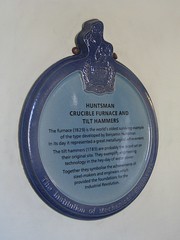
Huntsman Crucible Furnace and Tilt Hammers The furnace (1829) is the world's oldest surviving example of the type developed by Benjamin Huntsman. In its day it represented a great metallurgical achievement. The tilt hammers (1785) are probably the oldest set on their original site. They exemplify engineering technology in the heyday of water power. Together they symbolise the achievement of steel-makers and engineers which provided the foundations of the Industrial Revolution.
Abbeydale Industrial Hamlet, Abbeydale South Road, Sheffield, United Kingdom
Subjects
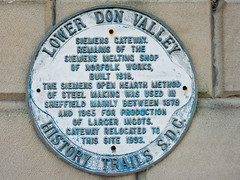
Siemens Gateway. Remains of the Siemens melting shop of Norfolk Works, built 1918. The Siemens open hearth method of steel making was used in Sheffield mainly between 1879 and 1965 for production of larger ingots. Gateway relocated to this site 1993.
Siemens Gateway, Savile Street East, Sheffield, United Kingdom
Bessemer House (1901) Former offices of Bessemer Steel Co. Across the road Henry Bessemer in 1859 established the first commercial Bessemer melting shop in Britain, leading to the worldwide introduction of cheap bulk steel
Bessemer House, Carlisle Street East, Sheffield, United Kingdom
Subjects

Carbrook Hall, Attercliffe Common. Carbrook Hall was once a much larger house, this wing being added in 1620. Here lived Colonel John Bright, famed for his part in the taking of Sheffield Castle by Parliament in the Civil War.
Carbrook Hall, Attercliffe Common, Sheffield, United Kingdom
Subjects
Broughton Lane / Attercliffe Common. Spence Broughton the highwayman, was hung in chains near here in 1796 close to the scene of his crime. He is thought to be the last man in England to be so punished.
Broughton Lane, Carbrook, Sheffield, United Kingdom
Subjects
River Don Works, Brightside Lane. River Don Works, founded in 1863 by Naylor Vickers, has long specialised in the heaviest forgings and castings for the shipbuilding, energy and defence industries. This tradition continues.
River Don Works, Brightside Lane, Sheffield, United Kingdom
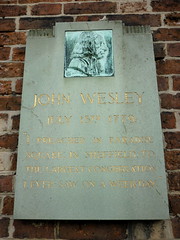
John Wesley July 15th 1779 "I preached in Paradise Square in Sheffield to the largest congregation I ever saw on a weekday ".
18 Paradise Square, Sheffield, United Kingdom
Subjects

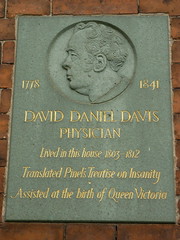
1778 1841 David Daniel Davis Physician Lived in this house 1803-1812 Translated Pinel's Treatise on Insanity Assisted at the birth of Queen Victoria
12 Paradise Square, Sheffield, United Kingdom
Subjects
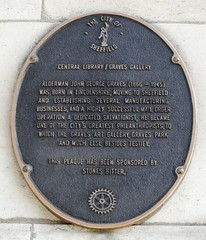
Central Library/Graves Gallery Alderman John George Graves (1866-1945) was born in Lincolnshire, moving to Sheffield and establishing several manufacturing businesses, and a highly successful mail-order operation.A dedicated Salvationist, he became one of the city's greatest philanthropists, to which the Graves Art Gallery, Graves Park and much else besides testify.
Central Library and Graves Art Gallery, Surrey Street, Sheffield, United Kingdom
William Marsden (1796-1867) was born in a house close to this site in August 1796. As a young man, he left Sheffield to study at St. Bartholomew's Hospital and was admitted a member of the Royal College of Surgeons in 1827. In 1828, he founded the country's first free hospital, the Royal Free Hospital, which was base don the principle "the disease and poverty should be the only claims for admission" In 1851, following the death of his wife from cancer, he opened a cancer hospital which is now known as the Royal Marsden.
Watson's Walk, Angel Street, Sheffield, United Kingdom
Subjects
_by_Thomas_Henry_Illidge.jpg?width=250)
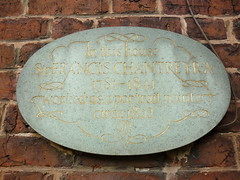
In this house Sir Francis Chantrey R.A. 1781-1841 worked as a portrait painter circa 1802
24 Paradise Square, Sheffield, United Kingdom
Subjects

Hillsborough Hall Hillsborough Hall was built in 1779 in the Adam style as the home of Thomas Steade. It was thus called as a mark of respect for Lord Downside of Hillsborough, County Down. Hillsborough subsequently became the name of a Sheffield suburb and a world famous football club ground. Nineteenth century occupants of the hall included three celebrated manufacturers; the Rodgers family of cutlers, the locomotive designer and engineer Edward Bury, and James Willis Dixon and his son of the same name who were silversmiths. It was James Willis Dixon jnr. who in 1899 released the ten acre site north of the hall which was to become Hillsborough football ground. He eventually gifted the hall to the people of Sheffield and it took on a new role as a public library in 1906.
Hillsborough Hall (now library), Hillsborough Park, Sheffield, United Kingdom
Subjects
Edward Bury Between 1852 and 1860 Hillsborough Hall was occupied by the family of Manchester born Edward Bury F.R.S. (1794-1858), pioneer locomotive builder with the London and Birmingham Railway (1838-1846), one-time locomotive superintendent and general manager of the Great Northern Railway, and subsequently co-founder of Sheffield steel firm Bedford, Burys and Co, of the Regent Works. Bury invented the bar frame locomotive, universally adopted by American railroads, and was a pioneer of standardisation in engineering.
Hillsborough Hall (now library), Hillsborough Park, Sheffield, United Kingdom
Subjects
Samuel Osborn Samuel Osborn (1826-1891) was one of the city's greatest industrialists, becoming Master Cutler in 1873 and Lord Mayor in 1890. The plaque marks the site of his company's Clyde Works, purchased in 1868 from Shortridge Howell and Co. It was here, during the late Victorian period, that the production of R.F. Mushet's self-hardening steel was perfected. This became a Sheffield speciality, making the name Samuel Osborn synonymous with the highest quality tool steel.
Clyde Steel Works, Wicker, Sheffield, United Kingdom
Subjects
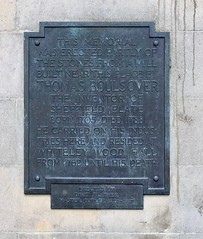
This memorial was erected partly of the stones from a mill built nearby this place by Thomas Boulsover the inventor of Sheffield Plate Born 1705 Died 1788 He carried on his industries here and resided at Whiteley Wood Hall from 1762 until his death Erected by David Flather Master Cutler 1926-1927
Wire Mill Dam, Whiteley Woods, Fulwood, Sheffield, United Kingdom
Subjects


The Bath Hotel by virtue of historic interest merits the title A Heritage Inn
The Bath Hotel, Sheffield, United Kingdom
Subjects
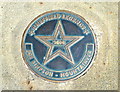

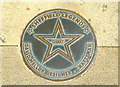
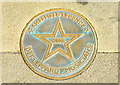

Centenary Of Cinema 1996 #222
Frank Mottershaw (1850-1932) pioneer of film production based in the city [full inscription unknown]
Ruskin Gallery, Sheffield, United Kingdom
Brendan Ingle MBE 1940 Dublin - 2018 Sheffield. Formed St Thomas' Boxing Club, Wincobank in October 1965. Red and yellow and pink and green, purple and orange and blue.
Ingle Boxing Gym, Newman Road, Sheffield, United Kingdom
Subjects

1954 Bramall Lane becomes the first English stadium to have its own floodlights
Sheffield United Football Club, Bramall Lane. Cherry Street., Sheffield, United Kingdom
Subjects
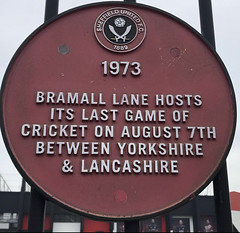
1973 Bramall Lane hosts its last game of cricket on August 7th between Yorkshire & Lancashire
Sheffield United Football Club, Bramall Lane. Cherry Street., Sheffield, United Kingdom
Subjects

1901 The world famous Archibald Leitch John Street Stand, a landmark in football, opens
Sheffield United Football Club, Bramall Lane, Cherry Street, Sheffield, United Kingdom
Subjects

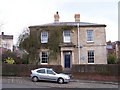
Ebenezer Elliott the Corn Law Rhymer 1781-1849 lived here 1834-1841
22 Blake Grove Road, Upperthorpe, Sheffield, United Kingdom
Subjects

Hecla Works, Newhall Road. At Hecla Works Robert A Hadfield developed manganese steel, one of the first 'special' steels. Hadfields once employed 15,000 here and at East Hecla Works, Tinsley
ex-Hecla Works, Newhall Road, Sheffield, United Kingdom
Subjects
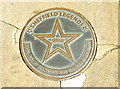
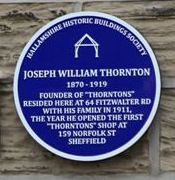
Joseph William Thornton 1870-1919 founder of "Thorntons" resided here at 64 Fitzwalter Rd with his family in 1911, the year he opened the first "Thorntons" shop at 159 Norfolk St Sheffield
64 Fitzwalter Road, Sheffield, United Kingdom
Subjects
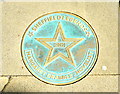
.jpg?width=250)
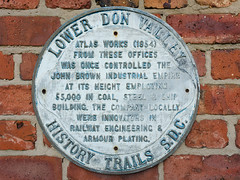
Atlas Works (1854) From these offices was once controlled the John Brown industrial empire at its height employing 55,000 in coal, steel and ship building. The company locally were innovators in railway engineering & armour plating.
Atlas Works, Savile Street East, Sheffield, United Kingdom
Subjects


World's First Prototype Cast Steel Node The world's first cast steel node made in 1978 at the nearby foundry of River Don Castings, now part of Sheffield Forgemasters. Used to join the tubulars of offshore oil platforms, the design in cast steel represented a significant milestone for both the development of casting technology and offshore structures.
Sheffield Forgemasters (roundabout outside works), Brightside Lane, Sheffield, United Kingdom