
Gender Diversity
The top 10


.jpg?width=250)


The Bessemer Converter In recognition of the outstanding contribution to the steel industry by Sir Henry Bessemer through his invention of the Bessemer Process for steelmaking as embodied in this last remaining example of the Bessemer Converter.
Kelham Island Industrial Museum, Alma Street, Sheffield, United Kingdom
Subjects
Site of the historic Wham Bar location of the first live performance by the Human League June 12th 1978 (site has been redeveloped, so plaque may be missing)
Psalter Lane campus, Sheffield Hallam University, Sheffield, United Kingdom
Subjects
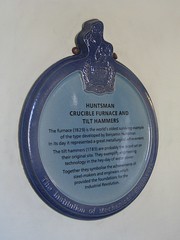
Huntsman Crucible Furnace and Tilt Hammers The furnace (1829) is the world's oldest surviving example of the type developed by Benjamin Huntsman. In its day it represented a great metallurgical achievement. The tilt hammers (1785) are probably the oldest set on their original site. They exemplify engineering technology in the heyday of water power. Together they symbolise the achievement of steel-makers and engineers which provided the foundations of the Industrial Revolution.
Abbeydale Industrial Hamlet, Abbeydale South Road, Sheffield, United Kingdom
Subjects
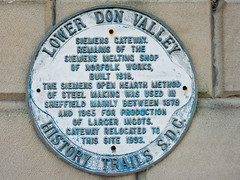
Siemens Gateway. Remains of the Siemens melting shop of Norfolk Works, built 1918. The Siemens open hearth method of steel making was used in Sheffield mainly between 1879 and 1965 for production of larger ingots. Gateway relocated to this site 1993.
Siemens Gateway, Savile Street East, Sheffield, United Kingdom
Bessemer House (1901) Former offices of Bessemer Steel Co. Across the road Henry Bessemer in 1859 established the first commercial Bessemer melting shop in Britain, leading to the worldwide introduction of cheap bulk steel
Bessemer House, Carlisle Street East, Sheffield, United Kingdom
Subjects

Carbrook Hall, Attercliffe Common. Carbrook Hall was once a much larger house, this wing being added in 1620. Here lived Colonel John Bright, famed for his part in the taking of Sheffield Castle by Parliament in the Civil War.
Carbrook Hall, Attercliffe Common, Sheffield, United Kingdom
Subjects
Broughton Lane / Attercliffe Common. Spence Broughton the highwayman, was hung in chains near here in 1796 close to the scene of his crime. He is thought to be the last man in England to be so punished.
Broughton Lane, Carbrook, Sheffield, United Kingdom
Subjects
River Don Works, Brightside Lane. River Don Works, founded in 1863 by Naylor Vickers, has long specialised in the heaviest forgings and castings for the shipbuilding, energy and defence industries. This tradition continues.
River Don Works, Brightside Lane, Sheffield, United Kingdom
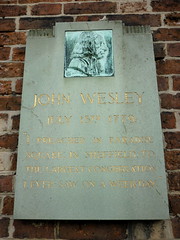
John Wesley July 15th 1779 "I preached in Paradise Square in Sheffield to the largest congregation I ever saw on a weekday ".
18 Paradise Square, Sheffield, United Kingdom
Subjects

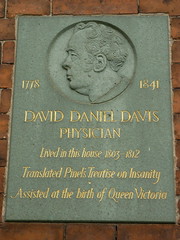
1778 1841 David Daniel Davis Physician Lived in this house 1803-1812 Translated Pinel's Treatise on Insanity Assisted at the birth of Queen Victoria
12 Paradise Square, Sheffield, United Kingdom
Subjects
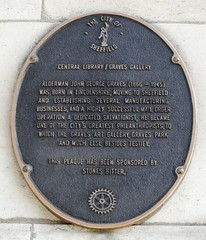
Central Library/Graves Gallery Alderman John George Graves (1866-1945) was born in Lincolnshire, moving to Sheffield and establishing several manufacturing businesses, and a highly successful mail-order operation.A dedicated Salvationist, he became one of the city's greatest philanthropists, to which the Graves Art Gallery, Graves Park and much else besides testify.
Central Library and Graves Art Gallery, Surrey Street, Sheffield, United Kingdom
William Marsden (1796-1867) was born in a house close to this site in August 1796. As a young man, he left Sheffield to study at St. Bartholomew's Hospital and was admitted a member of the Royal College of Surgeons in 1827. In 1828, he founded the country's first free hospital, the Royal Free Hospital, which was base don the principle "the disease and poverty should be the only claims for admission" In 1851, following the death of his wife from cancer, he opened a cancer hospital which is now known as the Royal Marsden.
Watson's Walk, Angel Street, Sheffield, United Kingdom
Subjects
_by_Thomas_Henry_Illidge.jpg?width=250)
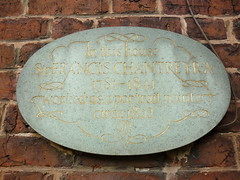
In this house Sir Francis Chantrey R.A. 1781-1841 worked as a portrait painter circa 1802
24 Paradise Square, Sheffield, United Kingdom
Subjects

Hillsborough Hall Hillsborough Hall was built in 1779 in the Adam style as the home of Thomas Steade. It was thus called as a mark of respect for Lord Downside of Hillsborough, County Down. Hillsborough subsequently became the name of a Sheffield suburb and a world famous football club ground. Nineteenth century occupants of the hall included three celebrated manufacturers; the Rodgers family of cutlers, the locomotive designer and engineer Edward Bury, and James Willis Dixon and his son of the same name who were silversmiths. It was James Willis Dixon jnr. who in 1899 released the ten acre site north of the hall which was to become Hillsborough football ground. He eventually gifted the hall to the people of Sheffield and it took on a new role as a public library in 1906.
Hillsborough Hall (now library), Hillsborough Park, Sheffield, United Kingdom
Subjects
Edward Bury Between 1852 and 1860 Hillsborough Hall was occupied by the family of Manchester born Edward Bury F.R.S. (1794-1858), pioneer locomotive builder with the London and Birmingham Railway (1838-1846), one-time locomotive superintendent and general manager of the Great Northern Railway, and subsequently co-founder of Sheffield steel firm Bedford, Burys and Co, of the Regent Works. Bury invented the bar frame locomotive, universally adopted by American railroads, and was a pioneer of standardisation in engineering.
Hillsborough Hall (now library), Hillsborough Park, Sheffield, United Kingdom
Subjects
Samuel Osborn Samuel Osborn (1826-1891) was one of the city's greatest industrialists, becoming Master Cutler in 1873 and Lord Mayor in 1890. The plaque marks the site of his company's Clyde Works, purchased in 1868 from Shortridge Howell and Co. It was here, during the late Victorian period, that the production of R.F. Mushet's self-hardening steel was perfected. This became a Sheffield speciality, making the name Samuel Osborn synonymous with the highest quality tool steel.
Clyde Steel Works, Wicker, Sheffield, United Kingdom
Subjects
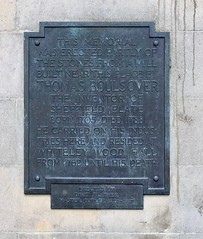
This memorial was erected partly of the stones from a mill built nearby this place by Thomas Boulsover the inventor of Sheffield Plate Born 1705 Died 1788 He carried on his industries here and resided at Whiteley Wood Hall from 1762 until his death Erected by David Flather Master Cutler 1926-1927
Wire Mill Dam, Whiteley Woods, Fulwood, Sheffield, United Kingdom
Subjects


The Bath Hotel by virtue of historic interest merits the title A Heritage Inn
The Bath Hotel, Sheffield, United Kingdom
Subjects
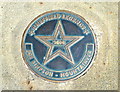

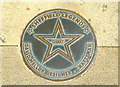
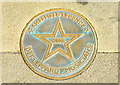

Centenary Of Cinema 1996 #222
Frank Mottershaw (1850-1932) pioneer of film production based in the city [full inscription unknown]
Ruskin Gallery, Sheffield, United Kingdom
Brendan Ingle MBE 1940 Dublin - 2018 Sheffield. Formed St Thomas' Boxing Club, Wincobank in October 1965. Red and yellow and pink and green, purple and orange and blue.
Ingle Boxing Gym, Newman Road, Sheffield, United Kingdom
Subjects

1954 Bramall Lane becomes the first English stadium to have its own floodlights
Sheffield United Football Club, Bramall Lane. Cherry Street., Sheffield, United Kingdom
Subjects
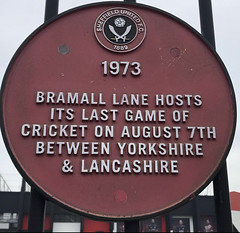
1973 Bramall Lane hosts its last game of cricket on August 7th between Yorkshire & Lancashire
Sheffield United Football Club, Bramall Lane. Cherry Street., Sheffield, United Kingdom
Subjects

1901 The world famous Archibald Leitch John Street Stand, a landmark in football, opens
Sheffield United Football Club, Bramall Lane, Cherry Street, Sheffield, United Kingdom
Subjects

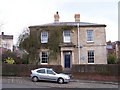
Ebenezer Elliott the Corn Law Rhymer 1781-1849 lived here 1834-1841
22 Blake Grove Road, Upperthorpe, Sheffield, United Kingdom
Subjects

Hecla Works, Newhall Road. At Hecla Works Robert A Hadfield developed manganese steel, one of the first 'special' steels. Hadfields once employed 15,000 here and at East Hecla Works, Tinsley
ex-Hecla Works, Newhall Road, Sheffield, United Kingdom
Subjects
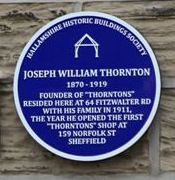
Joseph William Thornton 1870-1919 founder of "Thorntons" resided here at 64 Fitzwalter Rd with his family in 1911, the year he opened the first "Thorntons" shop at 159 Norfolk St Sheffield
64 Fitzwalter Road, Sheffield, United Kingdom
Subjects
.jpg?width=250)
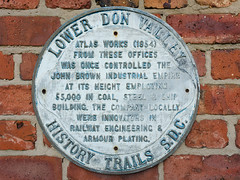
Atlas Works (1854) From these offices was once controlled the John Brown industrial empire at its height employing 55,000 in coal, steel and ship building. The company locally were innovators in railway engineering & armour plating.
Atlas Works, Savile Street East, Sheffield, United Kingdom
Subjects


World's First Prototype Cast Steel Node The world's first cast steel node made in 1978 at the nearby foundry of River Don Castings, now part of Sheffield Forgemasters. Used to join the tubulars of offshore oil platforms, the design in cast steel represented a significant milestone for both the development of casting technology and offshore structures.
Sheffield Forgemasters (roundabout outside works), Brightside Lane, Sheffield, United Kingdom
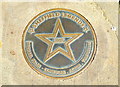

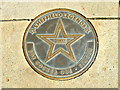

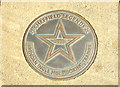
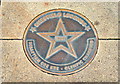



Attercliffe Library, Leeds Road. Attercliffe Library opened in 1894 in answer to local public demand and closed in 1986. As well as lending books it was one of the first places in Sheffield to display lists of job vacancies.
Attercliffe Library (former), Leeds Road, Sheffield, United Kingdom
Subjects
Attercliffe Baths, Attercliffe Road. Attercliffe Baths, built in 1879, provided both swimming and washing facilities for the area at a time when bathrooms at home were unknown. this was also Attercliffe's Speakers Corner, especially 1900-1939.
Attercliffe Road, Sheffield, United Kingdom
Subjects

To commemorate all ramblers who campaigned for National Parks and public access to mountains and moorland.
Town Hall, Sheffield, United Kingdom
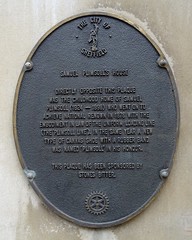
Samuel Plimsoll's House. Directly opposite this plaque was the childhood home of Samuel Plimsoll (1824-1898) who went on to achieve national renown in 1875 with the embodiment in law of the Uniform Loading Line (The Plimsoll Line). In the same year a new type of canvas sole with a rubber band was named 'Plimsoll' in his honour.
Regent St, Sheffield, United Kingdom
Subjects

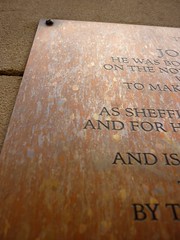
1783 1861 Joseph Hunter He was born 6 February 1783 in a house on the north side of New Church Street which was demolished to make way for the 1897 Town Hall. He is remembered as Sheffield's pre-eminent local historian and for his work in the Public Record Office. He died on 9 May 1861 and is buried in Ecclesfield churchyard.
Town Hall, Surrey Street, Sheffield, United Kingdom
Subjects


Welcome to Sheffield. Our Steel City is the home of the discovery in 1913 of stainless steel by Harry Brearley. He made the discovery that changed the world at Brown Firth. Sheffield Stainless Steel is used in everything from kitchen knives and medical instruments to buildings, power and aerospace. Harry Brearley's name lives on through his Freshgate Trust Foundation, which still provides charitable support to a wide variety of local education and community projects across South Yorkshire.
Railway Station, Sheaf Street, Sheffield, United Kingdom
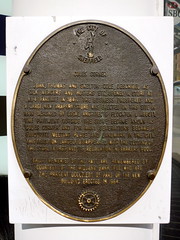
Coles Corner. John, Thomas and Skelton Cole, described as silk mercers and hosiers etc. opened a store at No 4 Fargate in 1847. The business prospered and a large new drapery store was erected on this site in 1869 designed by local architects Flockton & Abbott. The pavement outside the store became known as 'Coles Corner' and for many generations became a favourite meeting place and landmark in the city. This tradition largely disappeared with the closing of the store in 1963 and its relocation in Barkers Pool.
Fargate, Sheffield, United Kingdom
Subjects
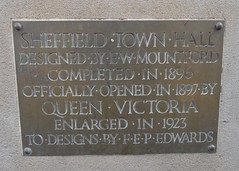
Sheffield Town Hall designed by EW Mountford. Completed in 1896. Officially opened in 1897 by Queen Victoria. Enlarged in 1923 to designs by FEP Edwards.
Town Hall, Pinstone Street, Sheffield, United Kingdom
Subjects


This Police Box, which is still used operationally, is the sole survivor of 120 boxes which served the Sheffield City Police and the community for nearly 40 years. Introduced by the Chief Constable, Percy J Sillitoe, in October 1928, in the days when there were few police vehicles and no personal radios the boxes were sited on police beats all over the City and provided a contact point for police officers and members of the public seeking police assistance. The boxes were visited by patrolling officers at hourly intervals when information was passed by 'phone between patrolling officers and supervisory staff at police stations. A 'blue' electric lamp, controlled from the local police station, was located on the top of each box and used to indicate that there was an important message to be passed out. Although small in size (approximately 5' square) the boxes were used by one, and often two, patrolling officers for meal breaks - usually sandwiches and a flask of tea - and for report writing and recording messages for other patrolling and supervisory officers. Occasionally the boxes served as a temporary lock-up for anyone who had been arrested and was awaiting transport to a police station. The boxes remained in regular use until the 1960's when modern policing techniques and improved communications made them obsolete.
Surrey Street, Sheffield, United Kingdom
1939-1945 On the night of December 15th 1940 this lock was severely damaged by enemy action during an air raid on the city This plaque is dedicated to the workforce of the Sheffield and South Yorkshire Navigation Company who stove to keep the waterway open under hazardous and extremely difficult conditions throughout the war
Tinsley Flight - Lock No 5, Sheffield & Tinsley Canal, Sheffield, United Kingdom
Tinsley Tramsheds, Sheffield Road. Tinsley Tramsheds were built in 1874 for the first horse drawn tram service in Sheffield. In 1899 they were extended to house electric trams. In 1960 the last Sheffield tram terminated here.
Tinsley Tramsheds, Sheffield Road, Sheffield, United Kingdom

Sandygate. The oldest football ground in the world. Home of Hall Football Club founded 1860
Sandygate Road, Sheffield, United Kingdom
Subjects
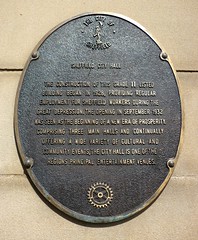
Sheffield City Hall The construction of this Grade II listed building began in 1928, providing regular employment for Sheffield workers during the Great Depression. The opening in September 1932 was seen as the beginning of a new era of prosperity. Comprising three main halls and continually offering a wide variety of cultural and community events, the City Hall is one of the regions principal entertainment venues.
City Hall, Barker's Pool, Sheffield, United Kingdom
River Don Engine A three-cylinder 12,000hp engine with Joy Valve Gear, one of the most powerful surviving steam engines in the world. Built in 1905 by Davy Brothers of Sheffield, and installed at Cammell's Grimesthorpe Works to drive an armour plate rolling mill, this engine was transferred to the River Don Works of English Steel Corporation where it remained until Easter 1978.
Kelham Island Industrial Museum, Alma Street, Sheffield, United Kingdom
Bramah Hydraulic Press Presented in recognition of the outstanding contribution to mechanical engineering made by Joseph Bramah in laying the foundations of fluid power engineering, as embodied in this last remaining example of a Bramah Hydraulic Press.
Kelham Island Industrial Museum, Alma Street, Sheffield, United Kingdom

Fluent CFD Software Awarded in recognition of the significant impact of the Fluent CFD software (Releases 1-5, 1983 to 1998) on knowledge, excellence and innovation in mechanical engineering, and for its resultant contribution to the health and well-being of society, the economy and the environment.
ANSYS UK, Sheffield Business Park, 6 Europa View, Sheffield, United Kingdom
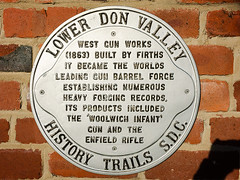
West Gun Works (1863) Built by Firths it became the worlds leading gun barrel forge establishing numerous heavy forging records. Its products included the 'Woolwich Infant' gun and the Enfield rifle
West Gun Works, Savile Street East, Sheffield, United Kingdom

These Cascades are dedicated to the memory of SAMUEL HOLBERRY Sheffield Chartist Leader. 1814-1840. He died in York Castle on the 21st of June 1842 after suffering two years imprisonment for his part in the Sheffield rising of January 1840. He gave his life for what he believed to be the true interest of the people of England, a democratic society that would guarantee freedom equality and security for all
Peace Gardens, Sheffield, United Kingdom

This panel bearing the Medical School motto (Ars Longa, Vita Brevis) came from the Surrey Street building which housed the school from 1812 to 1888. The motto is from an aphorism of Hippocrates (400 BC) which begins "art is long, life is short ...". It refers to the difficulty in acquiring and practising the art of medicine: the physician, patient, attendants and external circumstances must work together towards a cure
Royal Hallamshire Hospital, Sheffield, United Kingdom

THIS SQUARE PREVIOUSLY NAMED ST PAUL'S GARDENS WAS CALLED BY THE PEOPLE OF SHEFFIELD THE PEACE GARDENS & WAS DEDICATED AS SUCH ON HIROSHIMA DAY ON 6TH AUGUST 1985 IN THE PRESENCE OF THREE HIBAKUSHA SURVIVORS OF THE ATOMIC DEVASTATION OF THE CITY OF HIROSHIMA. IT WAS REBUILT IN CELEBRATION OF THE SECOND MILLENNIUM AND REDEDICATED IN THE NAME OF PEACE ON 9TH DECEMBER 1998 BY THE CHILDREN OF SHEFFIELD BLESSED ARE THE PEACEMAKERS FOR THEY SHALL BE CALLED THE CHILDREN OF GOD
Peace Gardens, Sheffield, United Kingdom

SPANISH CIVIL WAR 1936-1939 IN HONOUR OF THE SOUTH YORKSHIRE MEN WHO FOUGHT ALONGSIDE THE SPANISH PEOPLE IN SUPPORT OF DEMOCRACY AND OF THE LOCAL MEN AND WOMEN WHO WORKED IN SUPPORT OF THE CAUSE. THESE DIED IN SPAIN M.AARONBERG (JARAMA 2.37) G.ALLSTOP (EBRO 8.38) W.BRENT (EBRO 8.38) A NEWSUM (CORDOVA 1.37) H TAGG (JARAMA 2.37) F.TURNHILL (TERUEL 1.38) THESE ALSO FOUGHT IN SPAIN J ALBAYA . A COOPER. T DEGNAN. T JAMES. J MAIDEN. R RYDER. C SMITH. A STIRLING. S WARD. H WINDLE Yet, freedom, yet thy banner torn but flying Streams like a thunderstorm aginst the wind BYRON
Peace Gardens, Sheffield, United Kingdom

TO THE MEMORY OF ALL THOSE CITIZENS OF SHEFFIELD BOTH MILITARY AND CIVILIAN WHO LOST THEIR LIVES AS RESULT OF WAR AND IN PURSUIT OF PEACE They shall not grow old as we that are left grow old Age shall not weary them nor the years condemn At the going down of the sun and in the morning We will remember them (Binyon 1869-1945)
Peace Gardens, Sheffield, United Kingdom

The Francis Newton This building is the former Broombank House, which was built in the 1820's for the wealthy cutlery manufacturer, Francis Newton, for whom this pub is named. In 1844 Newton was elected Master Cutler, the head of the prestigious Company of Cutlers. Sheffield is the cutlery capital of the world. The premises were refurbished by JD Wetherspoon in February 2010.
Broombank House, Clarkehouse Road, Broomhall, Sheffield, United Kingdom
Jarvis Cocker musician sustained broken leg due to clambering out of a window above this site. 1985
Division Street, Sheffield, United Kingdom
Subjects
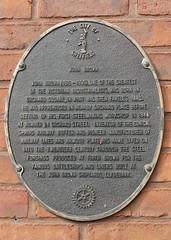
John Brown John Brown (1816-1896), one of the greatest of the Victorian industrialist, was born in Orchard Square, in what was then Favell's Yard. He was apprenticed in nearby Orchard Place before setting up his first steelmaking workshop in 1844 at number 24 Orchard Street. Inventor of the conical spring railway buffer and pioneer manufacturer of railway lines and armour plate, his name lived on into the twentieth century through the steel forgings produced at Firth Brown for the famous battleships and liners built at the John Brown Shipyards, Clydebank.
Favell's Yard, Orchard Square, Sheffield, United Kingdom
Subjects
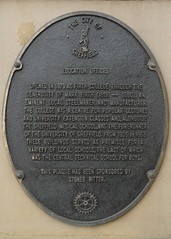
Education Offices Opened in 1879 as Firth College through the generosity of Mark Firth (1819-1880), an eminent local steelmaker and manufacturer, the college was a centre for popular lectures and university extension classes and, alongside the Sheffield Medical School, was the forerunner of the University of Sheffield. From 1905 to 1963 these buildings served as premises for a variety of local schools, the last of which was the Central Technical School for Boys.
Leopold Street, Sheffield, United Kingdom
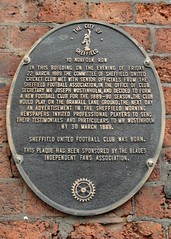
10 Norfolk Row. In this building on the evening of Friday 22 March 1889 the committee of Sheffield United Cricket Club met with senior officials from the Sheffield Football Association, in the office of Club Secretary Mr Joseph Wostinholm, and decided to form a new football club for the 1889-90 season. The club would play on the Bramill Lane Ground. The next day an advertisement in the Sheffield morning newspapers invited professional players to send their testimonials and particulars to Mr Wostinholm by 30 March 1889. Sheffield United Football Club was born.
10 Norfolk Row, Sheffield, United Kingdom
Subjects

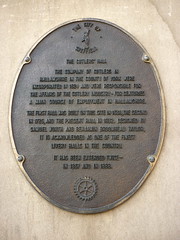
The Cutlers' Hall The Company of Cutlers in Hallamshire in the County of York were incorporated in 1624 and were responsible for the affairs of the cutlery industry - for centuries a main source of employment in Hallamshire. The first hall was built on this site in 1638, the second in 1725, and the present hall in 1832. Designed by Samuel Worth and Benjamin Broomhead Taylor, it is acknowledge as one of the finest livery halls in the country. It has been extended twice - in 1867 and in 1888.
Cutlers' Hall, Church Street, Sheffield, United Kingdom
Subjects
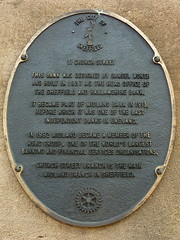
17 Church Street This bank was designed by Samuel Worth and built in 1837 as the head office of the Sheffield and Hallamshire Bank. It became part of Midland Bank in 1913, before which it was one of the last independent banks in England. In 1992 Midland became a member of the HSBC Group, one of the world's largest banking and financial services organisations. Church Street branch is the main Midland branch in Sheffield
17 Church Street, Sheffield, United Kingdom
Subjects
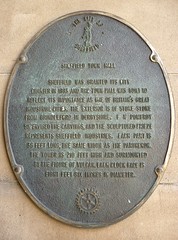
Sheffield Town Hall Sheffield was granted its city charter in 1893 and the town hall was built to reflect its importance as one of Britain's great industrial cities. The exterior is of Stoke stone from Grindleford in Derbyshire. F. W. Pomeroy supervised the carvings, and the sculptured frieze represents Sheffield industries. Each part is 36 feet long, the same width as the Parthenon. The tower is 210 feet high and surmounted by the figure of Vulcan. Each clock face is eight feet six inches in diameter.
Town Hall, Sheffield, United Kingdom
Subjects

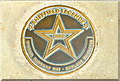

Three metres below this site lie the remains of Pond Tilt Forge 1793-1856. The tilt hammer forged Sheffield steel, powered by the rivers Sheaf and Porter. The forge closed to make way for the railway after a working life that included use as a grinding wheel and timber saw mill.
Sheaf Square, Sheffield, United Kingdom
Cemetery Road Church Football Club The World's Oldest Football Club to originate from a church was formed in the south west corner of this car park 1861.
Nuffield Health Napier St, Sheffield, S11 8HA, Sheffield, United Kingdom

The York Football Club Establish here 1861 The world's first football club to originate from a hotel was formed here in 1861.
243-247 Fulwood Road, Sheffield, S10 3BA, Sheffield, United Kingdom
Sir Nathaniel Creswick KCB 31st July 1831 - 20th Oct 1917 C0-founder of Sheffield FC in 1857 His Solicitors office was located here Creswick used there offices to support the development and administration of the world's first and oldest football club Local pioneers gathered here to discuss innovations which helped to shape the evolution of modern football.
9 East Parade, Sheffield, Sheffield, United Kingdom

1862 Bramall Lane stages its 1st football game between Sheffield F.C. & Hallam
Sheffield United Football Club, Bramall Lane, Cherry Street, Sheffield, United Kingdom
Subjects

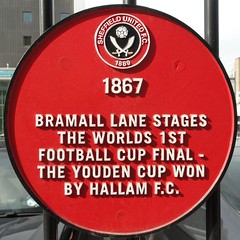
1867 Bramall Lane stages the worlds 1st football cup final - the Youden Cup won by Hallam F.C.
Sheffield United Football Club, Bramall Lane, Cherry Street, Sheffield, United Kingdom
Subjects
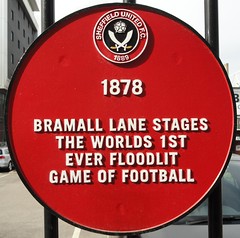
1878 Bramall Lane stages the worlds 1st ever floodlit game of football
Sheffield United Football Club, Bramall Lane, Cherry Street, Sheffield, United Kingdom
Subjects
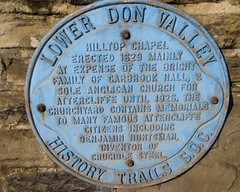
Hilltop Chapel erected 1629 mainly at the expense of the Bright family of Carbrook Hall, & sole Anglican church for Attercliffe until 1826. The churchyard contains memorials to many famous Attercliffe citizens including Benjamin Huntsman inventor of crucible steel
Hilltop Chapel, Attercliffe, Sheffield, United Kingdom
Subjects
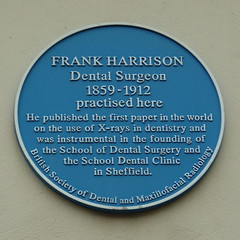
Frank Harrison Dental Surgeon 1859-1912 practised here He published the first paper in the world on the use of X-rays in dentistry and was instrumental in the founding of the School of Dental Surgery and the School Dental Clinic in Sheffield.
289 Glossop Road, Sheffield, United Kingdom
Subjects
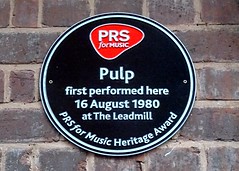
Pulp first performed here 16 August 1980 at The Leadmill
The Leadmill, Leadmill Road, Sheffield, United Kingdom
Subjects


1855 Bramall Lane opens for the first time as a cricket ground
Sheffield United Football Club, Bramall Lane. Cherry Street., Sheffield, United Kingdom
Subjects
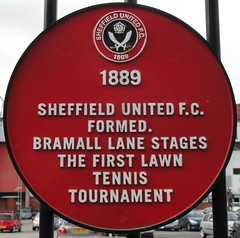
1889 Sheffield United F.C. formed. Bramall Lane stages the first lawn tennis tournament
Sheffield United Football Club, Bramall Lane. Cherry Street., Sheffield, United Kingdom
Subjects
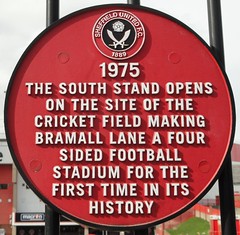
1975 The South Stand opens on the site of the cricket field making Bramall Lane a four sided football stadium for the first time in its history.
Cherry Street, Sheffield, United Kingdom
Subjects

The worlds first intercity football match, January 2nd 1865. On January 2nd 1865 Sheffield fc travelled from the Wicker Station to Nottingham to play the worlds first intercity football match. Returning in triumph with the match ball, the victorious players kicked it through the streets of Sheffield to Broomhill. From this point onwards football enthusiasts used the railway to seed the game across the United Kingdom and later the World
three arches, Sheffield, United Kingdom
Maxine Duffus bus sector trailblazer. Qualified as first black woman bus driver in South Yorkshire in 1983
, Sheffield, United Kingdom
Subjects
Brian Alcock BEM Born 1942 Sheffield's last jobbing grinder Worked here 1979-2023
Beehive Works, Milton Street, Sheffield, United Kingdom
Subjects

Education Offices From 1933 to 1964 Firth Building was used by the Sheffield Central Technical School, formerly the Junior Technical School. During that time over 5,000 boys passed through the school, many progressing to successful careers in the steel, engineering and building industries of the region. The first headmaster, Gwilym E. Thomas, was succeeded in 1947 by Herbert W. Wadge M.B.E. who was prominent in the development of secondary technical education in this country. Herbert Wadge had a profound life long influence on all his pupils. Flourish C.T.S. Forever!
Leopold Street, Sheffield, United Kingdom
Subjects


Cemetry road church football club, The worlds oldest football club to originate from a church was formed in the south west corner of this car parkadd a plaque
Cemetery road, Sheffield, United Kingdom
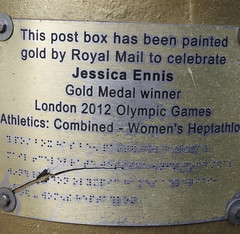
This post box has been painted gold by Royal Mail to celebrate Jessica Ennis Gold Medal winner London 2012 Olympic Games Athletics: Combined - Women's Heptathlon
Barker's Pool, Sheffield, United Kingdom
Subjects
The Sheffield rules of football were agreed & adopted here 1858. Members of Sheffield FC met to agree and adopt their first rules, regulations and playing lawson 28th October 1858 at the Adelphi Hotel which stood at this location
Tudor Square, Sheffield, United Kingdom

The Sheffield Rules of Football were agree and adopted here - 1858 - Members of Sheffield FC met to agree and adopt their first club rules, regulations & playing laws on 28th October 1858 at the Adelphi Hotel which stood at this location
The Crucible Theater on Arundle Gate., Sheffield, United Kingdom

John Charles Shaw 1830-1918 Founder of Hallam FC, the second oldest football club in the word in 1860. His business and residence were located here on Norfolk Row. Winning Captain of the Youdan Cup, the world's first football tournament, 1867. President of Sheffield FA 1869-1883. Oversaw the amalgamation of the Sheffield & FA Rules in 1877.
18 Norfolk Row, Sheffield, United Kingdom

Sir Nathaniel Creswick KCB, 31st July 1831 -20th October 1917, co-founder of Sheffield fc 1857, His solicitor's office was located here. Creswick used these Offices to support the development and administration of the world's first and oldest football club. Local pioneers gathered here to discuss innovations which helped to shape the evolution of modern football
9 East Parade , Sheffield, United Kingdom

Cemetry road church football club, the world's oldest football club to originate from a church was formed in the south west corner of this car park
Cemetery road, Sheffield, United Kingdom

The York Football club , Established here 1861.The worlds first football club to originate from an hotel was formed here in 1861
243-247 Fulwood Road, Sheffield S10 3BA, Sheffield, United Kingdom

Vickers Building, Brightside Lane. This imposing building was built in 1907 as the head office of Vickers, the steel, engineering and munitions giant. Later English Steel, British Steel and Sheffield Forgemasters have all occupied it in turn.
Vickers Building, River Don Works, Brightside Lane, Sheffield, United Kingdom