
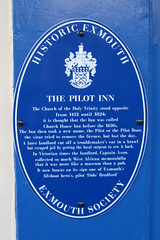
The Pilot Inn The Church of the Holy Trinity stood opposite from 1412 until 1824: it is thought that the Inn was called Church House Inn before the 1830s. The Inn then took a new name, the Pilot or the Pilot Boat: the vicar tries to remove the licence, but lost the day. A later landlord cut off a troublemaker's ear in a brawl but escaped jail by getting the local surgeon to sew it back. In Victorian times the landlord, Captain Axon, collected so much West African memorabilia that it was more like a museum than a pub. It now boasts on its sign on of Exmouth's lifeboat hero's, pilot 'Dido' Bradford'
Pilot Inn, Exmouth, United Kingdom
Subjects
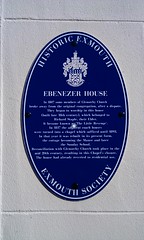
Ebenezer House In 1807 some members of Glenorchy Church broke away from the original congregation, after a dispute. They began to worship in this house (built late 18th century), which belonged to Richard Staple, their Elder. It became known as 'The Little Revenge'. In 1817 the adjacent coach houses were turned into a chapel which sufficed until 1893. In that year it was rebuilt in its present form, the cottage becoming the Manse and later the Sunday School. Reconciliation with Glenorchy Church took place in the mid 20th century, resulting in this Chapel's closure. The house had already reverted to residential use.
Ebenezer House, Little Bicton Place, Exmouth, United Kingdom
Subjects

Dolphin Hotel. Sub Lt R. Warneford VC, Royal Naval Air Service, 2 Morton Road. Awarded VC for conspicuous bravery when on the 7 June 1915, flying a single engined aircraft, hand dropped bombs, destroying a German Zeppelin airship on a night flight over Belgium. Died 10 days later in a flying accident near Paris, aged 23.
Dolphin Hotel, 2 Morton Rd, Exmouth, United Kingdom
Subjects


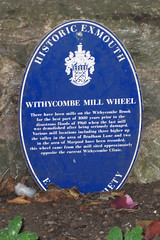
Withycombe Mill Wheel There have been mills on the Withycombe Brook for the best part of 1000 years prior to the disastrous floods of 1960 when the last mill was demolished after being seriously damaged. Various mill locations including three higher up the valley in the area of Bradham Lane and two in the area of Marpool have been recorded. this wheel came from the mill sited approximately opposite the current Withycombe Clinic.
Withycombe Mill Wheel, Exmouth, United Kingdom
Subjects
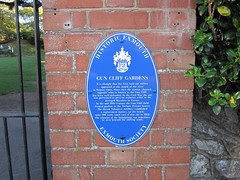
Gun Cliff Gardens. It is thought that the first look-out station appeared at the mouth of the river in Roman times. Since then the narrow channel opposite what is known as the Gun Cliff has been well defended. In the Civil War the site was garrisoned to prevent seaborne relief to the besieged Royalists in Exeter. In the mid 19th Century the Gun Cliff field formed gardens to the Trefusis Terrace houses, The Devon Volunteer Artillary established a replacement battery, on the beach, some 100 yards south east of this site in 1862. The remains of foundations can sometimes be seen beneath the shifting sands.
Gunfield Gardens, Carlton Hill, Exmouth, United Kingdom
Subjects

The Clipper. Formerly East India House. In the late 18th Century the site was used as a Tea Warehouse by the East India Company. They used the route from Exmouth to London by coach and horses: this being quicker than passing through Bristol. At that time tea was a scarce and valuable commodity: the quicker it reached the markets the higher the price. After 1810, when the 'Tea Bubble' burst, the premises became a high class grocer's shop. In 1955, the full licence was taken up, the premises becoming Leonard's Bar. Now modernised and renamed it returns to its associations with the tea trade.
The Clipper, The Strand, Exmouth, United Kingdom
Subjects

Thomas Tucker. Built in the 1790's and known originally as West End House. It was built as the dower house for the mother of Gustaves Ducarel, the squire of the now demolished Manor House in Manor Gardens. In 1801 Richard Webber astonished the town by buying the house and converting it into a shop. The original shop front is incorporated in the present frontage.
Thomas Tucker, The Strand, Exmouth, United Kingdom
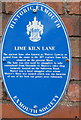
Lime Kiln Lane. The ancient lane, also known as Watery Lane, is so named from the route to the 18th century lime kiln situated on the present Maer. The lane was also used by smugglers to take contraband from Orcombe to Mutter's cider shop formerly located on the Salterton Road. Mutter was a local smuggler after whom Mutter's Moor was named which was the location of one of his look-out points near Sidmouth.
Lime Kiln Lane, Exmouth, United Kingdom