

Chester House. Formerly Manchester House, the home of Mary Ann Clarke, the notorious mistress of the Duke of York, brother of the Prince Regent. She came to live here in 1804 and sold appointments in the Army with the alleged connivance of the Duke, its Commander-in-Chief. Whilst living in Exmouth, she lived in luxury but ultimately died in disgrace and poverty in Paris in 1813.
Manchester House, Imperial Rd, Exmouth, United Kingdom
Subjects
.jpg?width=250)
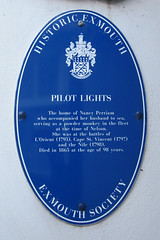
Pilot Lights. The home of Nancy Perriam who accompanied her husband to sea, serving as a powder monkey in the fleet at the time of Nelson. She was at the battles of L'Orient (1795), Cape St. Vincent (1797) and the Nile (1798). Died in 1865 at the age of 98 years.
Pilot Lights, Tower St, Exmouth, United Kingdom
Subjects
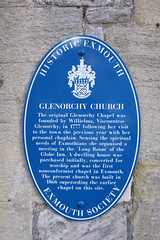
Glenorchy Church. The original Glenorchy Chapel was founded by Willielma, Viscountess Glenorchy, in 1777 following her visit to the town the previous year with her personal chaplain. Sensing the spiritual needs of Exmothians she organised a meeting in the 'Long Room' of the Globe Inn. A dwelling house was purchased initially, coverted for worship and was the first nonconformist chapel in Exmouth. The present church was built in 1866 superseding the earlier chapel on this site.
Glenorchy Church, Exeter Rd, Exmouth, United Kingdom
Subjects

Sir John Colleton. This site was formerly the Manor House of Rill or Hill, a sub-manor of Marpool, occupied in the early 18th century by Sir John Colleton, retired Administrator of S Carolina. He brought the first magnolias with him which he developed by mutation to produce the 'Magnolia Grandiflora Exmouthiensis' variety which is incorporated into Exmouth's Coat of Arms.
Library, Exeter Rd, Exmouth, United Kingdom
Subjects
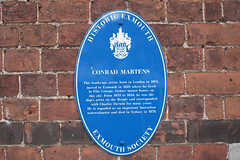
Conrad Martens. This landscape artist, born in London in 1801, moved to Exmouth in 1822 where he lived in Elm Cottage, former manor house, on this site. From 1833 to 1834, he was the ship's artist on the Beagle and corresponded with Charles Darwin for many years. He is regarded as an important Australian watercolourist and died in Sydney in 1878.
Library, Exeter Rd, Exmouth, United Kingdom
Subjects


Temple Winds. A late 18th century building erected at the foot of the Beacon Fields. A pharmacy before 1830 and it remained so until the 1960s. The recent name is from the copy of the Temple of the Winds in Athens, built in 1824 at the entrance to the Imperial Hotel and demolished in 1868.
Temple Winds, Chapel Hil, Exmouth, United Kingdom
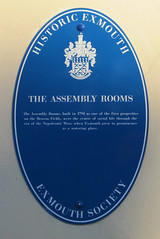
The Assembly Rooms, built in 1794 as one of the first properties on the Beacon Fields, were the centre of social life through the era of the Napoleonic Wars when Exmouth grew to prominence as a watering place.
Assembly Room, The Beacon, Exmouth, United Kingdom
Subjects
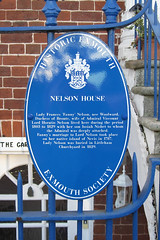
Nelson House. Lady Frances 'Fanny' Nelson, nee Woolward, Duchess of Bronte, wife of Admiral Viscount Lord Horatio Nelson lived here during the period 1803 to 1829 with her son Josiah Nisbet to whom the Admiral was deeply attached. Fanny's marriage to Lord Nelson took place on her native island of Nevis in 1787. Lady Nelson was buried in Littleham Churchyard in 1829.
Nelson House, The Beacon, Exmouth, United Kingdom
Subjects

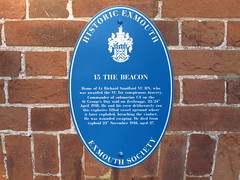
15 The Beacon. Home of Lt Richard Sandford VC RN, who was awarded the VC for conspicuous bravery. Commander of submarine C3 on the St George’s Day raid on Zeebrugge, 23/24th April 1918. He and his crew deliberately ran this explosive filled vessel aground where it later exploded, breaching the viaduct. He was wounded escaping. He died from typhoid 23rd November 1918, aged 27.
15 The Beacon, Exmouth, United Kingdom
Subjects

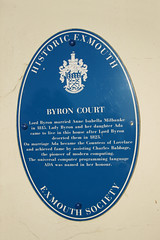
Byron Court. Lord Byron married Anne Isabella Milbanke in 1815. Lady Byron and her daughter Ada came to live in this house after Lord Byron deserted them in 1823. On marriage Ada became the Countess of Lovelace and achieved fame by assisting Charles Babbage, the pioneer of computing. The universal computer programming language ADA was named in her honour.
Byron Court, 10 The Beacon, Exmouth, United Kingdom
Subjects

.jpg?width=250)
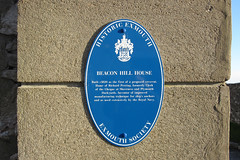
Beacon Hill House. Built in c1820 as the first of a proposed crescent. Home of Richard Perring, formerly Clerk of the Cheque at Sheerness and Plymouth Dockyards, inventor of improved manufacturing technique for ship's anchors and as used extensively by the Royal Navy.
Beacon Hill House, The Beacon, Exmouth, United Kingdom
Subjects
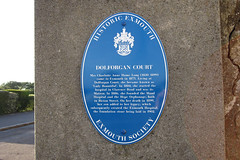
Dolforgan Court. Mrs Charlotte Anne Hume Long (1830-1899) came to Exmouth in 1875. Living at Dolforgan Court she became known as 'Lady Bountiful'. In 1884 she started the hospital in Clarence Road and was its Matron. In 1886, she founded the Maud Hospital and the Hope Orphanage, both in Bicton Street. On her death in 1899, her son added to her legacy, which subsequently created the Exmouth Hospital, the foundation stone being laid in 1902.
Dolforgan Court, Louisa Terrace, Exmouth, United Kingdom
Subjects
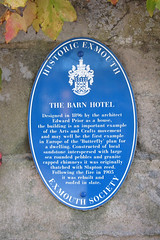
The Barn Hotel. Designed in 1896 by the architect Edward Prior as a house, the building is an important example of the Arts and Crafts movement and may well be the first example in Europe of the 'Butterfly' plan for a dwelling. Constructed of local sandstone interspersed with large sea rounded pebbles and granite capped chimneys it was originally thatched with Slapton reed. Following the fire in 1905 it was rebuilt and roofed in slate.
Barn Hotel, Foxholes Hill, Exmouth, United Kingdom
Subjects
Maer Bay Court. Built c1840 as a home for General Gordon and known originally as Miramar. The General was killed at Khartoum before he was able to occupy the property but it was lived in by his sister. During the period when it was a hotel, Vera Brittain, the authoress, was a frequent visitor.
Maer Bay, Court Douglas Avenue, Exmouth, United Kingdom
Subjects

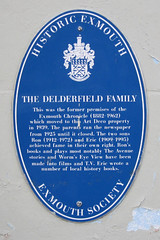
The Delderfield Family. This was the former premises of the Exmouth Chronicle (1882-1962) which moved to the Art Deco property in 1939. The parents ran the newspaper from 1925 until it closed. The two sons Ron (1912-1972) and Eric (1909-1995) achieved fame in their own right. Ron's books and plays most notably The Avenue stories and Worm's Eye View have been made into films and T.V. Eric wrote a number of local history books.
Chapel Hill, Exmouth, United Kingdom
Subjects
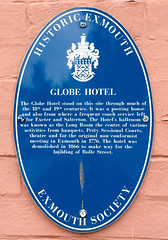
Globe Hotel The Globe Hotel stood on this site through much of the 18th and 19th centuries. It was a posting house and also from where a frequent coach service left for Exeter and Salterton. The Hotel's hallroom was known as the Long Room the centre of various activities from banquets, Petty Sessional Courts, theatre and for the original non-conformist meeting in Exmouth in 1776. The hotel was demolished in 1866 to make way for the building of Rolle Street.
Globe Hotel, Exmouth, United Kingdom
Subjects
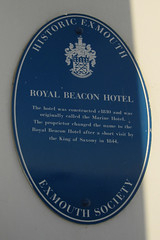
Royal Beacon Hotel. The hotel was constructed c1810 and was originally called the Marine Hotel. The proprietor changed the name to the Royal Beacon Hotel after a short visit by the King of Saxony in 1844
Royal Beacon Hotel, The Beacon, Exmouth, United Kingdom
Subjects
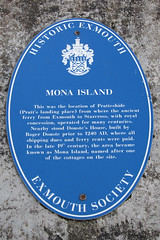
This was the location of Pratteshide (Pratt’s landing place) from where the ancient ferry Exmouth to Starcross, with royal concession, operated for many centuries. Nearby stood Douste's House, built by Roger Douste prior to 1240 AD, where all shipping dues and ferry rents were paid. In the late 19th century, the area became known as Mona Island, named after one of the cottages on the site.
Mona Island, Exeter Rd, Exmouth, United Kingdom
Subjects
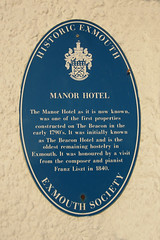
The Manor Hotel as it is now known, was one of the first properties constructed on The Beacon in the early 1790's. It was initially known as The Beacon Hotel and is the oldest remaining hostelry in Exmouth. It was honoured by a visit from the composer and pianist Franz Liszt in 1840.
Manor Hotel, The Beacon, Exmouth, United Kingdom
Subjects


Primrose Cottage. The last remaining thatched cottage in Exmouth town centre. There has been a dwelling on this site since the early 17th century. Constructed initially with cob walls but later faced with brick and sandstone. Primrose Cottage was at the northern edge of town well into the latter part of the 19th century, close to the turnpike beyond which were extensive marshes.
Primrose Cottage, North St, Exmouth, United Kingdom