
United Kingdom / Hemel Hempstead
all or unphotographed17 plaques 100% have been curated
25 subjects
Gender Diversity


The Charter Gardens are the probable site of the first and second medieval and Tudor manor houses known as 'Bury'; now a beautiful public space maintained by Dacorum Borough Council.
Queensway, Hemel Hempstead, United Kingdom
Subjects
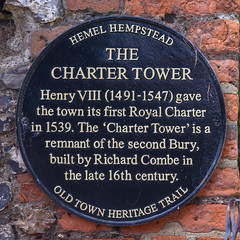
The Charter Tower Henry VIII (1491-1547) gave the town its first Royal Charter in 1539. The 'charter Tower' is a remnant of the second Bury, built by Richard Combe in the late 16th century.
Queensway, Hemel Hempstead, United Kingdom
Subjects

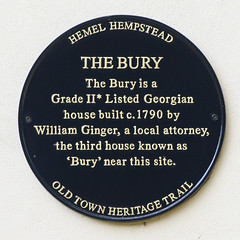
The Bury is a Grade II* Listed Georgian house built c. 1790 by William Ginger, a local attorney, the third house known as 'Bury' near this site.
Queensway, Hemel Hempstead, United Kingdom
Subjects
48 High Street New civic buildings erected in 1888, designed by G. and R. Lowe. The Hemel Hempstead Mechanics' Institute occupied the upper storey from 1908 until the end of World War I.
48 High Street, Hemel Hempstead, United Kingdom
Subjects
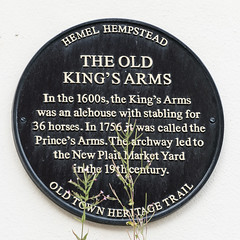
The Old King's Arms In the 1600's the King's Arms was an alehouse with stabling for 36 horses. In 1756 it was called the Prince's Arms. The archway led to the New Plait Market Yard in the 19th century.
High Street, Hemel Hempstead, United Kingdom
Subjects
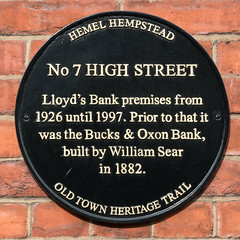
No 7 High Street Lloyd's Bank premises from 1926 until 1997. Prior to that it was the Bucks & Oxon Bank, built by William Sear in 1882.
7 High Street, Hemel Hempstead, United Kingdom
Subjects
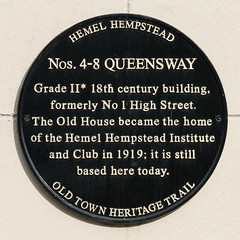
Nos. 4-8 Queensway Grade II* 18th century building, formerly No 1 High Street. The Old House became the home of the Hemel Hempstead Institute and Club in 1919; it is still based here today.
4-8 Queensway, Hemel Hempstead, United Kingdom
Subjects
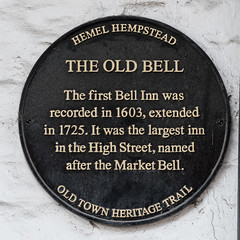
The Old Bell The first Bell Inn was recorded in 1603, extended in 1725. It was the largest inn in the High Street, named after the Market Bell.
High Street, Hemel Hempstead, United Kingdom
Subjects
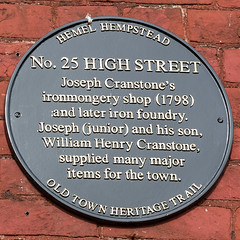
No. 25 High Street Joseph Cranstone's ironmongery shop (1798) and later iron foundry. Joseph (junior) and his son, William Henry Cranstone, supplied many major items for the town.
25 High Street, Hemel Hempstead, United Kingdom
Subjects

Oak House A private house in 1532, it became the Oak Tavern by the late 1500s, re-named the Royal Oak after the Restoration of the Monarchy. Later, a House of Correction, a jail, a beer-house and then a private home again.
High Street, Hemel Hempstead, United Kingdom
Subjects

St Mary's Close An open air market from 1888; formerly the site of the Butchers' Shambles, the Lamb Inn and part of St Mary's churchyard.
High Street, Hemel Hempstead, United Kingdom
Subjects
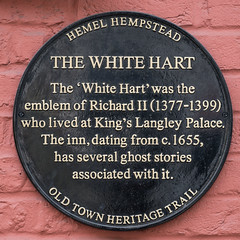
The White Hart The 'White Hart' was the emblem of Richard II (1377-1399) who lived at King's Langley Palace. The inn, dating from c.1655, has several ghost stories associated with it.
High Street, Hemel Hempstead, United Kingdom
Subjects

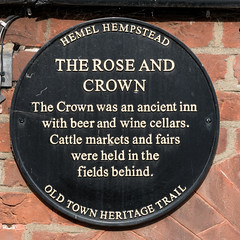
The Rose and Crown The Crown as an ancient inn with beer and wine cellars. Cattle markets and fairs were held in the fields behind.
High Street, Hemel Hempstead, United Kingdom
Subjects
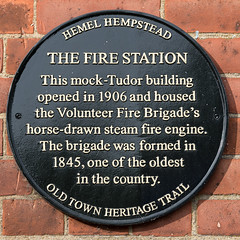
The Fire Station This mock-Tudor building opened in 1906 and housed the Volunteer Fire Brigade's horse drawn steam fire engine. The brigade was formed in 1845, one of the oldest in the country.
Queensway, Hemel Hempstead, United Kingdom
Subjects
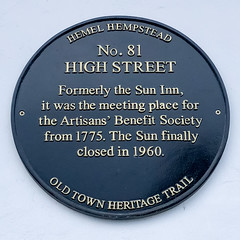
No. 81 High Street Formerly the Sun Inn, it was the meeting place for the Artisans' Benefit Society from 1775. The Sun finally closed in 1960.
81 High Street, Hemel Hempstead, United Kingdom
Subjects
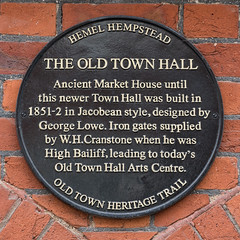
The Old Town Hall Ancient Market House until this newer Town Hall was built in 1851-2 in the Jacobean style, designed by George Lowe. Iron gates supplied by W.H. Cranstone when he was High Bailiff, leading to today's Old Town Hall Arts Centre
High Street, Hemel Hempstead, United Kingdom
