
Gender Diversity
The top 10


Texas Historical Marker #17304
Timothy Stephen Smith. #17304
Moody Street, Palestine, TX, United States
Subjects

Texas Historical Marker #12803
Site of Lincoln High School. Site of Lincoln High School In 1891, the first high school for African-American students in Palestine opened in the mission church on San Jacinto Street. Four years later, the school moved to this site and became known as Lincoln High School. The first class graduated from Lincoln in 1896. Originally a four-room building, the schoolhouse was expanded over time to accommodate increasing enrollment. In 1922, the Lincoln school building burned, and classes were held in several churches until the new, six-room brick structure was completed in 1923. As rural districts consolidated with Palestine, enrollment at Lincoln continued to increase, and the school became an important cultural center for the African-American community. In 1952, the school board approved construction of a new high school to be named in honor of Alonzo Marion Story, Lincoln's principal from 1925 to 1949. The building that had formerly housed the high school reopened as Lincoln Junior High in the fall of 1953. Serving grades five through eight, it later housed grades two through eight before closing in 1965 when the Palestine schools integrated. After 1965, the Lincoln school building remained in use as an important social center and as headquarters for the Anderson County community council. A 1996 fire resulted in its demolition, but this site remains a significant part of the educational and community heritage of Palestine and Anderson County. (2002) #12803
902 Swantz, Palestine, TX, United States
Texas Historical Marker #12859
Alonzo Marion Story. Alonzo Marion Story Alonzo Marion Story (1882-1966) was born in New Orleans to parents John and Mary Story. He attended public schools and graduated from Louisiana's Leland College before doing post-graduate work in Texas and Colorado. Story came to Texas at the age of 21 and taught mathematics in Midway. He also served as a mail clerk before moving in 1912 to Palestine, where he taught math at Lincoln High School, the school for African American students. He taught there until 1917, when he moved to Austin to be principal of the state's Deaf, Dumb and Blind Institute for African Americans. In 1924, Story was offered a job as principal in Dallas. Instead, he returned to Palestine's Lincoln High School, where he taught math and served as principal. Beloved and respected, Story stayed until retiring in 1949, teaching his last years with no eyesight. After retirement, he tutored from his home. In 1953, the school district opened a new facility and named it Alonzo Marion Story High School in honor of the revered educator. After desegregation, the school became a junior high and then an elementary school before being destroyed by a tornado in 1987. In 1990, the district built a new school named for him. Story dedicated his life to education. In addition to his roles as teacher and principal, he was director of religious education at West Union Baptist Church and served on the executive committee of the Texas State Teachers Association and as vice president of the East Texas Teachers Association. His immeasurable contributions to Palestine are reflected in the community's commemoration of his life. (2002) #12859
5300 N. Loop 256, Palestine, TX, United States
Texas Historical Marker #13186
Westwood United Methodist Church. Westwood United Methodist Church (Holmes Chapel Methodist Church) In November 1883, Harriet Mcclanahan Holmes donated one acre of land to Anderson County and William M. Holmes donated funds for the Holmes Community School, where Minnie Lee Holmes served as the first teacher. In the schoolhouse that year, area residents organized the Holmes Chapel Methodist Episcopal Church, South. The Rev. Daniel C. Neel served as the congregation's p. The church outgrew the schoolhouse and built a sanctuary in 1899. At that time, church services were held once a month by the Rev. A. Methvin. The congregation used its second house of worship, located on Holmes Road, until 1948. The church, like the Palestine area, experienced growth due to new industry and a post-war population increase. After selling the Holmes Road property, the congregation worshiped in a large tent while waiting for a new, larger sanctuary, which was completed in 1950. The congregation again outgrew its facilities and added new buildings a decade later. In the 1960s, area school districts consolidated into the Westwood Independent School District. The church, which originally bore the name of the once rural Holmes Chapel School, later changed its name to reflect its place in the community, which had become known as Westwood following school consolidation. During its more than 100 years as a congregation, the Westwood United Methodist Church (Holmes Chapel Methodist Church) has continued to grow, serving its community through its many programs. To commemorate the contributions of families that nourished the growth of the congregation, members over the years have placed memorials around church grounds, continuing the commitment to community and worship made by the founding members in the 1880s. (2003) #13186
110 Ridgewood St, Palestine, TX, United States
Texas Historical Marker #08778
Site of the McClean Massacre. Daniel McLean and John Sheridan, expert Indian fighters employed by the settlers as guides and protectors, were killed here in 1837. By holding the savages in check until the settlers could escape, both sacrificed their lives. #8778
?, Palestine, TX, United States
Subjects
Texas Historical Marker #13794
Site of Knox Glass Company Plant. In 1941, Chester Underwood of Pennsylvania-based Knox Glass Bottle Co. called Jim Keller, a company representative in Texas, with plans for a new plant. Product demand in the western United States for bottling and canning operations had increased, and Underwood asked Keller to scout locations for a plant with good rail access. Keller met with the Palestine Chamber of Commerce and banker Clifford Huffsmith, who in turn worked with bankers Clyde Hanks, J.E. Angly and others to identify area resources, including transportation. The final deal included natural gas provided by brothers Julian and Jack Meeker, and a Missouri Pacific Railroad spur to the plant site. The new facility began production on July 5, 1941. It housed a 90-ton-capacity furnace and equipment for manufacturing clear glass; Frank Hicks served as plant manager for 10 years. Company officials and area residents celebrated with a formal dedication on July 19. Employees belonged to unions related to their jobs, which varied from mixing and machine operations to mold makers and packing. Products included glass jars for the food industry and home bottling. The Knox plant played a vital role in the local economy for decades, with more than 450 employees at its peak. Glass Container Corp. purchased Knox Glass in 1969, but demands of a changing industry led to closure of the plant in 1984. The final glass jars manufactured here, bearing the closing date, Dec. 20, 1984, serve as souvenirs for three generations of area residents for whom the Knox plant represented a secure way of life. (2006) #13794
?, Palestine, TX, United States

Texas Historical Marker #13656
Site of Palestine Service Men's Club, World War II. Since 1872, the railroad has been a defining aspect of Palestine. During World War II, with the town more than a hundred miles from the nearest military installation, the railroad gave local citizens the opportunity to show their support to trainloads of soldiers passing through the city. In June 1942, area residents organized a service group inspired by, but independent from, the United Service Organizations (USO). Zula Hanks oversaw the fundraising, chaperoning and management of the club, operated by scores of local women. Volunteers offered refreshments, letter-writing materials, music, dancing and conservation in the club's room at the O'Neil Hotel at this site across Spring Street from the railroad tracks. The women also took sandwiches and cookies to distribute to the soldiers unable to leave the trains. Additionally, the Palestine group financially supported a separate Negro Service Club that served African American troops who often rode at the back of the trains farther down the line from this point. Military service people from around the country voiced their gratitude for Palestine's hospitality through recorded messages on "Recordgrams" and in countless letters. The volunteers continued their outpouring of support through the final days of the war, and the last troop train came through town on January 1, 1946. Today, the story of the Palestine club demonstrated the community's commitment to World War II service on the home front. (2006) #13656
400 W Spring St., Palestine, TX, United States
Texas Historical Marker #17131
Texas Fruit Palace, Anderson County Fair. #17131
200 E. Coronoca St, Palestine, TX, United States
Texas Historical Marker #08789
Palestine Fire Department. Palestine, founded 1846, acquired fire department when International & Great Northern Railroad extended line here in 1872. Early fire-wagon was horse-drawn flatbed loaded with hose. Motor truck and city water were introduced 1918. Bell from 1895 hangs in front. (1972) #8789
611 Avenue A, Palestine, TX, United States
Texas Historical Marker #08752
Fort Houston. A fort and stockade built about 1836 on the public square of the town of Houston (then in Houston County), as a protection against the Indians, by order of General Sam Houston, Commander-in-Chief of the Texan armies. The town was abandoned in 1846 for Palestine, the new seat of Anderson County, the fort about 1841. The site is now a part of the historic home of John H. Reagan, which is called Fort Houston. #8752
?, Palestine, TX, United States
Texas Historical Marker #08729
Judge William Alexander. Born 1814 in Scotland. Settled in Palestine 1851. Trustee in first school. Practiced in Supreme Courts, Alabama, Texas. Was a partner of John H. Reagan, C.S.A. Postmaster-General, U. S. Congressman, U. S. Senator, Railroad Commissioner. Married 1857 Mrs. Susan Scott Mallard, widow of another law partner. Had two daughters. Chief Justice, Anderson County, 1860-1865. Died in Palestine, 1872. Recorded, 1965 Incise in base: Erected by Ruth R. Eppner, Granddaughter #8729
?, Palestine, TX, United States
Subjects
Texas Historical Marker #08731
Anderson County. Created March 24, 1846, from Houston County. Organized July 13, 1846 with Palestine as the county seat. Named in honor of Kenneth Lewis Anderson, vice-president of the Republic of Texas, 1844-45 #8731
?, Palestine, TX, United States
Texas Historical Marker #08733
Anderson County Poor Farm. Although county records show some attempts to care for the poor as early as the 1860s, property for a poor farm was not purchased until 1884. Various buildings were erected, including housing for residents and a caretaker, storage barns, a cotton gin, and a canning operation. A jail building was also in use for convict laborers who worked on the farm and on county roads. The ruins of several wells can still be seen throughout the property. A cemetery containing some 75-100 graves is located near the southern edge of the original farm site. Texas Sesquicentennial 1836 - 1986 #8733
?, Palestine, TX, United States
Texas Historical Marker #08746
Henry Fields. A San Jacinto veteran; born in South Carolina, May 8, 1806; died Oct. 15, 1890 #8746
?, Palestine, TX, United States
Subjects
Texas Historical Marker #08751
First Presbyterian Church. Organized Nov. 3, 1849, with 18 charter members, by the great pioneer leaders, Revs. Daniel Baker and John May Becton, home missionaries. This Gothic building of handmade brick was erected in 1888; enlarged since by two additions. Recorded Texas Historic Landmark - 1966 #8751
410 Avenue A, Palestine, TX, United States
Texas Historical Marker #08759
Grace Methodist Church. Methodist missionary efforts in this area date to the late 1830s. Circuit-riding ministers served Methodists in Palestine from the time of its founding as the Anderson County seat in 1848. In 1850 church members built a frame sanctuary and in November of that year the East Texas Conference was held in the new building, named Bascom Chapel in honor of an early Methodist bishop. The arrival of the railroad in 1872 resulted in a population boom for Palestine, and in 1884 a new church, named Centenary for the 100th anniversary of Methodism in the United States, was built. Three years later, the congregation divided to form the present First United Methodist Church and Grace United Methodist Church. Initially called Methvin Chapel in honor of the Rev. Alex Methvin, this congregation built Howard Avenue Methodist Church in 1898. After it burned in 1913, a new sanctuary was constructed at this site and named Grace Methodist Church. Long a supporter of local and foreign missionary efforts, Grace United Methodist Church continues to serve the community with a variety of worship, educational, and outreach programs. (1995) #8759
209 W. Kolstad, Palestine, TX, United States
Subjects
Texas Historical Marker #08764
Hodges-Darsey House. In the 1870s, after the International & Great Northern Railroad line reached Palestine, brothers A. B. and Dan Hodges moved here from Tennessee Colony settlement and became leading merchants. This house was built in 1895 by Dan Hodges for his wife Margaret Sue (Jackson) and their five children. A good example of Queen Anne style residences of the late Victorian era, the house was purchased in 1959 by William Gray Darsey, Jr., (who restored and preserved it) a leader in the area oil industry. Recorded Texas Historic Landmark - 1973 #8764
517 E. Hodges St., Palestine, TX, United States
Texas Historical Marker #08766
Col. G. R. Howard House. Built 1851 by Col. G. R. Howard, merchant and public official. Owned by family until sold to city, 1965, for a museum. Recorded Texas Historic Landmark, 1966 #8766
1011 N. Perry St., Palestine, TX, United States
Texas Historical Marker #08796
Pennybacker-Campbell-Wommack House. "Silk Stocking Row" Victorian residence built in 1890. Noted as family home of Mrs. Percy V. Pennybacker (1861-1938), teacher, author of widely-used school history of Texas, first Texan President General Federation Women's Clubs. Purchased 1900 by Thomas M. Campbell (1856 - 1923), famous lawyer, banker, Governor of Texas in 1907-11. Enlarged by Gov. Campbell, house is now property of great-grandson, Drew Wommack, Jr. Recorded Texas Historic Landmark - 1969 #8796
814 S. Sycamore, Palestine, TX, United States
Texas Historical Marker #08802
John H. Reagan Monument. [plaque at base of monument reads:] Reagan Monument. Unveiled July 6, 1911. Sponsored by John H. Reagan Chapter, UDC. Pompeo Coppini, Sculptor #8802
?, Palestine, TX, United States
Texas Historical Marker #08776
John Byler Mallard, Judge. Born 1820 in Alabama. An honor graduate, University of Tennessee Law School. Married in 1844 Miss Susan Scott, Tippah County, Mississippi. In 1845 settled in Republic of Texas. Built one of first homes in Palestine, 1848. First lawyer in Palestine, formed partnership with Judges Wm. Alexander and John H. Reagan, later state and national leader. Was a member of the Fifth Texas Legislature. Died in 1854. Recorded, 1965 Incise in base: Erected by Miss Ruth R. Eppner #8776
?, Palestine, TX, United States
Texas Historical Marker #12552
First Baptist Church of Palestine. First Baptist Church can trace its history to 1851, five years after Palestine was founded as the Anderson County seat. Elders McKane and Zachariah Worley (an ordained minister), John and Sarah Smith, J. E. and Rachel Teague, Thomas V. Smith, Theresa Stevens, and Annie Harris organized the congregation. They met for worship in Bascom Chapel, which they shared with members of other early Palestine churches. The Baptists built their first sanctuary at the corner of Perry and Murchison streets in 1853. There they became known as Old Town Baptist Church and hosted the Baptist state convention in 1854. In 1879, the church hosted Palestine's first revival meeting led by Major William Penn. Under Penn's leadership, the congregation raised money through nickel contributions to build a new church on Avenue A. The new building, completed in 1887, became known as Avenue "Nickel" Baptist Church. After a fire destroyed the Avenue Church, a new sanctuary was completed on Sycamore Street under the leadership of the Rev. R. L. Gillon in 1912. Now known as First Baptist Church of Palestine, the congregation continues its commitment to Christian mission and ministry in Palestine, Anderson County and around the world. (2001) #12552
801 N. Sycamore St., Palestine, TX, United States

Texas Historical Marker #08806
Sacred Heart Church. Successor to 1874 Church of St. Joseph, built on site given by International & Great Northern Railway, and destroyed by fire in 1890. This building of handmade brick was begun later that year; Nicholas J. Clayton of Galveston was the architect. Recorded Texas Historic Landmark - 1964 #8806
401 W. Oak St., Palestine, TX, United States
Texas Historical Marker #08735
Bell Cemetery. Confederate veteran Uriah Jasper Bell (1839 -1915) brought his family to northeast Texas in 1871. An ordained Baptist minister, he relocated to this area to lead the Ft. Houston Baptist Church. He and his wife Nancy (d. 1918) were the parents of seven children. Their only daughter, Lula Bell Kent, died in a fire in January 1890, three months after her marriage to Will Kent. She was buried on the family farm, and hers is the first burial in what became the Bell Cemetery. Also buried here are the Bells' six sons, as well as several generations of Bell family descendants. (1991) #8735
?, Palestine, TX, United States
Texas Historical Marker #08741
Campbell Cemetery. Typical of a number of small family cemeteries located throughout the state of Texas, this graveyard was established by the Campbell family, who moved to the Mound Prairie community in this area in 1844. Albert Gallatin Campbell (1808 - 1876), his wife Jenny Elvira, and their children John Bartlett, Isadore, and James, established a farm. Soon the family grew with the addition of another daughter, Jettie, and another son, Alexander. John Bartlett Campbell (1834 - 1915) returned home after service in the Civil War and worked in a hardware store to earn money to purchase his own farm. He eventually purchased 270 acres and built a large home, where he and his wife Mary Elizabeth (1853 - 1927) reared their twelve children. John Bartlett Campbell set aside one acre of land on his farm for a family burial ground, and in 1876 his father, Albert Gallatin Campbell, became the first person buried here. Albert's was the only burial in the graveyard for twenty-four years, until his grandson, 23-year-old John Bartlett Campbell, Jr., died in 1900 of scarlet fever. The cemetery is still in use by Campbell family descendants. #8741
?, Palestine, TX, United States
Texas Historical Marker #08753
Fort Houston. (site one-fourth mile south) A stockade and blockhouse of the Republic of Texas. Built in 1835-1836 to protect settlers who founded Houston, a pioneer town, now in Anderson County. Friendly Indians would come to trade at the site, but wary settlers often slept inside the 25-foot-square blockhouse, built of heavy logs. Trappers bought supplies there and men from Houston formed one of the first Ranger units in Texas. The fort defended a large area of the frontier, 1836-1839, but it was abandoned about 1841. The site later became part of home of John H. Reagan, Texas Statesman. #8753
?, Palestine, TX, United States
Texas Historical Marker #08785
Northeast Texas Christian Theological and Industrial College. Led by the Rev. A. J. Hurdle, the Northeast Texas Christian Missionary Convention of the Christian Church (Disciples of Christ) was formed in Daingerfield in 1900. Established to serve black members of the denomination, its primary purpose was the creation of a college. The Christian College Building Association was formed by a group of women within the organization, and by 1904 enough funds had been raised to purchase 49 acres of land near Palestine, Texas. Contractor J. L. Randolph was hired in 1910, and on May 26, 1911, the cornerstone was laid for the main college structure. Opening with seven students in January 1912, the Northeast Texas Christian Theological and Industrial College consisted of several large frame buildings and had a faculty of four. D. T. Cleaver served as the first president and was succeeded by I. Q. Hurdle. In addition to their classroom studies, the students farmed the college lands and raised livestock. After the main college building was destroyed by fire about 1920, the school closed. The remaining buildings were later razed, leaving no visible reminders of the institution that once provided an education to students from several states. (1989) #8785
?, Palestine, TX, United States
Texas Historical Marker #08790
Palestine High School. A public school system in Palestine was established in 1881 under control of the municipal government. The first classes were held at the old Palestine Female Institute (built in 1858), then a high school was built in 1888 at the Institute site on Avenue A. In 1915 voters passed a $100,000 bond issue for a new high school. The City Council chose this site in newly created, 22-acre Reagan Park for the campus. Fort Worth architects Sanguinet & Staats were chosen for the design, which features Tudor Gothic -- or Jacobethan -- detail in brick, limestone, and occasional tile panels. The 2-story structure, on a raised basement, is framed with reinforced concrete, allowing ample window space for air and light. The original plan included eight lecture rooms, a library, a gymnasium, laboratories, and an auditorium. A principal and 10 teachers comprised the first faculty, and the first graduating class in 1917 contained 38 students. This building became a junior high in 1939, and was named in 1955 for John Henninger Reagan (1818-1905), Texas statesman and Palestine resident. Elementary grades were assigned here from 1966 to 1976, when the school was closed. The building was then preserved and rehabilitated as a museum and cultural center. Recorded Texas Historic Landmark - 1986 #8790
400 Micheaux Avenue, Palestine, TX, United States
Texas Historical Marker #08801
Providence Church and Cemetery. On March 20, 1858, W. T. Miller deeded eight acres of land here "to trustees Lemuel Mullins, Chairman, D. Capp and Wm. Webb, for school purposes and burial ground." W. M. Hardy added a half-acre to even north line. These gifts met a pressing need for a central place to educate the children in this farmland area. Local residents (including Freemasons) donated work and materials, fenced the churchyard cemetery, and built a two-story structure to house the Providence School and Providence Missionary Baptist Church downstairs, and Providence Lodge No. 400, A.F. & A.M. (later to be Elkhart Lodge), upstairs. Providence was second missionary Baptist church in Anderson County. After tornado damage to building in 1900, school was discontinued. The present one-story building was salvaged and repaired with original materials, and regular church services continued through 1935. The cemetery, still used for burials, has some graves of settlers who arrived in the Republic of Texas days, and for years held school and worship in their own homes. Providence celebrated its centennial July 4-18, 1958, with nightly church services. The annual homecoming is held the first Sunday in June, with morning service followed by dinner on the ground. (1973) #8801
?, Palestine, TX, United States
Texas Historical Marker #08816
St. Philips Episcopal Church of Palestine. During the 1850s Mrs. Frances Henderson, wife of Governor J. Pinckney Henderson, helped found St. Philips as a mission. Upon the petition of the Rev. John Owens, who served part-time as the priest here, the Diocese of Texas in 1860 raised the mission to full parish status. During the Civil War, members met in homes, the Masonic Lodge, or the Methodist sanctuary. In 1863 the Rev. Caleb Dow became the first full-time rector. James Firth Brook designed this building, erected in 1875-76 on Oak Street. The congregation grew with the town and in 1903 the structure was moved here. (1979) #8816
?, Palestine, TX, United States
Texas Historical Marker #11660
Swanson Cemetery. Micam Main of Illinois was granted a league of land by the Mexican government in 1835. One of the area's first brickmakers, Samuel M. Warden, died while working on Main's estate on Christmas Eve in 1847. He was interred on this site. According to oral history, Warden's grave was marked only with bricks of his own manufacture. His is believed to have been the first burial in this cemetery. Virginia native Henry Clay Swanson (1822-1906), a former member of the Alabama state legislature, moved to Texas with his brother, James Madison Swanson, their families and slaves in 1851. "Colonel" Henry C. Swanson owned a farm east of Palestine and later operated a mercantile store in town. He purchased the land around the cemetery from Elisha Main, Micam Main's son and heir, in 1854. The slaves and former slaves of Henry Clay Swanson and James M. Swanson, as well as African Americans from Anderson County and neighboring areas, were interrred on this site. Descendants of slaves attended funerals here from 1872 to the late 1940s and early 1950s. A young girl was among the last interred in the well-populated burial site in the late 1940s. Others buried here include Tom Swanson, a former slave from Virginia to whom Henry Swanson willed $100, and two of his brothers, as well as their descendants. Thirty-six marked and approximately 23 unmarked graves are believed to grace the cemetery. This is the final resting place of many of those whose labor built Anderson County, Houston County, and the state of Texas. (2000) #11660
?, Palestine, TX, United States

Anderson County in the Civil War. After the creation of Anderson County in 1846, most settlers came from southern states, shaping the county’s destiny in the Civil War. When Texas became the seventh state to secede from the union on March 2, 1861, the county vote, 870 to 15, was overwhelmingly in favor of secession. Notable citizens John H. Reagan, A. T. Rainey, S. G. Stewart and T. J. Word were delegates to the secession convention in Austin, and Rainey and Reagan signed the Texas ordinance of secession. Before the vote, Governor Sam Houston spoke against secession on the steps of the Osceola Hotel in Palestine. More than 1,100 Anderson Countians helped form twelve infantry and cavalry companies for the Confederate Army, including seven companies entirely of local men. More than 300 died in the war and are buried at famed battlefields from New Mexico to Pennsylvania. Those on the home front contributed greatly to the war effort. Factories near mound prairie and plenitude produced flour, cloth, rifles, ammunition, tin goods, shoes, harnesses, bridles, and other leather goods. The salt works west of Palestine filled a need for food and meat preservation. Ladies knitted socks and blankets and sewed shirts and trousers bound for the war front. The hunter hotel served as a makeshift hospital, hosting men of the 10th Texas Infantry in May 1862; nine of them ultimately succumbed to their wounds and illnesses and were buried in the old city cemetery. Several citizens served leading roles in the Confederacy, including Reagan, who was Postmaster General and Treasury Secretary of the Government at Richmond. He and Confederate President Jefferson Davis were captured together at the close of the war. Anderson County is the final resting place of more than 500 veterans from all across the south, and the present home of thousands of descendants of those veterans. - Historical Marker Text. Marker erected 2012.
, Palestine, TX, United States

Texas Historical Marker #13178
The I&GN Railroad in Palestine. The I&GN Railroad in Palestine Established as Anderson County seat in 1846 by the Texas Legislature, Palestine grew steadily throughout the remaining 19th century, nearing 9,000 residents by 1900. The town first centered on trade facilitated by the Trinity River, with frequent steamboats bringing in staples in exchange for local and East Texas products. The river, however, was only navigable for half of each year, leaving residents to rely on ox-drawn wagons at other times. Realizing the potential of the railroad, local leaders John H. Reagan and George A. Wright garnered wide support to offer county money to the Houston and Great Northern Railroad, later consolidated into the International and Great Northern Railroad, which reached Palestine in 1872. Between 1874 and 1875, the railroad moved its headquarters, along with shops and a roundhouse, to the town and became a vital economic force. From the time rail construction began until beyond 1900, the railroad was the biggest employer in Palestine. Many employees came from other parts of the state and nation, as well as from other countries. A county immigration society helped promote immigration efforts, and the local newspaper sent thousands of circulars recruiting newcomers. Many immigrant families lived in Palestine, creating an international community in East Texas. In an effort to spare the courthouse and original town square the noise and traffic associated with a railroad, the line was routed west of what became known as Old Town, the town's original business district. New Town developed around the rail depot, however it was decades before the two sections blended together. Although the automobile lessened the reliance on rail travel and shipping, the impact of the railroad is still seen in Palestine today. (2003) #13178
?, Palestine, TX, United States

Purvey Lee (P.L.) Chism P.L. Chism’s devotion to education was unsurpassed. From the time of his youth, through his many years as a teacher, principal, superintendent and supervisor, he never stopped challenging himself and others for education. Purvey Lee Chism was born on August 27, 1893, in Covin, Alabama, to James W. Chism, a school teacher, and his wife, Lela Dickinson Chism. P.L. served in World War I with the 127th field artillery in Wngland and France, and received numerous awards in marksmanship. After his return from the war in 1919, P.L. returned to Alabama. In 1922, he moved to Lamar County, Texas, and began a teaching career in the rural communities of Ballinger and Caviness. He later taught in powderly and was the principal of powderly school before being selected superintendent of Lamar County schools in 1935, a position he held until 1939. P.L. married Bess Carroll Moomaw in 1939 and, the next year, he earned his master’s degree in education from Texas A&M. He had also begun pursuing his doctorate at the University of Texas. In 1940, P.L. and Bess moved to Palestine when he was appointed Deputy State Superintendent of Schools for six counties, which later became 13 counties. In 1949, he accepted the position of Anderson County Supervisor of Schools. Chism not only helped with rural schools and curriculum, but he also visited schools every day and directly communicated with teachers and students, impacting their educational development. He held the position of county supervisor until his retirement in 1963. He served on numerous boards and received many accolades but P.L. chism will be remembered as a devoted and inspirational educator.
, Palestine, TX, United States

Texas Historical Marker #08754
Fort Houston Cemetery. In 1835, Joseph Jordan and William S. McDonald donated about 500 acres of land in this area for the town of Houston, later known as Fort Houston. An early map of the townsite shows a section designated as a "public burying ground." The infant child of the Rev. Peter Fullinwider, an early Protestant minister in Anderson County, is said to have been the first to be interred here. The oldest marked grave, that of Dr. James Hunter, is dated 1840. The Fort Houston Cemetery is the only remaining physical evidence of the early frontier town, which was abandoned after Palestine was made Anderson County seat in 1846. Victims of diseases, Indian massacres, and other hardships that faced early Texas settlers are buried here. A special soldiers' plot, marked with a large boulder, contains the graves of soldiers of the Republic of Texas. Two veterans of the Battle of San Jacinto, John W. Carpenter and James Wilson, are buried in unmarked graves. The burial site of General Nathaniel Smith, a War of 1812 veteran, is also located in the soldiers' plot. The Fort Houston Cemetery remains in use as a public burial ground and as a reminder of the early history of the area. (1985) #8754
?, Palestine, TX, United States
Texas Historical Marker #08771
Captain William Kimbro. In Memory of Commanded a company at San Jacinto; came to Texas in 1831; born in Tennessee; died in Anderson County, September 14, 1856. #8771
?, Palestine, TX, United States

Texas Historical Marker #08804
Christopher Columbus Rogers. (1846 - 1887) Elected marshal, 1874; served when Palestine was one of tough railroad towns in southwest. Won fame solving 1878 Grayson murders. Slain in argument over testimony in his trial for killing friend resisting arrest. Recorded, 1967 #8804
?, Palestine, TX, United States
Texas Historical Marker #08742
C. S. A. Iron Works. Nearby, between old towns of Plentitude and Mound Prairie, John Billups as early as 1847 used Anderson County ore for iron to manufacture cotton gins and grist mills. In the Civil War, with D. D. Hassell as partner, made rifles and bayonets for Confederacy. To obtain military goods, the State of Texas subsidized war plants and exempted workmen. Other factories at Lancaster, Houston, Bastrop, Fredericksburg, Waxahachie, Corpus Christi, San Antonio, Austin, Burnet, Rusk and Tyler made pistols, percussion caps and gunpowder. (1964) #8742
?, Palestine, TX, United States
Texas Historical Marker #08763
Harmony Baptist Church. The community of Harmony began in 1855, when several families from South Carolina and Mississippi settled here and established homes and family farms. Originally named Harmony Missionary Baptist Church, this congregation was established in 1891 under the leadership of the Rev. L. D. Funderburk and the Rev. A. H. Sowell. Beginning with nine charter members, the congregation conducted early worship services in a small building on the Jepthia D. Harris farm. The church building also housed the community school, and a Sunday School began in 1892. By 1917 the congregation had outgrown its small facility, and plans were made for the construction of a new church building at this site. As the congregation continued to grow over the years, additional facilities were added to the church complex, but the need for a larger sanctuary arose again in 1958. Completed in December 1958, the new building was dedicated on March 15, 1959. An indoor baptistry was built in 1976, ending a long tradition of conducting baptism services in nearby creeks, lakes, and ponds. (1991) Throughout its history, Harmony Baptist Church has served the community with a variety of programs. #8763
?, Palestine, TX, United States
Texas Historical Marker #08774
Link House, The. Built and continuously occupied by family of early Palestine physician Henry Harnsbarger Link (1820 - 90) and wife, Hypatia McGee (1829 - 88). First rooms, built 1852, now form front hall. Dr. H. R. Link, one of builders' three sons, remodeled house in 1912. Recorded Texas Historic Landmark - 1972 #8774
1003 Link St., Palestine, TX, United States
Texas Historical Marker #08775
Lone Pine Baptist Church. This congregation traces its history to a small group of worshipers who gathered together in the early 1890s to hold services in a small schoolhouse near this site known as Rocky Point. A plot of land was purchased by the church in 1903, and a one-room frame structure was built for school and church purposes. The one pine tree on the property gave the church its name: Lone Pine Baptist Church. Although the congregation met regularly before then, the church was formally organized on July 8, 1908, with 34 charter members. The Rev. A. M. Thompson was called as first pastor, a position he held until his death in 1911. In 1916 a larger building was erected for the combination church and school. About one year later the two institutions were divided, and a church structure was built in June 1920. Called the tabernacle, it had permanent walls and a roof, but the interior floor was of dirt. Continued growth over the years enabled the congregation to improve the tabernacle and build additional facilities. A new church auditorium was dedicated in 1957. The church continues to serve the community as it has for over eight decades. (1989) #8775
?, Palestine, TX, United States
Texas Historical Marker #08820
William and Caroline Broyles House. A native of Huntsville, Alabama, William Broyles came to Texas following the Civil War. Traveling by boat to Shreveport, Louisiana, he continued his journey to Texas on foot, finally settling in Palestine. Broyles worked as a carpenter and later opened a mercantile store near the Anderson County Courthouse. Following the arrival of the railroad and the subsequent relocation of the town, he opened the first store in the new townsite. In 1878 he established a lumber business which eventually included a lumberyard, saw mill, and cabinet shop. A real estate investor as well as merchant, Broyles played an important role in the economic development of Palestine. He had this home built for his wife, Caroline, in 1895. Designed by local architect Luther McKlemurry, the home is a fine example of 19th-century eclecticism, exhibiting influences of Italinate, Queen Anne, and Second Empire styles. Outstanding features include its tower, roof cresting, and fine milled woodwork crafted by workers at Broyles' Lumber Company. Landscaping originally surrounding the home included elaborate flower gardens and an adjacent pecan orchard. RTHL 1989 #8820
1305 S. Sycamore St., Palestine, TX, United States
Texas Historical Marker #15919
N. A. Banks Elementary School. Established in 1912, N.A. Banks Elementary School served African-American children of Palestine's South End Community. Initially the school served grades one through four and was named for the principle of Palestine's Lincoln High School. Nathaniel A. Banks (1854-1930) had great influence on the African-American community of Palestine, serving as Lincoln High School principal from 1898 to 1907. He also organized the area's Colored Summer Normal School, which prepared African-American teachers in ten surrounding counties for the State Teaching Certification Exam. Hundreds attended each summer from 1899 until about 1919, even after Banks left Palestine and the teaching profession to become a farmer. The Banks School was a two-story brick building with four classrooms. When it opened, it was the first elementary school for African-American students living south of the I&GN railroad tracks in Palestine. J.A.B. Strain was the first principal. He and teachers Alma Johnson-Stein, Leonora Howard-Robinson and Louise Scott-Updack each taught here for more than 35 years. The school added fifth and sixth grades and additional teachers in 1949, though in 1953 these grades moved to the Lincoln High School campus when the new A.M. Story High School opened. Twice a year, the school hosted meetings of the City Teachers' Association, an organization of African-American teachers. In May 1965, the Palestine School Board closed Banks School in accordance with desegregation guidelines. The facility operated as the Palestine Kindergarten Center under the federally-funded Headstart Program for an additional five years. The building was razed in the early 1980s. Today Banks School is remembered as the educational foundation for many in Palestine and a source of community pride. #15919
800 West Dye Street, Palestine, TX, United States
Texas Historical Marker #12774
Mary Kate Hunter (November 8, 1866 - April 15, 1945). Mary Kate Hunter (November 8, 1866 - April 15, 1945) Born just outside Palestine in 1866 to Nathaniel and Jennie (Beeson) Hunter, Mary Kate Hunter played a significant role in recording, promoting and preserving the history of Palestine and Anderson county. Educated at Palestine Female Academy and Sam Houston Normal Institute, she studied piano with classical musicians across the United States and in Germany, and taught piano to countless Palestine children. As a clubwoman, she was a charter member of the Self-Culture Club in Palestine, organized in 1894; served as a delegate to the first annual meeting of the Texas Federation of Women's Clubs in 1898;organized a local chapter of the Women's National Foundation in 1921 for the preservation and study of local history; and founded and led the Fort Houston chapter of the Daughters of the Republic of Texas. A supporter of voting rights for women, Mary Kate Hunter organized and was first president of the Palestine Equal Suffrage Association, and held statewide office in the Texas Equal Suffrage Association in 1915-16. In addition to her civic duties, Hunter also was a published poet, editor of a local society journal and board member of the Texas State Library. She extensively researched the history of Palestine and Anderson County and conducted dozens of oral history interviews with early area residents. At her death in 1945, she bequeathed her voluminous collection of material to the Palestine Public Library, where it remains in use as an important record of Anderson County history. (2001) #12774
1101 N. Cedar, Palestine, TX, United States
Texas Historical Marker #13031
South Union Missionary Baptist Church. In 1893, the Rev. Richard Henry Boyd (1843-1927), a native of Mississippi, organized the South Union Baptist Church of Palestine with 31 charter members. Boyd, known as the "Cowboy Preacher," had established churches around Texas, including Palestine's West Union congregation. The South Union Church, named for its geographic location within the city, met in a two-room building on Royall Street until moving to Dorrance Street in 1911. In addition to uniting communities through the formation of congregations, Boyd aspired to create Christian literature for the nation's African American churches. After working with the Southern Baptist Convention Sunday School board in Nashville, Boyd held a conference at South Union Church to discuss religious education with other Black leaders. He later moved to Nashville to publish religious materials. The South Union congregation, which built a larger sanctuary in 1948, has continued to offer its facilities to community groups for meeting and educational purposes. Its pastors have led parishioners in a variety of outreach and educational missions, including radio and television ministries, as well as a library. The congregation has reflected the trends in the community, with the membership roll including a large number of railroad employees in the early 20th century and numerous local and statewide leaders throughout the church's history. The church became South Union Missionary Baptist Church in 1986. Today, it is a long-standing Palestine institution, recognized for its service to the community and for its important history. (2004) #13031
807 S. Dorrance St., Palestine, TX, United States
Texas Historical Marker #13948
Pilgrim Rest Baptist Church. Pilgrim Rest Baptist Church organized in 1892 to serve residents of the area of Palestine known as South End. Following the Civil War, many African Americans moved here, working as laborers in shops and railyards. No church existed in the thriving community and it was sometimes difficult to travel for worship services. Several residents enlisted the help of the Rev. Richard H. Boyd, who was instrumental in establishing churches in Anderson County, to organize Pilgrim Rest Baptist Church. Members first met in the South Union Church sanctuary under the Rev. D.W. Whitting before conducting services in a residence. Services were held there in the winter and in a tent during the summer. The group erected its first building on South Fulton Street in 1898, but built a new facility here in 1928. In 1941, fire destroyed the church building and members rebuilt. The Rev. Shelbia H. Graham, a respected local pastor, ministered during this time, aiding in the development and growth of the church. Another noted pastor, the Rev. Joseph F. Wade, ministered at Pilgrim Rest from 1965 through 1988, further fostering congregational growth. Through the years, the church has been an important institution in the community and state. It has hosted meetings for local business organizations, as well as for church conventions. Members have also been active in helping others, providing goods and donations for those in need. Additionally, the church has long been involved in missions in places such as Africa and Mexico. Today, Pilgrim Rest Baptist Church continues to serve as a spiritual and civic focal point for Palestine. (2007) #13948
1007 S. Fulton St, Palestine, TX, United States

Texas Historical Marker #08819
Texas State Railroad. The Texas Prison System built a short rail line from the Rusk State Penitentiary to hardwood timber stands where charcoal was made for firing the prison's iron ore furnaces. The rail line became the foundation of the Texas State Railway, organized in 1896 to make the prison self-supporting and to develop the region's economy. Built by prisoners and supervised by the State Penitentiary System, the line was completed in 1909 to Palestine (30 mi.W) where it connected with existing routes. Financial woes and the closing of the furnaces led to the line being leased to the Texas & New Orleans Railroad, and later the Texas & Southeastern Railroad, which operated the line until 1969. Control of the line was transferred to the Texas Parks & Wildlife Department in 1972 for development as a state park. Restoration of the tracks between Rusk and Palestine was accomplished by Texas Department of Corrections inmates. New depots and parks were built at each terminus. Vintage steam locomotives and rail cars were purchased to provide tourist passenger service from Palestine to rusk. The park has become one of the most popular tourist attractions in the state. (1997) Incise on back: Marker donated by Correctional Employees Council, AFSCME/AFL-CIO, Local 3806 #8819
?, Palestine, TX, United States
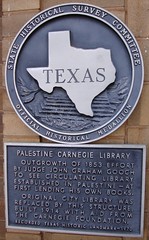
Texas Historical Marker #08788
Palestine Carnegie Library. Outgrowth of 1853 effort by Judge John Graham Gooch to see circulating library established in Palestine, at first lending his own books. Original city library was replaced by this structure, built 1914 with aid from the Carnegie Foundation. Recorded Texas Historic Landmark - 1970 #8788
502 N. Queen St., Palestine, TX, United States
Subjects


Col. Homer Garrison, Jr- Born in Kickapoo (Anderson Co.) in 1901, Homer Garrison was the son of Mattie (Milam) and Homer Garrison, Sr. The family moved to Angelina County, where Homer, Sr. served as district clerk. Homer, Jr. graduated from Lufkin High School and worked for his father. Against his father’s advice, he took his first law enforcement job at age 19, as Angelina County deputy sheriff. In 1929, he became the state license and weight inspector for the Texas Highway Department. When the Texas Highway Patrol organized in 1930, Homer, Jr. was one of the first thirty patrolmen. In 1935, the Texas Legislature created the Department of Public Safety (DPS), combining the Highway Patrol with the Texas Rangers, the state’s oldest law enforcement group. Garrison was the first assistant director and developed training for DPS officers. Three years later, Col. Garrison became DPS director and chief of the Texas Rangers. Under his leadership, the DPS grew to more than 3,400 employees and major programs developed, including crime control, police training and traffic supervision, driver licensing, vehicle inspection, safety education, and defense and disaster service. In his thirty years as head of the state law enforcement agency, federal and state agencies sought Garrison’s expertise and experience. He also served as head of state defense and disaster relief efforts. Garrison helped secure a headquarters building and museum for the Texas Rangers in Waco. At the groundbreaking, he gave what was to be his last speech, remarking of the Rangers, “They are men who cannot be stampeded;” these words are at the base of the museum’s Texas Ranger statue. Garrison died in 1968. He and his wife Mary Nell (Kilgo) are buried at the Texas State Cemetery in Austin.
703 N. Mallard St., Palestine, TX, United States

Texas Historical Marker #12630
Micham Main. Little is known about this Anderson County pioneer until he married Elizabeth Van Winkle in Crawford County, Illinois, in 1820. The Mains lived in the Illinois township of Palestine until 1833, when, drawn by a favorable change in the Mexican colonization laws, they moved their family to the Nacogdoches District of what is now Texas. Micham Main applied for a land grant in David G. Burnet's colony and received property in what is now Anderson County in 1835. He farmed the land, as was required under the terms of his grant, and joined the Republic of Texas army for a brief tenure in 1836. Ten years later, the first Texas legislature created Anderson County, and Micham Main was appointed as one of three men to establish a site for a county seat and to give it a name. Along with James Box and John Parker, also from Illinois' Palestine township, a 100-acre tract of land was selected and accepted by the Anderson County commissioners court. Early histories of Anderson County credit Micham Main with naming the new Anderson County seat Palestine for his former residence in Illinois. Later accounts, however, recognize John Parker for this action. Primary source materials that could verify either claim have not surfaced. Nevertheless, Micham Main remains an important part of Anderson County's early history. He died at his home in 1847 and is buried in the Swanson Cemetery. (2002) #12630
500 N. Church St., Palestine, TX, United States

Texas Historical Marker #12564
Palestine Post Office and Federal Building. Land at this site was purchased in 1907 from St. Philip's Episcopal Church for a new post office for Palestine. Architects Deacon Armiger and Dunplap, under the supervision of U. S. Treasury architect James Knox Taylor, drew the plans, and construction took place between 1911 and 1913. Located in Palestine's commercial district, the new post office building was an imposing addition to the downtown and prominently affirmed the presence of the federal government in Palestine. Other federal offices also were located in the building, including the Selective Service office and the National Weather Bureau's reading station. The Palestine post office vacated the building in 1962; thereafter, until 1987, it was used solely for the offices of various federal agencies. After the General Services Administration declared the building surplus to its needs, the county of Anderson, in search of additional space for county workers, stepped in to preserve the historic building. The property transfer to Anderson County took place in 1990. Listed in the National Register of Historic Places in 1998, the Palestine Post Office and Federal Building remains a significant part of Palestine's architectural heritage. (2001) #12564
101 E. Oak St., Palestine, TX, United States

Texas Historical Marker #08792
Palestine Salt Works C. S. A.. Located 6.5 miles southwest. During the Civil War this salt works was assigned to produce salt for the Confederacy at a fixed price of eight dollars for a hundred-pound sack. Private customers from East Texas, Arkansas, and Louisiana often paid twenty dollars for a sack. Producing salt was slow, tedious work. Salt water was taken from wells spread over a distance of three-fourths of a mile. A pump operated by a slave was placed in each well. Gum logs, hollowed out and joined together formed a pipeline from the wells to large cast iron boiling kettles which were kept fired. Heated water was then transferred to smaller kettles for quick evaporation. (see other side) (Back Palestine Salt Works) #8792
?, Palestine, TX, United States
_Knight.jpg?width=250)
Texas Historical Marker #15921
Robert (Bob) Knight. #15921
400 Micheaux Ave, Palestine, TX, United States
Subjects

Texas Historical Marker #08739
Bowers Mansion, The. Originally house of merchant Henry Ash; built 1878; bought 1884 by Andrew L. and Nellie O'Connell Bowers, who had architect-builder W. W. Wainright add cupola, gazebo, circular galleries after 1886. Charles Dunbar was architect in 1897 for ornate renovations, and Bowers continued to enlarge and enrich the structure until 1921. Andrew L. Bowers (1852-1926), an International & Great Northern Railroad official, president of Palestine Salt & Coal Co., banker, mayor for 20 years, was active in Anderson County oil discoveries. Four sons, two daughters grew up here; family owned place 72 years. Recorded Texas Historic Landmark - 1973 Restored by Mrs. H. R. Avera and Carl L. Avera, 1970 #8739
301 S. Magnolia St., Palestine, TX, United States

Bonner Frizzell was born in the Pine Grove Community, near Athens, in 1882. He was the son of William Asachel and Frances Missouri (Knight) Frizzell. Bonner attended high school at Bruce Academy in Athens and then moved to Tyler to attend Tyler Commercial College. At eighteen, he began his career in education by teaching algebra and geometry to a pair of children. He then entered Texas Christian University (then in Waco), where he graduated in 1909 with both B.A. and M.A. degrees. He later attended the Pulitzer School of Journalism at Columbia University 1910-1911. After teaching for a few years at Texas A&M University, Frizzell accepted a position in 1913 as principal at Rusk Grade School in Palestine; that same year, he married Jennie Elizabeth Keller. In 1919, Bonner was named superintendent and business manager of Palestine Schools, a position he would hold for the next 31 years. Bonner went on to complete doctoral studies at the University of Texas during the summers of 1925 and 1926. Frizzell was involved in many civic endeavors. He served as president of the Palestine Rotary Club, the Chamber of Commerce and the Y.M.C.A. He was also a life member of the Texas State Teachers Association, where he served as vice president in 1925. In 1951, after Frizzell’s retirement, the student-produced Arc Light paid tribute to him with these words: “the students of Palestine High School admire him for his great knowledge, respect him for his fine sense of sportsmanship and fair play, love him for his kindness and sympathy and above all, count him as their friend.” Dr. Frizzell remained a tireless promoter of public education until his death in 1968.
, Palestine, TX, United States

Roy B. Wallace Roy B. Wallace was born in Coolidge, Limestone county, on October 13, 1901, to Benjamin C. Wallace, Sr. And Mae McCoy Wallace. Roy attended school in rural Limestone County and attended Texas Christian University prior to earning his bachelor’s degree in music from Baylor University in 1925. He also did graduate work at Stephen F. Austin State University and Sam Houston State University. In 1927, he married Clothilde “Clo” Hiser. He began his teaching career in Elkhart in 1932 and taught there for three years, then taught at the Norwood Common School District. In 1936, Wallace became the band director at Reagan Junior High School in Palestine, and in 1942 became the director of the Palestine High School Band. Wallace’s band received first division sweepstakes honors fourteen of the nineteen years that he was band director. Under his direction, the band performed at numerous events, including a 1946 Texas A&M football game and the 1950 Cotton Bowl classic. Roy Wallace was named bandmaster of the year by the Texas Bandmasters Association in 1960. Wallace used recordings of performances for practices and selected a small group known as the “Radio Band” to broadcast music on the local radio station. Due to illness, Roy retired on October 15, 1961 and died on December 15, 1970. He is buried in Roselawn Cemetery in Palestine. On July 22, 2007, Wallace was inducted into the Texas Bandmasters Hall of Fame in San Antonio. He will be remembered as a devoted band director and educator who inspired students with his creative methods and positive influence.
400 S. Michaeux Ave., Palestine, TX, United States

Texas Historical Marker #08732
Anderson County Courthouse. Created by the Texas Legislature on March 24, 1846, Anderson County was named for former Republic of Texas Vice President Kenneth L. Anderson. The first court in the new county was held in a log house at nearby Fort Houston in 1846. The first Anderson County Courthouse, a one-story frame structure, was built in 1847. Located on the northeast corner of the square, it was replaced by a two-story brick courthouse in 1856. A third courthouse, also brick, was completed in 1886 but was destroyed by fire in 1913. The fourth and present Anderson County Courthouse was built in 1913-14. Designed by the Austin architectural firm of Charles Page & Bro., it was dedicated on December 20, 1914. The Beaux-Arts style building features giant order Ionic columns and pedimented porticoes on each facade, and is topped by a dome surmounted by a Justice statue. Still in use as the seat of justice for Anderson County, the courthouse underwent major restoration in 1986. The historically and architecturally significant building serves as a source of pride for county residents. Recorded Texas Historic Landmark - 1988 #8732
500 N. Church St., Palestine, TX, United States

Texas Historical Marker #08772
Kolstad Jewelers. Soren Kolstad (1823 - 1918), a skilled artisan and clockmaker, migrated to Texas from his native Norway in 1852. He settled in Palestine, where he opened a jewelry store in 1853. The store has occupied four locations. Mahogany display cases, installed in the third shop in 1916, were transferred to the present site in 1933. Managed by five generations of the Kolstad family, this is believed to be the oldest retail store in continuous operation by its founding family in the state of Texas. Members of the Kolstad family have also been leaders in religious, civic, and educational activities. (1977) #8772
100 W. Oak, Palestine, TX, United States
Subjects

Texas Historical Marker #08748
First Christian Church. Organized in 1847 under leadership of lawyer Joseph A. Clark (founder and administrator of college now T.C.U.) and John F. Taylor, a farmer. Both Clark and Taylor were followers of Campbell - Scott movement for Christian unity. Though 16 charter members were of different faiths, they successfully united through "Articles of Faith" which expressed their basic beliefs. From its very beginning, the church has been of evangelistic nature. A Rev. Mr. Jordan (relinquishing affiliation with the Baptist church) became the first pastor, ministering not only to the newly-formed congregation but to other settlements near and far. In the early 1850s, Rev. Carroll Kendrick became pastor. He too believed in the need for evangelism and pressed Joseph Clark to work with him. Clark set forth strengthening congregations already formed, establishing new churches and expounding the gospel. Interrupted only by the Civil War, evangelistic work by the church continues to this day. The first church building, erected in 1859, was located on Poplar and Fannin streets; the second on Houston and Crawford in 1884; the third, built in 1905, is now used for an educational building. The present church was constructed in 1955. #8748
113 E. Crawford, Palestine, TX, United States

Texas Historical Marker #08791
Palestine Lodge No. 31, A. F. & A. M.. Established on November 21, 1846, the Palestine Masonic Lodge is one of the oldest organizations in Anderson County. Established by 22 charter members meeting under a dispensation from the Grand Lodge of Texas, the group was officially chartered as Lodge No. 31 in 1848. For the first two years meetings were held in members' homes until a lodge building was erected on the west side of the courthouse square in 1848. In 1850 the Masons built a 2-story structure to provide a school for boys in the community on the first floor and a meeting hall on the second level. Their commitment to education continued when the Masons constructed a brick schoolhouse for girls in 1852. The third Lodge building contained three floors: the first floor was split into three separate stores for rental to area merchants; the second floor was styled as the city's first opera house; and the third floor housed the Lodge meeting room. The Masons have met in many other sites over the years. Among its many prominent members was John H. Reagan, U.S. Congressman and first Texas Railroad Commissioner. The Masonic Lodge continues to serve the community as it has for more than 150 years. (1996) #8791
401 W. Debard St., Palestine, TX, United States

Texas Historical Marker #08808
Site of St. Mary's Academy. The arrival of the railroad in Palestine brought many workers, several of whom were Catholic who wanted religious instruction for their children. St. Mary's Academy began in 1882 when Mother St. Andrew Felton, Superior General of the Sisters of Divine Providence located at Castroville, Texas, sent three sisters to establish religious education here. Sister Mary Flavienne Braun was appointed Superior and principal of the school. Classes were held in a three-room frame schoolhouse on Lacy Street. Basic education and classes in religion were supplemented with instruction in French and elocution. The citizens of Palestine contributed generously to a fund to relocate the school, which was moved to this site in the 1880s to occupy two houses. North wing was added that included a chapel, classrooms, and dormitories. By 1900 a south wing was added to accommodate the increase in both day students and boarding pupils. The addition contained an auditorium on the first floor and dormitories on the top floor. St. Mary's High School was closed in 1949 due to a decrease in enrollment. A reduced teaching staff continued to operate the facility for grades 1-8, but the school was closed permanently in 1966. (1997) #8808
418 Tennessee Ave., Palestine, TX, United States

Texas Historical Marker #08762
Home of Congressman and Mrs. Alexander W. Gregg. Honored national statesman from Palestine, Congressman A. W. Gregg (1855 - 1919) lived in this house at height of his career. Gregg, member of a distinguished southern family, graduated from University of Virginia School of Law; practiced in Palestine; was in State Senate, 1886-1888. Serving in U.S. Congress 1903-1919, he was instrumental in securing sea wall to protect Galveston from such devastation as that of 1900 hurricane. Congressman Gregg married (first) Mary Bridges and (second) Mary Brooks. Had four children. House was built 1886-1892. (1970) Incise on base: Marker donated by Col. Perry E. Taylor #8762
421 S. Magnolia St., Palestine, TX, United States

Texas Historical Marker #08750
First Methodist Church of Palestine. This church began with Methodist classes organized by John Wilson in 1840 and held in this area at the home of John Box. Louisiana Catherine "Aunt Bee" Small helped formally organize a Methodist church in Palestine soon after its selection as Anderson County Seat in 1846. By 1848 the Palestine community was included in the circuit of the Rev. Henderson D. Palmer. Palestine's first church structure was built by area Methodists in 1850 at present day 812 N. Mallard Street. Named "Bascom Chapel" after Bishop Henry B. Bascom, it served numerous congregations in the community for many years as Palestine's sole house of worship. In 1884 Palestine's Methodists erected a new sanctuary at the corner of Avenue A and N. Mallard Street and named it "Centenary." About 1900 a split in the congregation resulted in the formation of the First Methodist Church. Led by Dr. James Kilgore, First Methodist built a sanctuary here in 1910. The structure was remodeled in 1952 and in 1986 the adjoining "Carroll Building" was erected. Women's local and foreign missionary efforts have been a part of church activities since at least 1910. The congregation continues to support numerous youth programs and activities. #8750
422 S. Magnolia, Palestine, TX, United States
Subjects
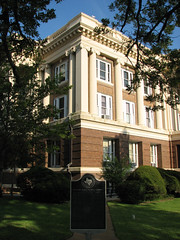
Texas Historical Marker #08740
Governor Thomas Mitchell Campbell. (April 22, 1856 - April 1, 1923) Born near Rusk in Cherokee County, Thomas Mitchell Campbell was the son of Thomas Duncan and Rachel (Moore) Campbell. He financed his education by working for the county clerk in Longview. In 1878 Campbell was admitted to the Bar and opened his law practice in Longview. He married Fannie Bruner the same year. Campbell moved to Palestine in 1892 after he was named receiver for the International & Great Northern Railroad. He was general manager of the line 1892-97. In 1905, without prior political experience, Campbell announced as a candidate for Governor. He received the Democratic nomination despite strong opposition at the party's 1906 convention. Rallying supporters with the rousing march tune, "The Campbells Are Coming," he won the election by a large margin and became Texas' second native-born Governor. The first was Campbell's boyhood friend, Gov. James S. Hogg (1851-1906). In 1908 Gov. Campbell was elected to a second term. His administration was marked by strong anti-trust legislation, a pure food law, and prison reform. When his term expired, Gov. Campbell returned to a banking and law career in Palestine. In 1916 he ran for the United States Senate but lost. He died in Galveston and was buried in Palestine's East Hill Cemetery. (1975) #8740
?, Palestine, TX, United States
Subjects


_Knight.jpg)


Texas Historical Marker #08787
Olive Branch Cemetery. This part of Anderson County was settled in the 1850s. Many of the early settlers were from the vicinity of Brushy Creek, South Carolina, and it is believed that is why the streams in this area and the community were named Brushy Creek. A smaller creek near this site became known as Olive Branch. In 1858, as the community began to grow, a small one-room building was erected to serve as a church and school. A cemetery was established on land adjacent to the building. Although the land was not officially deeded as a graveyard until 1858, there are marked burials from as early as 1856. The oldest documented grave is that of Joseph H. Waddell, who died in 1856 at age six. Also interred here are many early pioneers and a number of veterans, including James Eastland (1827 - 1911), who served in the Mexican War and the Civil War, and later represented Anderson County in the Texas Legislature. Daniel Henderson, who deeded the land for the church, school, and cemetery, is also buried here. This cemetery is a visible reminder of the early settlers of Brushy Creek. The Olive Branch Cemetery Association, organized in 1978, maintains the historic graveyard. (1988) #8787
?, Palestine, TX, United States
Texas Historical Marker #08782
Mount Vernon A.M.E. Church. Freedmen organized this African Methodist Episcopal Church in 1873. The first sanctuary, a frame building at Mulberry and Birch streets, was shared with a group of Missionary Baptists. In the late 1870s, the Methodists built their own chapel at this site and adopted the congregational name Mount Vernon. The present brick sanctuary, with influences of the Gothic Revival style, was completed in the 1920s. Recorded Texas Historic Landmark - 1986 #8782
913 E. Calhoun, Palestine, TX, United States
Texas Historical Marker #08745
Eilenberger's Bakery. F. H. Eilenberger (1878 - 1959), a German immigrant, worked at bakeries in Galveston and Fort Worth before starting this company in 1898. Originally located on the corner of John and Oak streets, the operation was moved to this site in 1918. Eilenberger also lived here for several years. Although he sold the business to his two sons and his son-in-law in 1949, his baked bread continued to be distributed throughout East Texas until 1968. Today the bakery is noted for fruit and pecan cakes, which are produced from a family recipe and marketed worldwide. #8745
512 N. John, Palestine, TX, United States
Texas Historical Marker #08786
Site of Old Magnolia. (one-half mi.S) Founded in 1840s as a ferrying point on the Caddo Trace; later became a major landing for flatboats and steamers on the Trinity River, where cotton and other products were shipped by a four-day trip to Galveston to be exchanged for flour, salt, and sugar. Magnolia -- named for a huge tree in center of town -- reached its zenith in 1863, when it had several hundred people and eight major stores. Focus of social life then was Haygood's Magnolia Tavern, where board and lodging for a man and two horses cost $2 a day. Haygood's was the scene of many gala parties feting riverboat passengers, for when a deep-throated steamer whistle blew a few miles from port, it signaled a rush of people from miles around eager to greet arrivals and collect long-awaited parcels. Growing river traffic spawned many towns like this, and from 1830 to 1880, Texas waterways were dotted with boats. From the first, though, the state's rivers were unsuited for extensive trade, because even the largest were shallow, winding, and often choked with debris. After 1880, trains replaced riverboats. An irony of the transition was that one of the last steamers to pass Magnolia, in 1872, carried rails for the tracks being lad through nearby Palestine. (1967) An irony of the transition was that one of the last steamers to pass Magnolia, in 1872, carried rails for the tracks being laid through nearby Palestine. #8786
?, Palestine, TX, United States
Texas Historical Marker #08783
Mount Vernon United Methodist Church. Early denominational records indicate that this congregation was in existence as a mission church as early as 1880. In 1896, A. L. and Susanna Herrington donated one acre to the county to be used for a free school. A one-room school building was erected on the site, on Walnut Creek twelve miles north of Palestine, and also served as a church meeting place. The community was known as Mount Vernon, and the Methodist church assumed that name, also. The one-room building was moved in 1907 two miles north of its original location, and two rooms were added to the structure for the growing school. The congregation continued to meet in the building until 1913, when this site, across the road from the school building, was deeded to the Mount Vernon Methodist Episcopal Church, South. A sanctuary was completed the same year. The church has maintained active programs over the years, and has served as a training ground for many young ministers and student pastors from nearby Lon Morris College. For over one hundred years, the Mount Vernon Methodist Church has served as a center for its rural community. Texas Sesquicentennial 1836 - 1986 #8783
?, Palestine, TX, United States

Texas Historical Marker #08803
John H. Reagan. John Henninger Reagan, son of Timothy and Elizabeth Lusk Reagan, was born on October 18, 1818, in Sevierville, Tennessee. He joined the Republic of Texas Army in 1839 and served in the Cherokee War. In the early 1840s he held several public offices in Nacogdoches County, and in 1847 obtained a law license and was elected to the Texas House of Representatives. He moved to Palestine in 1851 and opened a law office in his home. He was elected Texas 9th Judicial District Judge in 1852. Reagan, elected U.S. Congressman in 1857, resigned in 1861 over what he believed was a Federal takeover of states' rights. He served as postmaster general of the Confederacy during the Civil War. He was captured by Federal troops in 1865 and imprisoned for 18 months. He returned to Texas in 1866 and established a family farm near Palestine at the former site of Ft. Houston. During his tenure as a U.S. Congressman (1876-87) and U.S. Senator (1887-1891) Reagan led the fight that brought railroad monopolies under Federal control with the passage of the Interstate Commerce Act in 1887. In 1891 he became the first chairman of the Texas Railroad Commission, a position he held until 1901. Reagan died of pneumonia on March 6, 1906. The entire Texas legislative assembly attended his funeral. (1994) #8803
?, Palestine, TX, United States
Texas Historical Marker #08734
Antioch Missionary Baptist Church. According to local tradition this congregation traces its origin to informal services held in various homes in Palestine as early as 1856. Although referred to as "Antioch Under the Hill" the congregation was formally named Antioch Baptist Church in 1873. The church built its first sanctuary that year on land deeded to the Rev. Bristow Smith, Bob Johnson, Virgil Campbell, and Thomas Hughes by John H. Reagan. Church membership increased and in 1885 and again in 1887 the congregation purchased town lots near here for the purpose of building a parsonage and a new sanctuary which was completed in 1895. Two ministers, the Rev. T. W. Dailey and the Rev. J. B. Atkins, are credited with substantially improving church facilities during the first quarter of the 20th century. The church building, which had served the congregation well, was destroyed by fire in 1962. Services were subsequently held in a community center until a new sanctuary was erected at this site in 1964. The structure was later remodeled for use as a fellowship hall with the construction of a new church building here in 1980. Antioch continues to serve the local African American community with a variety of Christian educational and family programs. (1993) #8734
907 E. Murchison St., Palestine, TX, United States
Texas Historical Marker #08743
Concord Baptist Church and Cemetery. Three families named Fitzgerald moved to Texas in the 1840s and purchased land at Mound Prairie Creek, eleven miles north of Palestine. The area in which they settled became known as Fitzgerald. As other families moved to the area, interest grew in organizing a church. Fifteen charter members met at the Fitzgerald schoolhouse in 1871 and formed a Baptist church. It is believed they named it Concord for a community in Louisiana, the former home of some members of the church. By 1883 the congregation was holding services in its own church building. A wooden frame sanctuary was erected at this site in 1901-02 that served the congregation until 1940 when it was destroyed by fire. A brick structure was begun in 1940. The cemetery and church were located on land previously owned by pioneers William A. and Michael R. Fitzgerald. The oldest marked grave is that of Joel Kelley in 1872, although it is believed the site was in use before that time. Among those buried here are early settlers and their families and three Confederate Civil War veterans. The site continues to serve the Concord community and is maintained by a cemetery association. #8743
?, Palestine, TX, United States
Texas Historical Marker #08747
Fields Chapel Methodist Church and Cemetery. Pioneer settlement began in this vicinity in the late 1830s and early 1940s. This area was the location of several camp revival meetings. The Rev. John W. Fields organized the Methodist Episcopal Church in 1852 and the church was named for him. Trustees elected were W. R. Anglin, J. J. O'Quinn, E. W. Hassell, Joseph Shaver, A. J. Killion, L. D. Fulton, and A. K. W. Jones. Adrian Anglin donated land to this congregation and property deeds were signed on June 23, 1853. The church members built a church that also served as a school. That structure was in use until the late 1940s, when a white brick sanctuary was erected. The cemetery may have been in use prior to the date of the church organization, as there is evidence of more than 100 unmarked graves identified only by iron ore rock, native to the area. The oldest marked grave dating to November 8, 1858, is that of Arminda Florence Langston, infant daughter of Willis B. and Amarillo Anglin Langston. The burials include many pioneer settlers and their descendants and veterans of the Civil War. The community has gathered for homecoming, a social event held annually on these grounds. The church and cemetery continue to serve this area of Anderson County. (1996) #8747
?, Palestine, TX, United States
Texas Historical Marker #08757
Site of Four Pines School. In 1911 school trustees D. Barry, C. F. Everett, and W. L. Pickle purchased one acre of land here to establish a school. An old tobacco barn at this site was converted for use as a schoolhouse. The school was named for four prominent pine trees near the school entrance. By 1918 the barn/school building had been razed and replaced with a 3-room frame schoolhouse. The school offered instruction in grades one through eight. Funds raised by students through the sale of farm animals and cotton grown on school grounds were used by trustees to purchase an adjacent lot in 1925. In 1946 Four Pines had four teachers and a student enrollment of 67. The Harmony and Pleasant Grove Consolidated School Districts merged with Four Pines in 1949, and three classrooms and a gymnasium/auditorium building were added to the school complex. Athletic teams wore the school's green and gold colors and were known as the "Pine Burrs." In 1937 the nearby Magnolia, Long Lake, and Tucker schools formed the Woodhouse School District. In 1959 Woodhouse merged with Four Pines to form the Tucker common School District which in 1976 was renamed Westwood. Westwood Elementary School is currently on the same site as the original Four Pines School. (1993) #8757
2305 Salt Works Rd., Palestine, TX, United States
Texas Historical Marker #08777
McClure-McReynolds-Fowler Home. Built in 1849 by Judge Alexander E. McClure (1815 - 1870), who came from Tennessee to Texas in 1840 and lived for a number of years at Old Fort Houston. Judge McClure was the first district clerk in Anderson County, co-owner of the "Trinity Advocate," and one of the most prominent lawyers in East Texas. The house was purchased from the McClures in 1884 by Zachariah Aycock McReynolds (1846 - 1928), who immigrated to Texas in 1875 from Adairsville, Georgia. He was a Confederate veteran who had fought in the sieges at Vicksburg and Atlanta in the Civil War, 1861-1865. About 1890 the house was remodeled using the old timber, including well preserved hand-hewn sills. From 1880 to 1908, Z. A. McReynolds held the offices of district clerk, county clerk, county judge, tax collector, and postmaster. In 1934 Colonel Godfrey Rees Fowler (1876 - 1958) and his wife Ella Sue (McReynolds) returned to Palestine to retire to her old family home. Colonel Fowler was a grandson of Judge John H. Reagan (first Texas Railroad Commission chairman). Fowler had fought in the Spanish-American War, the Philippine insurrection, the Nicaraguan uprising, and World War I. The McClures and McReynoldses have been the only property owners since 1848. (1970) #8777
921 N. Perry St., Palestine, TX, United States

Texas Historical Marker #08781
Mound Prairie Cemetery. The earliest marked graves in this cemetery date to the late 1850s, although settlement of the Mound Prairie community occurred much earlier. Mound Prairie, once the home of a Baptist college known as Mound Prairie Institute, declined during the latter part of the 19th century. This cemetery is one of the few physical reminders of the town. Many of the early settlers and their descendants are buried here, as are several Confederate veterans. Some of the graves are marked with rock cairns or hand-hewn stones. (1985) #8781
?, Palestine, TX, United States
Texas Historical Marker #08773
Link Family Cemetery. This cemetery was established when John and Mary Otelia Link buried their young daughters Annie and Allean at this site within a week of each other in July of 1887. Both children died of diphtheria. At that time no Catholic cemetery existed nearby and local tradition suggests the children were buried near their home because transportation of unpreserved bodies over a long distance in the heat was impractical. John Link died in 1888 and was buried next to his daughters. The Links practiced burial procedures commonly used in rural Texas in the 19th century. The deceased was washed and laid out on a cooling board with bags of saltpeter or silver coins placed over the eyes in an undertaking shared by friends and neighbors. Pallbearers lowered the locally manufactured casket with the use of three traditional cotton straps. After the burial, participants gathered at the home of the deceased to eat and express sympathy. John and Mary's eldest son Andrew B. Link formally set aside the cemetery in a deed transferring family land to his youngest brother John F. Link in 1919. Of the 32 burials currently in the cemetery, 11 are of children under the age of 6. The Link Family Cemetery is maintained by an association of family members. (1993) #8773
?, Palestine, TX, United States
Texas Historical Marker #08767
I & GN Hospital and Nurses' Quarters. Established in 1884, the International & Great Northern Railway Employees' Hospital Association built a complex of frame structures at this site adjacent to the railroad tracks. The hospital, which operated on monthly employee dues, provided service to all railroad employees along the I&GN lines. In 1920 the frame structures were razed and replaced with a new brick hospital building. In addition to patient rooms, the institution included a pharmacy, laboratories, medical clinic, and emergency room with ambulance service. An adjacent two-story nurses' quarters building was added to the site in 1925. Designed by prominent Houston architect Alfred C. Finn, both buildings exhibit elements of Georgian Revival style architecture. Prominent features of the hospital include its raised basement, central bay, and ornate Georgian portico. The nurses' quarters features an offset classical portico and hipped roof. The Missouri-Pacific Railroad took over the I&GN lines in the 1930s, and after that time the institution was known as the Missouri-Pacific Lines Hospital Association. The hospital continued to operate until 1970. The buildings stand as reminders of the railroad's impact on the City of Palestine. Recorded Texas Historic Landmark - 1990 #8767
919 S. Magnolia St., Palestine, TX, United States
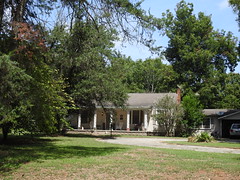
Texas Historical Marker #07158
Seven Oaks (Mallard-Alexander House). Built in 1848 as the home of Judge John B. Mallard, first lawyer in Palestine. Became the home of Judge William Alexander of 1857. Alexander was Chief Justice of Anderson County 1860-1865, and a trustee of the first school in Palestine. Recorded Texas Historic Landmark - 1966 #7158
407 E Kolstad, Palestine, TX, United States
Subjects

William Freeman William Freeman was born a slave in Anderson County on August 1, 1863, to Charlotte Freeman. His mother was a slave and the maid at the Jacob Hunter Plantation near Mound Prairie. After the slaves were freed in 1865, they moved to Palestine. William received his early education from the First Ward Colored School in Old Town Community and attended Prairie View State Normal School for two years in the early 1880s, focusing on a teaching certification and brick masonry studies. In 1885, William married Mary Frances Carter and they had three sons: Wesley, Samuel and Byron. Mary died in 1899 and William married Bobbie McMeans. They had four children: Elizabeth, Polly, Eugene and Lionel. As a rural school educator in Anderson County, William Freeman joined other visionary African Americans to change the name of the colored school in Palestine to Frederick Douglass Elementary School in 1898. The next year, he earned his teacher’s re-certification and, in 1901, became the principal of Douglass Elementary until 1909. In addition to his leadership abilities, Freeman was also a master brick mason. He made bricks for many of Palestine’s buildings before brick factories existed. He owned a brick yard and made bricks that were used to build the first Anderson County Jailhouse in 1879. Some notable works by Freeman are rock houses where red iron ore rocks were used to cover the homes’ exteriors. The son and grandson of William Freeman followed in his footsteps as principals of the Douglass school for 46 years. Freeman’s legacy as an educator, brick maker, brick mason and carpenter shaped Palestine’s history. He died on August 28, 1931, and is buried in Memorial Cemetery. (2013) Marker is Property of the State of Texas
1210 Moody Street, Palestine, TX, United States

Osjetea Briggs Native American photographer, artist and writer Osjetea Briggs was born on December 14, 1917, to Simeon Singleton Briggs (1877-1974) and Docia Augusta (Gant) Briggs (1894-1969) in Groesbeck, Limestone County, Texas. Following her high school education, Osjetea moved to Houston where she worked as a film re-toucher until she took an unpaid job as the associate editor of The Houstonian newspaper. Throughout the 1940s, she traveled the world as a photographer but moved to Palestine in the 1950s and opened her own photography studio. Her photographs captured downtown Palestine and local residents, as well as Palestine community groups. In 1954, she helped found and advise the Anderson County Council of Honor, a male-dominated organization that honored local citizens across eleven East Texas counties for their community service, a position she held for 40 years. In the early 1960s, she founded, edited and published her own weekly newspaper, the Elkhart Eagle and won awards for articles in the Grapeland Messenger and the Groesbeck Journal. Her column "Walk in my Moccasins" in the Elkhart Eagle won outstanding recognition for covering the assassination of U.S. President John F. Kennedy. In 1992, Osjetea's book, Walk in my Moccasins, was published, a 305-page compilation of her newspaper stories and experiences. In addition to her writing and photography career, Osjetea was a member the Anderson County Democratic Executive Committee and a delegate to the Texas Democratic Convention. Briggs' continuous dedication to her community and heritage benefitted Palestine as well as the greater State of the Texas. She died on April 7, 2002, and is buried near Groesbeck. (2017) Marker is Property of the State of Texas
118 East Palestine Avenue, Palestine, TX, United States

Site of McKnight Plaza- James B. McKnight moved to Anderson County in 1848. In 1876 and 1879, he bought land at this site from J.H. Mead. Here, he operated a saddlery and farrier business. McKnight died in 1907, and in 1910, the property was sold to the Farmers and Citizens Bank, which had been established by African American businessmen in 1906. The block here became known as McKnight Plaza. Between 1910 and 1945, McKnight Plaza housed numerous businesses and offices owned by African American merchants, doctors and dentists. The Farmers and Citizens Bank, which would close in the late 1920s, was on a prominent corner of the ground floor. George Macon Shuffer owned a dry good store. Dr. H.V. Hurd, a dentist, and Dr. J.H. Dodd owned a drugstore and soda fountain; Dodd's wife operated a millinery shop. Other businesses included J.B. Blake's cab company, John Tatum's café, H.G. Neely's accounting and insurance office, the funeral home of Al Davis and I.V. Bland, John Hunter's barbershop, and Noah Williams' cleaning and pressing shop. Doctors W.R. Roberts, R.E. Holland and H.D. Patton, as well as dentists Williamson McLellan and H.D. Mitchell, had offices and tended patients at this site. The Missouri Pacific Colored Booster Club, a private social organization located here, sponsored local events and dances. For 35 years, McKnight Plaza served as a commercial center for Palestine's African American community, representing local entrepreneurship and enterprise. Commonly referred to as "on the square," the plaza was once a bustling shopping and office center. Following the building's demolition in 1945, the plaza's former site became a grocery store and later a bank. Today, it remains a significant part of Palestine's social and economic history. (2004)
100 Avenue A , Palestine, TX, United States