
Gender Diversity

Texas Historical Marker #05898
The Woodhouse Home. Harry G. Woodhouse (1865-1918), a former conductor with Southern Pacific Railway, completed this house for his family in 1910. While living in Victoria, he became a successful farmer and served several terms on the city council. Interesting features of the home, which remained in the Woodhouse family for seventy years, include the Classical pediment and the Queen Anne porch with Doric piers on the first floor and Ionic columns above. Recorded Texas Historic Landmark - 1983 #5898
609 N. Wheeler St., Victoria, TX, United States
Texas Historical Marker #03534
Mundt Place. Constructed 1871 as the Continental Hotel which operated until 1897. Bought by Prof. O.E. H. Mundt. Served as classroom building for his school, founded in 1893. School operated until 1904. In 1946, purchased from Mundt family by Post 4146, Veterans of Foreign Wars. (1966) #3534
103 S. Glass St., Victoria, TX, United States

Texas Historical Marker #02407
Hauschild Opera House. German native George Herman Hauschild (1839-1911) came to Victoria shortly after his marriage to Adele Luder in 1866. A prominent pioneer businessman, Hauschild opened an opera house here in 1894. The theatre, which occupied the top two floors, featured Vaudeville shows, plays, and silent movies. The lower floor of the building was occupied by Hauschild's Music Store, established in 1891 by H.J. Hauschild (b. 1870), who succeeded his father as manager of the opera house. The theatre closed during the 1930s due to the increasing popularity of "talking pictures". 1984 #2407
202 E. Forrest Street, Victoria, TX, United States
Texas Historical Marker #02437
Henderson House. A native of Arkansas, John W. Henderson (1864-1947) became a prominent local businessman through his insurance company and his interests in ranching, farming and real estate. In 1909 he and his wife Minna Catherine (James) purchased this property. After moving the home of Dr. J.B. Ragland, which was located here, they had this Classical Revival residence constructed. Designed by Sam H. Dixon, it was built by Fred Urban. In 1926 it was sold to auto dealer and civic leader W.E. Franz, who died in 1939. His widow Bessie continued to live here until 1953. (1982) #2437
407 N. Moody, Victoria, TX, United States
Texas Historical Marker #13868
First Baptist Church of Victoria. On May 15, 1852, eight men and women, including a slave, joined together to organize the First Baptist Church of Victoria. That evening they elected the Rev. D.B. Morrall as pastor, and he performed the first baptismal service the following morning. After six months, a Northern Baptist missionary, the Rev. J.A. Kimball, came to serve Victoria and the surrounding area. At that time, the Baptist congregation met in the local Methodist Church building, sharing maintenance expenses with their neighbor congregation. Five years after the first church meeting, the Victoria Baptists met in a new structure, with a Baptist sanctuary on the ground floor and an Odd Fellows Lodge hall on the second floor of the frame building. The congregation continued meeting at their building, on Diamond Hill, until the Civil War; records indicate there was only one formal meeting between 1861 and 1877. That year, church trustees sold the Diamond Hill property and purchased a new site. In 1878, the congregation bought a steeple bell that had blown into the Gulf of Mexico when a storm hit Indianola. The bell was placed outside the church building and rung before worship services, and has since moved with the congregation to its subsequent sanctuaries, including a 1936 structure and later a 1960s sanctuary at this site. Throughout its years as a congregation, Victoria's First Baptist Church has offered worship and education programs to its community. Its Sunday School program began in 1897. The congregation has supported the organization of local mission churches. In recent years, the church property has served as relief shelter for victims of natural disasters and the congregation has supported other community programs, demonstrating commitment to service. (2003) #13868
300 N Moody St, Victoria, TX, United States
Texas Historical Marker #03497
Mount Salem American Baptist Church. In 1872 this church was organized in Indianola by 25 charter members as the Mount Salem American Baptist Free Mission Church. Two major hurricanes struck the gulf coast in 1875 and 1886 and destroyed the Mount Salem Church building. In 1886 the Reverend Robert Greer and more than 20 members moved to Victoria, bringing with them the bell and pulpit and some salvaged lumber. The congregation purchased a house to use as a sanctuary, placed it on the corner of Depot and River streets, and installed the bell and pulpit from the Indianola church building. In 1896 the congregation moved its facilities to Mantz Street, and additions were made to the building as the membership grew. A Sunday School and choir were organized. A new church building was constructed in 1932 and a baptistry was added. In 1939 the name of the church was changed to Mount Salem American Baptist Church. The membership purchased a new building in 1962. The bell and pulpit used by the founding members were prominently displayed in the fellowship hall. The church has been an integral part of the community, supporting activities and outreach programs. It continues to serve the area as it has for more than a century. (1997) #3497
609 E. North Street, Victoria, TX, United States

Texas Historical Marker #04122
Peter Underhay Pridham. (1812-July 3, 1853) Born on the Isle of Guernsey, Great Britain; moved to London at an early age. After marriage,he emigrated to Montreal, Canada, in 1832. Came to Texas in 1834, and settled on the San Jacinto River. Joined the Texas volunteers and fought in Battle of San Jacinto, April 21, 1836. After death of wife, moved to Victoria in 1839; fought in Battle of Plum Creek in 1840; married Matilda Roberts in 1841; and was tax assessor over Victoria County until his death. Recorded - 1973 #4122
?, Victoria, TX, United States
Texas Historical Marker #04129
Proctor House. A native of Victoria County, Venable Bland Proctor (1862-1936) joined his father's law firm in nearby DeWitt County in 1887. Proctor moved to Victoria in 1898 and purchased this piece of property in 1900. He soon had this Colonial Revival style home built for his wife Fannie Elizabeth (White), and their children. A landmark in Victoria, the Proctor House features two-story Classical porches with Doric columns and second floor balconies. Recorded Texas Historic Landmark - 1985 #4129
507 N. Glass Street, Victoria, TX, United States
Texas Historical Marker #04234
Regan House. Dominick H. Regan (1842-1927) was an Irish immigrant, Union Civil War veteran, and merchant in Corpus Christi and Indianola. He married Mary Hogan (d. 1894) and they became the parents of 13 children. Regan expanded his general stores to Victoria, Cuero, and Texana, and had this house built in Indianola in 1883. After devasting hurricanes in 1875 and 1886, Regan had the house moved to Victoria and rebuilt under the supervision of architect Jules Leffland. A fine example of Italinate Victorian design, the Regan house features jigsawn porch detailing and polygonal bay windows. Recorded Texas Historic Landmark - 1996 #4234
507 S. De Leon Street, Victoria, TX, United States
Texas Historical Marker #04678
Shillerville Cemetery. The community of Shillerville began when several Czechosovakian families came to this area in 1894. Among the first settlers was Jan Shiller, for whom the farm community was named. The first burial, that of Rosalie Balcar Jirasek, took place in 1897 on land given by Josef Lesikar and wife, Terezie Marek Lesikar. The graveyard was originally known as the Lesikar or Bohemian Burial ground. Additional land was donated in 1954 which increased the size of the cemetery to one acre. Some of the early grave markers are inscribed in Czech. (1986) #4678
4 mi. E on US 59; 10.2 mi. S/SE then SW on FM 1680; 1 mi. W/N on CR, Victoria, TX, United States
Texas Historical Marker #06558
Phillips-Sale House. New York native Alexander Hamilton Phillips (1804-1880) moved to Texas in 1837. He served in both the Congress of the Republic of Texas and the Legislature of the State of Texas. He moved his law practice to Victoria in the 1840s, and in 1851 hired local building contractor Richard Owens to build this house. Constructed of bricks made by slaves and fired at Owen's brickyard on the Guadalupe River, the house became a center of social activity in Victoria. During his 1857 campaign for Governor, Sam Houston attended a ball and reception here and made a speech from the front porch. Attorney Samuel Dabney purchased the house in 1893 and hired noted local architect Jules Leffland to remodel it. Leffland's changes, which included the application of stucco over the original brick exterior, reflect the popular interest in Colonial Revival architecture during the 1890s. Walter Wynne Sale (1887-1967), a medical doctor and decorated World War I veteran, bought the property in 1932, and it has remained in his family. Among the house's prominent features are a broad two-story porch with Classical columns, and a front entry with sidelights and elliptically arched transom. Recorded Texas Historic Landmark - 1967 #6558
701 N. Craig, Victoria, TX, United States
Subjects


Texas Historical Marker #06566
St. Mary's Catholic Church. Present church built 1903-1904. Third building used by this congregation as a church since the colonization of Victoria in 1824 by Don Martin de Leon. Recorded Texas Historic Landmark - 1964. #6566
100 W. Church Street, Victoria, TX, United States
Texas Historical Marker #06100
Abraham Levi House. Built before Civil War. Had 8 fireplaces, 10 rooms, many porches. Owned 1861-1881 by banker-merchant Abraham Levi, donor charitable fund. In 1865, taken over by U.S. Army of Occupation; used as Reconstruction headquarters, with prison in rear. Recorded Texas Historic Landmark - 1965 #6100
403 N. Main Street, Victoria, TX, United States
Texas Historical Marker #06103
Alexander Lowe House. 1883 home of Alexander Lowe, veteran of Mexican War, mayor, businessman, wheelwright, pioneer in refrigerated shipping. Recorded Texas Historic Landmark - 1965 #6103
701 N. Washington Street, Victoria, TX, United States
Texas Historical Marker #06258
Fleming-Welder House. Local rancher and postmaster Edward R. Fleming and his wife Lillian (Mueller) hired B. F. Williams to build this house about 1911. Charles and Wilhemina Grunder purchased the property in 1919, and sold it to Eliza Hughes Welder in 1936. Mrs. Welder made changes to the house, and its current colonial revival appearance reflects the period of her ownership. It is distinguished from most colonial revival buildings by its elongated dormers and horizontal lines. Recorded Texas Historic Landmark - 1996 #6258
607 N. Craig, Victoria, TX, United States
Texas Historical Marker #15994
Friedrech and Margaretha Hiller House. #15994
3003 N. Vine, Victoria, TX, United States
Subjects
Texas Historical Marker #15995
Murphy Ranch. #15995
389 Lower Mission Valley Road, Victoria, TX, United States
Subjects
Texas Historical Marker #06553
Captain James P. January. Texas War for Independence Veteran Assistant Surgeon and Surgeon for the Republic of Texas. Erected by the State of Texas, 1962. #6553
?, Victoria, TX, United States

Texas Historical Marker #06542
Don Martin De Leon. Founder of Victoria. Empresario of colonial grant from Mexico in 1824. Spanish cavalier, Indian fighter. First cattle baron of Texas. Born in Burgos, Tamaulipas, Mexico in 1765. Died in Victoria in 1833. RIP 1936 #6542
?, Victoria, TX, United States

Texas Historical Marker #06539
Dona Patricia De La Garza De Leon (1775-1849). Came from Tamaulipas to Texas (then northernmost province of Mexico) about 1800, to be at the side of her husband, Don Martin de Leon, as he sought to obtain a Spanish grant to establish a civilized colony here. With her family of ten children, she was a patriot, loyal to the cause of Texas. Her home was a center of pioneer culture. Homesite was later given to St. Mary's Church. Recorded - 1972 #6539
?, Victoria, TX, United States

Texas Historical Marker #06543
Home of Empresario Martin De Leon. Born at Burgos, Mexico, 1765. Appointed Captain in the Spanish Army, 1790, for bravery displayed in Indian fighting. Received a grant in 1824 to settle 41 families in Texas. Established the town of Victoria. Received an additional grant in 1829 to settle 150 families. Died in Victoria, 1833. His colony was the only one in which Mexican customs and traditions prevailed. 1936 #6543
Church & Bridge St., Victoria, TX, United States

Texas Historical Marker #06540
Felix De Leon. (1806-1850) Born in Texas; third son of the Empresario Don Martin de Leon, founder of De Leon Colony and City of Victoria. Felix de Leon was held hostage on a pirate ship about 1822, to force his father to comply with buccaneer demands. Later he became active in Colony's affairs. A skilled Indian fighter, he served Texas' cause in War for Independence. His business was supplying horses, mules, and cattle to the New Orleans market. (1972) #6540
Evergreen Cemetery, N. Vine & W. Red River streets, Victoria, TX, United States

Texas Historical Marker #06538
Agapito De Leon. (1808-1836) Born in Texas; fourth son of empresario Don Martin De Leon, founder of De Leon Colony and city of Victoria. Agapito De Leon was active in the colony's affairs, a Texas patriot during the War for Independence from Mexico, a skilled Indian fighter, engaged in cattle, horse, and mule business. He was assassinated by Mabry ("Mustang") Gray, leader of a gang systematically robbing Texans of Mexican descent, after close of War for Independence. Recorded - 1972 #6538
?, Victoria, TX, United States
Texas Historical Marker #06554
James A. McFaddin Home. Built 1890 of Florida pine and cypress; typical Victorian style. Home of James A. McFaddin (1840-1916), loyal citizen of Texas Republic and pioneer stockman. He married Margaret Virginia Coward in 1861 and served as an officer in the Confederate Army in the Civil War. Moved from Refugio to Victoria County 1876. Here he introduced barbed wire and Brahma cattle; Also founded town of Mariana (now McFaddin). His brand "M6", registered 1840, is still active. Recorded Texas Historic Landmark - 1967 #6554
207 W. Commercial St., Victoria, TX, United States
Texas Historical Marker #06549
Guadalupe River. Discovered in this vicinity on April 14, 1689 by Alonso de Leon. Named in honor of "Our Lady of Guadalupe" patron saint of Mexico. Here at a ford, used since Indian days, empresario Martin de Leon founded the town of Victoria in 1824. 1936 #6549
S. US 59 at Guadalupe River, Victoria, TX, United States
Texas Historical Marker #06581
B. F. Williams House. Victoria businesman, mayor and state legislator Benjamin F. Williams (1846-1916) built this home for his family in 1909. Designed by local architect Jules Leffland, the Classical Revival home features two-story front Ionic columns complemented by a side gable pedimented portico with matching one-story columns. Also of note are the distinctive balustrade on the balcony and the "widow's walk" from which the Guadalupe River may be viewed. Recorded Texas Historic Landmark - 1987 #6581
401 E. Murray Street, Victoria, TX, United States
Texas Historical Marker #06569
Darwin M. Stapp. Soldier in the Texas War for Independence Participated in the Siege of Bexar, 1835. Erected by the State of Texas, 1962 #6569
Evergreen Cemetery, N. Vine & W. Red River streets, Victoria, TX, United States
Texas Historical Marker #06574
John Van Bibber. Served in the Texas War for Independence; escaped the Goliad Massacre, 1836. Erected by the State of Texas, 1962 #6574
Evergreen Cemetery, N. Vine & W. Red River streets [section 4, lot 29], Victoria, TX, United States
Texas Historical Marker #06582
John Howland Wood. Born in New York, John Howland Wood came to Texas in 1836 and fought in the Texas Revolution. After serving as quartermaster with the Texas Army in Victoria, he settled on a ranch at Black Point (now Bayside) in the 1840s. Wood supplied beef to the U.S. Army stationed at Corpus Christi under Gen. Zachary Taylor. He served as patrol captain in coastal defense during the Civil War and was active in developing the City of Rockport. (1985) #6582
No. 1 Catholic Cemetery, Moody & Red River St., Victoria, TX, United States
Texas Historical Marker #16105
Victoria Advocate. Victoria Advocate, second oldest existing newspaper in Texas. Established May 8, 1846 by Thomas Sterne, John D. Logan. Among its editors have been John Henry Brown, Rev. H.S. Thrall, Victor R. Rose, Leopold Morris. Historians, Gen. William R. Scurry, Gen. A.P. Bagby of military fame. George H French Publisher since 1901 #16105
?, Victoria, TX, United States
Texas Historical Marker #00289
Band Stand. Originally built before 1885, on Constitution Street side of the public square, for public gatherings and concerts. Moved to center of public square and placed upon foundation of the old standpipe in 1923. Completely restored in 1962 by Mr. and Mrs. J.M. Pickering. Recorded Texas Historic Landmark - 1964 #289
Main & Constitution Sts., in Memorial Plaza, Victoria, TX, United States
Texas Historical Marker #00635
Callender Home. Built by Dr. Stephen Cocke as hunting lodge on Green Lake; of hand-hewn pine lumber bought in New York. In 1854 lodge was torn down, boards numbered; then rebuilt on present site. Since 1871 home of pioneer lawyer William L. Callender and his descendants. Recorded Texas Historic Landmark - 1966 #635
404 W. Guadalupe Street, Victoria, TX, United States

Texas Historical Marker #06544
Silvestre De Leon. (1802-1842) Son of the Empresario Martin de Leon, founder of the De Leon Colony and City of Victoria. Silverstre de Leon was active in the Catholic church, served alcade of Victoria, and had other commissions. An Indian fighter and soldier, he was taken prisoner by Mexican Army during Texas War for Independence. He owned and traded in vast herds of horses, mules, and cattle. He married Rosalia de la Garza; had two sons, Martin and Francisco. (1972) #6544
Evergreen Cemetery, N.Vine & W. Red River Sts., Victoria, TX, United States
Texas Historical Marker #06550
Old L.D. Heaton Home. Built in 1887. Architecture is Southern Colonial, with lofty porch pillars and Georgian front entrance. Original owner was in a prominent firm, J.C.Heaton & Brothers, druggists here and Cuero. Recorded Texas Historic Landmark - 1966 #6550
307 S. Bridge Street, Victoria, TX, United States
Texas Historical Marker #03306
McNamara House. Built 1870's by W.J. McNamara, town council member and dealer in cotton, wool, hides. Rural Victorian Gothic architecture. Donated by McNamara- O'Connor family in 1959. Restored as Historical and Fine Arts Museum. Recorded Texas Historic Landmark - 1965 #3306
502 N. Liberty, Victoria, TX, United States
Texas Historical Marker #13050
Robert H. and Pauline Clark House. Pennsylvania native Robert Clark (1818-1910) moved to Mississippi as a young man. A veteran of the Mexican War, in which he was severely wounded, he later moved to Brownsville and entered into a successful partnership with Charles Stillman. The two men eventually opened a cannery in Indianola (40 mi. SE). In 1870, Clark wed Pauline Shirkey Crocker (1846-1940). After a hurricane hit Indianola in 1875, he moved his family to Victoria, where he continued to prosper as a cattle buyer and seller. In 1877, he built this frame Greek Revival house with central portico and boxed columns. Robert and Pauline Clark, remembered for civic contributions, are buried in Evergreen Cemetery. Recorded Texas Historic Landmark - 2004 #13050
317 N Main, Victoria, TX, United States
Texas Historical Marker #13034
Goldman Ginnery. Adolph Goldman was born in Bremen, Germany in July 1836. At age seventeen, in 1853, he immigrated to New York City, where he worked as a clerk. He moved to New Orleans four years later and then to Goliad, Texas in 1859. There, he found work in a mercantile store. Following military service in the Civil War, Goldman moved to Victoria in 1865 and established his own mercantile firm. He became a successful businessman, with other endeavors including dairying, farming, grist milling and cotton ginning. Records indicate Goldman operated a cotton gin at this site beginning in the late 1880s. He purchased the land, as well as existing gin structures, from Ernst Moeller (Miller) in 1890 and may have leased the facilities prior to the date of purchase. Over the next several years, Goldman bought surrounding property and developed a successful ginning operation, which he continually updated with new equipment and structures. With immediate access to the rail line that ran along East Street, Goldman was able to manage other cotton-related operations at this site, including warehouses for area cotton growers. After the turn of the 20th century, Goldman's two sons, Edwin C. and G. Clarence, joined their father in the management of the family business. By 1907, they had constructed a red brick warehouse, and the business continued to grow, averaging 3,000 bales a season. Upon Goldman's death in 1921, he left the property to his sons. Edwin C. maintained the business until 1937, when he sold all but the brick warehouse to F.S. Tarkington. The ginning operations continued until the early 1940s, when the facilities burned. In the 1960s, Tarkington's heirs sold the property, which became the site of an agricultural supply center. (2006) #13034
914 NE Water St, Victoria, TX, United States
Texas Historical Marker #13867
Power Home. Built in 1894 for Edward Power, significant for its columns, wide porches, wood trim. Given in 1960 by Mrs. James Power, to the Daughters of the American Revolution, Daughters of the Republic of Texas and the United Daughters of the Confederacy. Recorded Texas Historic Landmark - 1966 #13867
307 S. William, Victoria, TX, United States
Texas Historical Marker #13869
Victoria. Founded 1824 by Martin de Leon as center of his colony, Mexico's buffer against Comanches. Active in 1836 in support of Texas War for Independence, and in Confederate cause during Civil War. Historic, trade, cattle, oil and industrial center. (1964) #13869
US 77, Victoria, TX, United States
Texas Historical Marker #14399
Mission Nuestra S. Del E. Santo De Zuniga. #14399
?, Victoria, TX, United States
Texas Historical Marker #14659
Early Victoria Home. #14659
604 N. Craig St., Victoria, TX, United States
Texas Historical Marker #14652
Foster Army Air Field. Prior to World War II, in an effort to match the powerful air armadas of the Axis nations, the U.S. Army Air Corps (later U.S. Army Air Forces) rapidly increased its number of training installations throughout the country. The city of Victoria secured an advanced single engine aerial gunnery training command here, with construction beginning on April 25, 1941. Initially named Victoria Field, the military renamed the site in honor of 1st Lt. Arthur L. Foster, an instructor at Brooks Field (San Antonio) killed when his plane crashed in 1925. The first class of cadets arrived in Sept. 1941 and subsequent classes arrived throughout the war. Cadets received both classroom flight instruction and gunnery training on site, with aerial gunnery practice at ranges on Matagorda Island and Matagorda Peninsula. In 1942, the military assigned a unit of the Women's Army Corps here. Cooperation between the U.S. and Allied nations brought foreign aviators here during the war for training, most notably the 201st Fighter Squadron, Mexican Expeditionary Air Force (The Aztec Eagles). The end of World War II brought the closure of military sites across the nation. Foster Army Air Field (AFF) closed on October 31, 1945; however, the airfield's inactivation was short lived. In 1951, the Korean War created a need for additional jet training facilities and once again the people of Victoria rallied behind efforts to secure a military installation. As a result of local solicitation, the military reactivated Foster AFF on April 1, 1952, with the first class of jet aviation cadets arriving in March 1953. On July 1, 1954, Foster Air Force Base (AFB) became a permanent military installation and later became the tactical air command control center for the western U.S. In Dec. 1958 the military closed Foster AFB. Two years later the federal government turned the airfield over to Victoria County in exchange for nearby Aloe Field, which the governemnt sold to private investors. In 1976, Foster Field became Victoria Regional Airport. (2008) #14652
Victoria Regional Airport, Victoria, TX, United States
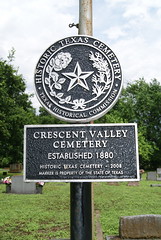
Texas Historical Marker #15818
Crescent Valley Cemetery. #15818
6679 State Hwy 185, Victoria, TX, United States
Subjects
Texas Historical Marker #00596
Camp Henry E. McCulloch. October 1861, on this site in Nuner Mott, a valley extending southwest in Victoria County, seven infantry and two cavalry companies of the 6th Regiment Texas Infantry trained in this camp of instruction commanded by Col. R.R. Garland. Co. A, of Port Lavaca, under A. Ham Phillips, and Co. B, Victoria, under Jacob Rupley, were joined for eight months by troops from nearby towns. The 6th on May 22, 1862, was ordered to Gen. Van Dorn at Arkansas post, where it was captured. Less than 100 of the 643 men survived the war. (1963) #596
US 87, 0.1 mi. N of city limits (4.1 mi. N of courthouse), Victoria, TX, United States
Texas Historical Marker #03424
Mitchell School. The citizens of Victoria voted to establish an Independent School District in an 1898 election. Immediate plans called for the building of eight schools: four for Anglos and four for African Americans. In 1901 school trustees hired prominent local architect Jules Leffland to design two buildings,and this site was acquired for the first Anglo high school. Named Central High School, it was completed in 1902. After secondary school students were reassigned to the new Patti Welder High School in 1918, the school at this site was renamed Third Ward School and served elementary grades. The name was changed again in 1922 to honor J.D. Mitchell (1848-1922), one of the school district's first trustees and a former city council member and state legislator. Leffland's imposing 3-story school building suffered major damage due to fires in 1935 and 1943, resulting in the removal of the third floor. Additional alterations occurred over the years to meet the changing needs of the facility. Although no longer in use as an elementary school, Mitchell School continues to serve as an educational center, housing classes of the Mitchell Guidance Center. (1995) #3424
306 E. Commercial, Victoria, TX, United States
Texas Historical Marker #06578
Viola Case. Born in Virginia in 1821, Viola Case moved in 1848 to Victoria, where she taught at the Victoria Female Academy founded by her husband, the Rev. John R. Shive. She continued the school after his death in 1853 and after the death of her second husband, the Rev. Joel T. Case, in 1868. By 1870 the academy known as Mrs. Case's Select School, was coeducational and widely respected. She remained in charge until her death in 1894. Until 1973 the Victoria Bronte Public Library, which began as a collection of Mrs. Case's books, was supported by the Bronte Club, a literary society she founded in 1873. #6578
Main Street, inside Victoria Public Library lobby, Victoria, TX, United States
Texas Historical Marker #06557
Our Lady of Lourdes Catholic Church. In 1872 the Rev. Jean Baptiste Teitien was appointed as an assistant pastor at St. Mary's Catholic Church in Victoria. There he realized the need for a separate parish to serve the area's German-speaking community. He received permission to begin a new church from the Rt. Rev. Anthony Dominic Pellicer, first Bishop of the Diocese of San Antonio, and traveled to his native Germany to collect funds for the construction of a church building. He returned to Victoria with enough money to begin construction, and in 1875 he led the first worship services in the completed building for Our Lady of Lourdes parish. After serving as pastor for sixteen years, Teitien resigned to return to Germany, where he died in 1923. Another minister who served Our Lady of Lourdes was the Rev. F.X. Heck (b. 1864), who succeeded Teitien and left in 1905 to become pastor of St. Mary's Church in Victoria. The original church building was destroyed by fire during the pastorate of the Rev. Lawrence Etschenberg (1870-1946) and was replaced with the current structure in 1924. The history of Our Lady of Lourdes Catholic Church is an important reminder of the cultural heritage of Victoria County. (1984) #6557
105 N William St, Victoria, TX, United States
Texas Historical Marker #06567
William Robert Smith. (July 20, 1888- July 20, 1952) Served in Co. D, Texas Rangers (1927-1933), under Captains W. W. Sterling, Will Wright, and Albert Mace. Hazardous duties included patrolling the Rio Grande for smugglers, protecting a prisoner from a Sherman lynch mob, dipping cattle for tick fever under death threat in Brazoria County, and investigating "hot oil" scandals at Kilgore. Deputy Sheriff of Cameron County (1933-1940), police lieutenant in Brownsville (1940-1946). An effective lawman. (1972) #6567
Memorial Park Cemetery, 300 Red River [section B, lot 19], Victoria, TX, United States
Texas Historical Marker #06561
Victor Marion Rose. Victor Marion Rose, poet, editor, historian and soldier. From the founders of Victoria he gathered the fragments of the past and wove them into the history of Victoria County. Born in Victoria January 1, 1844. Died in Myrtle Springs February 5, 1893. (1965) #6561
Evergreen Cemetery, N. Vine & W. Red River streets, Victoria, TX, United States
Texas Historical Marker #06563
Site of Round Top House. The Citadel of Victoria. Built before the year 1836 by Placido Benavides, son-in-law of Martin De Leon. The house served as a place of refuge for the citizens of Victoria during the Comanche raid of 1840. (1936) #6563
SW corner of S. Main & Juan Linn Streets, Victoria, TX, United States
Texas Historical Marker #12271
C. T. Beck Ranch. Born in 1846, Charles Theodore (C. T.) Beck migrated with his parents from their native Germany to the United States in 1851. The family landed at Indianola and made their way to Victoria. Though he was too young to serve in the Confederate Army during the Civil War, C. T. Beck worked for the cause. After the war he became a cattle driver. His father, Charles (Carl) August Beck (1810-1885) purchased 40 acres near this site for a family homestead in 1862. C. T. Beck married Johanna Lentz in 1872, and in 1893 the Becks purchased this additional acreage from George W. Norton. The main barn was erected between 1905 and 1906; the ranch house was crafted by Johanna Lentz Beck's brothers in 1907. A fever tick outbreak in the early 1920s prompted C. T. Beck to build a cattle dipping vat. Neighbors from miles away brought their cattle to the ranch's vats to fight the epidemic. C. T. Beck died in 1923 and ownership of the ranch passed to Willie T. Beck, the oldest of his and Johanna's seven children. Modernization came with the second half of the 20th century. After World War II, a small tractor and truck replaced the work animals. Electricity was furnished by the National Rural Electrification Administration in 1946. The first telephone was installed in the ranch house in 1952 and surrounding roads were paved in 1962. Though a significant portion of the original 20,000 acres was developed with the growth of the greater Victoria area, much of the ranch property continued to be held by the family at the end of the 20th century. (1999) #12271
3907 Salem Road, Victoria, TX, United States
Texas Historical Marker #05650
Victoria County Honor Roll. Country's Defenders from Victoria County who made the supreme sacrifice in the World War erected by the citizens of Victoria County dedicated by Leon Zear Post No. 166 the American Legion. Overton A.Abshier, Charles J. Beyer, Oscar R. Booker, John R. Branch, Leo Leslie Brown, Willie E. Butler, Harry Russell Canfield, John J. Caton, Horace c. Davidson, Jacob B. Dentler, Joseph H. Devasier Lawrence J. Fox, Manuel De La Garza, George Gleinser, Maurice Lombardi Groce, Andrew Jackson Handley, Fritz Hoeber, Frank Joseph Holy, Henry Innocenti, Alfred Kohl, Thomas Lambertson, Edwin Ley, John J.Mikeska, Leo E. Mitchell,Walter E. Nitschmann, Albert S. Noble, James W. Priddy, William J. Rawlines, Clarence Elton Smith, Pedro Villareal, David Dell Weaver, Fritz Wolf, Henry Wurdel, Leon A. Zear, Raymond A. Allen, Reed Thomas Anderson, Elijah Atwood, Henry Bell, William M. Halein. "The right is more precious then peace, we shall fight for thing which we have always carried in our hearts to such a Task, We have dedicated our lives." (1917) #5650
Courthouse grounds, Bridge Street, Victoria, TX, United States
Texas Historical Marker #05652
Victoria County, C.S.A.. Transportation, military and supply center in the Civil War. On one branch of the cotton road, which moved crop to Mexico for exchange on foreign markets for vital guns, ammunition, medicines and other goods. The 1861 vote favored secession 313 to 88. Troops furnished the confederacy included 5 cavalry companies. County men were also in the 6th Texas Infantry, which trained at "Henry E. McCulloch", a camp of instruction 4 miles from Victoria. Local men in Hood's, Ross' and Sibley's Brigades, Terry's Texas Rangers and Buchel's Cavalry were among the 90,000 Texans noted for mobility and daring who fought on every battlefront. Fort Esperanza, on Matagorda Island, was garrisoned by 100 Victoria Militia, who were captured by 1,900 Federals. The people at home made cloth, tallow candles, shoe blacking from china berries, coffee substitutes from parched corn, dried potatoes or okra seeds. To block 1863 threat of Federal invasion, Gen. John B. Magruder, commander of the Dept. of Texas, destroyed the railroad from Port Lavaca to Victoria. Citizens sacrificed their fine river harbor, one of the two busiest in Texas, by felling trees and sinking boats in the shipping lanes. (1963) #5652
US 59, 2.2 mi. NE of Victoria-Goliad county line, Victoria, TX, United States
Texas Historical Marker #06579
Sidney Roper Weisiger. (November 29, 1906-May 23, 1975) Born to a pioneer Victoria County family, Sidney R. Weisiger grew up with stories of the area's early history. After a term as county sheriff and naval service during World War II, he devoted the last years of his life to preserving Victoria's heritage. His "Vignettes of Old Victoria" and "Sidney's Journal" appeared in "The Victoria Advocate", 1971-1975. After his death, his widow Hilda donated his entire collection of historical research to Victoria College. (1981) #6579
Evergreen Cemetery, N. Vine & W. Red River streets, Victoria, TX, United States
Texas Historical Marker #06580
Robert S. Weisiger. (Feb. 25, 1876-Jan. 19, 1950) Became Deputy Sheriff of Victoria County at 19; served as County Sheriff 1906-1920, 1928-1936. In early days he rode horseback to carry out duties. Brought suspects to trial in all major crimes of area. Helped quell 1917 riot of Camp Logan soldiers. (1968) #6580
Evergreen Cemetery, N. Vine & W. Red River streets, Victoria, TX, United States
Texas Historical Marker #06548
Jacob Fox House. This home was constructed in the early 1890s for Jacob Fox (1841-1914), a native of Alsace who earlier had built a cottin gin and grist mill on this block. A Confederate veteran, Fox was known in Victoria as a successful businessman, farmer, miller, and community leader. His family home exhibits Eastlake style detailing and features a decorative balustrade, curved brackets, and a widow's walk on the roof. Recorded Texas Historic Landmark - 1985 #6548
708 W. Power, Victoria, TX, United States
Texas Historical Marker #06559
Pioneer Marker. To the memory of Texas soldiers and Victoria pioneer families who still lie buried in this sacred soil. A tribute from Colonel James W. Fannin Chapter of the Daughters of the Republic of Texas 1947. #6559
?, Victoria, TX, United States
Texas Historical Marker #06536
Edward Conrad. Born in Pennsylvania in 1810. Came to Texas in 1835. A signer of the Texas Declaration of Independence March 2, 1836. Died in Victoria July 13, 1836 while an officer in the Army of the Repubic of Texas. 1936 #6536
City Square -- Church Street between Bridge & Main, Victoria, TX, United States
Subjects
Texas Historical Marker #06546
Old Federal Building. This Italian Renaissance Revival building was constructed in 1911-13 to serve as the United States Post Office and Federal Courthouse. Otto P. Kroeger and Company of San Antonio was the contractor, and James Knox Taylor served as the supervising architect. Federal offices were located here until they moved to a new site in 1961. Four years later, the building became headquarters for Frels Theatres, Inc., a regional entertainment company. Recorded Texas Historic Landmark - 1981 #6546
210 E. Constitution St., Victoria, TX, United States
Texas Historical Marker #06547
Fossati's Delicatessen. In 1882, Italian immigrant Fraschio ("Frank") N. Fossati (1852-1939) opened his first delicatesssen in Victoria at Juan Linn and Main streets. He had this building constructed in 1895 and moved the business to this site. One of the oldest remaining commercial structures in Victoria, it features double front doors with multi-light transoms. Over the years, Fossati's has handled imported foods, groceries, and feed and has served as an important gathering place for Victoria's citizens. Recorded Texas Historic Landmark - 1987 #6547
302 Main Street, Victoria, TX, United States

Texas Historical Marker #06571
Thurmond Building. C.L. Thurmond, Jr. constructed this building in 1898 for use as a general mercantile store and residence. It is similar to other structures built here before the 1900s, when Bridge Street was a major commercial center of Victoria. The business district prospered until nearby rail lines and roads were relocated. The Thurmond Building, which features a distinctive three-story central section, housed stores, a grain mill, and the Farmers' Cooperative. Recorded Texas Historic Landmark - 1980 #6571
901 S. Bridge Street, Victoria, TX, United States
Texas Historical Marker #06575
The Victoria Advocate. The second oldest newspaper in continuous operation in Texas, the "Victoria Advocate" began as the weekly "Texan Advocate" in 1846. The first issue was published on May 8, 1846, the same day as the Battle of Palo Alto, first battle in the Mexican War. An extra edition was printed to inform local citizens of the event. The newspaper's first publishers were Thomas Sterne (1818-1906) and John Davis Logan (1818-1878), both experienced newspapermen. They changed the name of the paper in its first year to the "Texian Advocate" in response to requests from early Texas pioneers. Sterne and Logan sold the newspaper in 1853. Both became ranchers, and Logan later operated the "Daily Herald" newspaper in San Antonio. Later editors and publishers included Sam Addison White, Victor Marion Rose, Frank R. Pridham, Edward Daniel Linn, John L. Bartow, Louis Nicholas Hofer, and James McDonald. It was during White's ownership that the newspaper was renamed the "Victoria Advocate" between 1859 and 1861. McDonald introduced the "Daily Advocate" in 1897. Both daily and weekly editions were published until 1943. Growing with the city, the "Advocate" has served the citizens of Victoria for well over a century. (1989) #6575
311 E. Constitution, Victoria, TX, United States
Texas Historical Marker #12276
Mission Espiritu Santo Cattle Ranch. Traditionally recognized as the first great cattle ranch in Texas, Espiritu Santo Ranch traces its history to the Spanish Mission of Nuestra Senora del Espiritu Santo de Zuniga, established on Garcitas Creek in present Jackson County in 1722. It was moved to this site along the Guadalupe River in 1726, and this area of Victoria County has been known as Mission Valley since that time. The mission's principal secular activity was cattle ranching, largely developed at this site. After the mission relocated to present Goliad County in 1749, its ranching operation grew to an estimated 40,000 head of cattle and was influential in the development of the famed Texas longhorn breed. In 1833, Felix de Leon received a Spanish land grant that included the former Espiritu Santo property in Victoria County. Abner McDonald purchased the land at a public auction in 1841, and sold it to J. O. Wheeler in 1850. Quincy Davidson purchased the property in 1867. The 1870 census listed Davidson as the wealthiest landowner in Victoria County, and by 1878 the "Victoria Advocate" reported that he owned 59,989 of the 61,161 head of cattle then in Victoria County. The Davidson family retained ownership of the land for 97 years, gradually selling off large tracts. Much of the area surrounding the present ranch property remains known as the Davidson lands. In continuous operation as a cattle ranch since the 18th century, Espiritu Santo Ranch and the ruins of the 1726 mission complex have provided a wealth of archeological evidence of the Spanish Colonial period. It represents a tangible link to the frontier and to the earliest history of ranching in Texas. (2000) #12276
3377 Lower Mission Valley Road, Victoria, TX, United States

Texas Historical Marker #06541
Fernando De Leon. (1798-1853) Eldest son of empresario Martin de Leon. Came with parents from interior of Mexico to Texas, the northermost province, about 1800. Worked with his fathter in founding De Leon Colony and city of Victoria in 1820s. He was a commissioner of the colony and an Indian fighter. Loyal to cause of Texas freedom from Mexico, he was imprisoned by the Mexicans in Texas War for Independence. A cattleman and horseman, he owned the famous "Escondida" Ranch. Recorded - 1972 #6541
Evergreen Cemetery, N. Vine & W. Red River streets, Victoria, TX, United States

Texas Historical Marker #06101
John J. Linn. John J. Linn, one of De Leon's colonists, merchant, alcalde, mayor, member of the Congress of the Republic of Texas. Born in Ireland June 19, 1798. Died in Victoria October 28, 1885. 1936 #6101
?, Victoria, TX, United States

Texas Historical Marker #13496
Joe F. and Amelia Jecker House. After Republic of Texas President Sam Houston granted the original land to the town of Victoria in December 1841, the Rev. William C. Blair bought several parcels of land in the community, including this one. Blair came from Natchez, Mississippi in 1838 and organized a Presbyterian church and Sabbath school across the street from this lot on what became known as Presbyterian Church Square. Blair sold the site in 1851, and the property changed hands several times before James B.P. January bought it in 1859. A native of Kentucky, January came to Victoria after service as a physician for the Army of the Republic of Texas and for the U.S. Army during the U.S.-Mexico War. He settled in Victoria and became a full-time community doctor, and he built a house here by 1860. In 1872, January sold the property to George Williams, who served a term as Victoria's mayor. A sharp increase in the property's value during Williams' ownership indicates changes or new construction at the site. Louis Jecker bought it in April 1885 and gave the north half of the lot, inclunding the Williams' home, to his daughter Theresa A. Jecker shortly after she wed her cousin Joseph F. Jecker. The Jeckers later hired noted Victoria architect Jules C. Leffland to remodel the home, and contractor Henry Schroeder finished the project in the fall of 1904. The Jecker family owned the property until 1971. Subsequent owners have preserved the structure and the details added during the 1904 renovation, including turned spindle friezework and jigsawn brackets. The home, which reflects Victorian-era design, remains a landmark in the city as the closest extant residence to De Leon Plaza. Recorded Texas Historic Landmark - 2005 #13496
104 N Liberty St, Victoria, TX, United States

Texas Historical Marker #12273
De Leon Plaza. Originally called "Plaza De la Constitucion" by Martin De Leon, the founder of Victoria, this square was included as part of an early 1830s survey of Victoria by Jose M. Carbajal, son-in-law of De Leon. Carbajal's survey expanded on the founder's basic design for the city, which followed the style of traditional Spanish municipalities. A water well lined with brick was placed in the center of the square in 1850. By 1872 a windmill stood over the well; twelve years later it was replaced by a standpipe. Other improvements included a bandstand in the 1870s, hitching racks in 1897; a Confederate memorial status, "Last Stand" by Pompeo Coppini, dedicated in 1912; and lamp standards in 1923. In that year the standpipe was removed and the bandstand was relocated to the center of the plaza. Sidewalks were added by the Public Works Administration in the 1930s. Through the efforts of the United Daughters of the Confederacy, the site was renamed De Leon Plaza as part of a plaza beautification project in 1941. As a gathering place, summer concert arena, exposition site, and town center, De Leon Plaza continues to serve the people of Victoria as it has for generations. The plaza stands as a reminder of the rich heritage of the city and its founder. (1998) #12273
100 N. Main St., Victoria, TX, United States
Texas Historical Marker #12275
Camp Henry E. McCullough. At the suggestion of Confederate Col. Henry McCullough, an area near this site north of Victoria, known as Nuner's Mott, was selected for the establishment of a military training camp in 1861. Troops from Bell, Bexar, Calhoun, DeWitt, Gonzales, Guadalupe, Matagorda, Travis, and Victoria counties began arriving that September. Col. Robert Garland of Virginia was appointed regimental commander. The entire regiment, now known as the Sixth Texas Infantry, trained at Camp McCullough until May 1862. Captured at Arkansas Post in 1863, the regiment later fought in the Battles of Missionary Ridge, Atlanta, Franklin, and Nashville before finally surrendering with the Army of Tennessee in North Carolina. (1998) #12275
?, Victoria, TX, United States
Texas Historical Marker #12272
Coletoville Cemetery. When an epidemic of diphtheria hit the German settlement of Steinerville, established in 1849, two of August and Thekla Spitzer's children died. Ten-year-old Henry and six-year-old Robert were buried by their parents in 1872 on this site. In May of 1872, the Spitzer's deeded the land to the trustees of the new school and evangelic German church of the German community of Steinerville. The community was later renamed Coletoville for the nearby Coleto Creek. Both Thekla and August Spitzer are buried in the cemetery. The oldest birth dates are those of Eva Voigt and Joseph Weiser, both born in 1812. Several veterans of major American and international conflicts are interred here. In 1970, the church, now called Martin Luther Lutheran Church, deeded the cemetery land to the Coletoville Cemetery Association. The church and cemetery became two separate institutions for the first time, though community members of all faiths have traditionally been buried here. Burial sites are marked in rows and spaces rather than in plots, and graves are arranged in consecutive order by date. Many of the oldest markers were originally made of sandstone. A 1997 count revealed 623 marked and 78 unmarked graves. (1997) #12272
2533 Coletoville Road East, Victoria, TX, United States
Texas Historical Marker #12277
Pela House. Conservatively Greek Revival in its distinct bays, its center passage, pedimented windows, and columns, the Pela House was erected in 1884. Then-modern Victorian elements such as unusual geometric railings on a two-tiered porch make this house a striking hybrid of two very different architectural styles. Silvain Pela, a French immigrant, and his wife Elizabeth (Meyer) Pela, a Swiss immigrant, raised ten children within these walls. The colorful Pela family and their descendants remained in the home for more than 100 years. Recorded Texas Historic Landmark - 1998 #12277
309 E. Santa Rosa, Victoria, TX, United States
Texas Historical Marker #12274
Carlos de la Garza. A fourth-generation Tejano rancher, Carlos de la Garza was born into a family that was prominent among the colonies in Refugio, Goliad and Victoria. He and Tomasita Garcia were married in 1829; they settled on the family ranch at Carlos Crossing near this site. A community called Carlos Rancho developed at the crossing. Here de la Garza operated a commissary and oversaw his extensive holdings. In 1834, as a member of the Power and Hewetson colony, he obtained the title to a league of land including the old de la Garza Ranch. When the Texas revolution broke out in 1835, de la Garza served as a captain in the Mexican Army. When the people of La Bahia abandoned the town during its occupation by Texian military forces, de la Garza granted them asylum at Carlos Rancho. In the spring of 1836 de la Garza led about 80 ranchers known as "Guardia de Victoria" who served as scouts and advance cavalry for General Jose de Urrea's advancing Mexican Army. He played a significant role in the events that disastrously divided Fannin's command at Refugio and in those that led to the Mexican victory in the Battle of Coleto. After Fannin's surrender, de la Garza influenced Urrea to spare the lives of his neighbors during the Goliad Massacre. De la Garza's loyalty to Mexico was not held against him, and he became a prominent citizen of the Republic and later the state of Texas. After the revolution he continued ranching, operated a ferry at Carlos Crossing, participated in battles against Indians and allowed his rancho to serve as a place of refuge for settlers in difficult times. He died in 1882 from an old arrow wound. (1999) #12274
?, Victoria, TX, United States

Texas Historical Marker #06535
Beck Ranch Headquarters. German native Charles (Carl) August Beck (1810-1885) purchased forty acres at this site in 1862. Ten years later he built this Greek Revival home as a wedding gift for his son Charles Theodore Beck (b. 1846). This house served as the headquarters for their cattle ranch which eventually grew to about 25,000 acres. In 1923 it became the center of Arthur Yariger's dairy business and has remained in the Yariger Family since that date. Recorded Texas Historic Landmark - 1980 #6535
412 Magruder Dr., Victoria, TX, United States

Texas Historical Marker #13870
Victoria County. Inhabited briefly by adventurer Cabeza de Vaca in 1530's and French explorer La Salle in 1680's. Site of 1720 Mission Espiritu Santo de Zuniga. Mission friars, sent here to Christianize and civilize the Karankawa Indians, laid foundation for the cattle industry of Texas, their stray stock forming nucleus for later vast herds of wild cattle. Presidio La Bahia, founded 1721 within present Victoria County, has been restored on a later site, in Goliad. Civilian settlement began in 1824 with Martin de Leon's grant from the Mexican government to plant a colony on the Guadalupe River. Placido Benavides, son-in-law of De Leon, commanded Victoria militia, which as part of army of Gen. Sam Houston, opposed Mexican countrymen during the Texas Revolution. After the establishment of the Republic of Texas, Victoria County was officially organized in 1837. Many settlers from the Old South immigrated to the area. Navigation of Guadalupe River began 1854 with line of steamers between Victoria and Indianola. Kemper's Bluff was principal cotton loading point. Known as "Cradle of the Cattle Industry in Texas", county remained principally agricultural and ranching area until oil was discovered in late 1930's. (1968) #13870
US 59, Victoria, TX, United States
Texas Historical Marker #15996
Memorial Square Cemetery. #15996
402 North DeLeon, Victoria, TX, United States
Subjects

Texas Historical Marker #03327
Memorial Square. Once the oldest public burial ground in Victoria, this square was laid in 1824 when Martin de Leon founded the town, then located in the Mexican State of "Coahuila and Texas". In early years the cemetery included the block to the east, and many Victoria pioneers were interred here. Burials of soldiers in the Texas Revolution took place in 1836 and later. The cemetery was only occasionally used, however, until 1846, when an ordinance was passed deterring burials in family cemeteries, possibly to combat a cholera epidemic. Many who succumbed were citizens but some were soldiers, under General Zachary Taylor. As the community grew, a larger plot (now Evergreen Cemetery) was purchased in 1850. Later in the Civil War, Confederate soldiers were interred here, but after the war some members of the Federal Army of Occupation unfortunately destroyed many headstones, so that today most of the gravesites are unknown. As burials here gradually ceased, the ground came to be used for other purposes and since 1899 has been designated Memorial Square. It is today devoted to the preservation of monuments to Texas history and to the remembrance of Texas' honored dead. 1968 #3327
?, Victoria, TX, United States

Texas Historical Marker #06572
Tonkawa Bank (Vista of Mission Espiritu Santo). Campsite for Franciscans from Mission Espiritu Santo (La Bahia) bringing Christian teachings to Indians associated with Mission. Tonkawas and other tribes were in locality when first visited by the Spaniards, 1689. Indians were sought as converts after Mission was founded in 1722. In turn, converts became Mission's "cowboys"--herding horses and stock. Although nomadic, they left many occupational sites. Stone footings nearby indicate permanent structure for padres' use. Tonkawas were here in Anglo-American colonization era, 1800s. (1970) #6572
McCright Dr. in Riverside City Park, across from baseball field, Victoria, TX, United States
Texas Historical Marker #06577
Site of Victoria's First Church. Erected by Martin De Leon, founder of Victoria, soon after his arrival in October, 1824. Priests serving there were Rev. Fathers Jose Miguel Muro, Jose Antonio Valdez, Antonio Diaz De Leon, O.M.F. The church was restored in 1840 by Most Rev. John Mary Odin, first Catholic Bishop of Texas. In 1850 Father Agustine Gardet had it removed to the northwest corner of the lot where Nazareth Convent now stands. (1936) #6577
Market Square, Main Street, Victoria, TX, United States
Texas Historical Marker #06545
Evergreen Cemetery of Victoria. The first community cemetery in Victoria, located at present day Memorial Square, was unpopular with local citizens. They preferred home burial despite an 1846 city ordinance prohobiting the practice. In 1849 John McCrabb bought 27 acres of a tract granted to the city by the Republic of Texas. The property already contained the gravesite of Dr. Walter Fosgate, who died in 1848. During the 1850s, part of McCrabb's land became the new public cemetery. Following the Civil War (1861-65), many graves were moved here from the original city cemetery. Other reinterments occurred when old St. Mary's Catholic Church was razed in 1868. Because of city neglect, local women organized the Victoria Ladies' Cemetery Association in 1876 and took over care of the plot. The name "Evergreen Cemetery" was chosen in 1883 because of abundant trees in the area. The Evergreen Cemetery Endowment Association was established in 1912 to manage investment of maintenance funds. Over the years, further land acquistion has enlarged the site to 30 acres. Among the 9,000 graves here are those of Martin de Leon (1765-1833), early empresario and founder of Victoria; and veterans of the Texas Revolution, Mexican War, and Civil War. (1976) #6545
N. Vine & W. Red River Sts, at main entrance, Victoria, TX, United States
Texas Historical Marker #01897
First United Methodist Church of Victoria. When Victoria was settled in 1824, Texas was part of Mexico and there were no Protestant churches. Itinerant Methodist ministers began to visit this area soon after Texas won independence in 1836. The Rev.Jesse Hord (1808-86), a missionary sent to this region by the Mississippi Conference of the Methodist Church, preached here in 1839. This congregation, formed in 1840 with the Rev. Joseph P. Sneed (1804-81) as pastor, was the first Protestant church in Victoria. Among its early pastors were the Rev. John Wesley DeVilbiss (1818-83), who helped conduct the first Protestant service in San Antonio in 1844, and the Rev. James E. Ferguson (1824-76), the father of Texas governor James E. Ferguson (1871-1944). Methodists worshipped first on South Street, then moved in 1852 to a small, frame building on Santa Rosa Street. In 1876 the steadily growing congregation occupied a frame structure on this site. Between 1896 and 1910, the church was known as Callender Chapel in memory of a prominent member, lawyer W.L. Callender. Damaged by a hurricane in 1886, the frame sanctuary was destroyed by a fire in 1910 and replaced by a masonry structure in 1911. The present facility was built in 1960. In the 1970s, the historic fellowship recorded a membership of over 1400. (1976) #1897
407 N. Bridge Street, Victoria, TX, United States
Subjects
Texas Historical Marker #06102
John Joseph Linn Home. This marker faces the site (across the street) of the home of John Joseph Linn, merchant, soldier, statesman, historian. Born in Ireland, October 25, 1798. Last alcalde and first mayor of Victoria. Member of the General Council, Provisional Government of Texas, 1835. Member of the first Congress of Texas. Died here 1885. There members of the "New Orleans Greys" and the Alabama "Red Rovers" were entertained while on their way to Goliad to join Colonel Fannin's ill-fated command. There the women of Victoria moulded bullets for the Army. 1936 #6102
Bridge & Juan Linn streets, in Market Square, Victoria, TX, United States
Texas Historical Marker #05649
Victoria County. In this county the first European setlement in Texas, Fort St. Louis, was built by the French explorer La Salle in 1685. Between 1722 and 1726 a Spanish presidio and the Mission of Espiritu Santo were established. Settled by colonists under Martin De Leon in 1824 who named his capital later the county seat, Victoria. From it the county, created March 17, 1836, took its name. (1936) #5649
NE corner (inside loop) of US 77-US 59 junction, at W city limits, Victoria, TX, United States
Texas Historical Marker #06551
Hill-O'Connor-Howard House. This two-story brick residence was constructed in 1898-99 for attorney Joe L. Hill. In 1905 it was sold to Mary V. O'Connor, widow of prominent Victoria rancher Dennis O'Connor. During her family's ownership, the house was occupied by George Howard, bookkeeper for the extensive oil, ranching and banking enterprises of the O'Connor family. A center of early social activity in the city, the house features detailing of the Victorian style. Recorded Texas Historic Landmark - 1981 #6551
802 W. Power Street, Victoria, TX, United States
Texas Historical Marker #06537
Abel Seymour Cunningham. Soldier in the Texas War for Independence Soldier, Ranger and Congressman Republic of Texas. Erected by the State of Texas, 1962. #6537
?, Victoria, TX, United States
Texas Historical Marker #01849
First Presbyterian Church of Victoria. One of the oldest church congregations in Victoria, the First Presbyterian Church was organized on October 2, 1841, by the Rev. William C. Blair and eight charter members. The first house of worship was built in the 1840s across from DeLeon Plaza. Worship and educational programs were increased as the church experienced steady growth. The Ladies Aid Benevolent Society was organized in 1872. One year later a new sanctuary was built at the corner of Forest and Liberty Streets. It continued to serve the congregation until 1923, when a red brick structure was completed one block north at Goodwin and Liberty Streets. The church relocated to this site in 1966. Throughout its history, this congregation has served the community with variety of worship, educational, mission, and outreach programs. The women of the church, under various names over the years, have contributed much to the life of the congregation. In addition to the Sunday school, youth programs have included the establishment of the Presbyterian day school in 1946 and scout troops. This church was instrumental in organizing new Presbyterian congregations in Victoria and nearby communities. (1991) #1849
2408 North Navarro St., Victoria, TX, United States
Texas Historical Marker #03916
Palestine Missionary Baptist Church. Twenty-one former slaves gathered together at the corner of Convent and Depot streets on June 27, 1868, and formally organized the First Colored Baptist Church in Victoria County. It was renamed Palestine Missionary Baptist Church on September 11, 1868. That same month property was conveyed for the town's first freedmen's school, named Brauns Colored School. Early Baptist worship services were held in Brauns school and at Frazier Colored Methodist School at the corner of Convent and River Streets. Under the leadership of the Rev. Mitchell Harrison, the members of Palestine Missionary Baptist Church built their first sanctuary between 1871 and 1873. It was replaced in 1886 with a larger structure built on the corner of Convent and Navarro Streets. A new brick church building was erected at the corner of Convent and Depot streets in 1953. Throughout its history, this church has maintained programs with an emphasis on educational, social, civic, and missionary responsibilities. Members of the church have played an important role in community activities, and over the years four additional congregations were formed from the Palestine Missionary Baptist Church fellowship. (1991) #3916
608 E. Convent Street, Victoria, TX, United States
Texas Historical Marker #06555
William Pinckney McLean. (Member of First Railroad Commission of Texas) A Victoria lawyer. Elected from this county, 1861, to state legislature. In U.S. Congress, 1872-1874. Appointed by Gov. James S. Hogg to newly-formed Commission, created to regulate shipping rates and practices. In his term, 1891-1895, transportation of petroleum became important to Texas railways. Oil and gas regulation, a major responsibility, began in 1917 with jurisdiction over pipelines. The legislature made the Commission responsible in 1919 for oil and gas conservation. Proration began in the 1920s. Complete regulation came in 1930s with 1,700,000-barrel-a-day production in East Texas, and use of martial law to enforce Commission rules. Commission policies were acclaimed when in World War II Texas was able to supply the Allies with great stores of oil necessary for victory. The Commission's goal is to prevent waste and protect oil and gas reserves by orderly regulation of exploration, production and transportation. Such men as Commissioner McLean set high ethical standards that still prevail, causing the Commission to merit the confidence of the people and of the petroleum industry. (1966) (See other side for names of all Commission members) Incise on base: Commemorative series of Texas Railroad Commission. Erected in cooperation with Abell-Hangar Foundation, 1966 #6555
100 E. Constitution St., Victoria, TX, United States
Texas Historical Marker #05651
Victoria County Monument. Center front: Under the Mexican Government Victoria was a district in 1832, a Municipality in 1835. Under the Republic of Texas Victoria County was created March 17, 1836 with Victoria as the County Seat. Its Territory has since been materially reduced through the creation of other counties. The principal industry of the people of the region during the 19th century was cattle raising. Here that industry had its origin in Texas, and Victoria County continues to the present day to be the leading cattle county of the state. Left Front: Victoria County, early home of the Karankawa Indians. Region roamed by Alvar Nunez Cabeza de Vaca in 1534-1535, the first white man and companions to travel from the Atlantic to the Pacific Ocean. Site of the first French settlement in Texas attempted by Rene Robert Cavelier Sieur de La Salle and companions who built Fort St.Louis on Garcitas Creek in 1685. Devastated by the Karankawa Indians burned by members of the Alonso De Leon expedition in 1689. On its remains the Spaniards constructed Presidio de Nuestra Senora de Loreto de la Bahia Del Espiritu Santo. Right Front: As a protection for the Mission de Nuestra Senora del Espiritu Santo de Zuniga both established by Joseph De Azlor, Marquis of Aguayo and Father Fray Agustin Patron, O.F.M. in 1722. Both moved to Mission Valley on the Guadalupe River in 1726. Moved finally to Santa Dorothea no Goliad near the San Antonio River in 1749. The area embraced by this county settled by the Colony of Martin De Leon, empresario in 1824 the region was settled by Martin De Leon, empresario, in 1824 who named the seat of his colony Guadalupe Victoria in honor of the president of Mexico, hero of its struggle for Independence. (1936) #5651
?, Victoria, TX, United States
Texas Historical Marker #05737
Webster Chapel United Methodist Church. This fellowship was organized shortly after the Civil War to serve the newly freed slaves of the Victoria area. Originally a Methodist Episcopal Church, it began in 1871 when church trustees George Ware, Thads Phillips, Isaac Smith, Alexander Bonds, James Maulding, John Hall, Madison Gafford, Abner James, and George Washington purchased land at this site for the construction of a sanctuary. Many of the early members had attended services of the First Methodist Church of Victoria as slaves. The Rev. N. Webster, for whom the church was later named, served as the first pastor. The first church building, a frame sancturary, was completed here in 1889. Later changes, which included additions to the structure and extensive interior remodeling , were a result of the church's continued growth. Many members were added in the 1930s and 1940s as residents of the surrounding area moved to Victoria in search of jobs. Many prominent pastors and members have been associated with Webster Chapel United Methodist Church. Since the days following the Civil War, it has played a significant role in the growth and development of Victoria's Black community. (1981) #5737
407 S. Wheeler St., Victoria, TX, United States
Texas Historical Marker #06568
Site of Southern Pacific Railroad Depot. The coming of the railroad to Victoria was an important part of the town's economic and social history. Although the first line reached Victoria by 1860, the railroad's major impact came after the end of the Civil War. In 1882, the proposed New York, Texas & Mexican Railroad completed a stretch of track from Rosenberg to Victoria and established its line headquarters here. Three years later it was sold to the Southern Pacific Railroad Company. Southern Pacific built a depot at this site in 1888-89 to serve arriving and departing passengers and to house its headquarters. Later, Victoria served as division headquarters for the Galveston, Harrisburg & San Antonio Railroad. The two-story depot had a baggage room, waiting rooms, and ticket offices on its first floor, with the divisions' general offices and the dispatcher housed on the second floor. It often served as a gathering place for community social functions. The last passenger train left Victoria in 1953, but the depot remained in use for various purposes until 1979. Although the depot burned in 1984, its history is a reminder of the railroad's importance as a vital part of the economic and physical growth of Victoria. (1986) Texas Sesquisentennial 1836-1986 #6568
900 E. Santa Rosa, Victoria, TX, United States
Texas Historical Marker #06573
Trinity Evangelical Lutheran Church. German immigrants of the Victoria area began holding Lutheran worship sevices in private homes as early as the 1840s. The organizational meeting for this church, the first Lutheran congregation in the county, was conducted on December 14, 1851. Under the leadership of the Rev. William Strobel, the members raised funds for the operation of the new parish. In a charter meeting the following year the congregation was formally established as the Evangelical Lutheran Church of Victoria. The name was changed in the 1860s, during the pastorate of the Rev. Ulrich Berner. Active in area service, the church has sponsored missions in the nearby communities of Coletoville, Inez, and Tivoli. In addition, members also supported the Indianola ministry of the Rev. Frederick Flath. Other programs have included a school which closed in 1895, the Ladies Aid Society, now the Lutheran Church Women, and the Lutheran Brotherhood. All worship services were conducted in the German language until 1914 when English was first used on a limited basis. Additional buildings at this site were constructed later for the church, which has remained a significant area institution since the 1850s. (1981) 1981 #6573
106 N. De Leon St., Victoria, TX, United States

Texas Historical Marker #03629
O'Connor-Proctor Building. Constructed in 1895, this 2-story commercial building was designed by Cuero architect Paul Helwig. It housed the offices of rancher Thomas M. O'Connor, a leading area businessman,and the legal firm of brothers Venable B. and Fred C. Proctor. It was later used for services of Our Lady of Lourdes Catholic Church, 1915-24, and housed army officers during World War II. Built of red brick and white sandstone, the structure features Romanesque Revival styling. Recorded Texas Historic Landmark - 1980 #3629
202 N. Main, Victoria, TX, United States

Texas Historical Marker #06562
Victor M. Rose. (1842-1893) Son of Victoria County judge. From boyhood wrote stories and poems. Left college to join Confederate Army in the Civil War. Fought in Ross' Brigade, in many of the hardest battles in history. Was wounded twice and spent many months as a prisoner of war. Edited "Victoria Advocate" and several other Texas news- papers. Became a distinguished author. His books include a history of Victoria County, "History of Ross' Brigade" and "Life of General Ben McCulloch". Men actually fighting -- as Rose was -- wrote most of Civil War news reaching Texas. Lack of manpower and paper made professional war correspondents scarce. Only one Texas paper is known to have had a full time reporter stationed on the fighting front. Of 80 newspapers in Texas in 1860, only 20 survived by 1862; for war news most of these depended on mail from soldiers. It took 10 or more weeks for letters sent from camps east of the Mississippi to reach Texas and papers were read until worn to shreds. Many men kept wartime diaries or had families who kept their letters. About 50 Texans later published diaries, letters, memoirs, regimental histories and commentaries on men and events of the Civil War. (1965) #6562
101 N. Bridge Street, Victoria, TX, United States

Texas Historical Marker #00537
Brownson's Bank. John Milton Brownson (1836-1906), a Confederate veteran of the Civil War who grew up in nearby DeWitt County, moved to Victoria in 1866 and opened a grocery store. In 1867 he founded Brownson's Bank, the first banking establishment in Victoria. Located in a frame building on the west side of Main Street between Constitution and Santa Rosa Streets, it became known as Brownson and Company in 1876. Brownson entered into a partnership with Eugene Sibley in 1882 to form Brownson and Sibley. In December 1889 they joined with 22 additional investors and organized the First National Bank of Victoria. Brownson served as first president of the new bank, which opened with a capital stock of $150,000. It was reorganized in 1913 as the Victoria National Bank. The following year, the institution relocated to the Welder Building at this site. The institution became the First Victoria National Bank in 1963. An important element of Victoria's business and economic history, this bank has included among its directors, officers and staff some of the area's most influential citizens. It continues to serve its customers and support numerous civic and charitable endeavors in the community. (1992) #537
101 S. Main Street, Victoria, TX, United States