
Gender Diversity
The top 10



Canadian National Exhibition The second half of the 19th century was an era in which technological innovation brought rapid economic progress and social change. The spirit of the age was reflected in an annual fair that first opened on this site on September 5, 1879. Staged by the Industrial Exhibition Association of Toronto, it offered medals and prize money to encourage innovation and improvement in agriculture, manufacturing and the arts. The fair quickly became a popular attraction and a boon to the local economy. A national event since 1912, the CNE continues to showcase Canadian creativity and achievement.
Dufferin Gates, Exhibition grounds, Toronto, ON, Canada
Subjects
Canadian International Air Show Human fascination with flight has made air shows popular since the early days of aviation. Toronto was the site of numerous air shows as it developed into a centre of air transportation and aircraft manufacturing in the early twentieth century. The Canadian International Air Show originated in 1946 when the National Aeronautical Association of Canada attracted overflow crowds to a show at De Havilland Airport in Downsview. Staged annually thereafter, the air show moved to Exhibition Place in 1949 and became a regular feature of the Canadian National Exhibition in 1956. Here it developed into a world class exhibition featuring diverse types of aircraft, precision and stunt flying, and aeronautical technology.
Lake Shore Blvd. West, Toronto, ON, Canada
Chorley Park Chorley Park was originally the property of Toronto Alderman John Hallam, born in Chorley, Lancashire. In 1911 the garden provided the setting for Ontario's last Government House, which was designed by F.R. Heakes and built of Credit Valley stone in the French Chateau style. The house stood at the end of a curving approach from Roxborough Drive. From 1915 it was the imposing official residence for five Lieutenant-Governors, where distinguished visitors and Toronto citizens attended levees, receptions and charity balls, until closed for financial reasons in 1937. Acquired by the government of Canada, it served as a military hospital from 1940 to 1953, and later as RCMP headquarters and for Toronto Militia purposes. Chorley Park was purchased by the City of Toronto in 1960 and the building was demolished a year later when the site was developed as a public park.
245 Douglas Drive, Toronto, ON, Canada
Charles Trick Currelly 1876-1957 Born in Exeter, Huron County, this renowned archaeologist, teacher and administrator was educated locally and in Toronto. Completing his studies at Victoria College, he received his B.A. from the University of Toronto in 1898 and his M.A. in 1901. While in London, England, he met the famous Egyptologist, Flinders Petrie, and accompanied him to Egypt. His work in various parts of the Mediterranean world inspired him with the idea of establishing an archaeological museum in Ontario. With the aid of the University of Toronto, he worked toward this goal and when the Royal Ontario Museum of Archaeology was created in 1912, Currelly became its first director. He retained this post, as well as a professorship in archaeology at the University, until his retirement in 1946.
Royal Ontario Museum, Queen's Park, Toronto, ON, Canada
Subjects


Chudleigh. George Lissant Beardmore, a prosperous tanner, built this house, named for his birthplace, in 1871-72, with additions and alterations by Eden Smith, Architect, in 1890. His son, George Wathen Beardmore, occupied the house until his death. In 1937 it was purchased for use as the Italian Consulate. The property was taken over by the Government of Canada in 1939, and for almost twenty years, the building served as a barracks for the R.C.M.P. In 1962 the Canadian Government gave the house to the Italian community as a training centre for immigrants and in 1977 "Chudleigh" again became Toronto's Italian Consulate.
136 Beverley Street, Toronto, ON, Canada
Church of St. Simon-the-Apostle The Anglican parish of St. Simon-the-Apostle was founded in 1883 to serve the expanding Rosedale community. The congregation first worshipped in the chapel of St. James-the-Less, Parliament Street, until this church, by architects Strickland and Symons, was completed in 1887. Five years later it was enlarged to twice its original capacity. The parish hall and first rectory, designed by architect Eden Smith, were built in 1906. St. Simon's church has served as spiritual home to many Torontonians, and its choir of men and boys has long been renowned for its excellence.
525 Bloor Street East, Toronto, ON, Canada
Church of Our Lady of Lourdes 1886-1986 Centennial This church was erected as a gift from the clergy of the Archdiocese to the Most Reverend John Joseph Lynch, D.D., the first Roman Catholic Archbishop of Toronto, on the occasion of the 25th anniversary of his consecration. The original church was dedicated on 28 October 1886. The surrounding lands, known as St. John's Grove, had since 1876 been the site of the Archbishop's summer residence and contained a grotto honouring Our Lady of Lourdes. Parts of that residence are still in use as the Church Hall. The original building, modelled after Santa Maria del Populo in Rome, was designed by Frederick Charles Law, R.N. In 1910, alterations by James P. Hynes, Architect, included the addition of the present nave and the incorporation of the former church as the sanctuary.
520 Sherbourne Street, Toronto, ON, Canada
Church of Christ 1891 This building was designed by the architecture firm of Knox and Elliot as a Romanesque Revival-style church for a congregation of the Disciples of Christ. Its subsequent uses tell the story of a changing neighbourhood. The church became the Ostrovtzer Synagogue in 1925, and its Jewish congregation replaced the bell tower with the existing domed tower. In 1966, the synagogue became the Chinese Catholic Centre. Eventually acquired by the City of Toronto, the building became the Cecil Street Community Centre in 1978.
Cecil Street, Toronto, ON, Canada
Church of All Nations This site was originally part of lands owned in the late 1830s by John Henry Dunn, Receiver-General of Upper Canada. It was purchased in the 1840s by the Methodists to build a small chapel, replaced in 1856 by a larger Gothic-style brick church. By 1900 the church had been enlarged to house the biggest Methodist congregation in Toronto. As the area changed to industrial in the 1920s, the church became vacant. In 1927-28, the United Church of Canada added to the building and established the Church of All Nations, where services were held in many languages. An international fair was held here annually between 1929 and 1957, an early expression of Toronto's multicultural heritage. The Hungarian United Church was the last occupant until 1984 when the building was sold and demolished for commercial development.
422 Queen Street West, Toronto, ON, Canada
Coach-House of Chester Park The coach-house of Chester Park is all that remains of the residence of the Thomas Taylor family, built circa 1880. Robert Davies, a brother-in-law, purchased it in 1885. These two prominent local landowners and manufacturers were responsible for much of the development of East York. The Salvation Army bought Chester Park in 1940 and used it as a children's home until 1976 when the main house was demolished. This surviving structure is still of use to the community and represents part of the heritage left by the Taylors and Davies.
1132 Broadview Avenue, Toronto, ON, Canada
CNE Bandshell The Bandshell was dedicated by Toronto Mayor Sam McBride and the Lord Mayor of London, Sir Percy Vincent, at the opening of the Canadian National Exhibition 28 August 1936. The Kneller Hall Band of England and the Toronto Symphony Orchestra highlighted the inaugural program. Designed by architects Craig and Madill in the manner of the Hollywood Bowl, the Art Deco Bandshell was long the most up-to-date structure at the CNE. Over the years its outstanding acoustics and mood lighting effects have helped to attract international military and concert bands, world-famed opera and popular performers and audiences in the thousands. The Bandshell is the location for the CNE opening and closing ceremonies.
Exhibition Place, Toronto, ON, Canada
Coliseum Complex, Exhibition Place The Coliseum, erected to showcase the Royal Agricultural Winter Fair and the agricultural programs of the Canadian National Exhibition, opened in 1922. With additions made in 1926, the complex ranked as the largest exhibition space under one roof in the world. Its towers and classical detailing complemented the Beaux Arts buildings at the west end of the Exhibition grounds. During the Second World War, the Coliseum served as a recruitment centre, known as Manning Depot Number One, for the Royal Canadian Air Force. It has hosted a wide range of entertainment and sporting events and has served as a showplace for livestock and other farm products. Today, the Coliseum is part of the Metropolitan Toronto's National Trade Centre, the largest trade and consumer facility in Canada.
Ricoh Coliseum, Exhibition Place, Toronto, ON, Canada

Canada's First Victoria Cross Born in 1833 a short distance north of this site, Alexander Dunn was educated at Upper Canada College and at Harrow, England. In 1853 he was commissioned Lieutenant in the 11th Hussars. A participant in the charge of the Light Brigade at Balaclava on October 25th, 1854, he saved the lives of two of his regiment by cutting down their Russian attackers, and thus became Canada's first winner of the newly-created Victoria Cross. In 1858 Dunn helped to raise the 100th Royal Canadian Regiment, which he later commanded. In 1864 he transferred to the 33rd (Duke of Wellington's) Regiment, and four years later was accidentally killed while hunting in Abyssinia.
Clarence Square Park, Spadina Avenue, Toronto, ON, Canada
Subjects

Castle Frank The country home of Lieutenant Colonel John Graves Simcoe first Lieutenant Governor of Upper Canada 1791-1796, stood on these heights just south of this site 1794-1829. Named after Francis Gwillim Simcoe, son of Lieutenant Governor and Mrs. Simcoe, who died in the year 1812, serving under the Duke of Wellington.
Bloor Street East, Toronto, ON, Canada
Subjects
11 St. Joseph Street Rawlinson Cartage, one of the oldest express and storage firms in Toronto, had their main shop at 610 Yonge Street and their warehouse on St. Nicholas and St. Joseph Streets. The buildings at 5 St. Joseph (built 1905-1907), 11 St. Joseph (built in two phases between 1895 and 1898), 9 St. Nicholas (1913), and the former stables and storehouse at 15 St. Nicholas were red brick buildings with restrained classical detailing. They formed a distinctive commercial enclave in the area northwest of Yonge and Wellesley Streets. Designed by the successive architectural firms of Dick and Wickson, A. Frank Wickson and Wickson and Gregg, the St. Joseph Street facades were noteworthy for their flat-headed, segmental and arched openings, decorative brickwork, strong cornices, and stone details. They exemplified commercial architecture of the 1890s in Toronto. Between 2002 and 2004, the site was redeveloped for residential use. The designated facades on St. Joseph and St. Nicholas Streets were carefully dismantled and reassembled in their original location to commemorate the original architecture of the site.
11 St. Joseph Street, Toronto, ON, Canada

IN HONOR OF: KWOK PUN CHAN MEng(Elec & Comp Engineering) TMU 2007
21 Avenue of the Island, Toronto, ON, Canada
Annesley Hall Victoria University This building, named in honour of Susannah Annesley, mother of John Wesley, was built as a residence for women students and officially opened on October 1, 1903. It was designed by George M. Miller in an eclectic style sometimes referred to as "Jacobethan". The initiative to provide for "the Daughters of Methodism" a home of "high moral tone" in an "atmosphere of refined social culture" was taken by Margaret Burwash (wife of Victoria's chancellor of the day), with the able help of Lillian Massey, Margaret Cox and other prominent Methodist women in the community who were known as the Victoria Women's Residence and Educational Association (forerunner of the modern-day Victoria Women's Association). Their tireless efforts raised funds from individuals, the City of Toronto, and congregations far and wide to buy the site from the University of Toronto, furnish the residence, and later help with its upkeep. The building itself, which originally boasted a gymnasium, infirmary, and dining room in addition to residence facilities, was financed in large part by a gift from the estate of Hart M. Massey (father of Lillian) whose generosity to Victoria also made possible the later construction of Burwash Hall for men. In late August, 1988, the building was closed for a year of major renovation and restoration work during which the dining room and kitchen areas were converted to bedroom space thus enabling more students to experience residence life at Victoria. Alumni and friends contributed $400,000 through the heritage fund to give the venerable old building a new lease on life, and help defray the $4 million cost of the renovations. Annesley Hall was reopened in September 1989 and officially rededicated on October 21 of the same year.
Charles Street West, Toronto, ON, Canada
Subjects
Bracondale Hill On this site Robert John Turner (1795-1872) built his house 'Bracondale Hill' about 1847. A lawyer, he practised in the chancery courts at Osgoode Hall and became referee of titles and accountant general of the court of chancery. His son, Frank Edwin Prince Turner, inherited 'Bracondale Hill' and after a career of railroad building in Brazil, Argentina, Honduras and England, returned to become first post-master of Bracondale Village and after, deputy reeve of York Township. Frank's younger brother, Charles Conrad, lived in the house until his death in 1932. In 1937 the mansion was demolished but street names such as Turner, Conrad, Frank and Ashworth recall the influence of the Turner family.
950 Davenport Road, Toronto, ON, Canada
Subjects
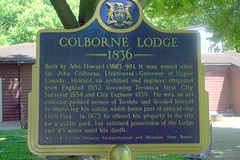
Colborne Lodge 1836 Built by John Howard (1803-90), it was named after Sir John Colborne, Lieutenant-Governor of Upper Canada. Howard, an architect and engineer, emigrated from England 1832 becoming Toronto's first City Surveyor 1834 and City Engineer 1838. He was an art collector, painted scenes of Toronto and devoted himself to improving his estate, which forms part of present-day High Park. In 1873 he offered his property to the city for a public park, but retained possession of the Lodge and 18 ha until his death.
Colborne Lodge Drive, High Park, Toronto, ON, Canada
Subjects
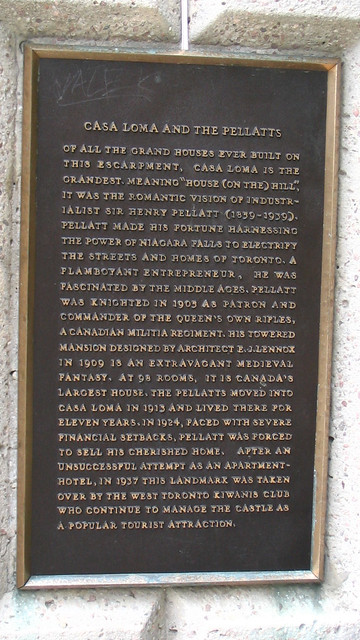
Casa Loma and the Pellatts Of all the grand houses ever built on this escarpment, Casa Loma is the grandest. Meaning "House (on the) Hill", it was the romantic vision of the industrialist Sir Henry Pellatt (1859-1939). Pellatt made his fortune harnessing the power of Niagara Falls to electrify the streets and homes of Toronto. A flamboyant entrepreneur, he was fascinated by the Middle Ages. Pellatt was knighted in 1905 as patron and commander of the Queen's Own Rifles, a Canadian militia regiment. His towered mansion designed by architect E.J. Lennox in 1909 is an extravagant medieval fantasy. At 98 rooms, it is Canada's largest house. The Pellatts moved into Casa Loma in 1913 and lived there for eleven years. In 1924, faced with severe financial setbacks, Pellatt was forced to sell his cherished home. After an unsuccessful attempt as an apartment-hotel, in 1937 this landmark was taken over by the West Toronto Kiwanis Club who continue to manage the castle as a popular tourist attraction.
Baldwin Steps, Toronto, ON, Canada
Subjects
Beaches Branch, Toronto Public Library 1916 Designed in 17th-century English Collegiate style, Beaches Branch by Kew Gardens replaced a storefront library opened in 1914 at the corner of Queen Street East and Hambly Avenue. The new building was one of three nearly identical libraries (together with Wychwood and High Park) built with a $50,000 grant to the Toronto Public Library from the Carnegie Corporation of New York. George Locke, the chief librarian, wanted the three buildings to "bring to the mind of the people of the outlying districts some recollection of their Scottish and English village type of architecture." The Toronto architecture firm Eden Smith and Sons completed the design, "a decided revolt" from the Classical styling of earlier Carnegie libraries. The brick and stone building features an upper floor modelled on a Tudor Gothic great hall. It boasts a soaring hammer-beamed ceiling, a plain stone fireplace, lead-glass casement windows, and a minstrel gallery. The west wing, built when the library was renovated and restored in 2005, replaces a 1980 addition.
2161 Queen Street East, Toronto, ON, Canada
Subjects

Casa Loma Stables In 1905 Sir Henry Pellatt purchased land which had been the private golf course of Albert Austin of nearby Spadina. The following year, anticipating construction of Casa Loma, he hired E. J. Lennox to design and build these stables, estimated to have cost $250,000. The stalls were made of Spanish mahogany and the floors were covered in tiles set in a zig-zag pattern so that the horses would not slip. When the main castle was completed, it was connected to the stables by a tunnel. Here, in 1944, in utmost secrecy, the Royal Navy placed an assembly plant for ASDIC, an early form of sonar which was vital in the battles of the Atlantic. The existence of this factory was disclosed only after the Second World War had ended.
330 Walmer Road, Toronto, ON, Canada
Subjects
Cliff Lumsdon Park Cliff Lumsdon was born April 13, 1931. By the age of eighteen, he had earned international acclaim for long distance swimming, winning the first of his four World Championships. Seven years later, he became the first swimmer to cross the icy waters of the Strait of Juan De Fuca from Victoria, British Columbia to Port Angeles, Washington. In 1949, he was awarded the Lou Marsh Trophy as the country's outstanding athlete and, in 1976, was inducted into Canada's Sports Hall of Fame. Lumsdon was inducted into the Order of Canada in 1982. Throughout his long career, Lumsdon received most of his swimming instruction from the legendary coach Gus Ryder. Lumsdon later went on to coach his daughter, Kim Lumsdon, who successfully crossed Lake Ontario on August 27, 1976. On March 1, 1988, the Municipality of Metropolitan Toronto dedicated this park in recognition of Cliff Lumsdon's many outstanding achievements and his lifelong contribution to the community. He passed away August 31, 1991.
5th Street, Toronto, ON, Canada
Subjects
Charles William Jefferys 1869-1951 Writer, artist, and illustrator of historical novels and textbooks, Charles Jefferys emigrated to Canada from England in 1879. After studying at the Toronto Art Students League, he joined the New York Herald as an illustrator in 1892, but returned to Canada in 1900 to work as a freelance artist for the Globe and the Daily Star. From 1911 to 1939 he taught drawing and painting at the University of Toronto. He painted landscapes and historical subjects across Canada, but is best known for his carefully researched drawings, such as those in his three volume Picture Gallery of Canadian History.
Medical Sciences Building, 1 King's College Circle, University of Toronto, Toronto, ON, Canada
Subjects
The College Gates These wrought iron lock-up gates were purchased by the College in 1888 for the main entrance to its newly constructed offices at 371 Bay Street, located on the south east corner of Bay and Richmond Streets in Toronto. They are the only remaining artifacts from the building which served as the College's home until 1905. The manufacturer was J.H. Pendrick who was contracted for a sum of $420 (whether this included other work is not known). The gates would have folded open to the side during the day and closed at night to discourage loitering or sleeping in the entranceway. When the building was demolished in 1960, Mr Warwick Noble, College solicitor and son of the former Registrar, Dr Robert T. Noble, rescued the gates and brought them to his country home near Norval, Ontario. The following year he suggested that they be used in the construction of the College's new building at 64 Prince Arthur. The Registrar, Dr Dawson, agreed, and had two sections lengthened in order to be mounted at the entrance to the parking lot. When the College moved to its present location in 1983, the gates were purchased by Stan Burr, a College staff member, who kept them for many years at his property in Durham. Mr Burr believed the gates should once again belong to the College and so returned them on his retirement in 1999.
80 College Street, Toronto, ON, Canada
Colonel James Givins This school bears the name of, and is located on land formerly owned by, James Givens, who came to Canada after fighting on the British side during the American Revolution. In 1791 he was commissioned in the Queen's Rangers and subsequently served as Indian agent at York from 1797. Appointed Provincial Aide-de-Camp to General Brock during the War of 1812, he was highly commended for the courageous manner in which, in command of a small band of Indians, he resisted American invaders during the attack on York in 1813. He served as Chief Superintendent of the Indian Department in Upper Canada 1830-1837. He died in March, 1846, at 87 and is buried in St. James Cemetery, Toronto.
49 Givins Street, Toronto, ON, Canada
Subjects
Central Hospital. Central Hospital was founded in 1957 in a house at 331 Sherbourne Street which had been built in 1875 for Robert T. Gooderham. The property was purchased in 1921 by the Canadian National Institute For The Blind (established in 1918) for use as a women's residence. The "Clarkewood Residence" moved to Bayview Avenue when the CNIB consolidated its operations there in 1956. The property was then purchased by doctors Paul and John Rekai, who had immigrated to Toronto from Hungary in 1950. In May 1957 they opened a 32 bed private hospital with a multilingual staff committed to providing health care to people of diverse cultural backgrounds. Their success led to the replacement of the Gooderham House with a new 176 bed public hospital that was opened in September 1969.
Sherbourne Health Centre, 333 Sherbourne Street, Toronto, ON, Canada
Church Avenue. Here, on land granted to Jacob Cummer, an early settler who came with his family from Pennsylvania in 1797, stood "Cummer's Chapel". In 1816 a Sunday school was established in his log house and camp meetings were held at his saw mill. In 1834 he gave this site for "A Place Where Divine Services Were To Be Held Forever" and a Methodist Episcopal log meeting house was built. In 1856 a yellow brick building, later Willowdale United Church, replaced the log chapel. In 1930 the front part was removed with the widening of Yonge Street and the remainder was demolished in 1956, with new church facilities being established nearby.
Yonge Street and Church Avenue, Toronto, ON, Canada
Subjects
Agincourt School School Section #14 was formed in January 1913 to serve the rapidly growing community of Agincourt. Mr. W.H. Paterson donated 1.2 hectares of land and the following year a four room brick building was erected at a cost of $12,000. Initially, only two rooms were needed so the trustees decided to offer secondary education, which had previously been available only in Markham. In 1915, Form I (Grade 9) began and Form II was added the following year. Thus Agincourt Continuation School was begun, and offered three years of secondary education by 1920. Agincourt students still travelled to Markham for their junior Matriculation until a new high school was built in 1930 on the east side of Midland Avenue. Since then, the original schoolhouse has continued to offer elementary education.
29 Lockie Avenue, Toronto, ON, Canada
Subjects
The Baldwin Steps Directly below you are the 12,000 year old shorecliffs of the great glacial Lake Iroquois, formed during the last ice age. Twenty-three meters high, this is the steepest part of the old bluffs running through the city just below St. Clair Avenue. All of Toronto below this point was once under water. An Indian trail connecting the Don and Humber Rivers wound its way along the foot of the hill. This shore line eventually became Davenport Road. These steep bluffs hampered the northward movement of early settlers. But as settlement progressed, much of the shorecliff was tamed and re-graded. A string of fine homes was built along its crest. In spite of these changes, the bluffs retained much of their imposing beauty. In 1913 a stairway was built on the Spadina Road alignment replacing an earlier wooden stairs. In recent times, this site was threatened by a proposal for a Spadina Expressway, with a tunnel beginning just below St. Clair Avenue, and exiting out of this hillside into a sweeping interchange. In 1971, the expressway was halted by the organized efforts of local residents. The Toronto Transit Commission's Spadina subway line was built deep beneath this site in 1980. The land on which the Baldwin Steps are located is now owned by the Province of Ontario and was leased back to the City of Toronto in 1984 for 99 years. The present steps were constructed by the City of Toronto in 1987 and were named to commemorate the Baldwin Family, whose land this once was.
Baldwin Steps at Davenport Road and Spadina Road, Toronto, ON, Canada

Armadale Free Methodist Church 1880 One of the earliest Free Methodist societies in Canada was established in this area at nearby Ellesmere in 1874. The first services were held in a "Meeting House" provided by Robert Loveless, a former Primitive Methodist, who was largely responsible for the organization of this congregation. Within six years another congregation had been established here at Armadale with initial services being held in the home of Silas Phoenix. The growth of the congregation led to the construction of this simple frame church in 1880. Built chiefly by volunteer labour on land acquired from Francis Underwood, this building, the oldest continuing Free Methodist place of worship in Canada, henceforth served the combined Ellsemere-Armadale congregation and stands as a tribute to the efforts of the early Free Methodists.
400 Passmore Avenue, Toronto, ON, Canada
Allen's Danforth Theatre 1919 Promoted as "Canada's First Super-Suburban Photoplay Palace", this theatre was constructed for Jule and Jay J. Allen, pioneers in the Canadian movie industry. After relocating the headquarters of Allen Theatres to Toronto in 1915, the Allen brothers quickly added 10 local theatres to their extensive Canadian chain. The Danforth Theatre - built after the completion of the Prince Edward Viaduct in 1918 - took advantage of its rapidly developing neighbourhood. Designed in modified Georgian Revival style by Hynes, Feldman & Watson, Architects, with C. Howard Crane of Detroit, the combination vaudeville and movie theatre seated 1,600. Its elegant auditorium featured wall panels of tapestry silk and richly detailed Adamesque plaster decoration. After the forced sale of many Allen theatres in 1923, the Danforth became the Century Theatre, and then The Music Hall. It is the best preserved former Allen theatre in Toronto. The symbol of its first owners, a stylized AT, can still be seen on its façade.
147 Danforth Avenue, Toronto, ON, Canada
Marshall McLuhan (1911 - 1980) a pioneer of media studies, this University of Toronto Professor became famous in the 1960s for his provocative theories about the impact of print and electronic media on human perception and behaviour. Teaching literary criticism led him to the idea that meaning was shaped by the technology of communication. His innovative work probed the influence of the printed word on society, the effects of combining print and images in advertising, and the world-wide impact of radio and television. The concepts of the "global village" and "the medium is the message" made McLuhan one of the most celebrated scholars in the Western world. [full inscription unknown]
English translation:
St. Michael’s College, University of Toronto, 6 St. Joseph Street, Toronto, ON, Canada
Subjects
Archives of Ontario In 1903, responding to public demands for an historical records repository, the Ontario government established a provincial archives under Alexander Fraser, a Toronto editor and historian. As first Archivist of Ontario, he initiated an ambitious acquisition programme and began the publication of important documents in a valuable series of annual reports. The Archives Act of 1923 directed the transfer of inactive government records to the Archives and by 1934 it had developed as a major centre for the preservation and public use of documents, maps and photographs related to Ontario. Following the Second World War and the introduction of a comprehensive government records management programme, the Archives of Ontario became one of Canada's foremost archival institutions.
134 Ian Macdonald Boulevard, York University campus, Toronto, ON, Canada
Allan A. Lamport Regatta Course On October 13, 1994, Metropolitan Toronto named the regatta course on Long Pond the Allan A. Lamport Regatta Course. Mr. Lamport's 35-year public service career included terms as Alderman and Mayor of the City of Toronto, Member of the Ontario Legislature, first Chairman of the Metropolitan Toronto Planning and Parks Committee and Chairman of the Toronto Transit Commission. In 1994, Mr. Lamport was awarded the Order of Canada. Regattas and other boating events have long been part of the Toronto Island culture. The Dominion Day Regatta was held at the Hanlan's Point Lagoon course from 1894 until about 1915 when it was moved to Long Pond. The Island Amateur Aquatic Association also hosted many social and competitive events on the islands. Allan Lamport played a key role in enlarging the regatta course at Long Pond to international competition standards when, in 1937, he was appointed to a committee studying air transportation needs. Construction of Toronto Island Airport soon followed, providing an opportunity to expand the existing regatta course to its present size of 1000 metres.
Avenue of the Island, Centre Island, Toronto, ON, Canada
Administration Building This building is one of the few surviving air terminal buildings dating from the formative years of scheduled air passenger travel. It was constructed in 1938-39 by the Toronto Harbour Commissioners to service the new Port George VI Airport, now known as the Toronto Island Airport. Geared to efficiency, it centralized passenger, baggage, and air traffic control services in a structure which was placed close to and in full view of the runway. Its horizontal massing, central projecting control tower and attractively landscaped setting are typical of air terminal buildings before the advent of jet aircraft.
Toronto Island Airport, Toronto, ON, Canada
Elizabeth Posthuma Simcoe 1766-1850 The wife of the first Lieutenant-Governor of Upper Canada, Elizabeth Posthuma Gwillim was born at Whitchurch, Herefordshire, England. Orphaned at birth, she lived with her uncle, Admiral Samuel Graves, and subsequently married his god-son, John Graves Simcoe. She accompanied her husband to Upper Canada where she travelled extensively. Her diaries and sketches, compiled during these years, provide a vivid description and invaluable record of the colony's early life. In 1794, near this site, Mrs. Simcoe and her husband erected a summer house which they named "Castle Frank" in honour of their son. Returning to England in 1796, Mrs. Simcoe devoted her later years to charitable work. She is buried beside her husband at Wolford Chapel, Devon.
Castle Frank Road, Toronto, ON, Canada
Subjects


Birthplace of Lester Pearson Lester Bowles "Mike" Pearson, scholar, diplomat and statesman, was born in his parent's home, the Wesleyan Methodist Church manse, which stood on this site in the then village of Newtonbrook, on April 23, 1897. He joined the Department of External Affairs in 1928, becoming First Secretary of the Canadian High Commission in London (1935-41) and Ambassador to the United States (1945-46). He was Member of Parliament for Algoma East and Minister of External Affairs in the government of Louis St. Laurent (1948-1957) where he was instrumental in the founding of NATO (1949) and the Korean Armistice (1953). He was President of the United Nations General Assembly (1952-53) and the architect of the UN Peacekeeping Force in Suez for which he received the Nobel Peace Prize in 1957. Elected leader of the Liberal Party in 1958, he became Prime Minister of Canada in 1963. His government (1963-68) left a legacy of reform and pioneering social legislation which included the Canada Pension Plan, universal health care, the Canada Student Loan Plan, a new Canadian flag, and the Royal Commission on Bilingualism and Biculturalism. Mr. Pearson died in Ottawa on December 27, 1972.
south-west corner of Yonge Street and Hendon Avenue, Toronto, ON, Canada
Subjects

The Beatrice Lillie Building The world renowned star of English musical comedy, Beatrice Lillie, was born May 28, 1894 at 68 Dovercourt Road. She was educated at Alexander Muir-Gladstone Public School and Loretto Academy in Toronto. At age 15 Beatrice moved to England with her family where she began a long and successful career on the London stage. In 1920 she married the great grandson of the 19th century statesman Sir Robert Peel and became Lady Peel. Beatrice Lillie's irrepressible wit and remarkable talent endeared her to audiences on both sides of the Atlantic. She became known as the darling of both Broadway and London stages appearing in more than 40 shows in a career spanning over 50 years.
1115 Queen Street West, Toronto, ON, Canada
Subjects


Christie's Methodist Cemetery Issac Christie and his wife, Isabella Graeme, came to Scarborough from Armagh, Ireland, and in 1836 purchased 40 hectares of Clergy Reserve land in Lot 33, Con. IV. This land had been rented and cleared for farming by Josué L'Amoreaux and his sons, United Empire Loyalists of French Huguenot origin, who settled here in 1808. In 1846 the Wesleyan Methodists of this area, led by Reverend T. Turner, built a small frame church amid the fields of Christie's farm. These settlers and their descendants worshipped here for 80 years. After the congregation was absorbed into the United Church in 1925, the chapel was closed. In 1936, a fire destroyed nearby St. Paul's Church and the Anglicans used Christie's Chapel until their church was rebuilt. The old chapel was closed again in 1938 and later dismantled and reconstructed at Buttonville as a community hall.
Bridlewood Mall, Warden Avenue, Toronto, ON, Canada