
Gender Diversity
The top 10



Church of St. John the Evangelist (The Garrison Church) 1858-1963 In 1858 the Anglican Church of St. John the Evangelist opened on Stewart Street to serve both the local population and the garrison stationed at the old and new forts (Fort York and Stanley Barracks). By the late 19th century, it had become a fashionable parish and the original frame structure was replaced in 1893 by a brick church on Portland Street. Designed by architect Eden Smith, the "Garrison Church" welcomed first British, then Canadian troops and their families, and met the religious needs of Toronto's militia regiments and veterans' organizations. Gradually the local residential neighbourhood was displaced by industry and the dwindling congregation could not meet the costs of maintaining the building. The church was deconsecrated and demolished in 1963. Regimental colours and other military items in the church were transferred to Canadian Forces Camp Borden.
Wellington Street West, Toronto, ON, Canada
Babe Ruth at Hanlan's Point Near this site, in Maple Leaf Park on September 5, 1914, the now legendary baseball player Babe Ruth hit his first home run as a professional. It was to be the only home run he ever hit in the minor leagues. As a 19-year-old rookie, playing for the Providence Grays in the International League, he connected with a pitch from Ellis Johnson of the Toronto Maple Leafs, sending the ball over the fence in right field and scoring three runs. Pitching for the Grays, Ruth allowed only one hit, earning the title "southside phenom" from the Toronto Daily Star. The final score was Providence Grays 9, Toronto Maple Leafs 0. Babe Ruth quickly moved up to the major leagues, and played his way to a phenomenal career. The Toronto team went on to win a total of eleven pennants before folding in 1967.
Hanlan's Point ferry dock, Toronto Island, Toronto, ON, Canada
Subjects
25 Years of Blue Jays Baseball April 7, 1977 marked the introduction of Major League Baseball to Toronto when the Blue Jays Baseball Club played their first home game. They won that memorable opener, and have since brought great excitement and entertainment to the City. Playing first at Exhibition Stadium and then at the unique SkyDome, enthusiasm rapidly grew in both players and fans alike. The Blue Jays achieved a major victory in 1985 by winning the American League East Championship. This Pennant was brought home again in 1989, and onward from 1991 until 1993. New heights were met in 1992 and 1993 when they became the American League Champions. The ultimate victory was achieved in 1992 when the Blue Jays won the World Series Championship, the first Canadian team to earn this honour. The next year the Jays followed up with their second spectacular World Series win. As the Blue Jays enter their 25th Anniversary season, the proud sports tradition continues to the call of "PLAY BALL!"
north-west corner of the foot bridge over the railway tracks from Front Street at the foot of John Street leading south to the Rogers Centre and the CN Tower, Toronto, ON, Canada
Lucius O'Brien (1832-1899) Here, from 1881 to 1887, stood the home of Lucius O'Brien, one of our foremost painters and a leader in the development of Canada'a artistic life. Born in Shanty Bay, Ontario, O'Brien practised as a civil engineer before becoming a full-time painter in 1872. His expansive light-filled water-colours and oils depicting an heroic Canadian landscape won him wide acclaim here and abroad. His most famous work, and a key painting of the era, remains the majestic "Sunrise on the Saguenay", of 1880, in that year O'Brien began a ten-year presidency of the Royal Canadian Academy of Arts which he helped to found. Later he was instrumental in the publication of "Picturesque Canada" whose 500 engravings revealed to many the variety and vastness of the young nation.
30 College Street, Toronto, ON, Canada
Subjects
Bernard Keble Sandwell (1876-1954) journalist, essayist, lecturer and academic, B.K. Sandwell is best remembered as the influential editor (1932-1951) of Saturday Night, which he made the voice of English Canadian liberalism. B.K. was a prolific writer, whose ambition was to achieve clear thinking on human problems and who was read widely for his great wit, shrewdness and grace of expression. His views on a wide range of subjects guided the options of an exclusive but important audience. In his ardent defence of civil liberties, he was ahead of his generation.
Graphic Arts Building, 73 Richmond Street West, Toronto, ON, Canada
Subjects

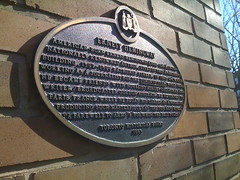
Ernest Hemingway. American-born Ernest Hemingway (1899-1961), internationally renowned author, lived in this apartment building, 1597-1599 Bathurst Street, in 1923-24, while working as a journalist for the Toronto Star. While here he became friends with novelist Morley Callaghan and writer/broadcaster Gordon Sinclair. He returned to Paris, France, where he began his career as a novelist, producing such masterpieces as "The Sun Also Rises", "A Farewell To Arms" & "For Whom the Bell Tolls".
1599 Bathurst Street, Toronto, ON, Canada
Subjects

Frances Loring and Florence Wyle. Sculptors Frances Loring (1887-1968) and Florence Wyle (1881-1968) were born in the United States mid-west. They met in 1907 while art students in Chicago, and moved to Toronto in 1913. Their home and studio near here at 110 Glenrose Avenue was a centre for artists, academics and students for 48 years. In 1918 they sculpted a series of figures of workers in the munitions industry for Canadian war memorials. Loring designed the lion, and Wyle the portrait reliefs of King George VI and Queen Elizabeth for the Queen Elizabeth Way Lion Monument, now located in Gzowski Park. The works of these colourful artists are represented in the Art Gallery of Ontario, the National Galley and the War Museum in Ottawa, and on many public and private buildings in Ontario. Their contribution is recognized, at the request of the Moore Park Residents' Association, by this park named in their honour.
corner of Mt Pleasant Road and St. Clair Avenue East, Toronto, ON, Canada
Subjects
Chapel of St. James-The-Less In its vigorous, harmonious composition, this small funeral chapel is a splendid example of High Victorian Gothic design. Its sense of strength and spirituality is derived from the subtle contrast of its stone walls, enveloping roofs, and soaring spire. The chapel was erected in 1860 to plans by Cumberland and Storm, one of Toronto's leading 19th-century architectural firms. Situated on a slight rise, St. James is enhanced by the picturesque setting of its cemetery, which was opened in 1844 and is the oldest established cemetery in the city.
Chapel of St. James-The-Less, Parliament Street, Toronto, ON, Canada
The Albany Club of Toronto The Albany Club of Toronto was established in 1882 as a conservative political club. Sir John A. Macdonald, Canada's first prime minister, strongly encouraged the creation of the club. He joined it in early 1883 and became its first honorary president in 1889. The first president was Alexander Morris, Q.C., Conservative house leader in Ontario and a former law student of Sir John A. Morris later became chief justice and Lieutenant Governor of Manitoba. The club was named after Prince Leopold, Duke of Albany, fourth son and eighth child of Queen Victoria. The club moved to 91 King Street East in August of 1898. Ten of Canada's Conservative prime ministers have been members of the Albany Club, as has every one of Ontario's ten Conservative premiers to date. Members have also held the offices of Governor General and Lieutenant Governor and have served their community, their city and their country with distinction. The club retains its conservative political affiliation. Erected to commemorate the centennial of the club's occupancy of this building.
91 King Street East, Toronto, ON, Canada
Subjects


The first Methodist church in Toronto was built upon this site in A.D.1818
Bank of Commerce Building (Jordan Street elevation), Toronto, ON, Canada

The Dominion Bank Building 1914 Founded in Toronto in 1869, The Dominion Bank moved its head office to this site ten years later. In 1914, the bank's rise to national prominence led to the construction of this early 12-storey skyscraper. Beaux-Arts in style with Renaissance Revival detailing, it boasted the city's largest vault and most elegant banking hall. The building was a major work of the leading firm, Darling and Pearson, Architects, in co-operation with Harkness and Oxley, Engineers. In 1955, a merger with the Bank of Toronto formed The Toronto-Dominion Bank. While many head office functions were relocated, a branch continued here until 2000. In 2005, the Dominion Bank Building was opened for residential use after being redesigned by Stanford Downey Architect.
1 King Street West, Toronto, ON, Canada

Gooderham "Flatiron" Building 1892 David Roberts Architect (1845-1907) designated under the Ontario Heritage act
49 Wellington St East, Toronto, ON, Canada

Leadlay Building 1872 1st Owner: Edward Leadlay, wool merchant Designated under the Ontario Heritage Act, 1986
87 Front St East, Toronto, ON M5B 1B8, Canada, Toronto, ON, Canada

Houses constructed for Columbus H. Green Barrister and Reverend Anson Green 1858 Designated under the Ontario Heritage Act
80 Gerrard Street East, Toronto, ON, Canada
.jpg?width=250)
55-79 Berkeley Street 1871, altered 1969 Constructed for John Irwin, this row of houses reflects the working-class character of this area in the late-19th century. Early tenants included labourers, machinists, and a distiller. City of Toronto Inventory of Heritage Properties.
79 Berkeley Street, Toronto, ON, Canada

Gladstone Hotel 1889. The Gladstone Hotel is the oldest continuously operating hotel in Toronto. Architect G.M. Miller designed the building in the Richardsonian Romanesque style. It features arches over the windows and porch entrances, in addition to curvilinear and animal ornamentation in stone and terracotta. The hotel was a highly visible Parkdale landmark, with its three-storey tower and a cupola (removed in the 1940s). Across the street from two railway stations (since demolished), the Gladstone Hotel frequently hosted commercial travellers, as well as exhibitors from the nearby Canadian National Exhibition. it also once accommodated long-term guests, particularly railway employees and workers in nearby factories. The hotel has been given new life by its owners over the years. Designated under the Ontario Heritage Act, 2005.
1214 Queen Street West, Toronto, ON, Canada

The Gladstone Hotel. Named after British Prime Minister Wm. E. Gladstone, this 60 room hotel was built in 1889 adjacent to the Parkdale train stations. The original owner Mrs. Susanna Robinson had been left a widow with 13 children. It was designed in a decorative Romanesque style by G.M. Miller, a distinguished Toronto architect. Its three-storey steeple dominated the skyline until the 1940’s. Accredited by the Royal Winter Fair, it was considered “the only safe place for one’s great aunt to stay alone”. It was originally used mostly by commercial travellers based in the heavy industry in the area. The building was restored by the Appelby family in 1989, in memory of their late father.
1214 Queen Street West, Toronto, ON, Canada

Canada's first subway On the 30th March, 1954, the first subway train was operated on the Yonge route of Toronto's Rapid Transit System from Eglinton Avenue to the Union Station. To record the event, this tablet was unveiled by The Honourable Leslie M. Frost Q.C., L.L.D., D.C.K., Prime Minister of Ontario.
Front St West, Toronto, ON, Canada
.jpg?width=250)
St James' Cathedral York's first church was built here in 1803-07 with the aid of public subscriptions and a government grant. That frame building was enlarged in 1818-19 and replaced by a larger one in 1831. The first incumbent was the Rev. George Okill Stuart, who served from 1800 to 1812 when he was succeeded by the Rev. John Strachan, later first bishop of Toronto. The second church was burnt in 1839. Toronto's first cathedral was then erected on this site but was destroyed in the great fire of 1849. The present cathedral was begun in 1850, opened for divine service in 1853, and completed in 1874.
106 King St East, Toronto, ON, Canada

St.George's Hall 1891 Edwards & Webster Architects designated under the Ontario Heritage Act
12 Elm Street, Toronto, ON, Canada

St.George's Hall St.George's Hall was built in 1891 by The Benevolent St.George's Society of Toronto, Edwards & Webster, Architects. Here the society carried out its work of aiding British immigrants until 1988. The Arts and Letters Club of Toronto, founded in 1908, moved into the building in 1920. At that time a baronial fireplace and choir loft were added to the great hall. The Group of Seven met here regularly, as did other leading artists, writers, musicians, theatre people, architects and supporters of the arts. A formal stage added later became the site of acclaimed annual revues. The Arts and Letters Club purchased the building in 1986 and carried out further renovations preserving the historic character of the hall.
14 Elm Street, Toronto, ON, Canada

The Royal York Hotel. This hotel stands on town lots granted in 1798 to William Dummer Powell, who built a log house on the site in 1812. Brick houses built here in 1844 by Captain Thomas Dick later became Sword's Hotel. Re-named the Queen's Hotel in 1862, it was enlarged several times before being demolished in 1927. The lot at York and Front Streets was used by a travelling circus, and, in the 1880s was the site of Alderman Harry Piper's zoo. The Royal York, opened on 11 June 1929, was the largest hotel in the British Empire and dominated the Toronto skyline for almost half a century, it was designed by the firm of Ross, Patterson, Townsend & Fish, who also added the east wing in 1959. The hotel provided Toronto's first major convention centre and has played an important role in the social life of the city. During its fifty years the Royal York has upheld the finest traditions of a grand hotel and remains the largest in the Commonwealth.
100 Front Street West, Toronto, ON, Canada
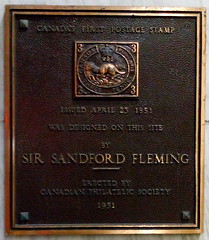
Canada’s first postage stamp issued April 23 1851 was designed on this site by Sir Sandford Fleming.
110 Yonge Street, Toronto, ON, Canada
Subjects


Queen Alexandra Gateway This stone and wrought iron structure was a gift to the Imperial Order Daughters of the Empire to commemorate the visit, on October 10 and 11, 1901 of their Royal Highnesses, the Duke and Duchess of Cornwall and York. The gateway, designed by Chadwick and Beckett, architects, originally stood on Bloor Street at the northern entrance to Queen's Park. It had to be moved twice to accommodate transportation improvements and was finally located here in 1962. The wrought iron lamps were restored in 1990 as a special project by the staff of the Faculties and Services department of the University of Toronto. The University of Toronto fully restored the gateway and the southward extension of Philosopher's Walk extending southward in 1995. A rededication ceremony was held on October 14, 1995.
Bloor Street West, Toronto, ON, Canada

The "Canada First" Movement. Originating in Ottawa, in 1868, with informal meetings of a few youthful patriots, "Canada First" was the name and slogan of a movement to promote nationalist sentiment. Its founding members were Charles Mair, Henry Morgan, William Foster, G.T. Denison and R.G. Haliburton. Two years later the movement created the North-West Emigration Aid Society to encourage British immigration. In 1874 the group, now centred in Toronto, established "The Nation", a weekly journal, entered politics as the Canadian National Association, and founded the National Club as its rallying place. By then "Canada First" had the support of such influential figures as Edward Blake and Goldwin Smith. Though the movement's political influence soon waned, its expression of a popular Canadian ideal had enduring significance.
303 Bay Street, Toronto, ON, Canada

Canadian General Electric Company Building 1908 Originally the head office of the Canadian General Electric Company, this building was designed in the Beaux-Arts Classical style by the noted architecture firm of Darling and Pearson. It was the first of three adjacent buildings constructed for the company, a nationwide manufacturer of various electrical products. Distinguishing features include white glazed terra cotta trim and the stone portico with paired columns. The classical metal cornice marks the original roofline below the sixth-floor addition.
212 King Street West, Toronto, ON, Canada
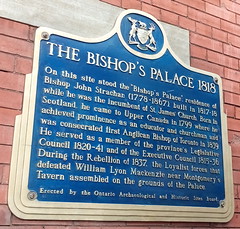
The Bishop's Palace 1818 On this site stood the "Bishop's Palace", residence of Bishop John Strachan (1778-1867), built in 1817-18 while he was the incumbent of St. James' Church. Born in Scotland, he came to Upper Canada in 1799 where he achieved prominence as an educator and churchman and was consecrated first Anglican Bishop of Toronto in 1839. He served as a member of the province's Legislative Council 1820-41 and of the Executive Council 1815-36. During the Rebellion of 1837, the Loyalist forces that defeated William Lyon Mackenzie near Montgomery's Tavern assembled on the grounds of the Palace.
150 Front Street West, Toronto, ON, Canada
Subjects

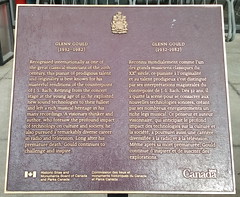
Glenn Gould (1932-1982). Recognized internationally as one of the great classical musicians of the 20th century, this pianist of prodigious talent and originality is best known for his masterful renditions of the counterpoint of J.S. Bach. Retiring from the concert stage at the young age of 32, he exploited new sound technologies to their fullest and left a rich musical heritage in his many recordings. A visionary thinker and author, who foresaw the profound impact of technology on culture and society, he also pursued a remarkably diverse career in radio and television. Long after his premature death, Gould continues to challenge and inspire. / Reconnu mondialement comme l’un des grands musiciens classiques du XXe siècle, ce pianiste à l’originalité et au talent prodigieux s’est distingué par ses interprétations magistrales du contrepoint de J.-S. Bach. Dès 32 ans, il a quitté la scène pour se consacrer aux nouvelles technologies sonores, créant par ses nombreux enregistrements un riche legs musical. Ce penseur et auteur visionnaire, qui anticipait le profond impact des technologies sur la culture et la société, a poursuivi aussi une carrière diversifiée à la radio et à la télévision. Même après sa mort prématurée, Gould continue d’inspirer et de susciter des explorations.
English translation:
250 Front Street West, Toronto, ON, Canada
Subjects


.jpg)

.jpg)


.jpg)


_plaque_-_14_Elm_St,_Toronto,_ON_M5G_1G7,_Canada.jpg)


From 1829 to 1891 the block bounded by King, Simcoe, Adelaide and John Streets, then known as Russell Square, was occupied by the buildings and grounds of Upper Canada College. This tablet was placed here on September 13th, 1929, at the time of the Centenary of the College, by old boys from all over the world. Somum Nom Animum Mutant.
Corner of King Street West and Simcoe Street, Toronto, ON, Canada

Canadian Pacific Railway Building 1913 Designed by the architecture firm Darling & Pearson, the Toronto office of the Canadian Pacific railway was one of the city's first skyscrapers, and briefly, the tallest building in the British Empire.
69 Yonge Street, Toronto, ON, Canada

Thornton-Smith Building 1921 John M. Lyle designed this limestone building for Thornton-Smith, and interior design and furniture company. In 1926, Lyle's design which features pilasters, decorative motifs, arched windows, and overhanging eaves, received the first gold medal awarded by the Ontario Association of Architects
340 Yonge Street, Toronto, ON, Canada

York Council Chambers 1907-1950 The township of York held Council meetings above this branch of the Canadian Imperial Bank of Commerce from 1907 to 1950. This plaque commemorates the 180th anniversary of the founding of the township
144 King Street East, Toronto, ON, Canada

.jpg?width=250)
The Club Bluenote was a small after-hours rhythm and blues dance hall that played a vital role in the Yonge Street music scene. Owned by Al Steiner, the club was located near here at 372 Yonge Street for about 10 years until it closed in 1969. The club was later revived twice in Yorkville by Bill Balkou, Lou Balkou, Syd Markowitz, Jack Valianes, and George Olliver. The original Club Bluenote launched the careers of Toronto artists such as Jay Jackson, Shawne Jackson, and Shirley Matthews. It supported regulars like Bobby Dean and the Gems, the Statlers, the Peepers, the Silhouettes (with Doug Riley and Steve Kennedy,) and the Five Rogues, featuring Joey Chirowski, Don Elliot, Penti "Whitey" Glan, George Olliver, and Domenic Troiano. The club was popular with well-known international artists such as Stevie Wonder, the Righteous Brothers, and the Supremes, who performed impromptu late-night sets at the club after giving concerts at major venues elsewhere in the city. The musical style that emerged at the Club Bluenote and at other Yonge Street clubs was a unique blend of rock with rhythm and blues that became characteristic of the "Toronto Sound."
372 Yonge Street, Toronto, ON, Canada

The Le Coq d'Or Tavern was one of the most popular rock'n'roll venues in Toronto in the 1950s and 1960s. Opened in the late 1940s at the heart of the Yonge Street strip, a raucous entertainment district between Queen and Gerrard Streets, the Le Coq d'Or hosted musicians such as Bo Diddley, Solomon Burke, Sam & Dave, and the Cougars, featuring Jay Douglas. Goldie and the Gingerbreads, the first all-female rock band on a major American record label, also played at the Le Coq d'Or, and Montreal band the Beau-Marks recorded a live album there. The tavern was known for its long association with Ronnie Hawkins and his band, the Hawks. The group first played the Le Coq d'Or in 1958 and later became regular performers. After separating from Hawkins, the Hawks toured and recorded with Bob Dylan, becoming the Band in the late 1960s. In 1965, Ronnie Hawkins opened the Hawk's Nest, a teenage dance club above the Le Coq d'Or that featured local acts like Mandala, the Ugly Ducklings, and the Sparrows (later Steppenwolf). Pioneering soul singer, Jackie Shane, and influential English rock band, the Kinks, also played at the Hawk's Nest. Amid declining attendance at bars and clubs on Yonge Street, the Le Coq d'Or closed in 1976.
333 Yonge Street, Toronto, ON, Canada

The Daniel Brooke Building This building was first constructed in 1833 for owner Daniel Brooke, a prominent merchant in the Town of York. It was substantially rebuilt between 1848-1849 prior to the Great Fire of April 1849 which started in a nearby stable. While much of the business district was destroyed, this building escaped major damage. It housed a variety of commercial enterprises over the years, including the prosperous wholesale grocery business of James Austin and Patrick Foy in the 1840s. Austin went on to become a president of the Consumers' Gas Company and of the Dominion Bank. His home, Spadina, became a museum in 1984. During the mid-19th century, the Daniel Brooke building contained the offices of The Patriot, an influential conservative newspaper. The block is a rare example of Georgian architecture in Toronto.
150-154 King Street East, Toronto, ON, Canada

The Canadian Bank of Commerce Building 1929-1931 Upon completion, this 34-storey skyscraper was the tallest building in the British Empire and was praised as the "greatest addition to Toronto's increasing, Manhattan-like skyline." It was designed for The Canadian Bank of Commerce jointly by the Toronto firm Darling and Pearson, and by York & Sawyer, the foremost New York City bank architects of the era. Rising in tiers, the building features richly carved Romanesque Revival detailing and a vaulted Main Banking Hall said to be modelled after Rome's Baths of Caracalla. A popular outdoor observation gallery on the 32nd floor - guarded by great carved heads with flowing beards - gave the public unobstructed city views until even taller office towers were built in the 1960s. After The Commerce merged with the Imperial Bank of Canada in 1961, the building became the head office of the Canadian Imperial Bank of Commerce.
25 King Street West, Toronto, ON, Canada

1918 Anti-Greek Riots In August 1918, over 50,000 people participated in riots that injured hundreds and caused significant property damage. Many of the rioters were veterans, already frustrated with government treatment, angered by Greece's neutrality during the First World War, and resentful of the large number of Greeks with highly visible jobs. On August 2, a mob attacked the Greek owned White City Cafe near Yonge and College Streets in response to rumours that a veteran had been roughly treated there. The mob swelled to thousands and looted Greek businesses as far west as Queen Street and Roncesvalles Avenue. Toronto police and Exhibition Camp soldiers were call to end the riot, but stood by as the violence unfolded. Criticized for their inaction, the police responded with excessive force the next night, beating demonstrators with whips and batons. The presence of additional troops, and threats to penalize public gatherings, kept tensions high in the following days. The underlying conflicts remained unresolved beyond the end of the war, but the intense violence of August 2 and 3 was not repeated.
433 Yonge Street, Toronto, ON, Canada
_plaque_-_14_Elm_St,_Toronto,_ON_M5G_1G7,_Canada.jpg?width=250)
St. Georges Hall (Arts and Letters Club) Since 1920, St. George's Hall has housed the renowned Arts and Letters Club. Founded in 1908 by a group of men involved in the arts, the Club has been a gathering place for artists and their patrons and has encouraged the organization of new artistic communities. With its long oak tables, timbered ceiling, and baronial fireplace, the Great Hall has provided a congenial setting for stimulating conversation and a venue for pageants, plays, musical evenings, and art exhibits. Filled with artwork and Club memorabilia, this building eloquently reflects the ideals and history of this important Canadian cultural institution. St. Georges Hall (Arts and Letters Club) St. George's Hall abrite depuis 1920 le célèbre Arts and Letters Club. Fondé en 1908 par des hommes désireux de promouvoir les arts, ce rassemblement d'artistes et de mécènes a favorisé l'essor d'autres organisations artistiques au pays. Avec ses longues tables de chêne, son plafond en bois et son foyer seigneurial, le grand hall offre un endroit chaleureux pour des conversations animées, des sketchs, des pièces de théâtre, des soirées musicales et des expositions artistiques. Ce bâtiment, riche en uvres d'art et en souvenirs du club, témoigne bien des idéaux et de l'histoire de cette importante institution culturelle canadienne.
12 Elm Street, Toronto, ON, Canada

J. E. H. MacDonald (1873-1932) Painter, designer, and poet, J. E. H. MacDonald was a founding member of the Group of Seven and a key figure in the emergence of a national style of painting the Canadian landscape. A talented graphic designer of Canadian motifs, he also painted the farmlands of southern Ontario, the rich autumn colours of Algoma, the shores of Nova Scotia, and the majestic Rocky Mountains. A leading member of the Arts and Letters Club, MacDonald was an idealist who fostered the growth of Canadian culture in all its manifestations and inspired a generation of students at the Ontario College of Art. J. E. H. MacDonald (1873-1932) Peintre, designer et poète, J. E. H. MacDonald fut l'un des membres fondateurs du Groupe des Sept et une figure marquante dans l'émergence d'une manière typiquement canadienne de peindre le paysage. Graphiste talentueux, réputé pour ses motifs canadiens, il a également peint les terres agricoles du sud de l'Ontario, les riches couleurs automnales d'Algoma, le littoral de la Nouvelle-Écosse et les majestueuses montagnes Rocheuses. Cet idéaliste, membre influent du Arts and Letters Club, encouragea l'essor de la culture canadienne sous toutes ses formes et inspira une génération d'étudiants à l'Ontario College of Art.
12 Elm Street, Toronto, ON, Canada