
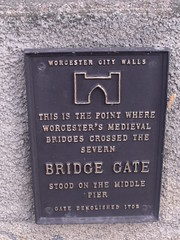
This is the point where Worcester's medieval bridges crossed the Severn Bridge Gate stood on the middle pier Gate demolished 1702
Le Vésinet Promenade, Worcester, United Kingdom
Subjects
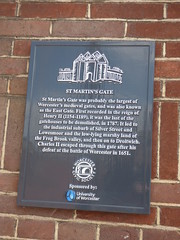
St Martin's Gate St Martin's Gate was probably the largest of Worcester's medieval gates, and was also known as the East Gate. First recorded in the reign of Henry II (1154-1189), it was the last of the gatehouses to be demolished, in 1787. It led to the industrial suburb of Silver Street and Lowesmoor and the low-lying marshy land of the Frog Brook valley, and then on to Droitwich. Charles II escaped through this gate aftr his defeat at the battle of Worcester in 1651.
Corn Market (near the end of New Street), Worcester, United Kingdom
Subjects

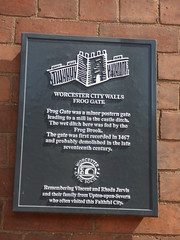
Worcester City Walls Frog Gate Frog Gate was a minor postern gate leading to a mill in the castle ditch. The wet ditch here was fed by the Frog Brook. The gate was first recorded in 1467 and probably demolished in the late seventeenth century. Remembering Vincent and Rhoda Jarvis and their family from Upton-upon-Severn who often visited this Faithful City.
Museum of Royal Worcester - Severn Street, Worcester, United Kingdom
Subjects
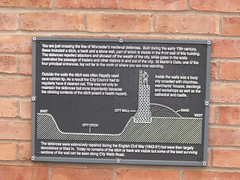
You are just crossing the line of Worcester's medieval defence's. Built during the early 13th century, these included a ditch, a bank and a stone wall, part of which is visible in the front of this building. The defences repelled attackers and showed off the wealth of the city, while gates in the walls controlled the passage of traders and other visitors in and out of the city. St Martin's Gate, one of the four principal entrances, lay not far to the north of where you are now standing. Outside the walls the ditch was often illegally used as a rubbish tip. As a result the City Council had to regularly have it cleaned out. This was not only to maintain the defences but more importantly because the stinking contents of the ditch posed a health hazard. Inside the walls was a busy city crowded with churches, merchants' houses, dwellings and workshops as well as the cathedral and castle. The defences were extensively repaired during the English Civil War (1642-51) but were then largely demolished or filled in. Today no remains of the ditch or bank are visible but some of the best surviving sections of the wall can be seen along City Walls Road.
Footbridge above City Walls Road, Worcester, United Kingdom
Subjects
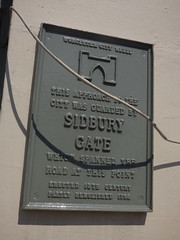
Worcester City Walls This approach to the City was guarded by Sidbury Gate Which spanned the road at this point Erected 13th century Partly demolished 1768
The King's Head - Sidbury, Worcester, United Kingdom
Subjects

Worcester City Walls Sidbury Gate Built before 1197, and demolished by public subscription in 1768. One of the main city gates, it guarded the roads to London and Gloucester. Part of the northern gate tower was rediscovered in 1907 and is presereved in the cellar below this building. After the fall of Fort Royal during the battle of Worcester, Sidbury Gate was held by the royalists allowing Charles II to escape from the city. Sponsored by John, Lorna, Anthony and James Eden
75 Sidbury, Worcester, United Kingdom