
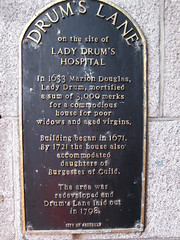
Drum's Lane on the site of Lady Drum's Hospital. In 1633 Marion Douglas, Lady Drum, mortified a sum of 3,000 merks for a commodious house for poor widows and aged virgins. Building began in 1671. By 1721 the house also accommodated daughters of Burgesses of Guild. The area was redeveloped and Drum's Lane laid out in 1798.
Upperkirkgate, Aberdeen, United Kingdom
Subjects
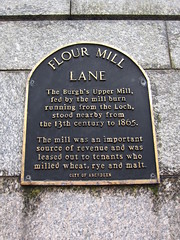
Flour Mill Lane. The Burgh's Upper Mill, fed by the mill burn running from the Loch, stood nearby from the 13th century to 1865. The mill was an important source of revenue and was leased out to tenants who milled wheat, rye and malt.
Flour Mill Lane, Aberdeen, United Kingdom
Subjects

Guestrow. A name unique to Aberdeen, but its origin is obscure. Some suggest that 'Ghaistraw' means street of spirits or ghosts. In the 17th century Ghaistrow had a number of lodging houses, the Episcopalian meeting house and Provost Skene's fine stone dwelling which stands today. Much of Guestrow, including Quaker Court, was demolished in the city's slum clearance schemes.
off Broad Street, Aberdeen, United Kingdom
Subjects

Back Wynd. This street is laid out on part of a croft which belonged to William Dunbar in 1374 and to the Blackfriars from 1398-1560. However the street itself was not formally laid out to houses until 1594. In the 17th century Back Wynd was known as Aedie's Wynd. Before the construction of Union Street Back Wynd provided access to and from the Green.
Back Wynd side of Screen in front of St Nicholas Churchyard, Aberdeen, United Kingdom
Subjects

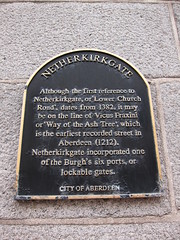
Netherkirkgate. Although first reference to Netherkirkgate, or 'Lower Church Road', dates from 1382, it may be on the line of Vicus Fraxini or 'Way of the Ash tree', which is the earliest recorded street in Aberdeen (1212). Netherkirkgate incorporated one of the Burgh's six ports, or lockable gates.
frontage of Holland Barret, Netherkirkgate, Aberdeen, United Kingdom
Subjects
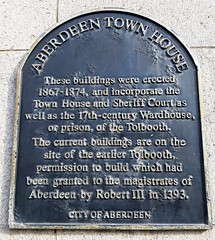
Aberdeen Town House. These buildings were erected 1867-1874, and incorporate the Town House and Sherriff Court as well as the 17th-century Wardhouse, or prison, of the Tolbooth. The current buildings are on the site of the earlier Tolbooth, permission to build which had been granted to the magistrates of Aberdeen by Robert III in 1393.
Union Street, Aberdeen, United Kingdom
Subjects
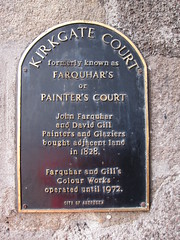
Kirkgate Court formerly known as Farquhar's or Painter's Court. John Farquhar and David Gill painters and glaziers bought adjacent land in 1628. Farquhar and Gill's Colour Works operated until 1972.
Upperkirkgate, Aberdeen, United Kingdom
Subjects
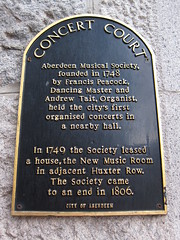
Concert Court. Aberdeen Musical Society founded in 1748 by Francis Peacock, Dancing Master and Andrew Tait, Organist held the city's first organised concerts in a nearby hall. In 1749 the Society leased a house, the New Music Room in adjacent Huxter Row. The Society came to an end in 1806.
off Broad Street, Aberdeen, United Kingdom
Subjects
Sugar House Lane. In 1776 a Sugar House was established here, where raw sugar from the Americas was refined for resale. This was one of several businesses in Aberdeen which were involved in the trans-Atlantic trade of slave-produced goods. Sugar House Lane was eventually formed in the ground which once belonged to the Sugar House Company.
Sugarhouse Lane, Aberdeen, United Kingdom
Subjects
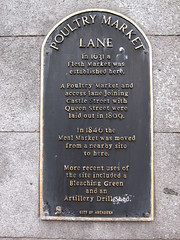
Poultry Market Lane. In 1631 a Flesh Market was established here. A Poultry Market and access lane joining Castle Street with Queen Street were laid out in 1809. In 1846 the Meal Market was moved from a nearby site to here. More recent uses of the site included a Bleaching Green and an Artillery Drill Shed.
West wall Aberdeen Arts Centre, Aberdeen, United Kingdom
Subjects
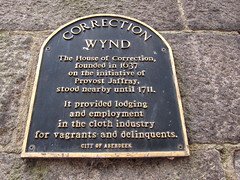
Correction Wynd. The House of Correction, founded in 1637 on the initiative of Provost Jaffray, stood nearby until 1711. It provided lodging and employment in the cloth industry for vagrants and delinquents.
Back Wynd, off Union Street, Aberdeen, United Kingdom
Subjects

Victoria Bridge. Erected following the Dee Ferry Boat Disaster, which claimed the lives of 32 people on 5 April 1876. Formally opened 2 July 1881, it was partly funded by public contribution. The link provided by the bridge allowed direct access for carriages from Torry, via Market Street, to the heart of Aberdeen.
west side of Victoria Bridge, under lamp post, Aberdeen, United Kingdom
Subjects
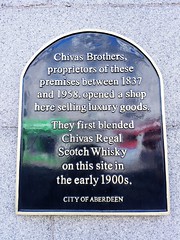
Chivas Brothers, proprietors of these premises between 1837 and 1958, opened a shop here selling luxury goods.They first blended Chivas Regal Scotch Whisky on this site in the early 1900s.
13-19 King Street, Aberdeen, United Kingdom
Subjects

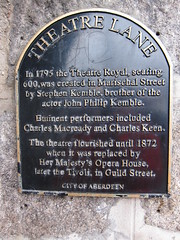
Theatre Lane. In 1795 the Theatre Royal, seating 600, was created in Marischal Street by Stephen Kemble, brother of the actor John Philip Kemble. Eminent performers included Charles Macready and Charles Keen. The theatre flourished until 1872 when it was replaced by Her Majesty's Opera House, later the Tivoli, in Guild Street.
Theatre Lane, Virginia Street end, Aberdeen, United Kingdom
Subjects


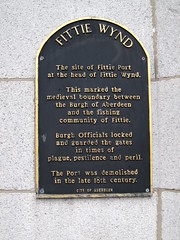
Fittie Wynd. The site of Fittie Port at the head of Fittie Wynd. This marked the medieval boundary between the Burgh of Aberdeen and the fishing community of Fittie. Burgh Officials locked and guarded the gates in times of plague, pestilence and peril. The Port was demolished in the 18th century.
Castlegate, Aberdeen, United Kingdom
Subjects
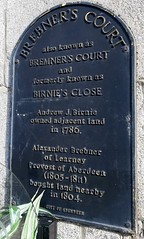
Brebner's Court also known as Bremner's Court and formerly known as Birnie's Close. Andrew J. Birnie owned adjacent land in 1786. Alexander Brebner of Learney, Provost of Aberdeen (1805-1811) bought land nearby in 1804.
Castlegate, Aberdeen, United Kingdom
Subjects
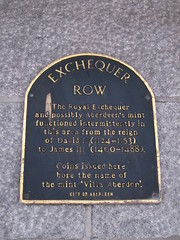
Exchequer Row. The Royal Exchequer and possibly Aberdeen's mint functioned intermittently in this area from the reign of David I (1124-1153) to James III (1460-1488). Coins issued here bore the name 'Villa Aberdon'
Exchequer Row, Aberdeen, United Kingdom
Subjects
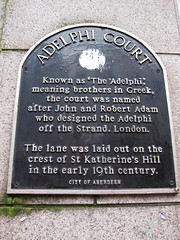
Adelphi Court. Known as 'The Adelphi' meaning brothers in Greek, the court was named after John and Robert Adam who designed the Adelphi off the Strand, London. The lane was laid out on the crest of St Katherine's Hill in the early 19th century.
off Union Street, Aberdeen, United Kingdom