
Series 'Texas Historical Marker'

Texas Historical Marker #03827
Old Union Community. Originally known as Ferguson Prairie, this settlement grew up around the property of Joseph and Hannah Ferguson who settled here about 1847. Listed on early maps it was named Ivanhoe, the community name changed following the establishment of a Union Church in 1877. The first sanctuary, a one-room structure, was also used as a community center and schoolhouse. The present building was completed in 1913. Classes were conducted here until 1935; the church continues to meet at this site. Annual homecoming memorial services are held each June. 1980 #3827
FM 3371, Old Union Community, TX, United States
Texas Historical Marker #03829
Old Walker Homestead. Texas adaptation, Greek Revival architecture. Waco-made sand brick. Built about 1853 by a father and son, James and W.C. Walker, both veterans of Battle of San Jacinto, in Texas War for Independence. First brick home, rural part of county. #3829
3401 Dever Drive, Waco, TX, United States

Texas Historical Marker #03830
Old Ward County Bank. C. E. Pierce, an early advocate of irrigated agricultural lands for the Pecos River valley, had this building constructed in 1901 to house Ward County's first bank. Never incorporated, the bank lost money due to area crop failures and closed in 1907. Constructed of red sandstone from the nearby Barstow Quarry, the building exhibits influences of the Romanesque revival style and features an interesting corner entrance. (Recorded Texas Historic Landmark, 1962.) #3830
Mackey Ave., Barstow, TX, United States
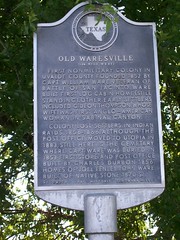
Texas Historical Marker #03831
Old Waresville. First nonmilitary colony in Uvalde County, founded 1852 by Capt. William Ware, veteran of Battle of San Jacinto. Ware built first log cabin home (still standing). Other early settlers included Gideon Thompson, whose wife was first Anglo-American woman in Sabinal Canyon. Colony lost settlers in Indian Raids, 1856-1866. Although the post office moved to Utopia in 1883, still here is the cemetery where Capt. Ware was buried in 1853; first store and post office built by Charles Durbon, 1856; homes of Joel Fenley, John Ware, built of native stone, 1870's. Recorded Texas Historic Landmark, 1966. #3831
FM 187, S of Utopia, Utopia, TX, United States
Subjects
Texas Historical Marker #03832
Old Watering Trough. One of Sudan's oldest structures. Built 1916, when Santa Fe Railway terminus here shipped out cattle of early ranches. Here ranchers watered herds and horses, traded, told yarns, hired hands. Trough also served mule teams, after the farming era began in the 1920's. Recorded Texas Historic Landmark, 1966 #3832
US 84, between Commerce & Main, Sudan, TX, United States

Texas Historical Marker #03833
Old Weather Bureau Building. This structure was completed for the Abilene Office of the United States Weather Bureau in 1909. The interior contained living quarters and an observatory for the administrator. The first official in charge here was W. H. Green, who served until 1944. Area weather services were later moved to the airport and the building was used for storage and for business school classes. The exterior features detailing of several architectural styles.
1482 N. 1st St., Abilene, TX, United States
Texas Historical Marker #03834
Old Wheeler County Jail. First jail in Panhandle of Texas. Central holding place for badmen. Built at cost of $18,500, including $1200 for a hangman's device put in to meet state requirement. Stone quarried on farm of Emanuel Dubbs, first county judge. (Recorded Texas Historic Landmark, 1965) #3834
SH 152, Mobeetie, TX, United States
Texas Historical Marker #03835
Old Wink Cemetery. Burial site of 26 persons who died during the early days of the oil boom, 1926-1929. Shifting sands over the years have erased all vestige of the graves. "We carved not a line, we raised not a stone, but left him alone" Wolfe. (1964) #3835
?, Wink, TX, United States
Texas Historical Marker #03836
Old Wurzbach Place. Built 1906 by H.F. Wurzbach, a rancher and Medina County Commissioner, 1915-1916. He planned house, featuring Colonial columns, banisters. His commissary, built 1915, served neighbors and passing stageline. Ranch was bought by E.M. Stevens Family, 1960. Recorded Texas Historic Landmark, 1967. #3836
?, Castroville, TX, United States

Texas Historical Marker #03837
Old Zapata. In 1770 residents of Revilla, Mexico, established a village (4.5 mi. W) on land granted by Jose de Escandon. The same year the Spanish built a fort nearby. In 1842 the men on the ill-fated expedition to Mier occupied the village while they foraged for supplies. First named "Habitacion," the town grew to be second largest on the Rio Grande. It was named for friendly Indians living in "carrizo" (cane) huts. In 1858, after Zapata County was created, the name changed to "Bellville" and then back to "Carrizo." In 1898 "Zapata" was chosen for Col. Antonio Zapata, a rancher executed for his part in the 1839 fight to found the Republic of the Rio Grande. Henry Redmond, a well-known area rancher, was the first county judge. Another county judge was Jose Antonio George Navarro, son of Jose Antonio Navarro, one of the two native-born signers of the Texas Declaration of Independence. The elimination of duty free trade along the border in 1903 caused an economic decline. With the coming of irrigation, a rich agricultural area developed. After the construction of Falcon Dam and the flooding of Old Zapata by lake water, the county seat was relocated at this site on land originally granted to Bartolome Cuellar and Jacinto de Cuellar. (1979) #3837
US 83, Courthouse Grounds, Zapata, TX, United States
Texas Historical Marker #03838
Oldenburg. The land in this area was included in a Mexican land grant awarded to Nathaniel Townsend in 1838. Portions of the grant were sold to a succession of different people over the years, and in 1885 August Heintze and Gus Steenken, both natives of Oldenburg, Germany, founded a community and named it after their hometown. The majority of the settlers in this area were immigrants from Germany and Bohemia. At its height Oldenburg boasted homes, farms, and a number of businesses and institutions, including stores, saloons, a cotton gin, tin shop, doctors' office, blacksmith shop, post office, church, dance halls (festplatz), and schools. The first school in the community was known as the German and Bohemian Oldenburg School. Founded in 1898, it was succeeded in 1922 by Oldenburg Common School District No.5. A separate school for black students opened about 1930. By 1944, both schools were consolidated with the Fayetteville School District. Descendants of early German and Bohemian settlers continue to reside in this vicinity. (1990) #3838
?, Oldenburg, TX, United States
Texas Historical Marker #03839
Oldest Bank in the Texas Panhandle. Second commercial bank opened in the Panhandle of Texas. Oldest in continuous service. Founded by James Christopher Paul, pupil of Sam Houston's son, lawyer Temple Houston. Early settlers throughout the High Plains area were among the first depositors. On May 6, 1927, during great oil boom, Judge Paul and associates opened a second bank, the First National. On December 31, 1942, the two merged. Many present accounts are held by heirs of early depositors. A son of Judge Paul still serves on the Board of Directors. #3839
?, Panhandle, TX, United States
Texas Historical Marker #03840
McClanahan House. Oldest business structure in Beeville, erected about 1867 on east side of courthouse square, near Poesta Creek. General store, lodging house, post office. Pioneer western style, with southern porches. Built by G.W. McClanahan, Beeville's first merchant, school teacher, postmaster, county clerk, inn keeper, Sunday School superintendent. Recorded Texas Historic Landmark, 1964 #3840
206 E. Corpus Christi St., Beeville, TX, United States

Texas Historical Marker #03841
Oldest Home in Stephenville. Built in 1869 by J. D. Berry. Native limestone; Victorian architecture distinguished by steep roof, narrow windows, filigree gingerbread trim. Purchased 1965. Restored by public donation sponsored by Stephenville Study Club to house historical museum. Recorded Texas Historic Landmark, 1967. #3841
525 E. Washington, Stephenville, TX, United States
Texas Historical Marker #03842
Oldest House. Oldest house. Only reminder of first Fort Stockton, founded 1859. Was part of old St. Gall townsite. Had thatched roof, adobe walls. Recorded Texas Historic Landmark, 1966. #3842
Sherer & Nelson St., Fort Stockton, TX, United States
Texas Historical Marker #03843
Oldest Mission in Texas. Originally founded in 1613 at Isleta Pueblo, in New Mexico, and dedicated in 1621 as San Antonio de Isleta. Removed to El Paso area, 1680 (during Pueblo Revolt), by Tigua Indians who brought along the patron saint as they accompanied fleeing Spaniards. Re-established here in 1682, it has been named successively: Sacramento de Los Tiguas de Ysleta; Corpus Christi de Los Tiguas de Ysleta (1691); San Antonio de Los Tiguas de Ysleta (1744); and Nuestra Senora Del Carmen (1874). Present chapel has walls and bells of 1744 building. Still ministers to the Tiguas. (1970) #3843
?, Ysleta, TX, United States
Texas Historical Marker #03844
Oldest Rock Building in City. Completed in 1903. 24-inch walls are made of sand and lime mix mortar. Originally used as grain and feed store. Recorded Texas Historic Landmark, 1967 #3844
Depot St., Rowena, TX, United States
Texas Historical Marker #03845
Oldham County. Formed from Young and Bexar territories; created August 21, 1876; organized January 12, 1881. Named in honor of Williamson Simpson Oldham 1813-1868; Arkansas lawyer and jurist; member of the Confederate Senate from Texas. County seat, Tascosa, 1881; Vega, since 1915. #3845
US 38, N or Vega at Canadian River, Vega, TX, United States

Texas Historical Marker #03846
Ole Pierson Homestead. Born in Norway, Ole Pierson (1804-1882) brought his family to the United States in 1853. He joined a group of Norwegians who journeyed to this area of Texas and found the land very similar to that of their native country. In 1854, eight families, including Ole Pierson's, began building their homes in what is now Bosque Country. Pierson received a grant of land from the State of Texas and later purchased surrounding tracts. Here he farmed and played a leading role in establishing the Norwegian community. The homestead remained in the Pierson family until 1939. Texas Sesquicentennial 1836-1986 #3846
?, Clifton, TX, United States

Texas Historical Marker #03847
Olin Baptist Church. Founded in 1878 by five charter members, this church originally was named Kings Chapel. It was also known as Pleasant Hill Missionary Baptist Church and as Dry Fork Church. The church deacons purchased land at this site in 1899, and when a post office for the community was granted under the name Olin, the church was renamed Olin Baptist Church. Serving the community for well over a century, this church has offered a variety of worship and educational programs and has supported both domestic and foreign missionary endeavors. #3847
?, Olin, TX, United States