
.jpg)


Spring Creek County [full inscription unknown]
Spring Creek Valley Estates, Tomball, TX, United States


Texas Historical Marker #00001
Early Community Building. Built 1877 by Charles Holman, builder-carpenter from Sweden. Stone was quarried south of town. Over the years, structure housed a school, churches, a newspaper office and a community center. It was purchased by J. E. McClelen in 1949 and restored as a private home. Recorded Texas Historic Landmark - 1969. #1
?, Seymour, TX, United States
Texas Historical Marker #00002
Isaac McCormick Cottage, "Birthplace of Hutchinson County". Built 1899 with materials hauled at great peril across the Canadian - then without a bridge. Mr. McCormick, his wife, Capitola, and eight children lived in a covered wagon and a tent while they put up their house. Home became cradle of county government when it was site of first meeting to plan separate organization of Hutchinson County (which previously had been joined to Roberts County for judicial purposes). In 1901 it was one of polling places in first county election. Moved to town, 1928; donated by Edgar Britain, 1964, for museum. Recorded Texas Historic Landmark, 1967. #2
?, Stinnett, TX, United States
Texas Historical Marker #00003
"C" Ranch House. First privately owned land in Midland area, purchased in 1883 by Nelson Morris of Chicago. Then known as the Chicago Ranch, it had the first wire fence and windmill in West Texas and world's largest herd of Black Angus cattle. Recorded Texas Historic Landmark, 1966 #3
?, Andrews, TX, United States
Texas Historical Marker #00004
El Castile (Old Waggoner Home). #4
1000 E. Main St., Decatur, TX, United States
Texas Historical Marker #00006
Kelly No. 2 Flight Line. In November 1916, Maj. Benjamin Foulois of the Aviation Section of the U.S. Army's Signal Corps chose a tract of land approximately three-fourths of a mile to the southeast of this spot to serve as a flying field for the Army Aviation Corps. In 1917, the site was named Camp Kelly and later Kelly Field in honor of Lt. George E.M. Kelly, who in 1911 had become the first American aviator to lose his life while piloting a military aircraft. Activities at the camp included both flight training and aircraft maintenance. In September 1917, Kelly Field's training activities moved north to this area, called "Kelly No. 2" to distinguish it from the original field. The new flight line, extending 125 yards east and 2400 yards west of this site, consisted of numerous hangars, warehouses, barracks, repair shops, classrooms, and maintenance buildings. "Kelly No. 2" retained its training function from 1917 through 1942. Its Air Corps Advanced Flying School produced many prominent American aviators, including Charles Lindbergh and Claire Chennault. In 1955, the advent of new and larger aircraft prompted the extension of the existing runway, this necessitating the demolition of the old "Kelly No. 2" flight line. (1986) #6
?, San Antonio, TX, United States
.jpg?width=250)
Texas Historical Marker #00007
Mission de las Cabras ("Mission of the Goats"). A fortified visita of Mission Espada, founded 1731 in San Antonio. Situated near Paso de las Mujeres ("Crossing of the Women"), an important ford on the San Antonio River, known to most parties obliged to travel between Mexico and San Antonio. Meadowland along the river and near the crossing was used to pasture cattle owned by Mission Espada. Indians under Espada's protection were kept here to herd the cattle. For the care of souls of the herdsmen, a chapel was built. The 1895 guide, "San Antonio at a Glance," described the Old Cabras site as a 2-acre, diamond-shaped lot with bastions at each end. After secularization of the missions in 1794, lands here were owned by one of the descendants of Spain's colonists from the Canary Islands, Ignacio Calvillo. In turn, the Cabras site was inherited by Calvillo's flamboyant daughter, Dona Maria Del Carmen (born in 1765). Noted for her independent spirit, she forsook her husband, Gavino Delgado, and personally managed the ranch, her long black hair flying in the wind as she rode a great white horse. She kept down Indian troubles by paying tribute in beef. In her time and for a century afterward Old Mission Cabras remained in use for rites of the church. (1970) #7
SH 97, S of Floresville, Floresville, TX, United States
Texas Historical Marker #00008
Presidio - Oldest Town in America. At confluence of Concho and Rio Grande Rivers. A settlement for over 10,000 years. Site of first recorded wagon train crossing into Texas, December [year illegible], headed by Antonio de Espejo. Marker placed jointly by Texas Society, Children of the American Revolution, Texas Society, Daughters of the American Colonists. (1961) #8
US 67 E of Marfa, Marfa, TX, United States
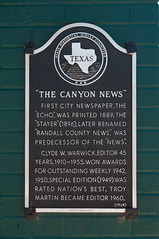
Texas Historical Marker #00010
The Canyon News. First city newspaper, the"Echo," was printed 1889. The "Stayer" (1896), later renamed "Randall County News," was predecessor of the "News." Clyde W. Warwick, editor 45 years, 1910-1955. Won awards for outstanding weekly 1942, 1950. Special Edition (1949) was rated nation's best. Troy Martin became editor 1960. (1968) #10
414 15th St., Canyon, TX, United States
Subjects

Texas Historical Marker #00011
Claude News. Established as the "Argus," Jan. 1, 1890, in the new railroad town of Claude. Later it merged with "Goodnight News" to become "Claude News." First publisher, W. S. Decker, sold paper to B. F. Hines, who sold to J. H. Hamner, in 1892. His daughter Laura V., later a foremost historian of the early great ranches of Texas Panhandle, edited the paper in this period. About 1913 Hamner sold to Spurgeon and Marvin Bishop. On Jan. 1, 1916, Thos. T. Waggoner, founder of 4 Oklahoma weeklies, bought the "News." After his death, his sons Wm. J. B. and Cecil acquired ownership, in 1950. (1969) #11
130 Trice Street, Claude, TX, United States

Texas Historical Marker #00012
The Ditch. The Vaughn Agricultural and Mechanical Canal Company was chartered in 1874 by William J. Vaughn, President; William Tipton, Director; and James H. Comstock, Director and Secretary. Major H.M. Holmes was appointed attorney. Irrigation for 2,000 acres of valley land and power for grist mills are furnished by gravity flow from San Saba River. Use of "The Ditch," running from 5 miles above town to 5 below, began in 1876. Vaughn sold his controlling interest to Gus Noyes in 1886. Since 1905 "The Ditch" has been operated by Menard Irrigation Company, using the original dam. (1972) #12
US 83 at Canal St., Menard, TX, United States
Texas Historical Marker #00013
Old Eighteen. On this site, September 29, 1835 began the strategy of the 18 Texans who by advising with alcalde Andrew Ponton, held for two days 150 Mexican Dragoons sent to demand the Gonzales cannon, allowing colonists time to mass recruits for the Battle of Gonzales. Captain Albert Martin, Almond Cottle, Jacob C. Darst, Ezekiel Williams, Winslow Turner, Simeon Bateman, Wm. W. Arrington, Joseph D. Clements, Gravis Fulcher, Almaron Dickerson, George W. Davis, Benjamin Fuqua, John Sowell, Valentine Bennet, James B. Hinds, Charles Mason, Thomas R. Miller, Thomas Jackson. #13
?, Gonzales, TX, United States
Texas Historical Marker #00014
Staked Plains. First newspaper published in Midland County. Printed in 1885 in frame building once on this site. Copies were hand-set and hand printed at rate of 5 per hour on old-style press. County court proceedings were printed at .75 cent per square inch. J. C. Rathbun was editor and publisher. (1970) #14
219 W Main St., Midland, TX, United States
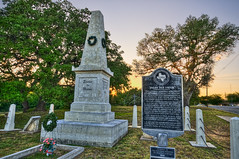
Texas Historical Marker #00015
Treue Der Union (Loyalty to the Union). This German language monument, erected 1866, honors the memory of 68 men (mostly Germans) from this region who were loyal to the Union during the Civil War. Trying desperately to reach U.S. Federal troops by way of Mexico, about 40 of the men were killed by vengeful Confederates bent on annihilating them, in the Battle of the Nueces (on Aug. 10, 1862) and a later fight (Oct. 18). The bodies of the slain and those who drowned swimming the Rio Grande were left unburied. A group of Germans gathered the bones of their friends and buried them at this site in 1865. (1968) #15
?, Comfort, TX, United States
Texas Historical Marker #00016
Weir No. 1 Oil Well. Except for the original Yates Ranch gusher of 1926, most dramatic oil discovery in Upton County. Brought in December 6, 1961. West of this site 3.5 miles. First quadruple completion of petroleum engineers the most important development of the year 1961-- and the most prolific discovery in many years. Drilled to depth of 12,432 feet. Plugged back at 9,925 feet. Produces from upper, middle and lower strawn zones, and from the bend, with perforations in lower detrital gas zone. Contractor was Brahaney Drilling Co. Discovery made by E. G. Rodman, W. D. Noel and Odessa Natural Gasoline Co., founded by Rodman and Noel, and affiliated with El Paso Natural Gas Products Co. Rodman and Noel, who began their Upton County operations in 1940, have been led in the establishment of a vast petrochemical complex in Odessa. This utilizes in the making of such things as plastics, many petroleum by-products once scrapped as waste. Such leadership and such wells as Weir No. 1 have enabled Upton County to remain for many years one of the outstanding production areas in Texas. (1964) #16
SH 329, NW of Rankin, Rankin, TX, United States
Texas Historical Marker #00017
8 Medallions on Officers' Row Quarters. -- #17
?, Brackettville, TX, United States