

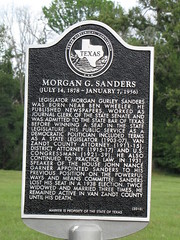
Texas Historical Marker #16591
Morgan G. Sanders. Legislator Morgan Gurley Sanders was born near Ben Wheeler. He published newspapers, worked as journal clerk of the state senate and was admitted to the State Bar of Texas before winning a seat in the state legislature. His public service as a democratic politician included terms as a state legislator (1903-07), Van Zandt County attorney (1911-15), district attorney (1915-17) and U.S. Congressman (1921-39); he also continued to practice law. In 1931, Speaker of the House John Nance Garner appointed Sanders to his previous position on the powerful ways and means committee. Sanders lost his seat in a 1938 election. Twice widowed and married three times, he remained active in Van Zandt County until his death. #16591
5300 FM 858, Ben Wheeler, TX, United States
Subjects

.jpg)


Texas Historical Marker #16599
Gonzales-San Antonio Road. Shortly after he established his colony along the Guadalupe River in 1825, Green Dewitt ordered that a road be built between his capital city, Gonzales, and San Antonio. Byrd Lockhart surveyed the road and opened it in 1827. Eighty miles long and running past three watering holes, settlers and Mexicans used it for travel and trade, though the presence of native groups in the area made traveling dangerous. Mile markers were carved into oak trunks along the route. During the Texas War for Independence, Stephen F. Austin, William B. Travis, and Jim Bowie used the road, as did the Immortal 32, who marched from Gonzales to the Alamo. Santa Anna also marched his army along it after the battle of the Alamo. #16599
?, , TX, United States
Texas Historical Marker #16614
Bell Fountain Cemetery SUPPLEMENTAL PLAQUE. #16614
?, DeBerry, TX, United States
Subjects
.jpg?width=250)
Texas Historical Marker #16615
Dove Community. The 1843 Bird's Fort Treaty between the Republic of Texas and several Native American tribes opened this area for new immigrants. In the ensuing years, a number of families from Platt County, Missouri and other parts of the United States migrated to this area and established the Cross Timbers community (now Grapevine). In February 1846, residents living on the northern edge of the community organized the Lonesome Dove Baptist Church in the fall of that year. In 1847, members built a long log structure approximately four miles northwest of Grapevine in the Eastern Cross Timbers. The Lonesome Dove School also began in 1846, and the Rev. John Allen Freeman served as schoolteacher as well as church pastor for ten years. In 1849, the state legislature created Tarrant County, with Birdville as county seat, and the U.S. Army established Fort Worth as a frontier fort. The small village of Dove developed by the 1870s. A general store and post office operated at the intersection of Dove and Lonesome Dove roads, and the community became a prosperous farming center for cotton, melon and dairy production. Included as part of the community were Lonesome Dove Cemetery just north of the church site, the Dove Branch swimming hole, used for recreation as well as baptisms, and Dove School, which consolidated with other area schools to form the Carroll Common School District in 1919. The federal government completed Lake Grapevine in 1952, requiring a number of families to relocate from the northern portion of the Dove Community. In 1979, the City of Southlake annexed Dove, but evidence of the early area community remains. (2006) #16615
?, Southlake, TX, United States
Texas Historical Marker #16619
Site of the Mission San Jose de Los Nazonis. Established by Franciscan missionaries in 1716 with the hope of civilizing and Christianizing the Nazoni and Nadaco Indians - abandoned temporarily in 1719 due to French incursions from Louisiana - restored by the Marquis of Aguayo in 1721 - removed to the Colorado River in 1730 - finally reestablished on the San Antonio River as Mission San Juan Capistrano in 1731 #16619
?, Cushing, TX, United States
Texas Historical Marker #16627
Sycamore Cemetery An 1845 land grant brought pioneers to this area and it is believed that at least some of the graves here marked with only a rock or a post are from those early years of settlement. The oldest dated gravestone is that of a 13-year-old boy, J.I. Jones (1872-1885). Honored in this burial ground are veterans of the Civil War, World War I, World War II, Korea and Vietnam, alongside the citizens that settled this area and have contributed to its history and development. The Sycamore Cemetery continues to serve the community and is maintained and care for by an association through the donations of descendants. Historic Texas Cemetery-2000 #16627
?, , TX, United States
Subjects
Texas Historical Marker #16628
Duncan Cemetery Also known as Flour Bluff Cemetery, this burial ground has always been open to the public. It was established in 1908 as part of a land purchase made by Edward Sidney Duncan (1868-1940) and Minerva Ellen Duncan (1877-1921). Earlier burials may exist here, but records show that the oldest documented grave is that of Mrs. N.F. Stigner. Her gravestone, recording her January 3, 1909, death, was stolen many years ago. Veterans of World War I, World War II, and the Korean and Vietnam Wars are buried here, as are generations of families who have contributed to the development of Corpus Christi and Nueces County. Historic Texas Cemetery-2000 #16628
2400 Debra Lane, Corpus Christi, TX, United States
Subjects
Texas Historical Marker #16629
Old Bayview Cemetery Established 1845 Historic Texas Cemetery-2002 #16629
?, Corpus Christi, TX, United States
Subjects
Texas Historical Marker #16630
Black Education in Orange County As early as the 1870s, Orange County's African American children attended school in private homes and churches. The Orange County commissioners established 17 school districts in 1887. Schools included the Duncan Woods No. 3, located in the Duncan Woods community of southwestern Orange County. The school had probably been in operation for several years at that time. Thomas F. Pollard served as an early teacher there. Students within the city of Orange attended school at Mount Zion Baptist and then Salem Methodist Episcopal Colored Church in the 1880s. Under the leadership of teacher A.J. Criner, the school later moved to the United Brotherhood Friendship Hall. S.R. Pickney served as principal for 13 years, and during his tenure the school moved into a two-story frame structure, which became the Orange Colored School. It was renamed in 1930 in honor of educator and Tuskegee Institute President Russa Moton and again in 1946 for longtime Orange teacher and principal Emma Henderson Wallace. Moton Elementary and High School, which later occupied a three-story brick structure, was known for its beautiful campus and won acclaim for its sports and band programs. The district included schools for several hundred African American students and continued to build new facilities up until integration in 1966. It utilized Franklin Elementary, built in 1958, and North Junior High School, opened in August 1964, only for a short while. Although most of the former African American campuses were phased out of use, the district, which became the West Orange Cove Independent School District, converted the North Junior High campus into a learning center. (1988, 2004) #16630
Turret Ave at Second St., Orange, TX, United States
Texas Historical Marker #16632
Dr. Peter Gunsolus (REPLACEMENT). A native of New York, Dr. Peter Gunsolus came to this area in the 1850s after first living in Illinois and Missouri. He lived and practiced medicine in Shackelford, Parker, and Stephens counties. Gunsolus eventually settled here on Duck Creek, which was later renamed in his honor, and here he was a valuable member of the community. During the 1980s, a local historian led a movement to educate the public on the correct and original spelling of Gunsolus Creek, after the spelling had changed through the years. This action helped to emphasize the important role that Gunsolus Creek has played in Breckenridge history as the site of social, religious, and civic activities. #16632
?, Breckenridge, TX, United States
Subjects
Texas Historical Marker #16638
Snyder Cemetery Established 1891 Historic Texas Cemetery-2001 #16638
?, Snyder, TX, United States
Subjects

Texas Historical Marker #16639
Smith Cemetery In 1846, Mary M. "Polly" Long received 640 acres in this area from the State of Texas. She deeded half to her son, Richard B. Long, in 1852. He sold this tract in 1881, reserving one acre to preserve the existing cemetery, which was used as early as 1857 by local settlers, many of whom were Long's relatives or neighbors. The earliest marked grave dates to 1862. The cemetery takes its name from the numerous members of the Smith family buried here. Other graves include those of "Polly" Long, early County Commissioner William Green, and Civil War veterans F.Y. Smith and James Dark. Historic Texas Cemetery #16639
West Cumberland Road, Tyler, TX, United States
Subjects
Texas Historical Marker #16640
Union Grove Cemetery On Sept. 25, 1887, local residents met in the Old Stone Schoolhouse to organize Union Grove Missionary Baptist Church with 12 charter members. In 1905, T.W. and Laura Marshall, and J.J. and Mattie Suber donated land to trustees Arthur O'Neal and L.C. Shuttlesworth for the church and cemetery. The oldest marked graves, for Jesse Richard Thompson and Mary Ann (Worley) Richardson, date to 1904. Other burials include those of Confederate veterans Albert Green Pullium (d. 1918) and veterans of World Wars I and II, and the Korean Conflict. The present church building dates to 1924. A cemetery association formed in 1972 oversees maintenance and homecoming activities on the Sunday of Memorial Day weekends. Recent changes to the historic cemetery include a pavilion and enlargement of the property with an additional donation of land. For more than a century, families and local residents have gathered here to remember, to worship, to pay respects to those of the past and to visit with loved ones. Union Grove Cemetery serves as an important historical reminder of the role churches and burial grounds play as centers of rural communities. Historic Texas Cemetery-2004 #16640
20550 FM 15, Troup, TX, United States
Subjects
Texas Historical Marker #16641
Bull Hill Cemetery This graveyard, one of the oldest in Falls County, was used for the interment of African Americans for more than a century. James Coryell, an Anglo frontiersman killed in 1837, may be on of the earliest burials. Bull Hill became the burial ground for the enslaved African Americans from the Churchill Jones plantation. Jones arrived in 1849 from Conecuh County, Alabama with nearly 60 enslaved African Americans and established a 28,000 acre plantation encompassing the former Sarahville de Viesca settlement. After emancipation, African American freedmen from the China Grove community continued to use Bull Hill to inter their deceased. The cemetery is one of the surviving vestiges of the China Grove community. About 1880, members of the Bailey, Broadus, Curry, Johnson, Mozee, Paul, Sneed, Stokes, Taylor, Tomlinson and Travis families formed this vibrant Freedman's community. Community members established the China Grove African Church, later renamed the China Grove Baptist Church, and built a school for their children. Many enslaved African Americans were brought to this area from Alabama by the Jones, Tomlinson and Stallworth families. Newly freed African Americans often remained in the area working as tenant farmers. Several families acquired land and some started businesses. The last burial in Bull Hill was in 1961. Recent archaeological, archival and oral historical research has helped reconstruct and preserve its history. Archaeology has confirmed oral history testimony stating there were more than 100 burials in Bull Hill. Grave marker materials include native stone, brick, concrete, marble, granite, metal and wood. Today, Bull Hill Cemetery remains a hallowed place and a vital link to the area's rich African American heritage. Historic Texas Cemetery - 2009 #16641
?, Cedar Springs vicinity, TX, United States
Subjects
Texas Historical Marker #16644
Weslaco City Cemetery. THE CITY OF WESLACO, NAMED FOR THE W. E. STEWART LAND COMPANY, WAS FOUNDED IN DECEMBER 1919. IN 1921, THE CITY ESTABLISHED A CEMETERY HERE, OUTSIDE THE ORIGINAL TOWNSITE. THE FIRST GRAVE IS THAT OF REUBEN W. WARREN (d. 1921). ALSO BURIED HERE ARE WESLACO CITY FOUNDERS EDMOND COOPER COUCH (1876-1944) AND ROBERT LEE REEVES (1871-1938). H.E. BENNETT PLATTED THE BURIAL GROUND IN 1922, AND HE PLATTED AN ADDITION IN 1926. THROUGHOUT THE CEMETERY, GRAVE MARKERS INDICATE MILITARY SERVICE AND FRATERNAL ORGANIZATION MEMBERSHIP. THE CITY OF WESLACO MAINTAINS THE BURIAL GROUND OF MORE THAN 6,000 GRAVESITES. #16644
?, Weslaco, TX, United States
Texas Historical Marker #16647
Nelson Grove Cemetery. #16647
?, Gainesville, TX, United States
Subjects
Texas Historical Marker #16651
Shiner Brethren Cemetery established 1890 Historic Texas Cemetery-2002 #16651
?, Shiner, TX, United States