
10 out of 11 (90%) plaques have been curated
10 subjects all or unphotographedGender Diversity
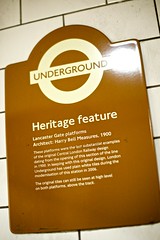
Lancaster Gate platforms Architect Harry Bell Measures , 1900 These platforms were the last substantial examples of the original Central London Railway design dating from the opening of this section of the line in 1900. In keeping with this original design, London Underground has used plain white tiles during the modernisation of this station in 2006. The original tiles can still be seen at high level on both platforms, above the track.
Lancaster Gate, Bayswater Road, London, United Kingdom
Subjects
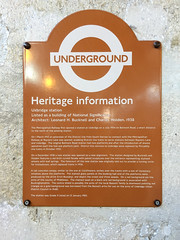
Uxbridge Station Listed as a building of National Significance Architect: Leonard H. Bucknell and Charles Holden, 1938 The Metropolitan Railway first opened a station at Uxbridge on 4th July 1904 on Belmont Road, a short distance to the north of the existing station. On 1 March 1910 an extension of the District line from South Harrow to connect wth the Metropolitan Railway at Rayners Lane was opened, enabling District line trains to serve station between Rayners Lane and Uxbridge. The original Belmont Road station had two platforms and after the introduction of shared operation each line had one platform each. District line services to Uxbridge were replaced by Piccadilly line trains in October 1933. On 4 December 1938 a new station was opened on a new alignment. The station designed by Bucknell and Holden features a red brick curved facade with paired sculptures over the entrance representing stylised wheels with leaf springs. The forecourt of the new station was originally laid out to provide a turning circle for trolleybuses, which prefaced trams in 1936. A tall concrete canopy, similar to the one at Cockfosters, arches over the tracks with a a row of clerestory windows above the platforms. The stained glass panels at the booking hall end of the platforms were produced by the artist Ervin Bossanyi, and depict the crown and three seaxes. On a red background are the arms of the county of Middlesex. The chained swan on a black and red background is associated with Buckinghamshire. The centre shield is possibly the arms of the local Bassett family (a downward pointing red triangle on a gold background was borrowed from the Bassett arms for use on the arms of Uxbridge Urban District Council in 1948). The station was Grade II listed on 12 January 1983.
High Street, Uxbridge, United Kingdom
Subjects

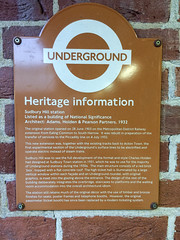
Sudbury Hill station Listed as a building of National Significance Architect: Adams, Holden & Pearson Partners, 1932 The original station opened on 28 June 1903 on the Metropolitan District Railway extension from Ealing Common to South Harrow. It was rebuilt in preparation of the transfer of services to the Piccadilly line on 4 July 1932. This new extension was, together with the existing tracks back to Acton Town, the first experimental section of the Underground’s surface lines to be electrified and operated electric instead of steam trains. Sudbury Hill was to see the full development of the format and style Charles Holden had designed as Sudbury Town station in 1931, which he was to use for the majority of Underground stations during the 1930s. The main structure consists of a red brick ‘box’, topped with a flat concrete roof. The high ticket hall is illuminated by a large vertical window within each facade and an Underground roundel, with original graphics, is inset into the glazing above the entrance. The design of the rest of the building deliberately integrates the overbridge, staircases to platforms and the waiting room accommodation into the overall architectural idiom. The station still remains much of the original decor with the use of timber and bronze finishes for seats, poster frames and telephone booths. However, the original passimeter (ticket booth) has since been replaced by a modern ticketing system.
Greenford Road, London, United Kingdom
Subjects
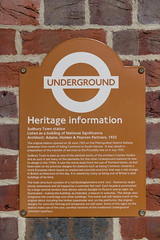
Sudbury Town station Listed building of National Significance Architect: Adams, Holden & Pearson Partners, 1932 The original station opened on 28 June 1903 on the Metropolitan District Railway extension from Ealing Common to South Harrow. It was rebuilt in preparation of the transfer of services to the Piccadilly line on 4 July 1932. Sudbury Town seen as one of the seminal works of the architect Charles Holden and as such it set many of the elements for the other Underground stations he was to design in the 1930s. It saw the move away from the use of Portland stone, as had been seen on his previous designs for stations such as Ealing Common, towards a more European idiom based on unadorned concrete and brick that was a real change in British architecture of the day. It is viewed by many many as being one of Britain’s best buildings of the time. The main structure consists of a red Buckinghamshire brisk ‘box’, flanked by single storey extension and all topped by concrete flat roof. Each facade is punctuated by a large vertical window that allows natural daylight to flood in and at night, be illuminated - making the building, as intended, a beacon in suburbia. The design also integrates the overbridge and other buildings. The ticket hall still retains much of the original decor including the timber passimeter and, on the platforms, the original designs for concrete fencing and lampposts are still used. Some of the signs on the station make use of the rare, serrifed variation of the traditional Underground Johnstone typeface.
Station Approach, London, United Kingdom
Subjects
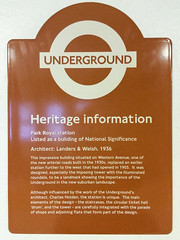
Park Royal station Listed building of National Significance Architect: Landers & Welsh, 1936 This impressive building situated on Western Avenue, one of the arterial roads built in the 1930s, replaced an earlier station further to the west that had opened in 1905. It was designed, especially the imposing tower with the illuminated roundels, to be a landmark showing the importance of the Underground in the new suburban landscape. Although influenced by the work of the Underground’s architect, Charles Holden, the station is unique. The main elements of the design - the staircases, the circular ticket hall ‘drum’, and the tower - are carefully integrated with the parade of shops and adjoining flats that form part of the design.
Western Avenue, London, United Kingdom
Subjects
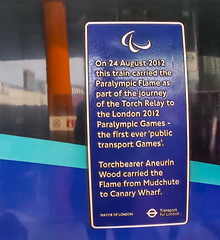
On 24 August 2012 this train carried the Paralympic Flame as part of the journey of the Torch Relay to the London 2012 Paralympic Games - the first ever 'public transprt Games'. Torchbearer Aneurin Wood carried the Flame from Mudchute to Canary Wharf.
Docklands Light Railway (on train 136), London, United Kingdom
Subjects
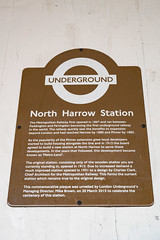
North Harrow Station The Metropolitan Railway first opened in 1863 and ran between Paddington and Farringdon becoming the first underground railway in the world. The railway quickly saw the benefits to expansion beyond London and had reached Harrow by 1880 and Pinner by 1885. As the popularity of the Pinner extension grew local developers started to build housing alongside the line and in 1912 the board agreed to build a new station at North Harrow to serve these developments. In the years that followed, this development became known as 'Metro-land'. The original station, consisting only of the wooden shelter you are currently standing in, opened in 1915. Due to increased demand a much improved station opened in 1931 to a design by Charles Clark, Chief Architect for the Metropolitan Railway. This forms the current station which remains true to the original design. This commemorative plaque was unveiled by London Underground's Managing Director, Mike Brown, on 20th March 2015 to celebrate the centenary of this station.
Station Road, Harrow, United Kingdom
Subjects
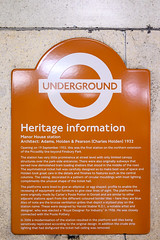
Manor House station Architect: Adams, Holden & Pearson (Charles Holden) 1932 Opening on 19 September 1932, this was the first station on the northern extension of the Piccadilly line beyond Finsbury Park. The station has very little prominence at street level with only limited canopy structures over the park-side entrances. There were also originally subways that served now demolished tram loading shelters designed so to make best use of space and Holden took great care in the details and finishes to features such as the central columns. The ceiling, decorated in a pattern of circular mouldings with inset lighting, compliments the unusual shape of the ticket hall. The platforms were lined to give an elliptical, or egg shaped, profile to enable the recessing of equipement and furniture to give clear lines of sight. The platforms tiles were originally made by Carter's Poole Potter in Dorset and are similar to other adjacent stations apart from the different coloured border tiles - here they are blue. Also of note are the bronze ventilation grilles that depict a styalised play on the station name. These were designed by Harold Stabler R.D.I., a notable artist and designer, who was eleected a "Royal Designer for Industry" in 1936. He was closely connected with the Poole Pottery. In 2006 a modernisation of the station resulted in the platform wall tilies being sensitively replicated according to the original design. In addition the crude strip lighting that had disfigured the ticket hall was removed.
Seven Sisters Road, London, United Kingdom
Subjects
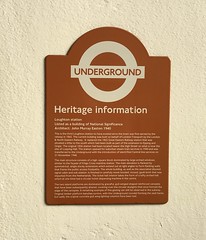
Loughton Station Listed as a building of National Significance Architect: John Murray Easton 1940 This is the third Loughton station to have existed since the town was first served by the railway in 1865. The current building was built on behalf of London Transport by the London & North Eastern Railway. It replaced the 1865 Great Eastern railway station that was situated a little to the south which had been built as part of the extension to Epping and Ongar. The original 1856 station had been located nearer the High Street on what is now the site of Looping Hall. The station opened for suburban steam train services in 1940 and was transferred to the Underground with the introduction of electrified Central line services on 21 November 1948. The main structure consists of a high, square block dominated by large arched windows, similar to the facade of Kings Cross mainline station. The main elevation is flanked by symmetrical, single-storey extensions which extend out at right angles to form flanking walls that frame the public access footpaths. The whole building, as well as the associated disused signal cabin and sub-station, is finished in carefully monk bonded, incised, gault brick that was imported from the Netherlands. The ticket hall interior takes the form of a lofty arched hall which at one time had a circular ticket dispensing machine in the centre. The two island platforms are dominated by graceful, gull-wing shaped reinforced canopies that have been subsequently altered, covering over the circular skylights that once formed the edge of the canopies. A remaining example of this glazing can still be observed in the subway. Original timber platform benches survive, with Underground roundel forming the seat backs, but sadly the original concrete gold wing lighting columns have been lost.
Station Road, London, United Kingdom
Subjects

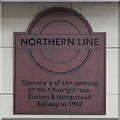
Northern Line Centenary of the opening of the Charing Cross, Euston & Hampstead Railway in 1907
Belsize Park Underground Station, Haverstock Hill, London, United Kingdom