
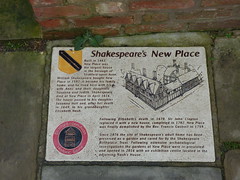
Shakespeare's New Place Built in 1483, New Place was the largest house in the borough of Stratford-upon-Avon. William Shakespeare bought New Place in 1597. It became his family home, and he lived here with his wife Anne and their daughters Susanna and Judith. Shakespeare died at New Place in April 1616. The house passed to his daughter Susanna Hall and, after her death in 1649, to his granddaughter Elizabeth Nash. Following Elizabeth's death in 1670, Sir John Clopton replaced it with a new house, completed in 1702. New Place was finally demolished by the Rev. Francis Gastrell in 1759. Since 1876 the site of Shakespeare's adult home has been preserved as a garden and cared for by the Shakespeare Birthplace Trust. Following extensive archaeological investigations the gardens at New Place were re-presented and opened in 2016 with an exhibition centre located in the adjoining Nash's House.
Shakespeare's New Place, Chapel Street, Stratford-upon-Avon, United Kingdom
Subjects


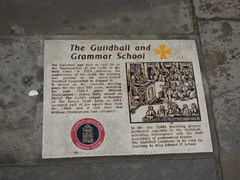
The Guildhall and Grammar School The Guildhall was built in 1417-20 as the headquarters of the Guild of the Holy Cross. In 1553 following the suppression of the Guild, the building was granted to the newly-formed Stratford Corporation by Edward VI. It served as the council's meeting place for the next 300 years, including the year 1568-9 when William Shakespeare's father, John, served as Balliff. The Guild's school, re-founded as The Kyng's Newe Scole in 1553, occupied part of the upper floor from the 1560s and it was here that William Shakespeare was eduated. In the late 1500s travelling players performed regularly in the Guildhall providing Shakespeare with his first experience of professional theatre. The Guildhall continues to be used for teaching by King Edward VI School.
The Guildhall and Grammar School - Church Street, Stratford-upon-Avon, United Kingdom
Subjects

The home of Judith Quiney, Shakespeare's daughter Artists impression of the house in Shakespeare's day Behind the early 20th facade to No. 1 High Street lies an important. timber-framed building, which may well date back to the 1440s. For a time it was known as the 'Cage', perhaps because a temporary lock-up was attached to it. It belonged to the Stratford Corporation and in the summer of 1616 was leased to Thomas Quiney, who had married William Shakespeare's younger daughter, Judith, earlier that year. Quiney was a vintner - or wine merchant - by trade and ran his business from this prime corner site for at least twenty years. The couple's first child, Shakespeare, died in infancy, in 1617, followed by their other two sons, unmarried, within a month of each other in 1639 The building has been refronted on at least three occasions, most recently in 1923, but the original timber frame survives basically Intact. The building is now administered by the Stratford Town Trust.
High Street, Stratford-upon-Avon, United Kingdom
Subjects


The Almshouses The Guild of the Holy Cross has been providing almshouses for its sick and aged members from at least 1405, but these were replaced around 1505 by the present range, funded by a generous bequest to the Guild by Stratford-born Thomas Hannys. At the time of his death he was a prosperous London mercer. In 1553, the almshouses were made over to the town authorities, with an obligation to provide rent-free accommodation for twenty-four almsfolk. Over the years this orderly arrangement came under pressure and in 1911 the census recorded thirty-six inhabitants squeezed into twenty-four units. In 1902/3 a layer of stucco was removed to expose the original timber framing. In 1982-4, after further restoration and an extension at the rear, the number of units in the original range was reduced to sixteen. In 1837, the management of the almshouses was vested in the Municipal Charities of Stratford-upon-Avon, They renamed Guild Cottages in 2009.
The Almshouses - Church Street, Stratford-upon-Avon, United Kingdom
