
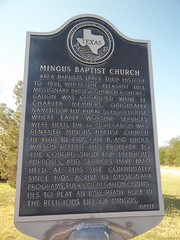
Texas Historical Marker #03395
Mingus Baptist Church. Area Baptists trace their history to 1891, when the Pleasant Hill Missionary Baptist Church congregation was organized with 14 charter members. Originally named for the rural schoolhouse where early worship services were held, the congregation was renamed Mingus Baptist Church in 1900. In 1905, Guy B. and Lucile Wilson deeded this property to the congregation for religious purposes, and services have been held at this site continually since 1906. Active in missionary programs, the congregation continues to play an important role in the religious life of Mingus. (1992) #3395
?, Mingus, TX, United States

Texas Historical Marker #03396
Minter's Chapel Cemetery. Soon after lay Minister Green W. Minter (1803-1887) moved here about 1854, he helped organize Minter's Chapel Methodist Church. His son-in-law James Cate set aside 4.1 acres here for a church and burial ground. The earliest marked grave is that of A.M. Newton in 1857. Many tiny graves indicate a high child mortality rate. The early log meetinghouse was replaced in 1882 by a frame structure. In 1967 the Dallas-Fort Worth Regional Airport acquired the land, except for this 1.5-acre cemetery, and the church was relocated. (1979) #3396
W. Airfield Dr., Grapevine, TX, United States

Texas Historical Marker #03397
Minters Chapel Methodist Church. Four pioneer area families established this congregation about 1854. Early services were conducted in a log cabin on land donated by James Cate for the church, a school and a cemetery. The congregational name was chosen in honor of the Rev. Green Washington Minter (1803-87), who was instrumental in the founding and early growth of the fellowship. Despite hardships, the church became a focal point of the community it served. It was moved here in 1967 when the original location was included within boundaries of the Dallas-Fort Worth Regional Airport. (1982) #3397
4344 Heritage Avenue, Grapevine, TX, United States

Texas Historical Marker #03398
Miriam A. Ferguson Birthplace. A five-room log cabin on this land was the home of Miriam A. Wallace (1875-1961) from her birth until her marriage to James E. Ferguson in 1899. After her husband had been twice elected governor, Mrs. Ferguson became the first woman elected governor of any state. She served two terms, from 1925 to 1927 and from 1933 to 1935. The property was inherited by Mrs. Ferguson and about 1917 was mortgaged to support her husband's political career. The home was destroyed by fire in 1926. (1967) #3398
?, Sparks, TX, United States
Texas Historical Marker #03399
Mission Nuestra Senora del Rosario. (Mission Our Lady of the Rosary) Founded in 1754 for the Cujane Indians. Capt. Manuel Ramirez de la Piszina, commander of nearby Presidio la Bahia, named this mission for his parish church in Spain, and Fray Juan Dios Camberos ministered to the first converts here. The Indians were taught crop-raising. In the years following, much livestock, including 30,000 head of cattle, belonged to Rosario. But these, along with Indian land at the mission, had to be surrendered later to the Spanish crown. In 1807 Rosario was permanently abandoned and its lands were distributed to Spanish settlers. (1969) #3399
?, Goliad, TX, United States
Texas Historical Marker #03400
Miss Clara Bussell. Joined staff, West Texas Chamber of Commerce February 26, 1920; was office manager 40 years. Worked unselfishly through day of death. Her love for West Texas and dedication to W. T. C. ideals did much to develop regional progress. Devoted life to making West Texas a better place to live. Outstanding Women of Texas Series, 1967. #3400
706 N. Cedar St., Abilene, TX, United States
Subjects
Texas Historical Marker #03401
Miss Mae Murfee. Pioneer Lubbock teacher; prominent civic and church leader. Born in Haskell County; daughter of J. E. and Sarah Murfee. First taught in Lubbock County schools in Slide community, 1905; was principal there. Entered Texas Woman's University 1909; earned degree; did graduate work later. Was first woman principal of Lubbock Junior High in 1914. With her own books, she began city's first high school library, 1916; head of Lubbock High School History and Government Department many years; obtained state credits for these and other courses. Introduced visual aids, buying her own equipment; made other innovations. She worked to bring Texas Tech to Lubbock, 1925. As county superintendent of education, 1928 to 1936, she standardized all schools. Her resolute philosophy was: "Every boy and girl may be saved to useful citizenship if the right person is there at the right time...the parent or the teacher". Active in Texas Federation of Women's Clubs, historical groups and other endeavors, she gave talents to public service throughout lifetime (Aug. 21, 1888-Dec. 31, 1965). This school is named in her memory. 1969 #3401
6901 Nashville Drive, Lubbock, TX, United States
Texas Historical Marker #03402
Miss Rogers' Music Room. Built opposite public school, for Laura T. Rogers, who (1880-1920) taught piano and choral music from 7 a.m. to 7 p.m., 6 days a week, 8 months in year. Had 4 pianos used all day; 8 pupils often played in union. Auditorium, with overflow seating in yard, staged recitals and dramas. A church organist-choir director 35 years, Miss Rogers kindled cultural interests in pupils of two generations. Recorded Texas Historic Landmark, 1965 #3402
609 N. Bonham St., Mexia, TX, United States
Texas Historical Marker #03403
Mission del Apostol Santiago. One of nine missions established in the Big Bend country by Father Fray Nicolas Lopez, O.F.M., and Don Juan Dominguez de Mendoza in 1683-1684. Maintained by Franciscan missionaries for the civilizing and christianizing of the Jumano, Julimes and other Indians of this area. (1936) #3403
FM 170, Presidio vicinity, TX, United States
Texas Historical Marker #03404
Mission Dolores a Visita. In the vicinity of this site was Mission Dolores a Visita; established in 1750 as a part of Jose de Escandon's project to settle the region and civilize and Christianize the Indians. #3404
US 83, N of San Ygnacio, San Ygnacio, TX, United States
Texas Historical Marker #03405
Mission Mier a Visita. In the vicinity of this site was Mission Mier a Visita; established in 1750 as a part of Jose de Escandon's project to settle the region and civilize and Christianize the Indians. #3405
US 83 west of Roma 3.5 miles, Roma, TX, United States
Texas Historical Marker #03406
Mission Nuestra Senora Del D.S. de Zuniga. -- #3406
?, Edna, TX, United States
Texas Historical Marker #03407
Mission Nuestra Senora de la Purisima Concepcion Del Socorro. Our Lady of the Immaculate Conception of Socorro Established in 1680 by Brother Antonio Guerra for Piros Indians, refugees from Old Socorro, N.M., this and 1682 mission at Ysleta (located 3.7 miles west) are among oldest continuously occupied settlements in the Southwest. By 1750, town had 498 Indians and 54 Spaniards. Present church, built about 1840, exhibits Indian influence on basic Spanish mission style. Adobe brick walls are several feet thick. Recorded Texas Historic Landmark - 1963 #3407
328 S. Nevarez, Socorro, TX, United States
Texas Historical Marker #03408
Mission Nuestra Senora del Espiritu Santo de Zuniga. (Mission of Our Lady of the Holy Spirit of Zuniga) Founded in 1722 by the Aguayo Expedition on "La Bahia del Espiritu Santo" (the Bay of the Holy Spirit), present Lavaca Bay. This mission reflects its former site in the popular name, "La Bahia". Its formal name (in part) honored Baltasar de Zuniga, Viceroy of New Spain. Because of threats from the French and the Indians, Spain founded this mission and its auxiliary fort, Presidio Nuestra Senora de Loreto de la Bahia (now 1/4 mi. SE) to defend its territory and convert the natives. Difficulties, however, caused both to be moved, in only four years, to the Guadalupe River, and again in 1749 to this site, on the San Antonio River. At its peak of success the mission possessed huge herds of cattle and supplied settlements in Mexico, as well as missions in present Texas. In 1758 about 180 persons resided at the mission and fort. All about were Indian "jacales", crude clay-plastered brush huts thatched with grass. Spacious grazing lands and fertile fields surrounded the area, where colonists had formed a small community. After a general decline caused the mission to be secularized in 1830, it fell into ruin. In 1932, this land was deeded to the state by Goliad County. The mission complex was partially restored, 1936 - 1939. Recorded Texas Hitoric Lanmark--1969 #3408
?, Goliad, TX, United States

Texas Historical Marker #03409
Site of the Mission Nuestra Senora del Espiritu Santo de Zuniga. First established at the site of La Salle's fort on Garcitas Creek, Victoria County, among the Coco, Cujanes, Karankawa and other Indian tribes in 1722. Moved to Mission Valley, Victoria County, on the Guadalupe River among the Jaranames and Tamiques in 1726. Located on the present site in 1749 for the same Indian neophytes. Secularized in 1794. Here Franciscan friars attempted to civilize and Christianize even the cannibalistic Indians of the region. (Near Goliad) #3409
?, Goliad, TX, United States
Texas Historical Marker #03410
Mission Revilla a Visita. In the vicinity of this site was Mission Revilla a Visita; established in 1750 as a part of Jose de Escandon's project to settle the region and civilize and Christianize the Indians. #3410
US 83, Zapata, TX, United States
Texas Historical Marker #03411
Mission San Francisco de la Espada (Mission St. Francis of the Sword). Established in San Antonio in 1731. May have been named for statue of St. Francis in the chapel which, according to tradition, once grapsed a sword. One of the few missions near which descenants of the Indian converts and spaniards still live, Espada is considered by some to date back to Mission San Francisco De Los Tejas, founded in East Texas in 1690. A succession moves eventually brought it here. The original buildings at Espada, the farthest south of the five missions near San Antonio, were undoubtly of adobe. A wall surrounded the church (usually called a chapel), friary, granary,and work shops. Extensive farms and pastures lay nearby. By 1745 the Indians produced grain and beans, and the missioned owned 1,150 head of cattle and 750 sheep. One of the few remaining early structures is the southeast bastion (fortified round tower), which is the only mission fort left intact in San Antonio. Its three-foot rock walls, which contain holes for cannons and muskets, support a vaulted roof. Composing Espada's once-vital waterworks are a dam (one mile north), an irriation ditch, and a fine aqueduct (near this site)--the only extant spanich aqueduct in the United States. #3411
?, San Antonio, TX, United States
Texas Historical Marker #03412
Mission San Francisco de la Espada Dam, Ditch and Aqueduct. Water was vital to the permanency of San Francisco de la Espada Mission, therefore Franciscan missionaries built a dam, irrigation ditch, and aqueduct. The 270 foot dam rose eight feet above a rock ledge crossing the San Antonio River, the lime salts of which gradually cemented gravel, rocks, and layers of brush which formed the dam, regarded as an engineering feat as it curved "the wrong way". Water transported by Espada ditch crossed Piedras Creek via this aqueduct on which construction continued from 1740 to 1745. According to tradition, goat's milk served as a cementing agent in the mortar used in Espada Aqueduct, the only such structure in the United States. Relative prosperity followed for a generation as this alluvial valley produced crops of maize, beans, melons, calabashes, sweet potatoes, and cotton, but deterioration had set in at Espada before the secularization of the mission in 1794, when only fifteen sick or aged Indians remained in the mission. Even so, dam, ditch, and aqueduct survived nearly a century of Indian attacks, ravaging floods, and controversy, both secular and clerical. The ditch had fallen into disuse for some fifteen years when, in 1895, the newly formed Espada Ditch Company repaired the dam, and enlarged the ditch while changing its course. When disaster again threatened to overtake this singular Spanish-American colonial irrigation project, in 1941 the San Antonio Conservation Society purchased this property to insure its preservation. Further assurance came in 1965, when the United States Department of Interior designated Espada Aqueduct as a Registered National Historic Landmark. #3412
?, San Antonio, TX, United States
Texas Historical Marker #03413
Mission San Francisco de los Julimes. One of nine Missions established in the Big Bend country by Father Fray Nicolas Lopez, O.F.M., and Don Juan Dominguez de Mendoza in 1683-1684. Maintained by Franciscan missionaries for the civilizing and Christianizing of the Jumano, Julimes and other Indians of this area. (1936) #3413
15401 FM 170, Presidio vicinity, TX, United States
Texas Historical Marker #03414
Mission San Franscico Xavier de Najera. Established in 1722. Its Indian neophytes, few in number, passed into the care of the missionaries at San Antonio de Valero in 1726. The land was later granted to the Mission Nuestra Senora De la Purisima Conception De Acunia. Reestablished in this vicinity in 1731. #3414
?, San Antonio, TX, United States