

Texas Historical Marker #00416
Birthplace of Texas 4-H Clubs. First Texas Boys' Corn Club was founded in Jacksboro, 1908, by Tom M. Marks (1865-1906), first Jack County agent. This was a forerunner of U.S. 4-H clubs, now international, and part of the cooperative extension service. Lack of adult interest in a 1907 corn show prompted friends to tell Marks, "You can't teach an old dog new tricks". Marks replied, "Then I'll start with the pups". 111 boys enrolled as demonstrators. Marks' 1908 show drew national attention, and he was called to Washington to aid in setting up extension program. Erected by Jack County 4-H Clubs. (1968) #416
237 Belknap St., Jacksboro, TX, United States

Texas Historical Marker #00417
Birthplace of the SPJST. On December 28, 1896, twenty-five Czech-Texans gathered in the district courtroom of this courthouse to establish a new fraternal benefit insurance society, the Slovanska Podporujici Jednota Statu Texas, more commonly known a the SPJST. The SPJST held its first convention in the same room on June 20, 1897. I. J. Gallia served as the society's first president and J. R. Kubena was the first secretary. The SPJST officially began its business in Texas on July 1, 1897. SPJST headquarters now is located in Temple. #417
?, La Grange, TX, United States
Texas Historical Marker #00418
Bishop. The town of Bishop was established in 1910 by F.Z. Bishop on land he had purchased from the Driscoll Ranch. The townsite was staked on both sides of the St. Louis, Brownsville and Mexico railroad line. F.Z. Bishop, who dreamed of building a model town on the prairie, managed construction of the town. Bishop planned the townsite and designed the business district to have a uniform appearance with brick facades. He began construction of an electric plant and water system, planted 600 palm trees along the streets, and laid three miles of sidewalks in town. A 40-acre city park with a lake, band pavilion and deer park were underway. A frame schoolhouse was built, and opened in September 1910. The town grew quickly and within two years the population had grown to 1,000. The town was incorporated in April 1912; R.R. Hall, business manager for F.Z. Bishop, was elected first mayor. Churches were built. A two story brick school with a raised basement replaced the first school. Although F.Z. Bishop declared bankruptcy in 1916, the town continued to grow and prosper. Oil and gas discoveries in the 1940's caused petroleum-related industries to supplant agriculture as the chief economic base. F.Z. Bishop was buried in Bishop in 1950. #418
Ash and E Main St., Bishop, TX, United States
Texas Historical Marker #00419
Bishop Peter Verdaguer. Born in the Cataluna region of Spain, the most Rev. Peter Verdaguer de Prat studied in the United States. He was ordained (1862) in San Francisco and ministered at Catholic Indian missions in California. While serving at Our Lady of the Angels Church in Los Angeles, he was nominated for the Vicariate of Brownsville. Consecrated a Bishop in Barcelona in 1890, he sailed to Corpus Christi and in 1891 took up residence in Laredo. Entrusted with the care of 42,500 Catholics, Bishop Verdaguer faced two severe problems: the extreme poverty of the Vicariate and the mobility of the many Mexican-Americans among his flock. The great drought of the early 1890s aggravated the situation. Bishop Verdaguer spent much of his time traveling on horseback from Laredo to Victoria and Brownsville, baptizing, marrying and confirming the faithful on South Texas ranches. Despite hardship, three new churches were built in Laredo from 1896 to 1909. During the tenure of the most Rev. Verdaguer, the number of Catholics in the Vicariate rose to 82,000, and the number of churches, schools and clergy increased significantly. After his death, the Vicariate continued to exist until 1913, when the Diocese of Corpus Christi was established. (1978) #419
US 59, Laredo Catholic Cemetery, Laredo, TX, United States

Texas Historical Marker #00420
Bivins Home. Prominent area rancher Lee Bivins (1862-1929) built this elegant town home in 1905. The brick and stone structure features classical styling. In addition to his large cattle operation, Bivins pioneered much of the Panhandle's oil and gas development. A philanthropist and community leader, Bivins was serving as mayor of Amarillo at the time of his death. His widow Mary Elizabeth Gilbert Bivins (1862-1951) bequeathed the residence to the city of Amarillo. Recorded Texas Historic Landmark - 1965. #420
1000 Polk St, Amarillo, TX, United States
Texas Historical Marker #00421
Black Education in Seguin. Sponsored by the Second Baptist Church, the first public school for blacks in Seguin opened in 1871. Through the efforts of the Rev. Leonard Ilsley (1818-1903), and the Rev. William Baton Ball (1840-1923), a frame school was built on this site, and named Abraham Lincoln School. Ball was the first principal. In 1892, the Lincoln School became a part of the Seguin Public School System. The name was changed to Ball High School in 1925, and ceased to be separate facility for blacks in 1966 when the Seguin Public School System was integrated. Texas Sesquicentennial 1836-1986. #421
225 North Saunders, Seguin, TX, United States
Subjects

.jpg)
,_Blanco,_Texas_Historical_Marker_(8691845468).jpg)
.jpg)
Texas Historical Marker #00422
Black Gap Wildlife Management Area. Black Gap, a natural cleft in the basalt ridge northeast of the Sierra del Carmen the headquaters site of the Black Gap Wildlife Mangement Area. Established in 1948, the "Gap" contains approximately 100,000 acres representative of the rugged big country- the typical arid, mountainous southwest. Owned by the people of Texas and operated by the Game and Fish Commission, the area is the scene of research and developmental work dedicated to the conservtion and restortion of wildlife species indigenous to the region. mule, deer, javelina, prong-horned antelope and scaled quail are among the principal game species managed. Work is in process to restore the bighorn sheep which, by the 1960' were all but eliminated from Texas. Scientific land use practices, designed to increases the yield of natural food for wildlife, have been instituted by the Commision, water impoundment, diversion dams and "push ups" seeded with native vegation. Research findings, through demonstratins and educational extension programs conducted on this federal-state cooperative project, are available to the surrounding landowners and others who are interested. Game surpluses produced on the Black Gap are harvested periodically by hunters under a controlled public hunt program. #422
?, Marathon, TX, United States
Texas Historical Marker #00423
Black Springs. Settled before the Civil War and named for the area's early water source, located nearby, the Black Springs community played a significant role in the growth of Palo Pinto County. Prominent individuals associated with the town included early cattlemen and trail drivers Oliver Loving and Charles Goodnight and J. J. "Jack" Cureton, a noted military veteran and pioneer. In 1886 the community was renamed Oran in honor of Texas Governor Oran M. Roberts. Once the county's leading town and the site of stores, churches, a school and railroad, it declined in the 1930s and 1940s. (1982) #423
?, Oran, TX, United States
Texas Historical Marker #00424
Black Springs Cemetery. Originally known as the Black Springs Cemetery, the nearby burial ground was established to serve pioneer settlers of the Keechi Valley and the settlement of Black Springs. The earliest marked grave is that of Mary A. Lasater (1841-1871). Land for the cemetery was deeded by Silas Adam Sheek, stepfather of the noted Texas cattleman Charles Goodnight. Renamed Oran Cemetery when a new community name was selected in 1886, it includes the graves of Goodnight's mother Charlotte Sheek (1810-1882), Civil War veterans, pioneer settlers and early community leaders. (1982) #424
?, Oran, TX, United States

Texas Historical Marker #00425
Blair House. A native of Georgia, J. T. Blair (1876-1949) migrated to this area in 1897. He married Carrie Agnes Love, of a pioneer Coleman County family. They had five children. Blair served as foreman of the Overall Ranch, in addition to managing his own ranch property. In 1914 he built this residence in town so his children could attend Coleman schools. Designed by architect J. P. Caldwell, the Classical Revival home was owned for 60 years by the Blair family. Recorded Texas Historic Landmark - 1978 #425
416 W. College Ave., Coleman, TX, United States
.jpg?width=250)
Texas Historical Marker #00426
Blanco County. Formed from Burnet, Hays, Gillespie and Comal counties. Created February 12, 1858, organized April 12, 1858. Named for the stream which traverses the region. County seat, Blanco City, 1858-1890; Johnson City, since. #426
?, Johnson City, TX, United States
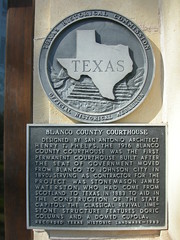
Texas Historical Marker #00427
Blanco County Courthouse. Designed by San Antonio architect Henry T. Phelps, the 1916 Blanco County Courthouse was the first permanent courthouse built after the seat of government moved from Blanco to Johnson City in 1890. Serving as contractor for the project was stonemason James Waterston, who had come from Scotland to Texas in 1883 to aid in the construction of the state Capitol. The Classical Revival limestone structure features Doric columns and a domed cupola. Recorded Texas Historic Landmark - 1983 #427
?, Johnson City, TX, United States
Subjects
,_Blanco,_Texas_Historical_Marker_(8691845468).jpg?width=250)
Texas Historical Marker #00428
Old Blanco County Courthouse. Designed in Victorian style by architect F. E. Ruffini. Erected in 1886 as first permanent county courthouse, building served only four years--until 1890. County seat then moved to Johnson City. Purchased by Chas. E. Crist, the structure entered varied career as school, Blanco National Bank, office of "Blanco County News," opera house, Farmers' Union Hall, and hospital (1936-70). Now houses Blanco Museum of Early West. Recorded Texas Historic Landmark -- 1972 #428
?, Blanco, TX, United States
.jpg?width=250)
Texas Historical Marker #00429
1894 Blanco County Jail. Noting the unhealthy dampness of the basement where prisoners were first kept after the Blanco County seat was moved to Johnson City, the commissioners court ordered the construction of this jail facility in 1893. Completed the following year, the jailhouse was built of limestone by J. E. L. (Kergie) Dildine (1853-1925), a rock mason who came to Blanco County from Kansas in the 1880s. Despite an 1897 jailbreak, the facility has continued in use, with interior modifications to meet state jail standards. Texas Sesquicentennial 1836-1986 #429
?, Johnson City, TX, United States
Texas Historical Marker #00430
Blanco High School. Chartered in 1883, Blanco High School began as a combination private and public school. A white limestone schoolhouse was constructed at this site and opened for classes in October 1884. During its early years, Blanco High School offered a six-month public school term and a ten-month private school term. Over the years, the school has grown through consolidation, and new facilities have been built to match its growth. Throughout its history, Blanco High School has continued to meet the need for rural education in the surrounding area. (1984) #430
814 11th St., Blanco, TX, United States

Texas Historical Marker #00431
Blanco Methodist Church. Organized, 1854, by Rev. Daniel Rawls, Methodist circuit rider. Six charter members. Worship was held in log cabin and frame building until 1882. Present structure erected, dedicated, 1883. Still serves as church sanctuary. Native limestone hauled 10 miles from quarry by ox cart and wagon team. Unique cornerstone is laid above east doorway arch. Tower bell is same as installed in 1883. Recorded Texas Historic Landmark, 1967 #431
?, Blanco, TX, United States
Texas Historical Marker #00433
Blasingame Home. When J.W. Pipkin constructed this Colonial Revival residence in 1910, Plainview was experiencing a period of dramatic economic development as a railroad center. In 1918 the home was purchased by F.E. Blasingame and his wife Mary (Rimes). For over sixty years they operated local restaurants which became popular social gathering places under their management. The home remained in the Blasingame's ownership until 1981. Recorded Texas Historic Landmark - 1982 #433
909 El Paso, Plainview, TX, United States
Texas Historical Marker #00434
Bledsoe Santa Fe Depot. A relic from one of America's last frontiers. Built in 1925 on range land of newly organized Cochran County, at Bledsoe, this structure not only served its purpose as a railroad station, but was a meeting hall for churches and social groups. Sheepherders and cowboys would bed down on its floor when detained at the station in shipping season. Phased out of service by 1966, structure was moved 70 miles to be preserved by Gene Hemmle. Recorded Texas Historic Landmark - 1973. #434
6105 19th Street, Lubbock, TX, United States
Texas Historical Marker #00435
Blevins Community and School. The community of Blevins began about 1860, when Texas Revolution veteran Thomas H. Barron and his family settled near Deer Creek. The Rev. Isaac Taylor operated a school for area children from the 1870s until 1885, when Blevins School opened. A public school district, formally organized in 1916, served students in a nine-square mile area until 1939. A post office operated from 1886 to 1904, and at its height the community boasted two general stores, two cotton gins, two churches, a blacksmith shop, and ice house. #435
?, Eddy, TX, United States
Texas Historical Marker #00436
Blevins Cemetery. Born in the Republic of Texas in 1838, Amanda Ruble Taylor moved to this are in 1855. This cemetery began with her burial on family land in 1875. Her widower, the Rev. Issac Taylor, deeded land for this cemetery to the Methodist Episcopal Church, South, in 1879. The numerous infant grave sites reveal the harsh realities of frontier life. Buried alongside veterans of conflicts from the Texas Revolution to World War II are farmers whose perseverance and faith in the land helped shape this area. The Blevins Cemetery Association, founded in 1958, restored this site in 1991. #436
?, Eddy, TX, United States