
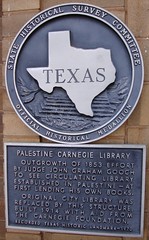
Texas Historical Marker #08788
Palestine Carnegie Library. Outgrowth of 1853 effort by Judge John Graham Gooch to see circulating library established in Palestine, at first lending his own books. Original city library was replaced by this structure, built 1914 with aid from the Carnegie Foundation. Recorded Texas Historic Landmark - 1970 #8788
502 N. Queen St., Palestine, TX, United States
Subjects


.jpg)



Texas Historical Marker #08789
Palestine Fire Department. Palestine, founded 1846, acquired fire department when International & Great Northern Railroad extended line here in 1872. Early fire-wagon was horse-drawn flatbed loaded with hose. Motor truck and city water were introduced 1918. Bell from 1895 hangs in front. (1972) #8789
611 Avenue A, Palestine, TX, United States
Texas Historical Marker #08790
Palestine High School. A public school system in Palestine was established in 1881 under control of the municipal government. The first classes were held at the old Palestine Female Institute (built in 1858), then a high school was built in 1888 at the Institute site on Avenue A. In 1915 voters passed a $100,000 bond issue for a new high school. The City Council chose this site in newly created, 22-acre Reagan Park for the campus. Fort Worth architects Sanguinet & Staats were chosen for the design, which features Tudor Gothic -- or Jacobethan -- detail in brick, limestone, and occasional tile panels. The 2-story structure, on a raised basement, is framed with reinforced concrete, allowing ample window space for air and light. The original plan included eight lecture rooms, a library, a gymnasium, laboratories, and an auditorium. A principal and 10 teachers comprised the first faculty, and the first graduating class in 1917 contained 38 students. This building became a junior high in 1939, and was named in 1955 for John Henninger Reagan (1818-1905), Texas statesman and Palestine resident. Elementary grades were assigned here from 1966 to 1976, when the school was closed. The building was then preserved and rehabilitated as a museum and cultural center. Recorded Texas Historic Landmark - 1986 #8790
400 Micheaux Avenue, Palestine, TX, United States

Texas Historical Marker #08791
Palestine Lodge No. 31, A. F. & A. M.. Established on November 21, 1846, the Palestine Masonic Lodge is one of the oldest organizations in Anderson County. Established by 22 charter members meeting under a dispensation from the Grand Lodge of Texas, the group was officially chartered as Lodge No. 31 in 1848. For the first two years meetings were held in members' homes until a lodge building was erected on the west side of the courthouse square in 1848. In 1850 the Masons built a 2-story structure to provide a school for boys in the community on the first floor and a meeting hall on the second level. Their commitment to education continued when the Masons constructed a brick schoolhouse for girls in 1852. The third Lodge building contained three floors: the first floor was split into three separate stores for rental to area merchants; the second floor was styled as the city's first opera house; and the third floor housed the Lodge meeting room. The Masons have met in many other sites over the years. Among its many prominent members was John H. Reagan, U.S. Congressman and first Texas Railroad Commissioner. The Masonic Lodge continues to serve the community as it has for more than 150 years. (1996) #8791
401 W. Debard St., Palestine, TX, United States

Texas Historical Marker #08792
Palestine Salt Works C. S. A.. Located 6.5 miles southwest. During the Civil War this salt works was assigned to produce salt for the Confederacy at a fixed price of eight dollars for a hundred-pound sack. Private customers from East Texas, Arkansas, and Louisiana often paid twenty dollars for a sack. Producing salt was slow, tedious work. Salt water was taken from wells spread over a distance of three-fourths of a mile. A pump operated by a slave was placed in each well. Gum logs, hollowed out and joined together formed a pipeline from the wells to large cast iron boiling kettles which were kept fired. Heated water was then transferred to smaller kettles for quick evaporation. (see other side) (Back Palestine Salt Works) #8792
?, Palestine, TX, United States
Texas Historical Marker #08793
First Gravesite of Cynthia Ann Parker. Captured from Ft. Parker by Indians, 1836. Recaptured by Texas Rangers in 1860. Mother of Quanah Parker, war chief of Comanches. First buried here. Reburied in Post Oak Cemetery, Okla., 1910. Reburied Ft. Sill Post Cemetery, Okla., 1957. Recorded --1969 #8793
?, Brushy Creek, TX, United States

Texas Historical Marker #08794
Rev. Daniel Parker. Pioneer Baptist minister; born in Virginia April 6, 1781; died Dec. 3, 1844. His wife Patsy Dixon Parker, born Jan. 17, 1783; died Dec. 1, 1846. #8794
?, Elkhart, TX, United States

Texas Historical Marker #08795
Dickinson Parker. A San Jacinto Veteran Born in Tennessee, May 29, 1812; died August 1, 1844. His wife Lucinda Eaton Parker, born Jan. 14, 1820, died Jan. 27, 1847
?, Elkhart, TX, United States
Subjects
Texas Historical Marker #08796
Pennybacker-Campbell-Wommack House. "Silk Stocking Row" Victorian residence built in 1890. Noted as family home of Mrs. Percy V. Pennybacker (1861-1938), teacher, author of widely-used school history of Texas, first Texan President General Federation Women's Clubs. Purchased 1900 by Thomas M. Campbell (1856 - 1923), famous lawyer, banker, Governor of Texas in 1907-11. Enlarged by Gov. Campbell, house is now property of great-grandson, Drew Wommack, Jr. Recorded Texas Historic Landmark - 1969 #8796
814 S. Sycamore, Palestine, TX, United States

Texas Historical Marker #08797
Old Pilgrim Church. Replica, oldest Protestant Church in Texas. As Pilgrim Primitive Baptist Church, constituted July 28, 1833, in Crawford County, Illinois. Under guidance of Elder Daniel Parker, a "moving arm" of established church, 11 members entered Texas, Jan., 1834. First building, 1848. RTHL 1965 [Note: RTHL designation removed 1989] #8797
?, Elkhart, TX, United States

Texas Historical Marker #08798
Pilgrim Predestinarian Regular Baptist Church. Organized in Crawford County, Illinois by Elder Daniel Parker in 1833 with the following charter members: Daniel Parker, Pheby Parker, Patsey Parker, Julious Christy, John Parker, Rachel Christy, Salley Brown. The first Baptist church in Texas. First meeting held in Stephen F. Austin's Colony, January 20, 1834. First log church built in 1839. #8798
?, Elkhart, TX, United States
.jpg?width=250)
Texas Historical Marker #08799
Pilgrim Predestinarian Regular Baptist Church. Organized in Illinois in 1833 by Daniel Parker. Members moved to Texas. First meeting in Stephen F. Austin's Colony, January 20, 1834. Log church built December, 1839. Old graveyard adjoins. Present church fourth on same site. Continuous worship since 1834. Daniel Parker, Pastor 1833 - 1844. #8799
?, Elkhart, TX, United States
Texas Historical Marker #08800
Pine Lodge Club House. Built by business leaders who in 1880s patronized Mineral Wells Hotel at spa in Elkhart, a nearby resort. After wells failed, group moved here, organized lodge, built (1907) this club house with wide fireplace, large rooms, long verandas. Recorded Texas Historic Landmark - 1967 #8800
?, Elkhart, TX, United States
Texas Historical Marker #08801
Providence Church and Cemetery. On March 20, 1858, W. T. Miller deeded eight acres of land here "to trustees Lemuel Mullins, Chairman, D. Capp and Wm. Webb, for school purposes and burial ground." W. M. Hardy added a half-acre to even north line. These gifts met a pressing need for a central place to educate the children in this farmland area. Local residents (including Freemasons) donated work and materials, fenced the churchyard cemetery, and built a two-story structure to house the Providence School and Providence Missionary Baptist Church downstairs, and Providence Lodge No. 400, A.F. & A.M. (later to be Elkhart Lodge), upstairs. Providence was second missionary Baptist church in Anderson County. After tornado damage to building in 1900, school was discontinued. The present one-story building was salvaged and repaired with original materials, and regular church services continued through 1935. The cemetery, still used for burials, has some graves of settlers who arrived in the Republic of Texas days, and for years held school and worship in their own homes. Providence celebrated its centennial July 4-18, 1958, with nightly church services. The annual homecoming is held the first Sunday in June, with morning service followed by dinner on the ground. (1973) #8801
?, Palestine, TX, United States
Texas Historical Marker #08802
John H. Reagan Monument. [plaque at base of monument reads:] Reagan Monument. Unveiled July 6, 1911. Sponsored by John H. Reagan Chapter, UDC. Pompeo Coppini, Sculptor #8802
?, Palestine, TX, United States

Texas Historical Marker #08803
John H. Reagan. John Henninger Reagan, son of Timothy and Elizabeth Lusk Reagan, was born on October 18, 1818, in Sevierville, Tennessee. He joined the Republic of Texas Army in 1839 and served in the Cherokee War. In the early 1840s he held several public offices in Nacogdoches County, and in 1847 obtained a law license and was elected to the Texas House of Representatives. He moved to Palestine in 1851 and opened a law office in his home. He was elected Texas 9th Judicial District Judge in 1852. Reagan, elected U.S. Congressman in 1857, resigned in 1861 over what he believed was a Federal takeover of states' rights. He served as postmaster general of the Confederacy during the Civil War. He was captured by Federal troops in 1865 and imprisoned for 18 months. He returned to Texas in 1866 and established a family farm near Palestine at the former site of Ft. Houston. During his tenure as a U.S. Congressman (1876-87) and U.S. Senator (1887-1891) Reagan led the fight that brought railroad monopolies under Federal control with the passage of the Interstate Commerce Act in 1887. In 1891 he became the first chairman of the Texas Railroad Commission, a position he held until 1901. Reagan died of pneumonia on March 6, 1906. The entire Texas legislative assembly attended his funeral. (1994) #8803
?, Palestine, TX, United States

Texas Historical Marker #08804
Christopher Columbus Rogers. (1846 - 1887) Elected marshal, 1874; served when Palestine was one of tough railroad towns in southwest. Won fame solving 1878 Grayson murders. Slain in argument over testimony in his trial for killing friend resisting arrest. Recorded, 1967 #8804
?, Palestine, TX, United States
Texas Historical Marker #08805
Paul L. Rutledge, Sr.. (1904 - 1961) A graduate of Prairie View A&M College, prominent educator Paul Rutledge, Sr., also attended Tuskegee Institute and Atlanta University. He served as principal of Flint Hill High school near Neches from 1933 to 1937, and Green Bay High School at Tucker from 1937 to 1942. In 1942 he became a Texas Education Agency area supervisor for vocational agriculture. Rutledge was a positive influence for generations of African American school children in Texas. (1991) #8805
?, Tucker, TX, United States

Texas Historical Marker #08806
Sacred Heart Church. Successor to 1874 Church of St. Joseph, built on site given by International & Great Northern Railway, and destroyed by fire in 1890. This building of handmade brick was begun later that year; Nicholas J. Clayton of Galveston was the architect. Recorded Texas Historic Landmark - 1964 #8806
401 W. Oak St., Palestine, TX, United States

Texas Historical Marker #08808
Site of St. Mary's Academy. The arrival of the railroad in Palestine brought many workers, several of whom were Catholic who wanted religious instruction for their children. St. Mary's Academy began in 1882 when Mother St. Andrew Felton, Superior General of the Sisters of Divine Providence located at Castroville, Texas, sent three sisters to establish religious education here. Sister Mary Flavienne Braun was appointed Superior and principal of the school. Classes were held in a three-room frame schoolhouse on Lacy Street. Basic education and classes in religion were supplemented with instruction in French and elocution. The citizens of Palestine contributed generously to a fund to relocate the school, which was moved to this site in the 1880s to occupy two houses. North wing was added that included a chapel, classrooms, and dormitories. By 1900 a south wing was added to accommodate the increase in both day students and boarding pupils. The addition contained an auditorium on the first floor and dormitories on the top floor. St. Mary's High School was closed in 1949 due to a decrease in enrollment. A reduced teaching staff continued to operate the facility for grades 1-8, but the school was closed permanently in 1966. (1997) #8808
418 Tennessee Ave., Palestine, TX, United States