

Texas Historical Marker #08728
American Well & Prospecting Company. Organized in Kansas in 1890 by Horace Greeley Johnston (1851-1930) of Ohio and Pennsylvania native Charles Rittersbacher (1857-1919). This company began as a water well drilling business. In 1891 the partners moved to Texas and began drilling in Corsicana. In 1894, while drilling on S. 12th street, they struck crude oil, which led to the discovery of the Corsicana oil field. The firm began making and distributing rotary drilling equipment in 1900. Converted to a munitions plant in World War II, the business was sold to Bethlehem Steel and operated at this site until 1959. (1982) #8728
211 N 7th Street, Corsicana, TX, United States
Subjects
Texas Historical Marker #08729
Judge William Alexander. Born 1814 in Scotland. Settled in Palestine 1851. Trustee in first school. Practiced in Supreme Courts, Alabama, Texas. Was a partner of John H. Reagan, C.S.A. Postmaster-General, U. S. Congressman, U. S. Senator, Railroad Commissioner. Married 1857 Mrs. Susan Scott Mallard, widow of another law partner. Had two daughters. Chief Justice, Anderson County, 1860-1865. Died in Palestine, 1872. Recorded, 1965 Incise in base: Erected by Ruth R. Eppner, Granddaughter #8729
?, Palestine, TX, United States
Subjects
Texas Historical Marker #08730
Anderson Campground. Located on a spring near Brushy Creek community, this area was first settled in the 1850s. In 1873 it was set aside for use as a religious campground by members of the local Methodist congregation. The land was purchased from E. S. Jamison of Galveston County for sixty dollars in gold. The tabernacle was built the following year of pine beams, sweet gum piers, and wooden pegs. Religious camp meetings were conducted here each summer. During the week-long services, residents of the surrounding area, representing several faiths, lived in tents on the grounds. The spring provided water for the campers and for baptisms. Although the meetings were primarily times of religious revival, they also allowed distant neighbors a chance to visit and exchange ideas. A sanctuary for the Brushy Creek Methodist Church, built here in the 1870s, was replaced by the present building in 1894. A parsonage for use by the circuit preachers burned in 1916. As rural life became more modernized, camp meetings declined in popularity. The last ones here were held in the 1930s. Still used for religious meetings, Anderson Campground is the site of an annual September homecoming. (1981) #8730
?, Frankston, TX, United States
Texas Historical Marker #08731
Anderson County. Created March 24, 1846, from Houston County. Organized July 13, 1846 with Palestine as the county seat. Named in honor of Kenneth Lewis Anderson, vice-president of the Republic of Texas, 1844-45 #8731
?, Palestine, TX, United States

Texas Historical Marker #08732
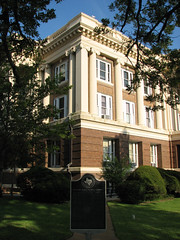
Anderson County Courthouse. Created by the Texas Legislature on March 24, 1846, Anderson County was named for former Republic of Texas Vice President Kenneth L. Anderson. The first court in the new county was held in a log house at nearby Fort Houston in 1846. The first Anderson County Courthouse, a one-story frame structure, was built in 1847. Located on the northeast corner of the square, it was replaced by a two-story brick courthouse in 1856. A third courthouse, also brick, was completed in 1886 but was destroyed by fire in 1913. The fourth and present Anderson County Courthouse was built in 1913-14. Designed by the Austin architectural firm of Charles Page & Bro., it was dedicated on December 20, 1914. The Beaux-Arts style building features giant order Ionic columns and pedimented porticoes on each facade, and is topped by a dome surmounted by a Justice statue. Still in use as the seat of justice for Anderson County, the courthouse underwent major restoration in 1986. The historically and architecturally significant building serves as a source of pride for county residents. Recorded Texas Historic Landmark - 1988 #8732
500 N. Church St., Palestine, TX, United States
Texas Historical Marker #08733
Anderson County Poor Farm. Although county records show some attempts to care for the poor as early as the 1860s, property for a poor farm was not purchased until 1884. Various buildings were erected, including housing for residents and a caretaker, storage barns, a cotton gin, and a canning operation. A jail building was also in use for convict laborers who worked on the farm and on county roads. The ruins of several wells can still be seen throughout the property. A cemetery containing some 75-100 graves is located near the southern edge of the original farm site. Texas Sesquicentennial 1836 - 1986 #8733
?, Palestine, TX, United States
Texas Historical Marker #08734
Antioch Missionary Baptist Church. According to local tradition this congregation traces its origin to informal services held in various homes in Palestine as early as 1856. Although referred to as "Antioch Under the Hill" the congregation was formally named Antioch Baptist Church in 1873. The church built its first sanctuary that year on land deeded to the Rev. Bristow Smith, Bob Johnson, Virgil Campbell, and Thomas Hughes by John H. Reagan. Church membership increased and in 1885 and again in 1887 the congregation purchased town lots near here for the purpose of building a parsonage and a new sanctuary which was completed in 1895. Two ministers, the Rev. T. W. Dailey and the Rev. J. B. Atkins, are credited with substantially improving church facilities during the first quarter of the 20th century. The church building, which had served the congregation well, was destroyed by fire in 1962. Services were subsequently held in a community center until a new sanctuary was erected at this site in 1964. The structure was later remodeled for use as a fellowship hall with the construction of a new church building here in 1980. Antioch continues to serve the local African American community with a variety of Christian educational and family programs. (1993) #8734
907 E. Murchison St., Palestine, TX, United States
Texas Historical Marker #08735
Bell Cemetery. Confederate veteran Uriah Jasper Bell (1839 -1915) brought his family to northeast Texas in 1871. An ordained Baptist minister, he relocated to this area to lead the Ft. Houston Baptist Church. He and his wife Nancy (d. 1918) were the parents of seven children. Their only daughter, Lula Bell Kent, died in a fire in January 1890, three months after her marriage to Will Kent. She was buried on the family farm, and hers is the first burial in what became the Bell Cemetery. Also buried here are the Bells' six sons, as well as several generations of Bell family descendants. (1991) #8735
?, Palestine, TX, United States

Texas Historical Marker #08736
Miles Bennett. A soldier in the Army of Texas, 1836. Born in Indiana, July 26, 1816; died November 24, 1849. His wife Laura Jordon Bennett; born August 28, 1830; died December 24, 1925. #8736
?, Elkhart, TX, United States
Texas Historical Marker #08737
Bethel Cemetery. Originally part of a Mexican land grant awarded to Jose de Jesus Grande in 1828, land at this site was later granted to early area settler Henry Rampy. Rampy, who had come to this part of Texas in 1848, deeded 5 acres of his land in 1859 for a community cemetery and church. The earliest significant settlement of pioneers in the Bethel area came in 1846. By 1852, the community was thriving and a post office was established. The Bethel Cemetery was used largely by residents of the town and by settlers in other parts of Anderson and Henderson counties. The earliest marked grave, that of M. B. Hodge, is dated 1862. Her husband, the Rev. Robert Hodge, who also is buried here, was a pioneer Cumberland Presbyterian minister. He was instrumental in the founding of the Science Hill academy, an important early educational institution in this part of the state. Other early settlers and their descendants are buried here, as are a number of Confederate veterans. The Bethel community began to decline after the end of the Civil War and was largely gone by the time the post office was discontinued in 1914. This cemetery is the only significant remnant of the once-thriving Anderson County community. (1985) #8737
?, Bethel, TX, United States
Texas Historical Marker #08738
Bethel Church and Cemetery. The Rev. James Madison McCarty (1802-1869) is the first Primitive Baptist minister known to have served in this area. In 1853 Bethel Primitive Baptist Church of Christ was established as a member of the Union Association organized by Daniel Parker. Church services were held one weekend a month. Members of the congregation participated in holy services of communion and foot washings during conference meetings. Singing for the services was performed in the non-instrumental sacred harp method. The church was the primary religious and social gathering place for the Sandflat community. The oldest documented burial in the Bethel Cemetery is that of the infant child of Daniel and Elizabeth Willingham Cook, who died on August 7, 1855. Among those buried in both marked and unmarked graves in the cemetery are veterans of the Civil War, World War I and World War II. After the railroad was built through the county in 1900, bypassing this area in favor of Frankston to the north, the Sandflat community began to decline. Worship services at Bethel Church ceased in the 1940s. The cemetery remains as a reflection of the area's heritage. (1994) #8738
?, Frankston, TX, United States

Texas Historical Marker #08739
Bowers Mansion, The. Originally house of merchant Henry Ash; built 1878; bought 1884 by Andrew L. and Nellie O'Connell Bowers, who had architect-builder W. W. Wainright add cupola, gazebo, circular galleries after 1886. Charles Dunbar was architect in 1897 for ornate renovations, and Bowers continued to enlarge and enrich the structure until 1921. Andrew L. Bowers (1852-1926), an International & Great Northern Railroad official, president of Palestine Salt & Coal Co., banker, mayor for 20 years, was active in Anderson County oil discoveries. Four sons, two daughters grew up here; family owned place 72 years. Recorded Texas Historic Landmark - 1973 Restored by Mrs. H. R. Avera and Carl L. Avera, 1970 #8739
301 S. Magnolia St., Palestine, TX, United States
Texas Historical Marker #08740
Governor Thomas Mitchell Campbell. (April 22, 1856 - April 1, 1923) Born near Rusk in Cherokee County, Thomas Mitchell Campbell was the son of Thomas Duncan and Rachel (Moore) Campbell. He financed his education by working for the county clerk in Longview. In 1878 Campbell was admitted to the Bar and opened his law practice in Longview. He married Fannie Bruner the same year. Campbell moved to Palestine in 1892 after he was named receiver for the International & Great Northern Railroad. He was general manager of the line 1892-97. In 1905, without prior political experience, Campbell announced as a candidate for Governor. He received the Democratic nomination despite strong opposition at the party's 1906 convention. Rallying supporters with the rousing march tune, "The Campbells Are Coming," he won the election by a large margin and became Texas' second native-born Governor. The first was Campbell's boyhood friend, Gov. James S. Hogg (1851-1906). In 1908 Gov. Campbell was elected to a second term. His administration was marked by strong anti-trust legislation, a pure food law, and prison reform. When his term expired, Gov. Campbell returned to a banking and law career in Palestine. In 1916 he ran for the United States Senate but lost. He died in Galveston and was buried in Palestine's East Hill Cemetery. (1975) #8740
?, Palestine, TX, United States
Subjects


Texas Historical Marker #08741
Campbell Cemetery. Typical of a number of small family cemeteries located throughout the state of Texas, this graveyard was established by the Campbell family, who moved to the Mound Prairie community in this area in 1844. Albert Gallatin Campbell (1808 - 1876), his wife Jenny Elvira, and their children John Bartlett, Isadore, and James, established a farm. Soon the family grew with the addition of another daughter, Jettie, and another son, Alexander. John Bartlett Campbell (1834 - 1915) returned home after service in the Civil War and worked in a hardware store to earn money to purchase his own farm. He eventually purchased 270 acres and built a large home, where he and his wife Mary Elizabeth (1853 - 1927) reared their twelve children. John Bartlett Campbell set aside one acre of land on his farm for a family burial ground, and in 1876 his father, Albert Gallatin Campbell, became the first person buried here. Albert's was the only burial in the graveyard for twenty-four years, until his grandson, 23-year-old John Bartlett Campbell, Jr., died in 1900 of scarlet fever. The cemetery is still in use by Campbell family descendants. #8741
?, Palestine, TX, United States
Texas Historical Marker #08742
C. S. A. Iron Works. Nearby, between old towns of Plentitude and Mound Prairie, John Billups as early as 1847 used Anderson County ore for iron to manufacture cotton gins and grist mills. In the Civil War, with D. D. Hassell as partner, made rifles and bayonets for Confederacy. To obtain military goods, the State of Texas subsidized war plants and exempted workmen. Other factories at Lancaster, Houston, Bastrop, Fredericksburg, Waxahachie, Corpus Christi, San Antonio, Austin, Burnet, Rusk and Tyler made pistols, percussion caps and gunpowder. (1964) #8742
?, Palestine, TX, United States
Texas Historical Marker #08743
Concord Baptist Church and Cemetery. Three families named Fitzgerald moved to Texas in the 1840s and purchased land at Mound Prairie Creek, eleven miles north of Palestine. The area in which they settled became known as Fitzgerald. As other families moved to the area, interest grew in organizing a church. Fifteen charter members met at the Fitzgerald schoolhouse in 1871 and formed a Baptist church. It is believed they named it Concord for a community in Louisiana, the former home of some members of the church. By 1883 the congregation was holding services in its own church building. A wooden frame sanctuary was erected at this site in 1901-02 that served the congregation until 1940 when it was destroyed by fire. A brick structure was begun in 1940. The cemetery and church were located on land previously owned by pioneers William A. and Michael R. Fitzgerald. The oldest marked grave is that of Joel Kelley in 1872, although it is believed the site was in use before that time. Among those buried here are early settlers and their families and three Confederate Civil War veterans. The site continues to serve the Concord community and is maintained by a cemetery association. #8743
?, Palestine, TX, United States
Texas Historical Marker #08744
Denson Springs Cemetery. Early settlers of this area, known as Ioni after a nearby Indian village, began arriving in the early 1830s. The land on which this cemetery is located was granted to James Bradshaw in 1835. When he died in 1844, the property was inherited by his brother, William, who moved here with his family from Nacogdoches in 1849. One of William Bradshaw's daughters, Diana, married Kindred Watkins in 1850. When their first child, a son, was born and died on August 15, 1851, he was buried near their home. The child's burial was the first in what would become Denson Springs Cemetery. Over the years, this one-acre plot became a family burial ground. Later, other settlers of the area were also buried here, and when the name of the community was changed in 1878 to Denson Springs, this site became known as the Denson Springs Cemetery. Besides the marked graves, it is believed there are a number of unmarked burials. Veterans of the Civil War, World War I, and World War II are interred here. The graveyard was deeded to the Denson Springs Cemetery Association in 1980. Set in a grove of trees, it is a quiet reminder of the area's early pioneers and settlers. Texas Sesquicentennial 1836 - 1986 #8744
?, Slocum, TX, United States
Texas Historical Marker #08745
Eilenberger's Bakery. F. H. Eilenberger (1878 - 1959), a German immigrant, worked at bakeries in Galveston and Fort Worth before starting this company in 1898. Originally located on the corner of John and Oak streets, the operation was moved to this site in 1918. Eilenberger also lived here for several years. Although he sold the business to his two sons and his son-in-law in 1949, his baked bread continued to be distributed throughout East Texas until 1968. Today the bakery is noted for fruit and pecan cakes, which are produced from a family recipe and marketed worldwide. #8745
512 N. John, Palestine, TX, United States
Texas Historical Marker #08746
Henry Fields. A San Jacinto veteran; born in South Carolina, May 8, 1806; died Oct. 15, 1890 #8746
?, Palestine, TX, United States
Subjects
Texas Historical Marker #08747
Fields Chapel Methodist Church and Cemetery. Pioneer settlement began in this vicinity in the late 1830s and early 1940s. This area was the location of several camp revival meetings. The Rev. John W. Fields organized the Methodist Episcopal Church in 1852 and the church was named for him. Trustees elected were W. R. Anglin, J. J. O'Quinn, E. W. Hassell, Joseph Shaver, A. J. Killion, L. D. Fulton, and A. K. W. Jones. Adrian Anglin donated land to this congregation and property deeds were signed on June 23, 1853. The church members built a church that also served as a school. That structure was in use until the late 1940s, when a white brick sanctuary was erected. The cemetery may have been in use prior to the date of the church organization, as there is evidence of more than 100 unmarked graves identified only by iron ore rock, native to the area. The oldest marked grave dating to November 8, 1858, is that of Arminda Florence Langston, infant daughter of Willis B. and Amarillo Anglin Langston. The burials include many pioneer settlers and their descendants and veterans of the Civil War. The community has gathered for homecoming, a social event held annually on these grounds. The church and cemetery continue to serve this area of Anderson County. (1996) #8747
?, Palestine, TX, United States