
Gender Diversity
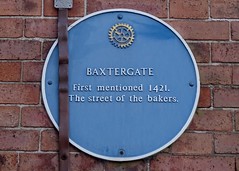
Baxtergate. First mentioned 1421. The street of the bakers.
Baxtergate, Pontefract, United Kingdom
Subjects
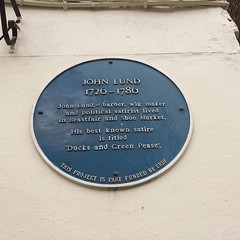
John Lund 1726-1786. John Lund - barber, wig maker and political satirist lived in Beastfair and Shoe Market. His best known satire is title 'Ducks and Green Pease'
Beastfair, Pontefract, United Kingdom
Subjects
Gillygate First recorded about 1240. The street leading to St. Giles Church and formerly the main approach to the town from the south.
Connexions, Gillygate, Pontefract, United Kingdom
Subjects
Salter Row First recorded in 1368 "Salterrowe". The street of the salt merchants.
Pontefract Museum, Salter Row, Pontefract, United Kingdom
Subjects
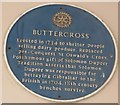
Buttercross Erected in 1734 to shelter people selling dairy produce. Replaced pre-Conquest St Oswald's Cross. Posthumous gift of Solomon Dupeer. Tradition asserts that Solomon Dupeer was responsible for betraying Gibraltar to the British in 1704. 18th century benches survive.
middle of Pontefract Market Place, Pontefract, United Kingdom
Subjects
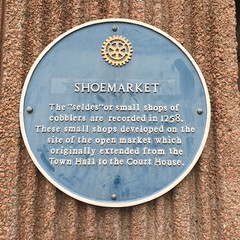
Shoemarket The "seldes" or small shops of cobblers are recorded in 1258. These small shops developed on the site of the open market which originally extended from the Town Hall to the Court House.
Pontefract library, Shoemarket, Pontefract, United Kingdom
Subjects
St. Giles St. Giles was founded in the early twelfth century and became the parish church in 1789. The present building is mainly eighteenth century with medieval remains.
St Giles Church, rear of Pontefract Market Place, Pontefract, United Kingdom
Subjects
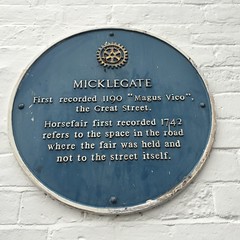
Micklegate First recorded 1190 "Magus Vico", the Great Street. Horsefair first recorded 1742 refers to the space in the road where the fair was held and not to the street itself.
Horsefair, Pontefract, United Kingdom
Subjects
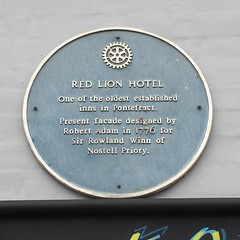
Red Lion Hotel One of the oldest established inns in Pontefract. Present facade designed by Robert Adam in 1776 for Sir Rowland Winn of Nostell Priory.
, Pontefract, United Kingdom
Subjects

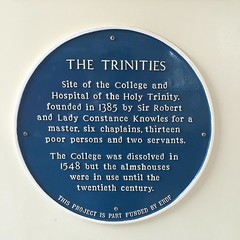
The Trinities Site of the College and Hospital of the Holy Trinity, founded in 1385 by Sir Robert and Lady Constance Knowles for a master, six chaplains, thirteen poor persons and two servants. The College was dissolved in 1548 but the almshouses were in use until the twentieth century.
just inside Pontefract bus station, Pontefract, United Kingdom
Subjects

The Hermitage Beneath here are two chambers and a spiral staircase cut out of natural sandstone by the medieval hermits who lived here.
Old hospital entrance, Bondgate, Pontefract, United Kingdom
Subjects
1 Market Place Two families of Pontefract historians and printers lived and worked here: the Fox family, notably George Fox, from 1825-1862 and Richard Holmes from 1862-1897.
1 Market Place, Pontefract, United Kingdom
Subjects
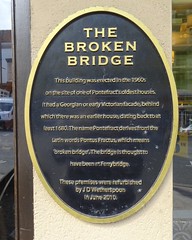
The Broken Bridge. This building was erected in the 1960s on the site of one of Pontefract's oldest houses. It had a Georgian or early Victorian facade, behind which there was an earlier house, dating back to at least 1680. The name Pontefract derives from the Latin words Pontus Fractus, which means 'broken bridge'. The bridge is thought to have been at Ferrybridge. These premises were refurbished by J. D. Wetherspoon in June 2010.
Horse Fair, Pontefract, United Kingdom
Subjects

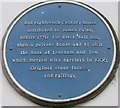
Mid eighteenth Century house attributed to James Paine. Before 1776 the Black Bull Inn, then a private house and by 1801 the Bank of Leatham and Tew which merged with Barclays in 1906. Original stone facade and railings.
Barclays Bank, Market Place, Pontefract, United Kingdom
Subjects
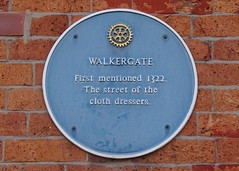
Walkergate. First mentioned 1322. The street of the cloth dressers.
, Pontefract, United Kingdom
Subjects

St. Joseph's. Built in 1806 before the Catholic Emancipation of 1829. Replaces mission church St. Michael of Carleton Green, founded about 1685 by Father Hammerton S.J. of Purston
St. Joseph's Church, Pontefract, United Kingdom
Subjects
Merchant's Warehouse. This half-timbered building is part of a merchant's house on Cornmarket, built from 15th to 17th century. The market bell once hung on the front of the building. Leonard Healaighe, Mayor of Pontefract (1565-1601), lived here.
, Pontefract, United Kingdom
Subjects
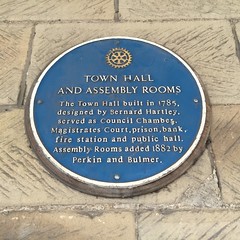
Town Hall and Assembly Rooms. The Town Hall built in 1785, designed by Bernard Hartley, served as Council Chamber, Magistrates Court, prison, bank, fire station and public hall. Assembly Rooms added 1882 by Perkin and Bulmer.
Town Hall, Baxtergate, Pontefract, United Kingdom
Subjects

All Saints The ancient parish church of Pontefract. Present building 13-15th Century. Ruined in 1645 during Civil War. Tower and Transept restored 1831. New nave 1967. Noted for double helix staircase. Sketched by Turner.
All Saints church, Pontefract, United Kingdom
Subjects

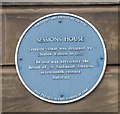
Sessions House Sessions House was designed by Charles Watson in 1807. The site was previously the house of Dr Nathaniel Johnson, seventeenth century historian.
Sessions House, Cornmarket, Pontefract, United Kingdom
Subjects
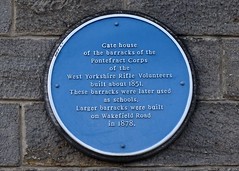
Gate house of the barracks of the Pontefract Corps of the West Yorkshire Rifle Volunteers built about 1851. These barracks were later used as schools. Larger barracks were built on Wakefield Road in 1878.
, Pontefract, United Kingdom
Subjects
The Market Hall Built in 1859-60 to the designs of Joseph Wilson. Opened by the Prime Minister Viscount Palmerston. This side of Market Place, known in the 17th century as the Shambles, has been designated for the sale of fresh meat since the 14th century. The lane behind was known as Pudding Middens. Rebuilt 1957.
Market Hall, Pontefract, United Kingdom
Subjects


Peter and Fred Asquith This is the site of Peter and Fred Asquith's first supermarket. From the success of this store they went on to become co-founding fathers on the national retailer ASDA, which later merged with Walmart, the world's largest retailer.
Horsefair, Pontefract, United Kingdom
Subjects
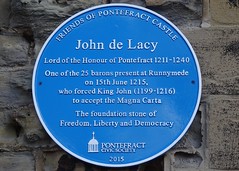
John de Lacy. Lord of the Honour of Pontefract 1211-1240. One of the 25 barons present at Runnymede on 15th June 1215, who forced King John (1199-1216) to accept the Magna Carta. The foundation stone of Freedom, Liberty and Democracy.
Catle Lodge, Castle Garth, Pontefract, United Kingdom
Subjects
Nevison's Leap Named after John or William Nevison 1639-1685, a notorious highwayman reputed to have leapt on horseback across the then narrower road cutting to escape his pursuers. Dick Turpin's ride from London to York was in fact a feat of Nevison's.
approx 300m from the pub towards Pontefract, Ferrybridge Road, Pontefract, United Kingdom
Subjects
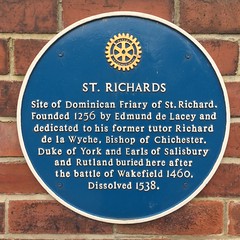
St. Richards. Site of Dominican Friary of St. Richard. Founded 1256 by Edmund de Lacey and dedicated to his former tutor Richard de la Wyche, Bishop of Chichester. Duke of York and Earls of Salisbury and Rutland buried here after the battle of Wakefield 1460. Dissolved 1538.
, Pontefract, United Kingdom
Subjects


Elizabeth Moxon's influential cookbook known as 'English Housewifery' and first published in 1741 was sold by the author near this place
Barton's Cafe, Finkle Street, Pontefract, United Kingdom
Subjects


Stump Cross. Base of 12th century boundary cross. Ornate fragment of the shaft in Pontefract Museum.
, Pontefract, United Kingdom
Subjects

The Elizabeth Love Trust Formally The Castle's Main Guard or Barbican built about 1150 to defend the entrance of the Castle 1649 Reputed to be the first debtor's prison in England 1780 French Napoleonic prisoners were kept here 1901 HQ of the York and Lancs Vol. Battalion 1920 It became Farr's antique shop 1935 Queen Mary visited 1960s Home of Elizabeth and Joe Love
Castle Garth, Pontefract, United Kingdom

The Booths First mentioned as 'Les Fleshebothes' 1384. One of the two places in town (with the Northside of Market Place) reserved for the sale of fresh meat.
Castle Garth, Pontefract, United Kingdom
Subjects

Quaker Burial Ground established in 1664. Also a site of the Friends' Meeting House built in 1697 and demolished in 1948
, Pontefract, United Kingdom
Subjects

Liquorice. Liquorice was introduced to Pontefract as a medicinal plant in the Middle Ages. It was probably brought by crusaders returning from the Middle East to Pontefract Castle or by monks travelling to the town's monasteries. This road links Dunhill's, founded in 1760, and now Haribo, to the former liquorice works of Robinson and Wordsworth founded in 1877.
Haribo, Cornmarket, Pontefract, United Kingdom
Subjects
There has been a water supply to Pontefract Market Place since the reign of Queen Elizabeth I. A conduit is first referred to in 1571. This pump which replaced it was mentioned in 1765 and may have been installed when the present Buttercross was built in 1734. City of Wakefield Planning Committee 1979
Market Place, Pontefract, United Kingdom