
Gender Diversity

Old Deanery King Henry VII was the guest of Dean Gunthorpe here in 1497
9 Cathedral Green, Wells, United Kingdom

Behind this wall was situated the Herb Garden of William Turner, M. D. (c.1508 - 1568) Dean of Wells 1551-4 & 1560-8 author of A New Herball, 1551-68, and known as 'the Father of English Botany'.
The Old Deanery, 9 Cathedral Green, Wells, United Kingdom

Guests at this hotel have included King Henry VII, Prime Ministers Ramsay MacDonald and Winston Churchill, author George Bernard Shaw and Queen Anne of Denmark
Sadler Street, Wells, United Kingdom
Subjects


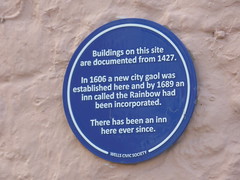
Buildings on this site are documented from 1427. In 1606 a new city gaol was established here and by 1689 an inn called the Rainbow had been incorporated. There has been an inn here ever since.
City Arms, High Street, Wells, United Kingdom
Subjects

The Town Hall was built on the site of a canonical house by public subscription in 1778. It replaced the former market and assize hall at the centre of the market place. The porch and arcade were added in 1861. the balcony and round windows in 1932-33. The assize court last sat here in October, 1970.
Market Place, Wells, United Kingdom


The use of this water was given to the inhabitants of this city for the purpose of cleansing the town, and, if occasion should require it, of extinguishing fires, by Richard, Lord Bishop of Bath & Wells, with the consent of Mr John Lovell, his Lefsee of the Mill, in the year of our Lord 1803, and in the Mayoralty of George Lax Esquire. NB To be kept in repair by the overseers of the In parish.
3 High Street, Wells, United Kingdom

Known as Grope Lane in medieval times altered to Grove Lane by 1821 and changed to Union Street in 1834
Union Street, Wells, United Kingdom
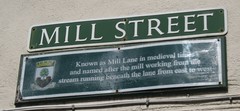
Known as Mill Lane in medieval times and named after the mill working from the stream running beneath the lane from east to west
Mill Street, Wells, United Kingdom
Subjects


Brine's Brush Factory. Here stood the entrance to Brine's Brush Factory - an important industry spread across several sites in Victorian Wells.
7a Portway, Wells, United Kingdom
Subjects

Edward (Jock) Henderson Bishop of Bath & Wells 1960 - 1975
Henderson Place, Wells, United Kingdom
Subjects

Wells Water Courses - Bishop's Mill (2). Wells derives its name from the natural springs which rise in the Bishop's Palace grounds (1). The springs known collectively as St. Andrew's Well, produce an average of 40 gallons of water per second. In the 15thC Bishop Bekynton tamed the sources to power the Bishop's Palace, and provide water for the City and the once busy City mills. Close to this site, the Bishop's Mill (2) was built, perhaps as early as Saxon times, where the Bishop's tenants were required to have their corn ground by the water mill and to pay him for the privilege. Water is still running under your feet and several adjacent buildings including the Town Hall as a relic of this mill.
Townhall Buildings, Wells, United Kingdom

VICARS CLOSE. Vicars Choral (originally Deputies of the Canons) have sung in the Cathedral since about 1140. In 1348 they were incorporated as a College of Vicars when the dining hall above this archway came into use. The houses were complete by 1363; the chimneys were raised and crowned about 1470. At the far end is the Chapel, above which was their library.
Vicars Close, Wells, United Kingdom
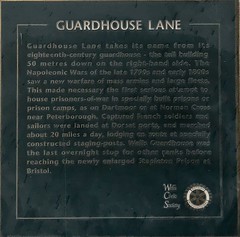
Guardhouse Lane Guardhouse Lane takes its name from eighteenth-century guardhouse - the tall building 50 metres down on the right-hand side. The Napoleonic Wars of the late 1790s and early 1800s saw a new warfare of mass armies and large fleets. This made necessary the first serious attempt to house prisoners-of-war in specially built prisons or prison camps, as on Dartmoor or at Norman Cross near Peterborough. Captured French soldiers and sailors were landed at Dorset ports, and marched about 20 miles day, lodging en route at specially constructed staging-posts. Wells Guardhouse was the last overnight stop for other ranks before reaching the newly enlarged Stapleton Prison at Bristol.
High Street, Wells, United Kingdom
Subjects
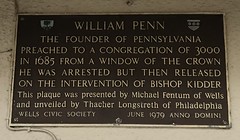
William Penn The founder of Pennsylvania Preached to a congregation of 3000 in 1685 from a window of The Crown He was arrested but then released on the intervention of Bishop Kidder This plaque was presented by Michael Fentum of Wells and unveiled by Thacher Longstreth of Philadelphia.
Market Place, Wells, United Kingdom
Subjects


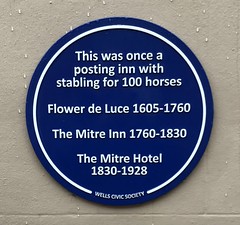
This was once a posting inn with stabling for 100 horses Flower de Luce 1605-1760 The Mitre Inn 1760-1830 The Mitre Hotel 1830-1928
17 Sadler Street, Wells, United Kingdom
Subjects

This plaque commemorates the twinning of the City of Wells with Paray le Monial, France 10 years - 443 miles and Bad Dürkheim, Germany 5 years - 488 miles
Town Hall - Market Place, Wells, United Kingdom
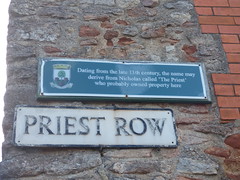
Dating from the late 13th century, the name may derive from Nicholas called 'The Priest' who probably owned property here
Priest Row, Wells, United Kingdom
Subjects
.jpg?width=250)
Here was the shop where iconic Wells photographer Bert Phillips worked 1910-1949
10 Market Place, Wells, United Kingdom
Subjects

Wells Water Courses - St John's Priory Mill (5). This is the site of St. John's Bridge where the brethren of St John's Priory, opposite, had a mill (5) which utilized the power from St Andrew's Stream flowing from the wells of the Bishop's Palace. It continues on to Sheldon's Mill on West Street where, the ground having fallen 2 metres, it turned a breast shot wheel of which the remains can be seen in the entrance of the old Mill buildings (6). St Andrew's Stream carries on to Keward Mill on Jocelyn Drive (7) which ceased working in about 1970 but the hatch spillway and mill intake are preserved as are the 5ft water wheel and some mill machinery. The stream eventually joins the River Sheppey and Brue.
St John Street, Wells, United Kingdom

England's most famous cricketer W. G. Grace played on this pitch in 1867 but was bowled out for a mere three runs
Silver Street, Wells, United Kingdom
Subjects


Broad Street. Originally called Wet Lane and subsequently Water Lane, this finally became Broad Street when widened from a modest 3.5 metres to its present size in 1838. At that time the early buildings opposite here were demolished and replaced with those now forming the frontage; the street was also continued to the completely new Priory Road to create a more direct route to Glastonbury. Broad Street is part of the main shopping area of Wells, and remains an important thoroughfare through the city. In the eleventh century the street was the site of an early market in Wells. By the fourteenth century some of the buildings were occupied by dyers producing purple from woad, and in 1426-7 there are records of five properties registered in Water Lane. By 1821 Water Lane had a smithy, the Bulls Head Inn, and at the junction with High Street, Jacob’s Well. In 1858 No 1 Broad Street, part of this building, was sold for £58.
2 Broad Street, Wells, United Kingdom
Subjects

The Rib The novelist Elizabeth Goudge lived here 1903-11
St Andrews Street, Wells, United Kingdom
Subjects

The Market Place Bekynton's New Works This row on the north side of the Market Place was provided by Bishop Bekynton in 1451-52. He had planned to build a complete square but only this side was constructed. It is known as 'Bekynton's New Works'. The Conduit The present water fountain was erected by the City Corporation to replace an earlier mediaeval conduit built by Bishop Bekynton in 1451 and demolished in 1797. Near the present conduit stood the High Cross built by Bishop Knight in 1542 with money bequeathed by Dean Woleman to replace an earlier 14th century cross. It was used for important civic occasions and by market traders until demolished From 1601 until demolished in 1779, a long rectangular pillared market house stood in the centre of the Market Place, The upper storey comprised two rooms one the Council Chamber/Exchequer, which was also used as a courthouse and the other a wool store. The ground floor housed a fire engine. Its construction marked the final relocation of the market from the High Street to the present site.
9 Market Place, Wells, United Kingdom
Subjects

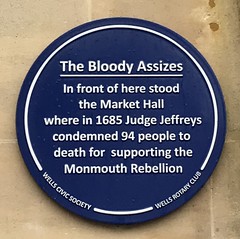
The Bloody Assizes In front of here stood the Market Hall where in 1685 Judge Jeffreys condemned 94 people to death for supporting the Monmouth Rebellion
9 Market Place, Wells, United Kingdom
Subjects


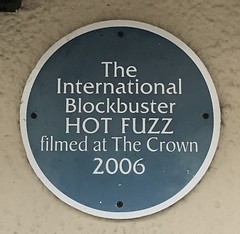
The international blockbuster Hot Fuzz filmed at The Crown 2006
The Crown Hotel - Market Place, Wells, United Kingdom
Subjects
.svg?width=250)

The last fighting Tommy Pte. Henry John Patch (Harry) C Company 7th D.C.L.I. 17th June 1898 - 25th July 2009 Age 111 Fought in the Battle of Passchendaele During the 1914 - 1918 war Freeman of the City of Wells also representing all the brave young men lost in The Great War
8 Cathedral Green, Wells, United Kingdom
Subjects
.jpg?width=250)
.jpg?width=250)

St John Street Until 1840 and the creation of Priory Road, the main entry to Wells from Glastonbury was via Southover and St John Street, named after the Priory of the Hospital of St John the Baptist, founded c1220 by Bishop Jocelyn and his brother Bishop Hugh of Lincoln. The Priory was a religious community dedicated to worship, nursing the sick, and helping the poor and the disabled. It comprised the Prior and ten Brothers. The Priory was dissolved by Henry VIII in 1539, but the main Priory buildings survived until 1859, being then demolished and replaced by the Central School, whose buildings still exist but are now converted into dwellings. The adjacent house, called The Priory, was probably the Prior's lodging, and contains significant mediaeval remains.
1 Priory Road, Wells, United Kingdom
Subjects


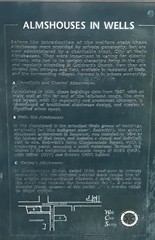
Almshouses in Wells Before the introduction of the welfare state these almshouses were provided by private generosity, but are now administered by a charitable trust, City of Wells Almshouses. They were important in caring for elderly citizens, who had to be upright character living in the city and regulatory attending St Cutherbert’s Church. Now they are divided into cottages and flats, available to residents of Wells and the surrounding villages. Harpers is in private ownership. A Llewellyn’s and Charles’ Almshouses Established in 1636, these buildings date from 1887, with an older unit at the far end of the left-hand range. The style and layout, with its regularity and prominent chimneys, is reminiscent if traditional almshouses design, and creates a dignified urban space. B Wells Old Almshouses In the churchyard is the principal Wells group of buildings originally for the indigent poor'. But with this, the oldest almshouse endowment in Somerset, was founded in 1486 by the bishop of that name, and includes a chapel and Guildhall, still in use. Bubwith’s faces Chamberlain Street, with a projecting porch spanning a small waterway. Towards the church is the delightful, small-scale range of Still's (1615) with Willes’ (1777) and Bricke's (1637) behind. C Harper's Almshouses In Chamberlian Street, dated 1726, and now in private ownership, the two-storeyed painted front retains fro of the original stone-mullioned windows. A small tablet set into the front wall records the foundation for “…5 poor old decayed Wooll-combers of this parish …” a proviso which no longer applies.
City of Wells Almshouses, Priest Row, Wells, United Kingdom
Subjects
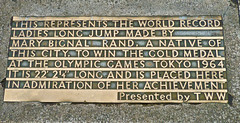
This represents the world record ladies long jump made by Mary Bignal Rand, a native of this city, to win the gold medal at the Olympic Games Tokyo 1964 it is 22' 2 1/4" long and is placed here in admiration of her achievement Presented by TWW
Market Place, Wells, United Kingdom
Subjects


Wells Water Courses - Market Place Conduit (3). In 1451 Thomas Bekynton, Bishop of Bath and Wells, who had built new houses in the Market Place, Penniless Porch and the Bishop's Eye made a grant to provide clean water for the citizens of Wells from the copious springs within the Bishop's Palace. The water flows from the Palace moat to this Conduit (3) and then down the right side of the High Street. In return for this gift the City Council were required to visit the Bishop's tomb in the Cathedral to pray for his soul. To this day, prayers are offered at the Chantry Chapel of Bishop Bekynton in January each year. The present conduit dates from the late 1800's and the water running down the left side of the High Street was the gift of Bishop Richard Beadon in 1803 "for the cleansing of the City and the extinguishing of fires."
Market Place, Wells, United Kingdom

Edgar Wright student at The Blue School 1985-92 director of the film Hot Fuzz
The Blue School, Wells, United Kingdom
Subjects


.jpg)


The Liberty and East Liberty. The Liberty refers to the area of land, including the Cathedral, which until 1866 was free of the bishop’s jurisdiction. The oldest fabric lies within Ritchie Hall, rebuilt in 1884 but containing six 12th century piers of the former Canon’s Barn. The adjacent house, named after Polydor Vergill, the humanist scholar and non-resident Archdeacon (1508-46), also has 15th century details. The splendid corner property, Cedars House, was designed by Thomas Paty in 1758, and became the Tudway family’s home: it contains rich plasterwork by Thomas Stocking and much original joinery, notably the great staircase. Opposite here the lofty stone boundary wall which enclosed the Deanery garden plays a vital part of the townscape. Towards its west end a gap reveals the Canon’s houses built in the late 1960s. The eastern section of the Liberty’s features the elegant Claver Morris House which was built for an eminent local physician in the early 18th century. Further down, behind high walls, the large 15th century house is the Dean’s lodging. Most of these properties are now occupied by Wells Cathedral school.
The Liberty, Wells, United Kingdom

Sadler Street and Brown's Gate. From the mid 13th century Sadler street has been the main entry to the city from the north. Known earlier as Canons Street, Cheap Street and High Street, it was a favorite place for the establishment of Coaching Inns and Taverns – some still trading. The west side of the street was developed first in the 13th century, whilst the east side adjacent to the churchyard was built only after the construction of the Precinct wall. A. Brown’s Gate. This was built by Bishop Beckynton c. 1450 on the site of the earlier churchyard steps, as was the Ancient Gatehouse Hotel. It pierces the mid-14th century Precinct Wall around the Cathedral Churchyard and became a popular shortcut for traffic into Wells until closed c. 1970. B. The White Hart Hotel. There was an earlier building on this site from 1301 to c. 1497. This inn was first known as “The Hertehed” and by 1706 as “The White Hart”. Parts of the structure are original, but the frontage dates from c. 1908. C. 15-17 Sadler Street. There was an Inn here known as the “Flower De Luce” from 1605 – 1760. It was then renamed the “Mitre Inn” but has since closed. D. The Swan Hotel. First mentioned in 1422 and called a “Great Inn”. Being an important Coaching Inn, it was rebuilt in 1769 by Charles Tudway, Mayor and the Member of Parliament for Wells.
Sadler Street, Wells, United Kingdom

Wells High Street. The High Street dates from the 12th Century, the wider middle section of the street becoming the main market area. In 1201, King John granted the right to hold a weekly market and five fairs annually also took place here. A Middle Row was built in the centre of the widest part of the street in 1571 to accommodate the butchers’ and fishmongers’ shambles. The following year a Town Hall was erected at the upper end of the row opposite modern numbers 27 and 29 High Street over the fish shambles. In 1591 the fish shambles were replaced by the first city prison. The prison was moved in 1606 to what is now the City Arms where it remained until the 19th Century. In an earlier building close to where you are standing, a linen hall was established in 1571 for the twice-yearly linen fairs. The Corporation established the city exchequer and the Town Clerk’s office here in 1599, following the grant of the City’s royal charter in 1589. Most of the main city traders lived and worked in the High Street, and here most of the important inns were situated. In 1700 there were 13 inns in the upper part of the street of which only the King’s Head now remains as an inn. With the demolition of the Middle Row in 1767, to ease traffic flow, the market finally moved to today’s Market Place.
31 High Street, Wells, United Kingdom