
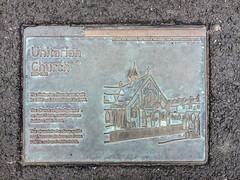
Unitarian Church 1858-1985 The Unitarian Church was built in 1858 and demolised in 1985. The church originally stood on Jane Lane, now known as Swinton Hall Road. The church had a steep gable roof, lancet windows and was built in red and white brick.
Swinton Hall Road, Swinton, United Kingdom
Subjects
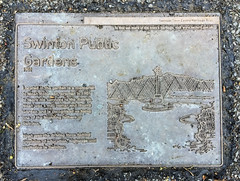
Swinton Public Gardens 1901 Located in the garden is a memorial to Noah Robinson, erected in 1901 to mark his services to the district. Noah was a mill owner and church warden and is recognised as being one of the founding fathers of Swinton. Noah was the driving force behind provision of education, highways and sanitation in Swinton.
Chorley Road, Swinton, United Kingdom
Subjects

Where the civic centre now stands was the Swinton Moral and Industrial School set up by the Manchester Poor Law Union. 'Union' was the name given to groups of parishes which had joined together to provide workhouses. The Manchester Union was one of the first to set up a large separate institution for pauper children. Charles Dickens himself visited the school in 1850 and said that it could easily be mistaken for a duke's country seat. He called it a pauper's palace. Swinton Industrial School Opened in 1846 - Closed 1925 'The Pauper's Palace' also locally known as "The Bastille"
Chorley Road, Swinton, United Kingdom
Subjects

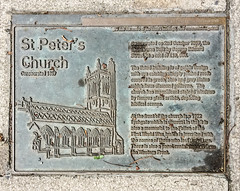
St Peter's Church Consecrated 1869 Consecrated on 2nd October 1869, the church was built by George Edward Street, at a cost of £18,000. The listed building is of gothic design with eye catching steeply pitched roofs covered in green, blue and grey slates which form diamond patterns. The church has magnificent stained windows by famous glass artists, depicting biblical scenes. At the front of the church is a 1922 Lychgate which is unusual in that it is also a memorial to the Fallen of the First World War. Inside is inscribed with the names of those how lost their lives. There is also a panel containing soil from the Western Front.
Chorley Road, Swinton, United Kingdom
Subjects

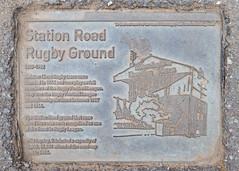
Station Road Rugby Ground 1929-1992 Swinton Lions Rugby team were founded in 1866 and now play as full members of the Rugby Football League. They won the Rugby Football League Championship six times between 1927 and 1964. The Station Road ground that once stood here was once recognised as on of the finest in Rugby League. In its heyday, it boasted a capacity of 60,000. 44,621 attended the semi cup final in 1951.
Station Road, Swinton, United Kingdom
Subjects

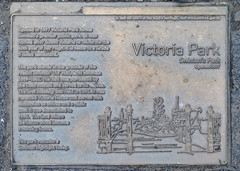
Victoria Park Swinton’s Park Opened 1897 Opened in 1897 Victoria Park forms Swinton’s premier public park. It was named after Queen Victoria to celebrate the 60th year of her reign. It is home to a Grade II listed bandstand. The park stands in the grounds of the rebuilt Swinton ‘Old’ Hall, was built between 1859-1862. The hall was purchased by the town council and served as its offices. The first meeting was held in 1896. It was renamed Victoria House and served with distinction as offices and a clinic until it was demolished in 1993. The land where the house stood became a nursing home. The park remains a Swinton highlight today.
Manchester Road, Swinton, United Kingdom
Subjects
.jpg?width=250)

Swinton Hall c.1740s-1914 Swinton Hall Road which was once known as Jane Lane, gets its name from a large house which originally stood on the site of the present day shopping precinct. Its original inhabitants were cotton merchants called Strettel, although it was the Chadwick family that made improvements between 1742 and 1851. Chadwick Walk and Chadwick Street recall this family name. The hall was rebuilt and relocated in the early 1800s, to a site now covered by the junction of Clarendon Road and Swinton Hall Road. The house had a fine conservatory and was set in large open grounds at the brow of a hill, overlooking a lake which bordered Chorley Road. The house and grounds were largely demolished in the 1870s to make way for terraced houses, but part of the house survived until the early 20th century.
Swinton Hall Road, Swinton, United Kingdom
Subjects
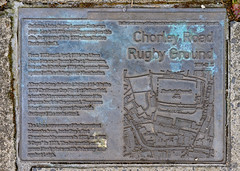
Chorley Road Rugby Ground 1886-1925 Swinton Lions Rugby League Club once played on a 25,000 capacity ground on this site, but vacated it in 1929 when Station Road was built. From 1873 until April 1886 the Lions played on an adjacent site at Stoneacre, but on 2nd October 1886 this ground was opened with a victory over Manchester. After Swinton defeated Salford 16-8 in the 1900 Challenge Cup Final at Fallowfield, a torchlight procession welcomed the players back to the ground. Two years later there was a great fire which destroyed the main stand. The lions saw some of their greatest triumphs here, including a first Championship success in 1927, and “All 5 Cups” in 1928. The last match on the ground took place on 9th February 1929 against Leigh.
Victoria Avenue, Swinton, United Kingdom
Subjects
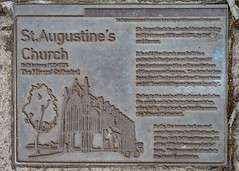
St Augustine's Church Built between 1870-1874 The Miners’ Cathedral St. Augustine’s is a Grade I listed building built between 1870 and 1874 by Bodley and Garner. It is said the church was built to a cathedral sized scale so that it would stand out amongst the mills and mines of the surrounding area. The interior has been described as of national importance and of “breathtaking majesty and purity”. Owing to the scale of the church and also the area’s main industry being mining, when built, the church gained the name the ‘Miner’s Cathedral’. Sadly, the name took on a real meaning when in 1885 after the Clifton Hall Colliery Disaster 64 of the 178 victims were buried here. Their memorial stands in the churchyard today.
Bolton Road, Swinton, United Kingdom
Subjects


White Lion Public House A home of the Swinton Lions Built circa 1790 The White Lion was built in 1790 and is Swinton's fourth oldest pub. In 1873 the fledgling Swinton Rugby Club (formed 1866) moved from a playing off Burying Lane (now Station Road), to another field opposite the pub at Stoneacre. At this time the club switched its HQ from the Bull's Head to the White Lion, and remained there following a further relocation to the adjacent but larger Chorley Road ground in 1886. The pub provided dressing rooms until 1898. Thanks to these links with the pub, in about 1874 the club gained its historic nickname "The Lions" which remains to this day
Worsley Road, Swinton, United Kingdom