

Nevada Historical Marker #225
Spooner Area (Logging And Lumbering Period: 1868 – 1895). This area bears the name of Michele E. Spooner, a French Canadian entrepreneur, who, along with others, was instrumental in establishing the wood and lumber industry which supplied the needs of the Comstock mines and mills.In 1868 Spooner became a partner with Oliver and John Lonkey, the Elliot brothers, Henry M. Yerington, William Fairburn and Simon Dubois in the Summit Fluming Company and operated a shingle mill and sawmill. In 1870 Yerington, Bliss & Company took over the summit fluming company.In 1873 another sawmill was erected at Spooner Meadows. Later in 1873, all the mills were taken over by the Carson & Tahoe Lumber and Fluming Company. This company, headquartered at Glenbrook, went on to become the largest of the three huge companies supplying wood and lumber to the Comstock.
, Glenbrook, NV, United States

Nevada Historical Marker #227
Lake Mansion Home Of Myron C. Lake Founder Of Reno 1877. Built by Washington J. MarshEntrant: National Register of Historic Places
Court St, Reno, NV, United States

Nevada Historical Marker #228
The Great Fire Of 1875. The most spectacular calamity to befall Virginia City had its origins within fifty feet of this marker. Early on the morning of October 26, 1875, a coal oil lamp was knocked over in a nearby boarding house and burst into flames. Strong winds spread the blaze and thirty-three blocks of structures were leveled. The losses included St. Mary in the Mountains Catholic Church, the Storey County Courthouse, Piper’s Opera House, the International Hotel, city offices and most of Virginia City’s business district. The offices and hoisting works of nearby mines were also destroyed.After the fire, Virginia City established a new hydrant system and erected a number of new hose houses including this structure.
A Street, Virginia City, NV, United States

Nevada Historical Marker #229
Oil From Shale. Directly south of this point and across the valley floor are the remains of a short-lived extraction plant, which reached the peak of its productive capacity in the early twenties. Driving of the main shaft began in 1916. Of several tries at extracting oil from shale, this was the only successful operation in Nevada.Robert M. Catlin, Sr. spent many years experimenting on the extraction of crude oil from these beds before beginning the commercial production of oil. After a production period of less than two years, the plant was closed in the fall of 1924. Hi-Power Catlin Oil was too expensive to complete with the fossil oils of that day.Easily 50 years ahead of his time, Catlin gave Elkoans and Nevadans a dream and the community an oil boom in the Roaring Twenties.
West Idaho Street, Elko, NV, United States
Nevada Historical Marker #23
Humboldt House. Humboldt House, also known as Humboldt Station, was originally the point of departure for Humboldt City, Prince Royal, and the mines in that vicinity. In September 1866, it became a stage stop for the historic William (Hill) Beachey Railroad Stage Lines.As the Central Pacific Railhead advanced from eastern California, it reached Humboldt House in September 1868. From 1869 to 1900, Humboldt House was well known as one of the best eating-houses on the Central Pacific Railroad. It was truly an oasis in the great Nevada desert, with good water, fruit, and vegetables. The large grove of trees to the west marks the site of this famous hotel.Between 1841 and 1857, 165,000 Americans traveled the California emigrant trail past here. In 1850, on the dreaded Forty Mile Desert southwest of present-day Lovelock, over 9,700 dead animals and 3,000 abandoned vehicles were counted.HISTORICAL
Dwight D Eisenhower Highway, Imlay, NV, United States

Nevada Historical Marker #230
Mount Rose Weather Observatory. Two miles to the northwest of this point lies Mt. Rose. On the 10,778 foot summit, Dr. James Edward church of the University of Nevada established one of America’s first high-altitude meteorological observatories on June 29, 1905. At the observatory, he carried out his famed snow studies and developed the modern science of snow survey. Dr. Church’s Nevada system of snow survey is used throughout the world today to predict seasonal water flow from precipitation stored as snow pack. In his honor, the north summit of Mt. Rose has been named “Church Peak.”
Mount Rose Highway, Reno, NV, United States

Nevada Historical Marker #231
Star City. Located in the Star Mining District some seven miles west of here, Star City was established in 1861 when rich silver ore was discovered in the area. During the boom years of 1864 and 1865, the town boasted 1,200 residents, two hotels, three general stores, a wells-Fargo office, a church and a dozen or more saloons. The Sheba Mine, the district’s biggest operation, had produced about $5,000,000 in silver by 1868, the year the rich ore began to run out. Three years later, only seventy-eight inhabitants remained in Star City. All that remains today are crumbling foundations, rusted mill equipment and memories.
Unionville Road, Imlay, NV, United States
Nevada Historical Marker #232
Reunion In Unionville. Across the road and down about 300 feet was the original Unionville School. Built in 1862, this adobe building was the first public structure in Humboldt County. Used by such organizations as the Union League, Knights of the Golden Circle, the Free Masons, and the Ancient and Honorable Order of E Clampus Vitus, it served the community until its demolition in 1871.Exactly 109 years later, members of the E.C.V. gathered here to hold a reunion in commemoration of this propitious event. To the rear of this marker is the site where Samuel Clemens allegedly lived briefly before going to Virginia City in 1862 and taking the name Mark Twain.
Unionville Road, Imlay, NV, United States
Subjects

Nevada Historical Marker #233
Dayton Cemetery. Founded in 1851, this is one of the oldest constantly maintained cemeteries in Nevada. The trail to the California Mother Lode passed directly in front and the wagon tracks can still be seen with careful observation.In 1849, the emigrants discovered gold in Gold Canyon and a trading post was opened here. In the 1850s, a permanent settlement was established. In 1861, the town was officially named Dayton in honor or John Day, a surveyor who agreed to plot the town on the condition the place would be named after him. That year, Lyman Crockett, later state treasurer, and Judge Calvin Hall located this cemetery. On December 9, 1861 Crockett dug the first grave. Two of his children are buried here. James Finney (“Old Virginny”) after whom Virginia City is named, is buried here. Many people buried here are Italian Americans, as this ethnic group dominated much of Dayton’s early history. Recognizing the potential of the land and the irrigating value of the Carson River, Italian Americans made this area the breadbasket for the Comstock.
Cemetery Road, Dayton, NV, United States

Nevada Historical Marker #234
Moana Springs. Opened as a resort on October 29, 1905, Moana Springs took its name from a famous Hawaiian spa. In addition to a large bath house with a pool fed by hot springs, Moana had a stately hotel, a clubhouse, baseball diamond and picnic grounds. Constructed and initially operated by Charles T. Short, (who gave the resort its name), Al North and John N. Evans, Moana was acquired by Louis W. Berrum in 1913 and remained in his family for the next four decades. Served by Berrum’s Nevada interurban trolley line from 1907 to 1920, Moana hosted dances, rodeos, boxing matches, trapshoots, circuses and aviation exhibitions. The City of Reno purchased Moana in 1956 and the remaining buildings were demolished the next year to make way for a new recreational complex.
West Moana Lane, Reno, NV, United States

Nevada Historical Marker #235
Camp Nye 1864 1865. Established one-half mile to the north in October 1864, Camp Nye served as the home base for the men of companies “D” and “E,” 1st Nevada Volunteer Cavalry. During the Civil War, troopers from Camp Nye took an active role in struggles with American Indians, and Company “D” suffered the only two combat deaths incurred by Nevada units during the war in a battle at Table Mountain in the Tuscarora Range in Elko County on May 20, 1865. Camp Nye was deactivated in August 1865. Time has obliterated all vestiges of the barracks, stables and other facilities.
Kings Canyon Road, Carson City, NV, United States

Nevada Historical Marker #236
Piper’s Opera House. This building, the most significant vintage theatre in the West, was erected by John Piper in 1885. Third in a succession of theatres which he operated on the Comstock, Piper’s Opera House, with its original scenery, raked stage, and elegant proscenium boxes, is a remarkable survivor of a colorful era in American theatrical history. Many popular nineteenth-century touring stars and concert artists appeared here.
B Street, Virginia City, NV, United States
Nevada Historical Marker #237
Carson And Colorado R.R. Freight Depot. This is the first railroad building to be constructed in Hawthorne. It is the remnant of the narrow-gauge Carson and Colorado Railroad built south from Mound House, near Virginia City in 1881. Railroad officials laid out the town in the desert and the first lots were auctioned off on April 14, 1881. The line was subsequently extended into Owens Valley, California, with rail service to Hawthorne coming to an end when the town was bypassed in 1905. In later years, this building served as the general store of J. E. Adams and Senator John H. Miller, a bar and restaurant with a bingo parlor, and a banquet hall, until acquired by the Hawthorne Elks Lodge in 1946.
5th Street, Hawthorne, NV, United States

Nevada Historical Marker #238
Huffaker’s. Before the arrival, 1858, of Granville W. Huffaker driving 500 head of cattle into the Truckee Meadows, the principal settlers were Mormons. The Comstock Lode and its mining needs focused attention on the valley. Huffaker established his ranch in 1859. Langton’s stage line and the first post office were functioning by 1862. For ten years, Huffaker’s was a most active stage-stop and a center for a community. The schoolhouse was constructed in 1868. Bachelors of a jolly nature gathered here for dancing, horse-racing and “land squabbles”. The Athenian Literary Society flourished for the more cultured. In 1875, the “Bonanza Kings” completed their pacific lumber and flume operation from the Lake Tahoe Basin. For fifteen miles, trestled logs were propelled “by waters rushing faster than any train”. At the terminus of the flume, the Virginia and Truckee Railroad opened a depot and telegraph office and constructed a spur where workers transferred timber.
South Virginia St, Reno, NV, United States

Nevada Historical Marker #239
Stonehouse. Native Americans and passing emigrants once camped here and the stone house was erected in the 1860s by officials of the Overland Stage Company as a dining and overnight rest stop. The Central Pacific Railroad line passed through this section of Humboldt County in 1868, and the nearby springs provided water for engines. A small community flourished here for a number of years to serve the needs of railroaders and neighboring ranchers, and a post office operated here from November 1890 to March 1915.
Dwight D Eisenhower Highway, Valmy, NV, United States
Nevada Historical Marker #24
Olinghouse. Named for a former teamster-turned-sheepman, Elias Olinghouse, who settled in a quiet canyon at the base of the Pah Rah mountain range to get away from it all. As prospecting activities increased about him, Olinghouse was caught up in the whirl of things, buying several claims and erecting a small stamp mill in 1903 to process ores.The district was first prospected in 1860; it was not organized, however, until 1899. Shortly thereafter, the region reached its peak of activity, producing $410,000 in gold and silver values between 1898 and 1903.Both electric and telephone service were installed in 1903, and in 1907 the standard-gauge Nevada Railroad arrived. This short-lived railroad was completed from a junction on the Southern Pacific near Wadsworth to Olinghouse in February of 1907; regular operations ceased on November 1, 1907. Aside from its short life, the Nevada Railroad Company was distinguished by having the first Shay-geared locomotives to be used in Nevada.Sporadic activity has continued at Olinghouse until the present time. Total production is estimated to have been $520,000.
unnamed road, Wadsworth, NV, United States

Nevada Historical Marker #240
Coney Island. Opened to the public on June 20 1909, Coney Island was among the most elaborate amusement parks of its day. Otto G. Benschuetz, founder and owner, landscaped the grounds, put in a children’s playground, a bandstand for outdoor concerts and a dance pavilion which also served as a skating rink and theatre. Coney Island also had an artificial lake complete with boats, covered landings and bath houses. The park’s heyday passed with Benschuetz’s death in 1912. An aircraft assembly plant occupied the site in the early “twenties” and an auto court was established here later. The pavilion was destroyed by fire in 1927 and a second blaze in 1930 took other structures. All the remaining buildings were torn down when Interstate 80 was constructed in the 1960’s.
Galletti Way, Reno, NV, United States

Nevada Historical Marker #242
Southern Nevada Consolidated Telephone Telegraph Company Building. This building was the communications center of Goldfield from 1908 until 1963. The Consolidated Telephone-Telegraph Company Building was one of the few spared by a fire that destroyed 53 blocks of the downtown area in 1923. Today, this building survives as an unspoiled expression of the work of turn-of-the-century craftsman, and serves as an example of the business life in the Tonopah-Goldfield area from the years when the mines were producing millions and bringing new prosperity to Nevada. From 1904 to 1910, the gold mines of the region boomed. With more than 15,000 people, Goldfield was the largest city in Nevada during that period, having four railroads and other modern conveniences. The town was damaged by a flash flood in 1913 and mining was in decline, so many people left the area. The fire of 1923 caused the remaining residents to leave. Today the largest employer in Goldfield is Esmeralda County.
East Ramsey Ave, Goldfield, NV, United States
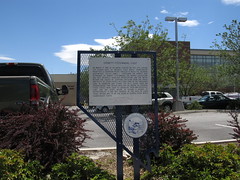
Nevada Historical Marker #243
On March 17, 1897, at an arena located on this site, Carson City played host to Nevada's first world championship prizefight, a fourteen-round thriller in which the reigning heavyweight titlist, James J. "Gentleman Jim" Corbett, was dethroned by Robert Fitzsimmons. The Nevada Legislature had only recently legalized prizefighting and the match became the object of scathing criticism from the press and pulpit of other states, but fight fans by the thousands came in. Promoter Dan Stuart put on a clean show and demonstrated that boxing need not be brutal or crooked. Other states were soon to liberalize their own prizefight laws and the sport began to assume a degree of respectability it had not enjoyed in the past. In later years, Nevada was to be the scene of several other world championship fights.
, Carson City, NV, United States
Subjects


Nevada Historical Marker #244
Dinner Station. Dinner Station stands as a reminder of Nevada’s stagecoach era. Established in the early 1870s by William C. (Hill) Beachey as a meal stop for the Tuscarora and Mountain City Stage Lines, it was originally known as Weilands. The name later changed to Oldham’s Station when a change of ownership took place. A frame structure accommodated the traffic, but a fine two-story stone house, outbuildings, and a corral were built following a fire in the 1880s. Early in the twentieth century, both automobiles and horse-drawn stages stopped at Dinner Station and it became one of the most popular county inns of the time. After 1910, when automobiles became more common, the station ceased to be used.
Mountain City Highway, Elko, NV, United States