
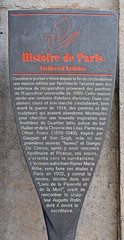
Ateliers d'Artistes Derrière le portail s'élève depuis la fin du siècle dernier une maison édifiée par l'architecte Taberlet avec des matériaux de récupération provenant des pavillons de l'Exposition universelle de 1889. Cette maison abrite une centaine d'ateliers d'artistes. Dans ces ateliers clairs et bon marché s'installèrent, bien avant la guerre de 1914, des peintres et des sculpteurs qui avait abandonné Montmartre pour chercher une nouvelle inspiration aux frontières du Quartier latin, autour du bal Bullier et de la Closerie des Lilas. Parmi eux, Othon Friesz (1879-1949), inspiré par Gauguin et Van Gogh, créa ici ses premières oeuvres "fauves" et Giorgio De Chirico, après y avoir rencontré Apollinaire et Picasso, ses voisins, s'orienta vers le surréalisme. L'écrivain autrichien Rainer Maria Rilke, venu faire ses études à Paris en 1902, y connut la misère, décrite dans son "Livre de Pauvreté et de la Mort", avant de rencontrer le sculpteur Auguste Rodin dont il devint le secrétaire.
English translation: Artists' Workshops Behind the portal has since the end of the last century been a house built by the architect Taberlet with recovery materials from the pavilions of the Universal Exhibition of 1889. This house houses about 100 artists' workshops. In these clear and inexpensive workshops, long before the War of 1914, painters and sculptors who had abandoned Montmartre to seek new inspiration at the borders of the Latin Quarter, around the Bullier Ball and the Closerie des Lilas. Among them, Othon Friesz (1879-1949), inspired by Gauguin and Van Gogh, created his first “fake” works here and Giorgio De Chirico, after meeting Apollinaire and Picasso, his neighbours, moved towards surrealism. Austrian writer Rainer Maria Rilke, who came to Paris in 1902, experienced poverty, described in his “Book of Poverty and Death”, before meeting the sculptor Auguste Rodin, of whom he became secretary. [AWS Translate]
9 rue Campagne-Première, Paris, France
Subjects


.jpg?width=250)
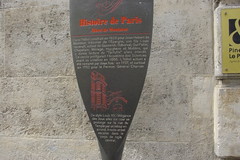
Hôtel de Montmor Dans l'hôtel construit en 1623 pour Jean Habert de Montmor, trésorier de l'Epargne, son fils Louis recevait, autour de Gassendi, Roberval, Gui Patin, Chapelain, Ménage, Huygens et Molière, qui y donna lecture du "Tartuffe" alors interdit. Ce cercle préfigurait l'Academie des Sciences avant sa création en 1666. L'hôtel actuel a été remanié par deux fois: en 1737, et surtout en 1752 pour le Fermier Général Charron. De style Louis XV, l'élégance des deux ailes sur cour se prolonge sur la rue du Temple par un retour en arrondi. Il reste un bel escalier dans le corps de logis central.
English translation: Hotel de Montmor In the hotel built in 1623 for Jean Habert de Montmor, treasurer of the Epargne, his son Louis received, around Gassendi, Roberval, Gui Patin, Chapelain, Housekeeping, Huygens and Molière, who read the “Tartuffe” then forbidden. This circle prefigured the Academie des Sciences before its creation in 1666. The present hotel was redesigned twice: in 1737, and especially in 1752 for the farmer General Charron. Louis XV style, the elegance of the two wings on the courtyard extends on the street of the Temple by a round return. There's still a nice staircase in the central housing body. [AWS Translate]
79, Rue du Temple, 3rd arrondissement, Paris, France
Subjects
_-_Google_Art_Project_(cropped).jpg?width=250)


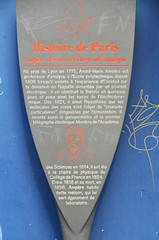
Ampère découvre l'électrodynamique Né près de Lyon en 1775, André Marie Ampère est Professeur d'analyse à l'école Polytechnique depuis 1809 lorsqu'il assiste a l'expérience d'Oersted sur la déviation de l'aiguille aimantée par un courant électrique : il en construit la théorie en quelques jours et pose ainsi les bases de l'électrodynamique. Dès 1821, il èmet l'hypothèse que les molécules des corps sont l'objets de "courants particulaires" dirigeables par l'aimantation. Il invent aussi le galvanomètre et le premier télégraphe électrique. Membre de l'Académie des Sciences en 1814, il est étu a la Chaire de Physique du Collège de France en 1824. Entre 1818 et sa mort, en 1836, Ampère habite cette maison, qui lui sert également de laboratoire.
English translation: Ampère discovers electrodynamics Born near Lyon in 1775, André Marie Ampère has been a professor of analysis at École Polytechnique since 1809 when he attended Oersted's experiment on the deflection of the magnetic needle by an electric current: he built the theory of it in a few days and thus laid the foundations of electrodynamics. As early as 1821, he hypothesized that the molecules of the bodies were the objects of “particulate currents” that were airborne by magnetization. They also invent the galvanometer and the first electric telegraph. A member of the Academy of Sciences in 1814, he was a Chair of Physics at the Collège de France in 1824. Between 1818 and his death in 1836, Ampère lived in this house, which also served as a laboratory. [AWS Translate]
29bis, Rue Monge, 5th arrondissement, Paris, France
