

La Salpêtrière. Cet immense hôpital doit son nom à l'entrepôt de poudre, ou "Petit arsenal", installé ici en 1643 et don subsistent deux bâtiments. Sur les mêmes terrains, Louis XIV décide en 1656 la construction d'un "Hôpital général" destiné aux femmes pauvres ou invalides, aux folles, puis aux filles publiques. Les architectes Duval, Le Vau, Libéral Bruant se succèdent entre 1658 et 1678. Au XVIIIe siécle, Boffrand, Payen et Viel, achèvent l'édification de la Salpêtrière; l'arc d'entrée, la façade et la chapelle Saint-Louis constituent un ensemble d'une puissante sobriété. Son histoire est riche en tragédies: de 1669 à 1750, les prostituées sont embarquées de forces aux colonies, le 4 septembre 1792, des fanatiques envahissent les bâtiments, violent et massacrent orphelines, prostituées et détenues. Les médecins Pinel (1745-1826) et Esquirol (1772-1840) améliorent néanmoins le traitement réservé aux aliénées. Les travaux de Vulpian (1826-1887), et surtout de Jean-Martin Charcot (1825-1893) aboutissent à la création de la première chaire mondiale de neurologie en 1882.
English translation: Salfman. This huge hospital owes its name to the powder warehouse, or “Small Arsenal”, installed here in 1643 and donation remain two buildings. On the same grounds, Louis XIV decided in 1656 to build a “General Hospital” for poor or disabled women, the insane and then the public daughters. The architects Duval, Le Vau, Libéral Bruant succeeded each other between 1658 and 1678. In the 18th century, Boffrand, Payen and Viel completed the construction of the Salpêtrière; the entrance arch, the façade and the chapel of Saint-Louis form a complex of powerful sobriety. Its history is rich in tragedies: from 1669 to 1750 prostitutes were forced into the colonies on 4 Sept. 1792, fanatics invaded buildings, violent and massacred orphans, prostitutes and prisoners. Doctors Pinel (1745-1826) and Esquirol (1772-1840) nevertheless improved the treatment of insane persons. The work of Vulpian (1826-87), and especially of Jean-Martin Charcot (1825-93), led to the creation of the first world chair in neurology in 1882. [AWS Translate]
47 Boulevard de l'Hôpital, Paris, France

Hôtel d'Hallwyll. Echu à François d'Hallwyll, colonel du régiment de la Garde suisse, un premier hôtel avait été loué à Necker, banquier suisse, future contrôleur général des finances de Louis XVI. Sa fille Germaine, devenue plus tard baronne de Staël, y naquit en 1766. La même année, Claude-Nicolas Ledoux édifié l'hôtel actuel, déjà de style Louis XVI. La façade sur rue est inspirée de l'antique. Sur cour, le corps de logis est beaucoup plus simple, mais il présentait sur le jardin une colonnade dorique, aujourd'hui dénaturée. Le décor intérieur a été dispersé: seul l'escalier demeure. Des hôtels construits à Paris par Claude-Nicolas Ledoux, l'hôtel d'Hallwyll est le seul à n'avoir pas été détruit.
English translation: Hallwyll hotel. A first hotel had been rented to François d'Hallwyll, Colonel of the Swiss Guard Regiment, in Necker, Swiss banker, future Chief Financial Officer of Louis XVI. His daughter Germaine, later baroness of Stael, was born there in 1766. In the same year, Claude-Nicolas Ledoux built the current Louis XVI. The façade on the street is inspired by the antique. On the courtyard, the housing body is much simpler, but it presented on the garden a doric colonnade, now denatured. The interior decor has been scattered: only the stairs remain. From hotels built in Paris by Claude-Nicolas Ledoux, Hallwyll's hotel is the only one that has not been destroyed. [AWS Translate]
28 rue Michel-le-Comte, Paris, France

La naissance d'une Etoile. Sarah Bernhardt voit le jour ici, le 25 octobre 1844, mais elle est assez vite placée en nourrice en Bretagne, puis mise au couvent, près de Versailles. Sa tante Rosine, très liée au duc de Morny, décide de sa carrière en la faisant entrer au Conservatoire en 1859, et sa véritable naissance date de sa rencontre avec le théâtre. "L'évolution se fit en moi à partir de ce jour. Je fus encore assez longtemps avec mon âme enfantine, mais mon cerveau perçut plus nettement la vie". Elle débute à l'Odéon dans "Le jeu de l'amour et du hasard", tout de suite adorée des étudiants, surnommés les "Saradoteurs"... "Je recevais des petits bouquets de violettes, des sonnets, des poèmes..." "Mais j'attendais: l'événement qui devait me consacrer Etoile. Et ce fut le plus grand poète du siècle dernier qui posa sur mon front la couronne des élus." A la fin de 1871, en effet, Hugo lui offre le rôle de la reine d'Espagne, dans "Ruy Blas" où elle triomphe: "j'étais restée jusqu'à ce jour, la petite fée des étudiants: je devins l'Elue du Public."
English translation: The birth of a Star. Sarah Bernhardt was born here on 25 Oct. 1844, but she was soon placed as a nurse in Brittany and then placed at the convent near Versailles. His aunt Rosine, closely linked to the Duke of Morny, decided on his career by bringing her to the Conservatory in 1859, and his real birth dates from his meeting with the theatre. “The evolution took place in me from that day on. I was still long enough with my childish soul, but my brain felt life more clearly.” She starts at Odeon in “The game of love and chance”, immediately loved by students, nicknamed the “Saradoteurs”... “I received small bouquets of violets, bells, poems...” “But I was waiting: the event that was to dedicate me Star. And it was the greatest poet of the last century who laid on my forehead the crown of the elect.” At the end of 1871, Hugo gave her the role of the queen of Spain, in “Ruy Blas” where she triumphed: “I had stayed until today, the little fairy of the students: I became the Elue of the Public.” [AWS Translate]
3 rue de l'École de Médecine, Paris, France

Confrérie des Chirurgiens. Etablie dès le Moyen Age dans les dépendances de l'église Saint Côme, la confrérie des chirurgiens fait édifier au XVIe siècle un local pour ses activités d'enseignement. Après une intervention chirurgicale réussie, Louis XIV l'autorise à se doter d'un amphithéâtre anatomique. Charles et Louis Joubert construisent entre 1691 et 1695 un superbe édifice octogonal coiffé d'un dôme à hautes fenêtres et à lanternes. L'Académie royale de chirurgie, fondée en 1748, ayant obtenu la création d'une faculté, ses anciens locaux sont attribués à "l'Ecole gratuite de dessin" où se forment générations d'ornemanistes. Constant-Dufeux fut chargé des travaux d'aménagement. L'Institut des langues modernes occupe actuellement ces bâtiments.
English translation: Brotherhood of the Chirurgians. Established in the Middle Ages in the outbuildings of the Church of Saint Como, the brotherhood of surgeons built a space for its teaching activities in the 16th century. After successful surgery, Louis XIV allows him to acquire an anatomical amphitheatre. Charles and Louis Joubert built between 1691 and 1695 a superb octagonal building with a dome with high windows and lanterns. The Royal Academy of Surgery, founded in 1748, having obtained the establishment of a faculty, its former premises are attributed to the “Free School of Drawing” where are formed generations of ornemanists. Constant-Dufeux was responsible for the development work. The Institute of Modern Languages currently occupies these buildings. [AWS Translate]
6 rue de l'École de Médecine, Paris, France

Faculté de Médecine. Le chirurgien La Martinière obtient de Louis XV la construction d'une Académie de chirurgie. L'architecte Gondouin réalise de 1769 à 1786 une partie d'un vaste projet, marqué par un retour à l'Antiquité classique: un portique à quatre rangées de colonnes ioniques devant une grande cour entourée d'une colonnade; le grand amphithéâtre s'ouvre au fond sous un péristyle corinthien. La Convention y réunit en 1794 les corporations rivales, médecins et chirurgiens, sou le nom d'"Ecole de santé" rebaptisée sous l'Empire "Faculté de médecine". L'architecte P. Ginain reprend de 1878 à 1900 les plans de Gondouin pour construire sur le boulevard Saint-Germain un édifice doté d'un bel escalier, qui abrite la salle du conseil, la riche bibliothèque, le musée et les archives de la Faculté.
English translation: Faculty of Medicine. The surgeon La Martinière gets from Louis XV the construction of an Academy of Surgery. The architect Gondouin carried out from 1769 to 1786 a part of a large project, marked by a return to classical antiquity: a four-row portico of ionic columns in front of a large courtyard surrounded by a colonnade; the large amphitheatre opens at the bottom under a Corinthian peristyle. In 1794 the Convention brought together the rival corporations, doctors and surgeons, the name “School of Health”, renamed the Empire “Faculty of Medicine”. The architect P. Ginain took Gondouin's plans from 1878 to 1900 to build on Boulevard Saint-Germain a building with a beautiful staircase, which houses the council hall, the rich library, the museum and the archives of the Faculty. [AWS Translate]
12 rue de l'École de Médecine, Paris, France

Collège des Grassins. Fondé en 1569 par un conseiller au Parlement du nom de Pierre Grassin, il est à l'origine prévu pour abriter dix-huit boursiers originaires du diocèse de Sens; un siècle de prospérité lui permet de devenir l'un des établissements les plus importants de la montagne Sainte-Geneviève, et l'un des dix grands collèges de l'Université de Paris. Ses premiers bâtiments sont édifiés grâce `Thierry Grassin, frère du fondateur, qui acquiert une partie de l'ancien hôtel d'Albret, et deux maisons voisines, rue des Sept-Voies (actuelle rue Valette). Quatre autres s'y ajoutent peu après, et la chapelle, dédiée à la Vierge, est consacrée en 1578 par l'évêque de Digne. Au début du XVIIIe siècle le Parlement doit intervenir pour mettre un terme aux dettes accumulées, mais sa renommée se maintient: Chamfort y est élève en 1755. Des bâtiments démantelés pour permettre, en 1844, l'ouverture de la rue de l'Ecole polytechnique, subsiste cette porte du XVIIe siècle.
English translation: College of Grassins. Founded in 1569 by an adviser to Parliament named Pierre Grassin, it was originally intended to house eighteen fellows from the diocese of Sens; a century of prosperity allowed it to become one of the most important establishments in Sainte-Geneviève Mountain, and one of the ten major colleges of the University of Paris. Its first buildings are built thanks to 'Thierry Grassin, brother of the founder, who acquires part of the former hotel of Albret, and two neighbouring houses, rue des Sept-Voies (now rue Valette). Four more were added shortly thereafter, and the chapel, dedicated to the Virgin, was consecrated in 1578 by the Bishop of Digne. At the beginning of the 18th century Parliament had to intervene to put an end to the accumulated debts, but its fame continued: Chamfort was raised there in 1755. This 17th-century door survives buildings dismantled to allow the opening of the Rue de l'Ecole Polytechnique in 1844. [AWS Translate]
12 rue Laplace, Paris, France

La place Maubert. Son appellation serait la corruption du nom d'Aubert, abbé de Sainte-Geneviève en 1161. Avant la création de la Sorbonne, elle fut un centre d'enseignement: Albert, dominicain allemand, dit le Grand, y professa. Marché au pain à la fin du Moyen Age, ce fut ensuite un lieu d'exécutions publiques, surtout au XVIe siècle: de nombreux protestants, dont le libraire humaniste Etienne Dolet, y furent brûlés vifs. Au XIXe siècle, la place abrite une myriade de petits métiers: fripiers, rempailleurs de chaises, fabricants d'arlequins, qui accommodaient les restes, chiffonniers, qui faisaient commerce de tabac récupéré sur les mégots, ou ravageurs, qui écumaient la boue des ruisseaux. Défigurée au XIXe siècle, elle garde quelques maisons anciennes, à l'angle de la rue Frédéric Sauton.
English translation: Place Maubert. His name would be corruption by the name of Aubert, Abbé de Sainte-Geneviève in 1161. Before the creation of the Sorbonne, it was an educational centre: Albert, Dominican German, says the Great, professed there. A bread market in the late Middle Ages, it was then a place of public executions, especially in the sixteenth century: many Protestants, including the humanist bookseller Etienne Dolet, were burned there alive. In the 19th century, the square was home to a myriad of small trades: fripiers, filled with chairs, manufacturers of harlequins, who accommodated the remains, rags, who traded recovered tobacco on the buttocks, or pests, who smoked the mud of the streams. Disfigured in the 19th century, it keeps a few old houses, at the corner of Rue Frédéric Sauton. [AWS Translate]
33 Place Maubert, Paris, France

Saint-Germain-des-Prés. Childebert, fils de Clovis, construit vers 543 une basilique dédiée à saint Vincent et à la sainte Croix; elle devient la nécropole des rois mérovingiens (chapelle Saint-Symphorien). Saint Germain, qui lui donne son nom, y est lui aussi inhumé en 576. Pillée par les Normands, l'église est réédifiée à partir de l'an mille; le clocher-porche en est le témoin. La construction est longue and apporte aux problèmes architecturaux des solutions nouvelles. La nef est achevée vers 1050. Le choeur en hémicycle est entouré d'un déambulatoire bordé par cinq chapelles rayonnantes voûtées d'ogives (1163). Pierre de Montreuil ajoute à l'église en 1245 la chapelle de la Vierge et le cloître aujourd'hui disparus. L'abbaye bénédictine, sous la dépendance directe du pape, adopte en 1631 la règle de Saint-Maur; elle devient un centre fécond de recherches historiques grâce à ses érudits, tel Dom Mabillon. En 1790 l'abbaye est supprimée. Si les restaurations menées dans l'église au XIXe siècle ne furent pas toujours heureuses, son architecture est désormais remise en valeur.
English translation: Saint-Germain-des-Prés. Childebert, son of Clovis, built around 543 a basilica dedicated to Saint Vincent and the Holy Cross; it became the necropolis of the Merovingian kings (chapel of Saint Symphorians). Saint Germain, who gave him his name, was also buried there in 576. The church was spoiled by the Normans and was rebuilt from the year 1000; the bell-porch witnessed it. Construction is long and brings new solutions to architectural problems. The nave is completed around 1050. The choir in the hemicycle is surrounded by an ambulatory bordered by five radiating chapels vaulted with warheads (1163). Pierre de Montreuil added to the church in 1245 the chapel of the Virgin and the cloister now missing. The Benedictine Abbey, under the direct dependence of the Pope, adopted the rule of Saint-Maur in 1631; it became a fruitful centre for historical research thanks to its scholars, such as Dom Mabillon. In 1790 the abbey was abolished. Although the restoration in the church in the 19th century was not always happy, its architecture is now refurbished. [AWS Translate]
3 place Saint-Germain des Prés, Paris, France

Atelier d'Henri Bouchard (1875-1960). L'auteur du grand Apollon de la terrasse du Palais de Chaillot abandonne en 1920 le quartier de Montparnasse pour acquérir dans le village de Passy une maison dotée d'un jardin où construire un atelier. Agé de 45 ans, l'artiste est déjà célèbre pour avoir réalisé, avec Landowski, le grand "Monument de la Réforme" à Genève. Les pièces du rez-de-chaussée de la maison contiennent encore les meubles dessinés par Henri Rapin et sculptés par Bouchard lors de son installation. L'atelier est resté en l'état, et conserve toujours certains plâtres originaux, les outils de travail, des exemples des techniques de modelage, de moulage ou de fonte, qui exposent un peu de la genèse d'une oeuvre.
English translation: Atelier by Henri Bouchard (1875-1960). The author of the great Apollo on the terrace of the Palais de Chaillot abandoned the Montparnasse district in 1920 to acquire in the village of Passy a house with a garden where to build a workshop. The 45-year-old artist is already famous for having made the great “Monument of Reformation” in Geneva with Landowski. The rooms on the ground floor of the house still contain furniture designed by Henri Rapin and carved by Bouchard during its installation. The workshop remained as it was, and still retains some original plasters, working tools, examples of modeling, molding or casting techniques, which expose a little of the genesis of a work. [AWS Translate]
25 rue de l'Yvette, Paris, France
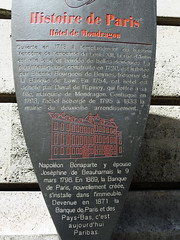
Hôtel de Mondragon. Ouverte en 1718 à l'emplacement du bastien Vendôme de l'enceinte de Louis XIII, la rue d'Antin est vite lotie et bord/eee de belles demeures. La plus prestigieuse, construite en 1720, est habitée par Etienne Bourgeois de Boynes, trésorier de la Banque de Law. En 1754, cet hôtel est acheté par Duval de l'Epinoy, qui l'offre à sa fille, Marquise de Mondragon. Confisqué en 1793, l'hôtel héberge de 1795 à 1833 la mairie du deuxième arrondissement. Napoléon Bonaparte y épouse Joséphine de Beauharnais le 9 mars 1796. En 1869, la Banque de Paris, nouvellement créée, s'installe dans l'immeuble. Devenue en 1871 la Banque de Paris et des Pays-Bas, c'est aujourd'hui Paribas.
English translation: Hôtel de Mondragon. Opened in 1718 to the site of the bastien Vendôme of the Louis XIII precinct, the Rue d'Antin was quickly subdivided and bordered by beautiful mansions. The most prestigious, built in 1720, was inhabited by Etienne Bourgeois de Boynes, Treasurer of the Bank of Law. In 1754, this hotel was bought by Duval de l'Epinoy, who offered it to his daughter, Marquise de Mondragon. Confiscated in 1793, the house held from 1795 to 1833 the town hall of the second arrondissement. Napoleon Bonaparte married Joséphine de Beauharnais here on March 9, 1796. In 1869, the newly created Banque de Paris moved into the building. Becoming in 1871 la Banque de Paris et des Pays-Bas, it is today Paribas.
3 rue d'Antin, Paris, France
Subjects


Ile Saint-Louis. En 1641 débute le lotissement et la construction de l'île, par les soins de Christophe Marie - dont ce pont a pris le nom - associé à Poulletier et Le Regrattier. Une voie centrale, deux séries de quais et trois rues de traverse constituent le maillage de cet habitat régulier et homogène achevé vers 1660. Des hôtels somptueux aux maisons les plus modestes règne sur les façades une harmonieuse diversité, la profonde unité d'un style architectural annonce les réalisations du règne de Louis XIV. Restée à l'écart des bouleversements de la voirie et du tissu urbain des deux derniers siècles, l'île Saint-Louis a subi peu de mutilations et présente toujours l'aspect d'un paisible vaisseau de pierre ancré au milieu de la Seine.
English translation: St. Louis Island. In 1641 the subdivision and construction of the island began, under the care of Christophe Marie - whose name this bridge took - associated with Poulletier and Le Regrattier. A central lane, two sets of docks, and three blocks of crossovers form the mesh of this regular and homogeneous habitat completed around 1660. From sumptuous hotels to the most modest houses reigns harmonious diversity on the facades, the deep unity of an architectural style announces the achievements of the reign of Louis XIV. Away from the upheavals of the roads and urban fabric of the past two centuries, Île Saint-Louis has undergone little mutilation and still has the appearance of a peaceful stone ship anchored in the middle of the Seine. [AWS Translate]
Quai de l'Archevêché near the Pont Saint Louis, Paris, France

Ancienne abbaye de Port-Royal: Réunie au groupe hospitalier Cochin, la maternité Baudelocque-Port-Royal abrite les bâtiments construits en 1625 pour les religieuses cisterciennes de Port-Royal. La chapelle, élevée en 1646-47 par l'architecte Antoine Lepautre, et le cloître adjacent, bâti entre 1652 et 1655, forment encore un incomparable asile de paix. Gagnées aux idées réformatrices et à l'austérité janseniste de leur aumônier, l'abbé de Saint-Cyran, les religieuses furent mises en demeure par Louis XIV, en 1664, de renoncer à leur doctrine; sur leur refus, il les fit expulser. Ce tragique épisode a inspiré a Henri de Montherlant, en 1954, la pièce "Port-Royal." En 1681, la duchesse de Fontanges, favorite de Louis XIV, mourut à Port-Royal (passé aux Visitandines) des suites d'un accouchement prématuré.
English translation: Former Port-Royal Abbey: Joining the Cochin Hospital Group, the Baudelocque-Port-Royal Maternity houses buildings built in 1625 for the Cistercian nuns of Port-Royal. The chapel, raised in 1646-47 by architect Antoine Lepautre, and the adjacent cloister, built between 1652 and 1655, still form an incomparable asylum of peace. Winning the reformatory ideas and the Jansenist austerity of their chaplain, the Abbot of Saint-Cyran, the nuns were warned by Louis XIV in 1664 to abandon their doctrine; upon their refusal he had them expelled. This tragic episode inspired Henri de Montherlant, in 1954, to play “Port-Royal.” In 1681 the Duchess of Fontanges, Louis XIV's favorite, died in Port-Royal (passed to the Visitandines) as a result of premature delivery. [AWS Translate]
On the corner of Blvd du Montparnasse and rue du Faubourg Saint-Jacques, Paris, France

Georges Méliès Né ici le 8 décembre 1861, Georges Méliès, fasciné dans son enfance par le théâtre tout proche de Robert Houdin, devient un illusionniste et prestidigitateur réputé. Enthousiasmé par l'avenir des images animées avant les frères Lumière eux-mêmes, il se fait construire le premier studio de l'histoire du cinéma, une sorte de hangar de 17 mètres sur 7, dans son jardin de Montreuil. Sa "Partie de cartes" date de 1896; il réalise alors plus d'une centaine de films, dont le célèbre "Voyage dans la lune", ancêtre de la science-fiction, long de 16 minutes. Inventeur de trucages sophistiqués, Méliès innove par l'irruption du merveilleux et du fantastique; il s'occupe lui-même de tout et fonde une maison de production, Star Films. Ruiné par la guerre et par l'explosion foraine du cinéma, il abandonne tout pour ouvrir un magasin de jouets près de la gare Montparnasse. Redécouvert en 1929, Méliès est président d'honneur de la Cinémathèque fondée par Langlois, de 1936 à sa mort, en 1938.
English translation: Georges Méliès Born here on December 8, 1861, Georges Méliès, fascinated in his childhood by the theatre close to Robert Houdin, became a renowned illusionist and magician. Enthused by the future of animated images before the Lumière brothers themselves, he was built the first studio in the history of cinema, a kind of hangar of 17 by 7 meters, in his garden in Montreuil. His “Map Game” dates back to 1896, making more than 100 films, including the famous “Journey to the Moon”, the ancestor of science fiction, 16 minutes long. An inventor of sophisticated tricks, Méliès innovates through the rush of wonderful and fantastic; he himself takes care of everything and founds a production company, Star Films. Ruined by war and the explosion of cinema, he abandoned everything to open a toy shop near the Montparnasse station. Rediscovered in 1929, Méliès was honorary president of the Cinémathèque founded by Langlois from 1936 to his death in 1938. [AWS Translate]
29 Boulevard Saint Martin, Paris, France
Subjects


Cité Internationale Universitaire. Sur un terrain de 40 hectares libéré par la démolition des anciennes fortifications fut créée, à partir de 1920, la Cité Internationale Universitaire, destinée à "favoriser les échanges entre les étudiants de toutes les nationalités choisis à un niveau élevé de leurs études et compte tenu de leurs ressources". Trente-sept pavillons, élevés entre 1923 et 1968, forment un ensemble architectural original et varié ainsi la très anglo-saxenne Fondation Deutsch de la Meurthe (Lucien Bechmann, 1925), la Fondation Suisse (Le Corbusier, 1932), le Collège néerlandais (W. Marinus-Didok, 1938) d'esprit cubiste, ou la Fondation franco-brésilienne (Lucio Costa et Le Corbusier, 1959). La Cité accueille près de 5000 étudiants de 120 nationalités différentes; elle dispose également d'une maison internationale ouverte à tous, d'un hôpital et d'une église dédiée au Sacré-Coeur des Etudiants, construite, faute de place, sur le territoire de Gentilly.
English translation: International University City. On a plot of 40 hectares liberated by the demolition of the ancient fortifications was created, from 1920, the International University City, designed “to foster exchanges between students of all nationalities chosen at a high level of their studies and taking into account their resources”. Thirty-seven pavilions, raised between 1923 and 1968, form an original and varied architectural ensemble thus the very Anglo-Saxon Foundation Deutsch de la Meurthe (Lucien Bechmann, 1925), the Swiss Foundation (Le Corbusier, 1932), the Dutch College (W. Marinus-Didok, 1938) of Cuban spirit, or the Franco-Brazilian Foundation (Lucio Costa and Le Corbusier, 1959). The City welcomes nearly 5000 students of 120 different nationalities; it also has an international house open to all, a hospital and a church dedicated to the Sacred Heart of the Students, built, for lack of space, on the territory by Gentilly. [AWS Translate]
19 boulevard Jourdan, Paris, France

L'immeuble Lavirotte Né d'un désir de rupture avec le passé et d'une réaction contra l'académisme, l'Art Nouveau s'est manifesté pendant une courte période, de 1890 à 1905 environ. Laissant libre cours à l'imagination créatrice, il apporte un souffle de jeunesse et de fantaisie. Ornementations surabondantes, nombreux motifs végétaux, les façades s'égayent de couleurs chatoyantes. Tous les matériaux sont utilisés: pierre, stuc, grès, céramique. Cet immeuble construit en 1901 par Jules Lavriotte pour le céramiste Alexandre Bigot est l'un des exemples les plus caractéristiques de l'Art Nouveau à Paris. La façade en grès flammé, d'une exubérance étonnante et harmonieuse, obtint le prix des façades de la Ville de Paris en 1903.
English translation: The Lavirotte Building Born from a desire to break with the past and a reaction contrasted academism, Art Nouveau manifested itself for a short time, from about 1890 to 1905. Leaving open the creative imagination, it brings a breath of youth and fantasy. Overabundant ornamentation, many plant motifs, the facades are brightly brightly coloured. All materials are used: stone, stucco, sandstone, ceramic. This building built in 1901 by Jules Lavriotte for ceramist Alexandre Bigot is one of the most characteristic examples of Art Nouveau in Paris. The flammed sandstone façade, with an astonishing and harmonious exuberance, won the price of the façades of the City of Paris in 1903. [AWS Translate]
29 avenue Rapp, Paris, France

Charles Péguy. Né à Orléans le 7 janvier 1873, Charles Péguy, après être passé par l'École normale supérieure de la rue d'Ulm et avoir suivi les cours de Bergson, est un dreyfusard militant lorsqu'il crée ici, le 5 janvier 1900, ses Cahiers de la Quinzaine. Entouré de collaborateurs tels Romain Rolland, Julien Benda ou Georges Sorel, il fait paraître 229 numéros jusqu'en juillet 1914, où il publie l'essentiel de ses oeuvres en prose, dont "Notre jeunesse" en 1910. "Lourde, répétitive, obstinée, la pensée se forme en même temps qu'elle se fait"... Après avoir retrouvé la foi catholique, et accompli plusieurs pèlerinages à Chartres, Péguy meurt au front en 1914.
English translation: Charles Péguy. Born in Orléans on 7 Jan. 1873, Charles Péguy, after passing through the École normale supérieure de la rue d'Ulm and following the courses of Bergson, was a militant dreyfusard when he created his Cahiers de la Quinzaine here on 5 Jan. 1900. Surrounded by collaborators such as Romain Rolland, Julien Benda or Georges Sorel, he published 229 issues until July 1914, where he published most of his works in prose, including “Our Youth” in 1910. “Lourde, repetitive, stubborn, thought forms at the same time as it is done”... After regaining the Catholic faith and carrying out several pilgrimages to Chartres, Péguy died at the front in 1914. [AWS Translate]
21 rue des Fossés Saint Jacques, Paris, France

La fondation Le Corbusier. D'origine suisse, Charles-Edouard Jeanneret, dit Le Corbusier (1887-1965), devient très jeune, par ses oeuvres et ses écrits, une figure de proue du style international. En 1923 il déclare: "L'architecture est le jeu savant, correct et magnifique des volumes assemblés sous la lumière", et lance en 1925 la célèbre formule: "Une maison est une machine à habiter!" Sa théorie du Modulor repose sur le nombre d'or: "Trouver une gamme harmonique à l'échelle des dimensions humaines, et qui soi universellement applicable à l'architecture, au mobilier, à la mécanique, cette idée m'avait préocupé depuis longtemps". Après sa mort, Malraux salue en ces termes sa dépouille exposée dans la Cour carrée du Louvre: "Il avait été peintre, sculpteur, et plus secrètement poète. Il ne s'était battu ni pour la peinture, ni pour la sculpture, ni pour la poésie: il ne s'est battu que pour l'architecture. Elle seule rejoignait son espoir confus et passionné de ce qui peut être fait pour l'homme".
English translation: Le Corbusier Foundation. Of Swiss origin, Charles-Edouard Jeanneret, dit Le Corbusier (1887-1965), became a prominent figure in international style by his works and writings. In 1923 he declared: “Architecture is the wise, correct and magnificent game of volumes assembled under the light”, and in 1925 launched the famous formula: “A house is a living machine!” His modulor theory is based on the number of gold: “To find a harmonic range at the scale of human dimensions, and which is universally applicable to architecture, furniture, mechanics, this idea had preconceived me for a long time.” After his death, Malraux greets in these words his remains as exhibited in the Square Court of the Louvre: “He had been a painter, sculptor, and more secretly a poet. He had not fought for painting, sculpture or poetry: he fought only for architecture. She alone joined her confused and passionate hope of what can be done for man.” [AWS Translate]
55 rue du Docteur Blanche, Paris, France

La Cité Fleurie. En 1878, un promoteur entreprend de construire une série d'ateliers d'artistes avec les matériaux provenant du démontage de l'Exposition Universelle sur un terrain vague attenant à une petite maison du XVIIIe siècle. Le renom de ses locataires et occupants va rendre la Cité fameuse: Eugène Grasset, initiateur du style 1900 ou Pierre Roy, peintre des natures mortes surréalistes. Rodin, Bourdelle, Maillol, y font patiner leurs bronzes. L'atelier de Daniel de Monfreid a été le logement précaire de Gauguin; le no. 9, celui de Modigliani; le no. 22 abrita Jean-Paul Laurens, puis César Domela. En 1973, l'opiniâtreté du peintre Cadiou et des artistes de la Cité Fleurie en a fait un site protégé.
English translation: La Cité Fleurie. In 1878, a promoter began to build a series of artists' workshops with materials from the dismantling of the Universal Exhibition on a vague plot adjoining a small 18th century house. The renown of its tenants and occupants will make the City famous: Eugène Grasset, initiator of the 1900 style or Pierre Roy, painter of surreal still life. Rodin, Bourdelle, Maillol, have their bronzes skated there. The workshop of Daniel de Monfreid was the precarious housing of Gauguin; No. 9, that of Modigliani; No. 22 housed Jean-Paul Laurens, then César Domela. In 1973, the stubbornness of the painter Cadiou and the artists of the Cité Fleurie made it a protected site. [AWS Translate]
65 Boulevard Arago, Paris, France
Dante rédige la Divine Comédie Depuis 1293, Florence est en proie à lutte incessante des partis guelfe et gibelin. Dante Alighieri, issu en 1265 d'une famille noble sans fortune, est proscrit en 1302, voué au bûcher s'il vient à être pris sur le territoire de la commune. Tous ses biens ont été confisqués, sa demeure brûlée; le poète mène alors jusqu'à sa mort, en 1321, une vie errante, et s'attache à la rédaction de son grand oeuvre. De passage à Paris, il célèbre dans ses écrits le "vico degli strami" (rue du fourrage); la rue tire en effet son nom des bottes de foin utilisées comme siège par les étudiants. Peut-être les Mystères représentés sur le parvis de Notre-Dame ont-ils contribué à nourrir l'inspiration visionnaire des cercles de l'Enfer!
English translation: Dante has been writing the Divine Comedy Since 1293, Florence has been in constant struggle with the guelf and gibelin parties. Dante Alighieri, born in 1265 of a noble family without fortune, was banned in 1302, dedicated to the stake if it comes to be taken on the territory of the commune. All his property was confiscated, his house burned, and the poet then led a wandering life until his death in 1321, and devoted himself to the writing of his great work. While in Paris, he celebrates in his writings the “vico degli strami” (rue du fourrage); the street derives its name from the hay boots used as the seat by the students. Perhaps the Mysteries represented on the parvis of Our Lady have helped to nourish the visionary inspiration of the circles of Hell! [AWS Translate]
10 rue Legrange, Paris, France
Subjects


La Mosquée. L'origine en est la création en 1920 de l'Institut musulman dirigé par SiKaddour ben Ghabrit, président de la Société des Habous des lieux saints de l'Islam, sous les auspices de la France qui participa au financement. Il s'y adjoignit le projet de construire une mosquée. La Ville de Paris offrit le terrain de l'ancien hôpital de la Pitié (75 000m2). La Société des Habous choisit les architectes Robert Fournez et Maurice Mantout, mais ce sont des artisans marocains, algériens et tunisiens qui ont réalisé les revêtements de marbres, de faïences polychromes, de stucs, les fontaines de porphyre et les portes de cèdre. La mosquée, édifiée grâce à la générosité des pays arabes, a été inaugurée en 1926. Son minaret s'élève à 26 mètres.
English translation: The Mosque. The origin was the creation in 1920 of the Muslim Institute, headed by SiKaddour bin Ghabrit, President of the Society of Habous of the Holy Places of Islam, under the auspices of France, which contributed to the funding. He joined the plan to build a mosque. The City of Paris offered the grounds of the old hospital of Mercy (75 000m2). The Société des Habous chose architects Robert Fournez and Maurice Mantout, but Moroccan, Algerian and Tunisian craftsmen made the coatings of marble, polychrome earthenware, stucco, porphyry fountains and cedar doors. The mosque, built thanks to the generosity of the Arab countries, was inaugurated in 1926. Its minaret is 26 metres. [AWS Translate]
39 rue Saint-Hilaire, Paris, France