
3 out of 7 (42%) plaques have been curated
9 subjects all or unphotographedGender Diversity
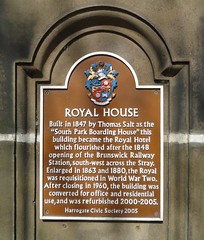
Royal House. Built in 1847 by Thomas Salt as the "South Park Boarding House" this building became the Royal Hotel which flourished after the 1848 opening of the Brunswick Railway Station, south-west across the Stray. Enlarged in 1863 and 1880, the Royal was requisitioned in World War Two. After closing in 1960, the building was converted for office and residential use, and was refurbished 2000-2005.
Station Parade, Harrogate, United Kingdom
Subjects

20 Park Parade. In 1796, this building was converted into a Methodist Chapel, later becoming a club house. From 1890-1912 it was the home and studio of Bernard Evans RA, the celebrated water colourist.
20, Park Parade, Harrogate, United Kingdom
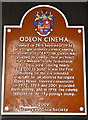
Odeon Cinema. Opened on 28th September 1936 as a single screened cinema seating an audience of 1,647, the Odeon was designed by cinema chain architect Harry Weedon, in the fashionable Art Deco style, costing nearly £32,000 to build. It was the first building on the site originally intended for an abortive Harrogate Opera House. Internal conversions in 1972, 1989 and 2001 provided multi-screens, and in 1996 the cinema featured on the 19p postage stamp.
East Parade, Harrogate, United Kingdom
Subjects
_004.JPG?width=250)
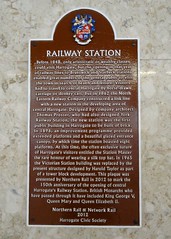
Railway Station. Before 1848, only aristocratic or wealthy classes could visit Harrogate, but the opening in that year of railway lines to Brunswick and Starbeck stations enabled great numbers of the general public to visit the town in search of health and leisure. Visitors had to travel to central Harrogate by horse-drawn carriage or donkey cart, but in 1862 the North Eastern Railway Company constructed a link line with a new station in the developing area of central Harrogate. Designed by company architect Thomas Prosser, who had also designed York Railway Station, the new station was the first public building in Harrogate to be built of brick. In 1896, an improvement programme provided extended platforms and a beautiful glazed entrance canopy, by which time the station boasted eight platforms. At this time, the often exclusive nature of Harrogate’s visitors entitled the Station Master the rare honour of wearing a silk top hat. In 1965 the Victorian station building was replaced by the present structure designed by Harold Taylor as part of a tower block development. This plaque was presented by Northern Rail in 2012 to mark the 150th anniversary of the opening of central Harrogate’s Railway Station. British Monarchs who have passed through it have included King George V, Queen Mary and Queen Elizabeth II.
Railway Station, Station Parade, Harrogate, United Kingdom
Subjects


.JPG?width=250)

The Magnesia Well. This pump room for the Magnesia Spring was erected by the Harrogate Improvement Commissioners in 1858.
Valley Gardens, Harrogate, United Kingdom

Grants Hotel. This terrace was built for the Duchy of Lancaster as private housing by George Dawson from 1881-1886. In the mid 1980s Nos 3-13 were converted into a hotel by the Grant family. It has been the home of the Harrogate Civic Society since 1991.
9, Swan Road, Harrogate, United Kingdom
Ogden's of Harrogate James Roberts Ogden founded the firm which bears his name in 1893 and acquired this building in 1910. An expert in precious metals, he accompanied Howard Carter's 1922 expedition to Egypt which discovered Tutankhamen's tomb and helped with the study of the gold artefacts found there. As advisor to the British Museum, he helped to restore gold objects in many European and American museums. In 1934 Ogden's remodelled some of Queen Alexandra's jewellery for Princess Marina of Kent and in 1937 handled the sale of a tiara once belonging to the Empress Josephine. They also made a cigar case for Winston Churchill and two silver tureens for Eleanor Roosevelt. In 1940 James Roberts Ogden 2nd took over the firm, which still remains a family business. Harrogate Civic Society 2006
38 James Street, Harrogate, United Kingdom