
Harrogate
Gender Diversity
The top 10


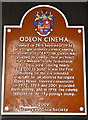
Odeon Cinema. Opened on 28th September 1936 as a single screened cinema seating an audience of 1,647, the Odeon was designed by cinema chain architect Harry Weedon, in the fashionable Art Deco style, costing nearly £32,000 to build. It was the first building on the site originally intended for an abortive Harrogate Opera House. Internal conversions in 1972, 1989 and 2001 provided multi-screens, and in 1996 the cinema featured on the 19p postage stamp.
East Parade, Harrogate, United Kingdom
Subjects
_004.JPG?width=250)

Victoria Gardens occupies the site of Harrogate's first covered public market, built in 1874 to the design of Arthur Hiscoe. On 31 January 1937, this building was destroyed by fire and was replaced in 1939 by a new market hall designed by Leonard Clarke. The present building, funded by the National Provident Institution and developed in partnership with Harrogate Borough Council and Speyhawk Retail plc (Architects: Cullearn & Phillips of Manchester) opened to the public on 9 November 1992. Inspited by Palladio's Basilica at Vicenza, Victoria Gardens continues Harrogate's tradition of quality shopping whilst retaining the market. As part of the development, Station Square was remodelled and Queen Victoria's monument, built to commemorate the Golden Jubilee of 1887, was cleaned and illuminated by the Borough Council.
Victorian Gardens, Station Square, Harrogate, United Kingdom

Kings Road Promenade Well. This pure water well is fed from the natural ground waters of the Springfield Estate to the north of this plaque. The shaft appears to have been built between 1780 and 1830, the water being used to supply a neighbouring farm. Following the 1911 gift of W.H. Baxter (inventor of the road knapping process), which created a tree-lined promenade in memory of King Edward VII, the disused well was paved over. On restoration of the Kings Road Promenade in 2010, the well was rediscovered, and with the support of Harrogate Chamber of Trade and Commerce and Harrogate in Bloom, it was made a feature of the improvements.
King's Road, Harrogate, United Kingdom

The Royal Baths. The Royal Baths were built from 1894-7 by London architects Bagalley and Bristowe, winners of the Harrogate Corporation competition and opened by H.R.H. The Duke of Cambridge on 23rd July 1897. The sulphur and kissingen springs beneath the building are amongst the finest in England. The major extension of 1936-9, designed by Leonard Clarke replaced the Winter Gardens with the Lunge Hall and Fountain Court. The development of the Royal Baths occurred a few years before the building of the Royal Hall and Roundhill Reservoir which together must represent an almost unparalleled example of municipal enterprise.
Crescent Road, Harrogate, United Kingdom

Cathcart House. Built shortly after 1860, Cathcart House was soon established by the Allen family as one of Harrogate's leading board houses. Princess Alix of Hesse, who became Czarina in 1894, stayed here, and until her murder in 1917 by the Bolsheviks, acted as Godmother to the owner's twin children. In 1911, a tea-party was attended by Empress Marie of Russia; Queen Alexandra, former Empress of India; King Manuel of Spain; Prince Christopher of Greece; Princess Victoria and the Grand Duchess George of Russia. A.A. Thompson's novel of life in pre-1914 Harrogate, "The Exquisite Burden" features Cathcart House, where it is disguised as Mexborough Hall.
1, Prospect Place, Harrogate, United Kingdom
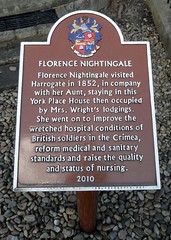
Florence Nightingale. Florence Nightingale visited Harrogate in 1852, in company with her aunt, staying in this York Place house then occupied by Mrs Wright's lodgings. She went on to improve the wretched hospital conditions of British soldiers in the Crimea, reform medical and sanitary standards and raise the quality and status of nursing.
York Place, Harrogate, United Kingdom
Subjects

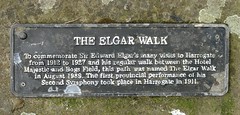
The Elgar Walk. To commemorate Sir Edward Elgar's many visits to Harrogate from 1912 to 1927 and his regular walk between the Hotel Majestic and Bog Field, this path was named the Elgar Walk in 1989. The first provincial performance of his second symphony took place in Harrogate in 1911.
Elgar Walk, Elgar Gardens, Harrogate, United Kingdom
Subjects

The Stray. When the Great Forest of Knaresborough was enclosed by the Act of 1770, an award dating from 19th August 1778 set aside as common land 200 acres between the ancient villages of High and Low Harrogate to protect the public right of access to the unique mineral springs and to provide exercise space for all in search of health. The award states '...the 200 acres shall forever hereafter remain open and unenclosed, and all persons shall and may have free access at all times to the said springs... and enjoy full and free ingress, egress and regress in, upon and over the said 200 acres...'. Grazing rights were controlled by gate holders until the 1893 Stray Act passed control to Harrogate Corporation, whose successors administer, but do not own, this priceless public asset.
Montpellier Hill, Harrogate, United Kingdom

The Crown Hotel. The Crown is probably the oldest of the great Low Harrogate hotels, existing long before Joseph Thackwray became the owner in 1740. The nearness of the sulphur well and the provision of the highest standards of accommodation resulted in the small inn rapidly becoming an importnat hotel. In 1835 his great nephew, also named Joseph, achieved notoriety after sinking his own well close to the sulphur well but, following a hearing at York assizes in 1837, agreed to give up the well to public use. Lord Byron stayed here in the autumn of 1806 and, in addition to writing the "Ode to a Beautiful Quaker", was much distressed that his favourite dog had to be shot after attacking a horse. In 1839, at the outbreak of World War II, the Crown was requisitioned by the Air Ministry who remained until 1959, when it reverted to an hotel.
Crown Place, Harrogate, United Kingdom

This tablet was erected by the officers and nurses of the 116th General Hospital of the United States Army who, serving their country during World War II, spent happy days in Harrogate and enjoyed the hospitality of all Yorkshire. July 28 1944. May 11 1945.
Valley Gardens, Harrogate, United Kingdom

Crown Place. A few feet from this shop once stood the shop in once the notorious attempt was made by Joseph Thackwray, owner of the Crown Hotel, to divert the waters of the public sulphur spring into private control by means of the excavation of a new well. The discovery of this by Jonathon Shutt, owner of the Swan Hotel, on 1st December 1835, led to such an outcry that steps were taken not only to prosecute Thackwray but also to form a local authority with powers to protect the mineral springs and to improve the townships of Bilton - with - Harrogate and Pannal. The act of 1841 established the improvement commisioners who administered the town with great ability until 1884, when Queen Victoria granted Harrogate's incorporation as a borough.
Crown Place, Harrogate, United Kingdom

Wintergarden. Largely inspired by the design of the Crystal Palace, the Wintergarden was built in 1897 for the Royal Baths development. It was largely demolished in 1938 but the original entrance and staircase were preserved. In December 1900, Winston Churchill spoke here of his experience as a prisoner during the Boer War.
Parliament Street, Harrogate, United Kingdom
Subjects

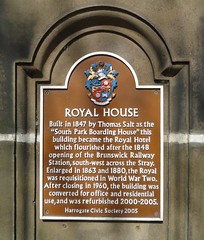
Royal House. Built in 1847 by Thomas Salt as the "South Park Boarding House" this building became the Royal Hotel which flourished after the 1848 opening of the Brunswick Railway Station, south-west across the Stray. Enlarged in 1863 and 1880, the Royal was requisitioned in World War Two. After closing in 1960, the building was converted for office and residential use, and was refurbished 2000-2005.
Station Parade, Harrogate, United Kingdom
Subjects

The former Queen Hotel. Tradition dates Harrogate's oldest hotel from 1687 when it was built as a coaching inn called the "Queen's Head" possibly after Catherine of Braganza, consort of Charles II, who received the revenues of the Forest of Knaresborough. It was rebuilt in its present form in 1855 and extended in 1961. The owner, John Dearlove, together with J. Dunn of the Granby and J. Shutt of the Swan was a prosecutor of Thackwray of the Queen Hotel, whose attempt in 1835 to divert the waters of the public sulphur spring led to a demand for better protection of the mineral springs. This was accomplished when, following three public meetings held here in November 1840, Parliament passed the Improvement Act of 1841. The costs of the Thackwray case were met by Dearlove, Benn and Shutt, whose public spirited action ensured the future of Harrogate. In 1951 the hotel became the regional headquarters for the National Health Service before reopening as a hotel in 1999.
Park Parade, Harrogate, United Kingdom

20 Park Parade. In 1796, this building was converted into a Methodist Chapel, later becoming a club house. From 1890-1912 it was the home and studio of Bernard Evans RA, the celebrated water colourist.
20, Park Parade, Harrogate, United Kingdom

Ogden's of Harrogate James Roberts Ogden founded the firm which bears his name in 1893 and acquired this building in 1910. An expert in precious metals, he accompanied Howard Carter's 1922 expedition to Egypt which discovered Tutankhamen's tomb and helped with the study of the gold artefacts found there. As advisor to the British Museum, he helped to restore gold objects in many European and American museums. In 1934 Ogden's remodelled some of Queen Alexandra's jewellery for Princess Marina of Kent and in 1937 handled the sale of a tiara once belonging to the Empress Josephine. They also made a cigar case for Winston Churchill and two silver tureens for Eleanor Roosevelt. In 1940 James Roberts Ogden 2nd took over the firm, which still remains a family business. Harrogate Civic Society 2006
38 James Street, Harrogate, United Kingdom

In this part of the Valley Gardens are found many of the sulphur and iron waters used in the spa treatment at the Royal Baths. Thirty six springs arise within an acre. No two are exactly alike in chemical composition. So far as is known, in no similar area in the world can such a diversity of springs be found. These facts make the Valley Gardens unique.
Valley Gardens, Harrogate, United Kingdom

Grants Hotel. This terrace was built for the Duchy of Lancaster as private housing by George Dawson from 1881-1886. In the mid 1980s Nos 3-13 were converted into a hotel by the Grant family. It has been the home of the Harrogate Civic Society since 1991.
9, Swan Road, Harrogate, United Kingdom
.jpg?width=250)
Beech Villa and its neighbour, Beech Lodge, were built in the 1950's as a model development by the Duchy of Lancaster and served for many years as private hotels. In 1913 E. M. Forster, the author of 'Howard's End', 'A Passage to India', etc, stayed here when writing his controversial novel 'Maurice'. The buildings are not open to the public
1 Esplanade, Harrogate, United Kingdom
Subjects


Hotel Majestic. The Hotel Majestic opened on 18 July 1900 as the finest hotel of the world's greatest spa. Built by Frederick hotels and designed by London architect G. D. Martin, the majestic has, for over a century, been the preferred address of visitors such as Winston Churchill, Edward Elgar, Errol Flynn, 'James Herriot', G. B. Shaw and several Prime-Ministers. Bombed on 12 July 1940, the Hotel Majestic served as an RAF Reception Centre during the Second World War. It was extensively refurbished between 1998 and 2002.
Ripon Road, Harrogate, United Kingdom
Subjects


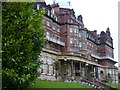
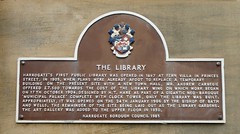
The library. Harrogate's first public library was opened in 1887 at Fern Villa in Princes Street. In 1903, when plans were already afoot to replace a temporary building on the present site with a new town hall, Mr Andrew Carnegie offered £7,500 toward the cost of the library wing on which work began on 17th October 1904. Designed by H.T. Hare as part of a gigantic neo-baroque 'municipal place' complete with clock tower, only the library was built. Appropriately, it was opened on the 24th January 1906 by the Bishop of Bath and Wells, the remainder of the site being laid out as the library gardens. The art gallery was added to the upper floor in 1930.
Victoria Avenue, Harrogate, United Kingdom
Subjects


Bogs Field. Behold Bogs Field, a wonder of the natural world where a greater number of unique mineral springs come to the surface than at any other place known on Earth! 36 of Harrogate's 88 mineral wells are found here, of which no two are alike. The waters are Magmatic or Plutonic in origin, having never existed as rain, and have flowed deep beneath the Earth for 20,000 years before surfacing in vertical shafts in the strata . Known in C15 as Sauerkeld or Sour Springs, Bogs Field was investigated and developed by the Victorians who piped the mineral waters to the Royal Bath Hospital and to the Pump Rooms and Baths of Low Harrogate.
Valley Gardens, Harrogate, United Kingdom

Magnesia Well. The Magnesia Well (number 54 on the official list) was identified by Dr. Short in his 1652 book "The Yorkshire Spaw". Recommended as a powerful diuretic, the Magnesia Well contains a mild sulphur water, which was once highly popular, requiring the neighbouring Pump Room to be built in 1858, succeeded in 1895 by the New Magnesia Pump Room, now the Cafe. The water was analysed in 1865 by the celebrated chemist Dr. Sheridan Muspratt. this Well Head was restored in 1999 by the Harrogate Civic Society, the cost having been donated in loving memory of Kit Kelly, by his mother, Irene, and brother, David.
Valley Gardens, Harrogate, United Kingdom

The Magnesia Well. This pump room for the Magnesia Spring was erected by the Harrogate Improvement Commissioners in 1858.
Valley Gardens, Harrogate, United Kingdom

Prospect Square. Prospect Square was developed between 1859 and 1880 on land once owned by the Carter Family. Cambridge Crescent (N) of 1867-8 and Prospect Crescent (E) of 1873-80 were built by George Dawson and designed by J.H. Hirst who also designed St. Peter's Church (NE) of 1870-6, of which the tower, designed by A.A. Gibson, was built in 1926. The Prospect Hotel (S) of 1859 was given a tower and enlarged in 1870 to a design by Perkin and Son and a further rebuilding in 1937 permitted the widening of James Street. The war memorial was built in 1922-3 to a design by Prestwich and Sons, the two relief panels being sculpted by Gilbert Ledward.
Prospect Square, Harrogate, United Kingdom

Montpellier Baths. This land once formed part of the Crown Hotel estate owned by Joseph Thackwray, who owned a pump room in Chinese style over the strong sulphur spring in 1822, admittance to the surrounding pleasure gardens being through this ticket office. The Crown Baths, built in 1834 and later known as the Montpellier Baths, were the best in Harrogate until the completion of the New Victoria Baths (now the council offices) in 1871. George Dawson bought the estate in 1869 and commissioned the architect J.H. Hirst to build a great new pump room. In 1888 Harrogate Corporation purchased the estate for £29, 500 and launched a national competition for a magnificent new building - the Royal Baths. The Pump Room was demolished in 1954 to make way for a car park.
Montpellier Gardens, Harrogate, United Kingdom

The Old Town Hall. This building was erected in 1805 by private subscription to provide shelter and a meeting place for visitors to the spa. At a meeting here on 6th July 1841 the newly formed Harrogate Improvement Commisioners decided to build the Royal Pump Room. Remodelled in 1875 by Arthur Hiscoe, the Old Town Hall has been variously known as the Promenade Room, the Voctoria Room and the Town Hall Theatre. Lily Langtry and Oscar Wilde were two of the many celebrities to perform here.
31, Swan Road, Harrogate, United Kingdom
.jpg?width=250)
HALE'S BAR Inns were established near the world's strongest sulphur well by the 1660 s and the antiquity of Hale's Bar is shown by its cellars, as such excavations were prohibited by an Act of 1770. The Inn would have been known to Tobias Smollett who in 1766 visited Harrogate in which he set part of his novel 'Humphrey Clinker'. It was a lively coaching inn, with coaches such as 'The Courier', 'Tally Ho!' and 'Teazle' arriving and departing. Known as the 'Promenade Inn' after the opening of the nearby Promenade Room in 1806, it changed it's name to 'Hodgson's' (c.1849) before adopting the name of it's new landlord, William Hale, in about 1882. Enlarged to the east in 1856, the inn was a favourite with Sir John Barbirolli who visited Harrogate each summer with the Halle Orchestra throughout the 1950's and 1960's. Hale's Bar still retains its gas-lit, early Victorian interior, used in 1980 for publicity shots for the film 'Chariots of Fire' 1997
1-3 Crescent Rd, Harrogate, United Kingdom
.jpg?width=250)
Crescent Gardens derives its name from the Crescent Inn, and early 18th century establishment known originally as 'The Globe' and later as 'The Half Moon'. The discover in 1783 of an important mineral spring brought prosperity to the inn before its demolition in the 1890's for the construction of these gardens. Nearby once stood the old Victoria Baths, built in 1832 by John Williams as the first purpose built baths in Harrogate. Afte the opening of the Improvement Commissioners' New Victoria Baths in 1871 they became redundant and were later bought by Sampson Fox for re-erection on his Grove House estate. The Eastern part of Crescent Gardens forms part of The Stray.
Crescent Gardens, Harrogate, United Kingdom
.jpg?width=250)
Prospect Cottage. These premises contain Prospect Cottage, principal farmhouse of medieval Crookisnab - an irregular promontory seperating the two ancient villages of High and Low Harrogate. From 1814 to 1825 it was home to James Franklin, who in 1810 purchased for £9000 the whole of central Harrogate between York Place and the site of the Hotel Majestic. Until c.1780, Prospect Cottage was central Harrogate's only substantial building.
47 Oxford Street, Harrogate, United Kingdom
.jpg?width=250)
Harrogate Theatre. Opened on 13 January 1900 as the Grand Opera House, designed by F.A. Tugwell, with a fine foyer frieze by Frances Darlington added later, the building was refurbished in the mid 1970s and 2007-9 and is home to theatrical activities that have flourished in Harrogate since the 1760s. Performers who have appeared here include Sarah Bernhardt, Mrs Patrick Campbell, Charlie Chaplin, Sonia Dresdel, Trevor Howard, George Robey, Ellen Terry, Arnold Ridley, Fats Waller, Ken Dodd, Martin Shaw, Ben Kingsley and Eddie Izzard. Home of the White Rose Players 1933-1955.
Oxford Street, Harrogate, United Kingdom
Subjects


.jpg?width=250)


.jpg?width=250)
Oxford Street. Known as Chapel Street before its renaming in 1908, this thoroughfare was the first direct link between the sulphur well in Low Harrogate and the Chapel of Ease of 1749 (later rebuilt as Christ Church) in High Harrogate. Its principal buildings were the Wesley Chapel of 1862, Belle Vue (home of the remarkable Captain Thrush) of 1826, the Old Ship Inn, and the Grand Opera House (now the Harrogate Theatre) of 1900. These present offices for the Halifax Building Society (architects Jackson & Calvert) were completed in 1987, replacing an 1860's villa (possibly built as a manse to the Wesley Chapel) on the same site.
24 Oxford Street, Harrogate, United Kingdom
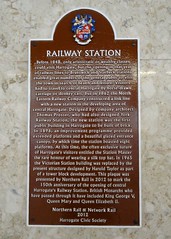
Railway Station. Before 1848, only aristocratic or wealthy classes could visit Harrogate, but the opening in that year of railway lines to Brunswick and Starbeck stations enabled great numbers of the general public to visit the town in search of health and leisure. Visitors had to travel to central Harrogate by horse-drawn carriage or donkey cart, but in 1862 the North Eastern Railway Company constructed a link line with a new station in the developing area of central Harrogate. Designed by company architect Thomas Prosser, who had also designed York Railway Station, the new station was the first public building in Harrogate to be built of brick. In 1896, an improvement programme provided extended platforms and a beautiful glazed entrance canopy, by which time the station boasted eight platforms. At this time, the often exclusive nature of Harrogate’s visitors entitled the Station Master the rare honour of wearing a silk top hat. In 1965 the Victorian station building was replaced by the present structure designed by Harold Taylor as part of a tower block development. This plaque was presented by Northern Rail in 2012 to mark the 150th anniversary of the opening of central Harrogate’s Railway Station. British Monarchs who have passed through it have included King George V, Queen Mary and Queen Elizabeth II.
Railway Station, Station Parade, Harrogate, United Kingdom
Subjects


.JPG?width=250)

The Council Offices. This building was reconstructed in 1931 by Leonard Clarke from the New Victoria Baths, erected by the Harrogate improvement commissioners in 1871 and the scene of their meetings for several years. The baths were designed by James Richardson and the foundation stone was laid on 4th February 1871 by Richard Ellis.
Crescent Gardens, Harrogate, United Kingdom
Agatha's Retreat. In 1926 Agatha Christie hid away in the Old Swan Hotel. Her 10 day disappearance created one of the greatest man-hunts in history
The Old Swan, Harrogate, United Kingdom
Subjects

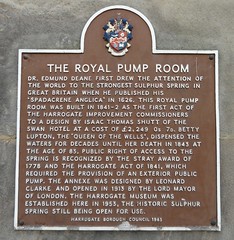
The Royal Pump Room. Dr. Edmund Deane first drew the attention of the world to the strongest sulphur spring in Great Britain when he published his 'Spadacrene Anglica' in 1626. This Royal Pump Room was built in in 1841-2 as the first act of the Harrogate Improvement Commissioners to a design by Isaac Thomas Shutt of the Swan Hotel at a cost of £2,249 0s 7d. Betty Lupton, 'The Queen of the Wells' dispensed the waters for decades until her death in 1843 at the age of 83. Public right of access to the spring is recognized by the stray award of 1778 and the Harrogate Act of 1841. Which required the provision of an exterior public pump. The annexe was designed by Leonard Clarke and opened in 1913 by the Lord Mayor of London. The Harrogate Museum was established here in 1953, the historic sulphur spring still being open for use.
Crown Place, Harrogate, United Kingdom
Subjects

Pure Chalybeate Well. The Pure Chalybeate Well (number 53 on the official list) is a remarkably pure water, of very low salinity, similar to High Harrogate's St. John's and Tewit wells all of which were once used to treat delicate and anaemic patients. the water was once piped to the Royal Baths for aeration. Harrogate Civic Society restored the Well Head in 1999.
Valley Gardens, Harrogate, United Kingdom

Victoria Avenue. The work of the Victoria Park Company in joining the two ancient villages of High and Low Harrogate to form a modern town reached a climax in 1860 with the opening of Victoria Avenue. Two of the first developments were the Belvedere of 1861, now the College of Arts and the congregational church by Lockwood and Mawson of 1861-2. The avenue at one time had private entrance gates and the combination of wide roads and pavements. Grass verges, trees and noble buildings provided an example from which future generations could obtain inspiration.
Victoria Avenue, Harrogate, United Kingdom
Subjects

The Kursaal. Harrogate Council's 1898 competition for the design of a Kursaal or "Cure Hall" was won by London architect Robert Beale, who worked with Frank Matcham, England's most celebrated theatrical designer. The Kursaal was opened by Sir Hubert Parry on 28th May 1903 and is the only remaining building of its type in the country. Intended to complement the town's other spa facilities the Kursaal contained many innovations that provided great flexibility of use. Renamed the "Royal Hall" in 1918, the building has been host to the greatest artists of the day - from Sir Edward Elgar to The Beatles. Following a complete restoration from 2006-8, Matcham's spectacular interior now contains more gold leaf than any similar auditorium in England. The much-loved building was reopened by HRH The Prince of Wales, patron of the Royal Hall Restoration Trust, on 22nd January 2008.
Ripon Road, Harrogate, United Kingdom
Subjects


.jpg)
.jpg)
.jpg)
.jpg)
.jpg)
.jpg)

Hotel St. George. This hotel grew out of the Chequers Inn built near the C18 toll bar on the Leeds and Ripon turnpike roads. renamed the "George" after George II's gift of the Stray in 1778, the hotel was enlarged on several occasions during the C19. A fire on 5th May 1927 damaged much of the roof but the internal stained glass survived. Renamed the "St. George" shortly before the First World War, in the Second the hotel was requisitioned by the Post Office and Air Minstry. It re-opened in 1952, and acquired a spa facility in 1985.
1, Ripon Road, Harrogate, United Kingdom