

The Strangers In 1565 the City authorities invited Protestant refugees from the Spanish Netherlands to settle in Norwich to boost the City's textile industry. 30 households of master weavers came over from Flanders, of which 24 were Flemish and 6 were French-speaking Walloons. Soon followed by many more, they became known as the Strangers, and at their peak accounted for over a third of the City's population.
Pottergate, Norwich, United Kingdom

Plains of Norwich The Dutch and Flemish who came to Norwich in the 16th century left their mark on the Norwich landscape and local language. From the Dutch 'plein', the Norwich 'plains' define the squares and open spaces of land, in the midst of the narrow maze of streets. Maddermarket Plain, St Giles' Plain, St Benedict's Plain, St Margaret's Plain and St Andrew's Hall Plain can be found in the Norwich Lanes area.
Expresso, St George's Street, Norwich, United Kingdom
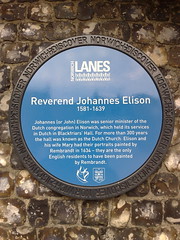
Reverend Johannes Elison 1581-1639 Johannes (or John) Elison was senior minister of the Dutch congregation in Norwich, which held its services in Dutch in Blackfriars' Hall. For more than 300 years the hall was known as the Dutch Church. Elison and his wife Mary had their portraits painted by Rembrandt in 1634 - they are the only English residents to have been painted by Rembrandt.
Princes Street, Norwich, United Kingdom
Subjects
United Reformed Church Originally a Congregational Church the current building, along with the adjoining Church rooms on Redwell St, was designed by well-known Norwich architect Edward Boardman. He was also responsible, amongst other projects, for converting Norwich Castle into a Museum.
Princes Street, Norwich, United Kingdom
Subjects
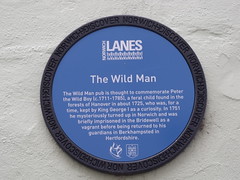
The Wild Man pub is thought to commemorate Peter the Wild Boy (c.1711-1785), a feral child who was, for a time, kept by King George I as a curiosity. In 1751 he mysteriously turned up in Norwich and was briefly imprisoned in the Bridewell as a vagrant before being returned to his guardians in Berkhampstead in Hertfordshire.
Bedford Street, Norwich, United Kingdom
Subjects

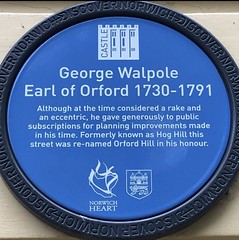
George Walpole Earl of Orford 1730-1791 Although at the time considered a rake and an eccentric, he gave generously to public subscriptions for planning improvements made in his time. Formerly known as Hog Hill this street was re-named Orford Hill in his honour.
Orford Hill, Norwich, United Kingdom
Subjects

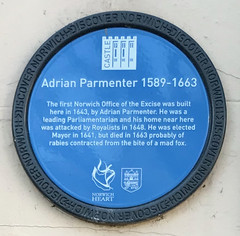
Adrian Parmenter 1589-1663 The first Norwich Office of the Excise was built here in 1643, by Adrian Parmenter. He was a leading Parliamentarian and his home near here was attacked by Royalists in 1648. He was elected Mayor in 1641, but died in 1663 probably of rabies contracted from the bite of a mad fox.
Timberhill, Norwich, United Kingdom
Subjects
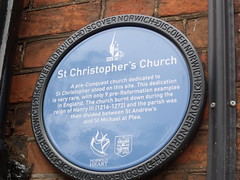
St Christopher's Church A pre-Conquest church dedicated to St Christopher stood on this site. This dedication is very rare, with only 9 pre-Reformation examples in England. The church burnt down during the reign of Henry III (1216-1272) and the parish was then divided between St Andrew's and St Michael at Plea.
Princes Street, Norwich, United Kingdom
Subjects
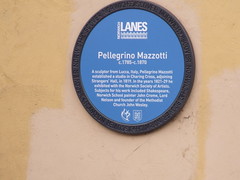
Pellegrino Mazzotti c.1785-c.1870 A sculptor from Lucca, Italy, Pellegrino Mazzotti established a studio in Charing Cross, adjoining Strangers' Hall, in 1819. In the years 1821-29 he exhibited with the Norwich Society of Artists. Subjects for his work included Shakespeare, Norwich School painter John Crome, Lord Nelson and founder of the Methodist Church John Wesley.
Charing Cross, Norwich, United Kingdom
Subjects
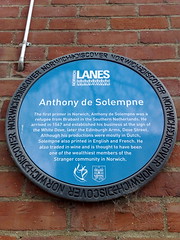
Anthony de Solempne The first printer in Norwich, Anthony de Solempne was a refugee from Brabant in the Southern Netherlands. He arrived in 1567 and established his business at the sign of the White Dove, later the Edinburgh Arms, Dove Street. Although his productions were mostly in Dutch, Solempne also printed in English and French. He also traded in wine and is thought to have been one of the wealthiest members of the Stranger community in Norwich
Dove Street, Norwich, United Kingdom
Subjects
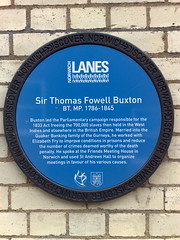
Sir Thomas Fowell Buxton BT. MP. 1786-1845 Buxton led the Parliamentary campaign responsible for the 1833 Act freeing the 700,000 slaves then held in the West Indies and elsewhere in the British Empire. Married into the Quaker Banking family of the Gurneys, he worked with Elizabeth Fry to improve conditions in prisons and reduce the number of crimes deemed worthy of the death penalty. He spoke at the Friends Meeting House in Norwich and used St Andrews Hall to organize meetings in favour of his various causes.
Upper Goat Lane, Norwich, United Kingdom
Subjects

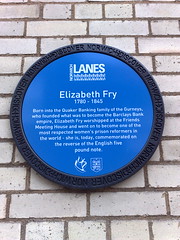
Elizabeth Fry 1780-1845 Born into the Quaker Banking family of the Gurneys, who founded what was to become the Barclays Bank empire, Elizabeth Fry worshipped at the Friends Meeting House and went on to become one of the most respected women's prison reformers in the world - she is, today, commemorated on the reverse of the English five pound note
Upper Goat Lane, Norwich, United Kingdom
Subjects

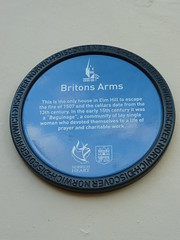
Britons Arms This is the only house in Elm Hill to escape the fire of 1507 and the cellars date from the 13th century. In the early 15th century it was a "Beguinage", a community of lay single women who devoted themselves to a life of prayer and charitable work.
Britons Arms, 9 Elm Hill, Norwich, United Kingdom
Subjects
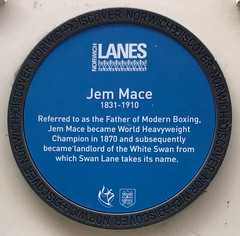
Jem Mace 1831-1910 Referred to as the Father of Modern Boxing, Jem Mace became World Heavyweight Champion in 1870 and subsequently became landlord of the White Swan from which Swan Lane takes its name.
Swan Lane, Norwich, United Kingdom
Subjects

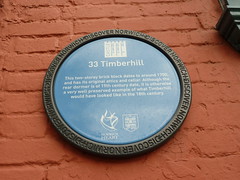
33 Timberhill This two-storey brick block dates to around 1700, and has its original attics and cellar. Although the rear dormer is of 19th century date, it is otherwise a very well preserved example of what Timberhill would have looked like in the 18th century.
33 Timberhill, Norwich, United Kingdom
Subjects
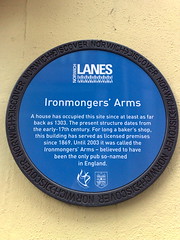
Ironmongers' Arms A house has occupied this site since at least as far back as 1303. The present structure dates from the early-17th century. For long a baker's shop, this building has served as licensed premises since 1869. Until 2003 it was called the Ironmongers' Arms - believed to have been the only pub so-named in England.
Pottergate, Norwich, United Kingdom
Subjects
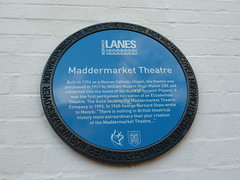
Maddermarket Theatre Built in 1794 as a Roman Catholic chapel, the theatre was purchased in 1921 by William Nugent Blight Monck CBE and converted into the home of the Guild of Norwich Players. It was the first permanent recreation of an Elizabethan Theatre. The Guild became the Maddermarket Theatre Company in 1993. In 1940 George Bernard Shaw wrote to Monck: "There is nothing in British theatrical history more extraordinary than your creation of the Maddermarket Theatre..."
Maddermarket Theatre, St John's Alley, Norwich, United Kingdom
Subjects
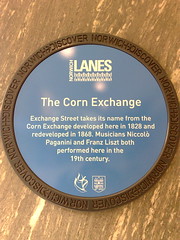
The Corn Exchange Exchange Street takes its name from the Corn Exchange developed here in 1828 and redeveloped in 1868. Musicians Niccolo Paganini and Franz Liszt both performed here in the 19th century.
Jarrold's, Exchange Street, Norwich, United Kingdom
Subjects


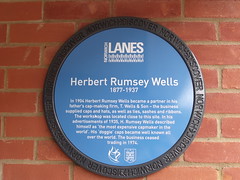
Herbert Rumsey Wells 1877-1937 In 1904 Herbert Rumsey Wells became a partner in his father's cap-making firm, T. Wells & Son - the business supplied caps and hats, as well as ties, sashes and ribbons. The workshop was located close to this site. In his advertisements of 1935, H. Rumsey Wells described himself as "the most expensive capmaker in all the world". His "doggie" caps became well known all over the world. The business ceased trading in 1974
Rumsey Wells Place, Charing Cross, Norwich, United Kingdom
Subjects
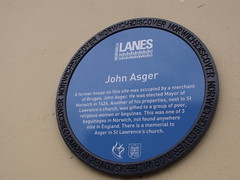
John Asger A former house on this site was occupied by a merchant of Bruges, John Asger. He was elected Mayor of Norwich in 1426. Another of his properties, next to St Lawrence's church, was gifted to a group of poor, religious women or beguines. This was one of 3 beguinages in Norwich, not found anywhere else in England. There is a memorial to Asger in St Lawrence's church.
Charing Cross, Norwich, United Kingdom